Aaker brand equity model
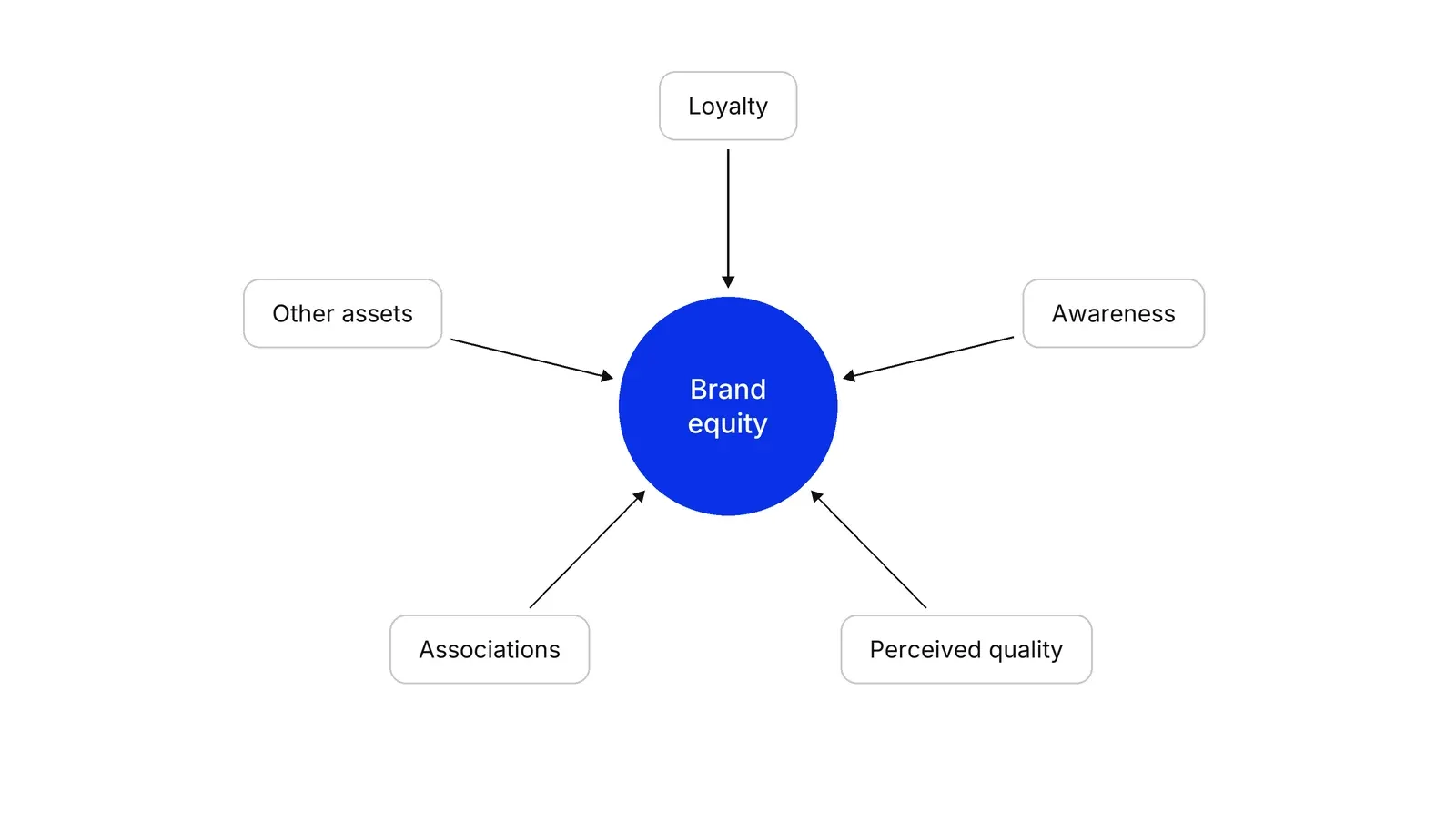
The Aaker brand equity model breaks the value of a brand into five groups of assets, so a team can see which ones it owns, which ones are weak and where to invest.
The Aaker brand equity model is David Aaker's framework from his 1991 book Managing Brand Equity. It defines brand equity as a set of assets and liabilities linked to a brand's name and symbol, sorted into five groups: brand loyalty, brand awareness, perceived quality, brand associations and other proprietary assets such as trademarks. Teams use it to decide what to measure and where to invest.
- Origin
- David A. Aaker, 1991 (measurement set: 1996)
- Level
- 301 · Advanced
- Fits
- Scale-up, Enterprise
- Time to apply
- two to three weeks for a first audit, most of it waiting for survey answers
- What you need
- access to 200 or more current and potential customers for a short survey · repeat purchase, churn and price data for your brand and two or three rivals · a list of your registered trademarks, domains and exclusive contracts · one owner for the brand budget who can act on the result
The Aaker brand equity model is a way to list what a brand is worth in parts instead of as one vague feeling. David Aaker set it out in his 1991 book Managing Brand Equity. He defines brand equity as a set of brand assets and liabilities linked to a brand’s name and symbol, which add to or subtract from the value a product gives its customers, according to WARC’s summary of the model. Those assets fall into five groups: loyalty, awareness, perceived quality, associations and other proprietary assets.
The book landed when the subject was new. Kevin Lane Keller opened his 1993 Journal of Marketing paper by noting how much attention brand equity had drawn, and listed Aaker (1991) among the main perspectives on it. Marketing teams still use Aaker’s five groups as the checklist for brand audits, and many survey scales in academic research are built on them.
The five assets
Each group is a separate reason customers pick the brand, pay more for it or stay with it. Aaker’s point, as Prophet’s summary of the book puts it, is that the most important assets of a business are intangible, and managers rarely measure them with confidence.
| Asset | What it means | A question to measure it |
|---|---|---|
| Brand loyalty | Customers who come back and resist rivals | Would you buy from us again if a rival cost 10% less? |
| Brand awareness | Recognition and recall of the name | Which providers of this service can you name? |
| Perceived quality | What customers believe about quality, whatever the specification says | How would you rate the quality of each brand? |
| Brand associations | Everything linked to the brand in memory | What three words come to mind when you hear the name? |
| Other proprietary assets | Patents, trademarks, channel relationships | Which of these does the company own, and where? |
Loyalty matters because keeping a customer costs less than winning a new one. Harvard Business Review reports estimates that acquiring a customer costs five to 25 times more than retaining one, depending on the study and industry. Awareness is the entry ticket: a buyer cannot pick a brand that does not come to mind. Perceived quality is a belief, so a dental clinic with excellent outcomes and no visible proof of them can still score low. Associations are the words and images the brand triggers, good or bad. The fifth group is the one most often forgotten: a trademark you do not own in a market you plan to enter is a gap in your brand equity.
Assets that add, liabilities that subtract
The model counts losses as well as gains. A brand can make a product worth less than the same product without the name, for example after a data breach, a public outage or a recall. Aaker calls these liabilities, and in practice they show up in the same five groups: a negative association, a reputation for poor quality, a habit of switching to whoever is cheapest.
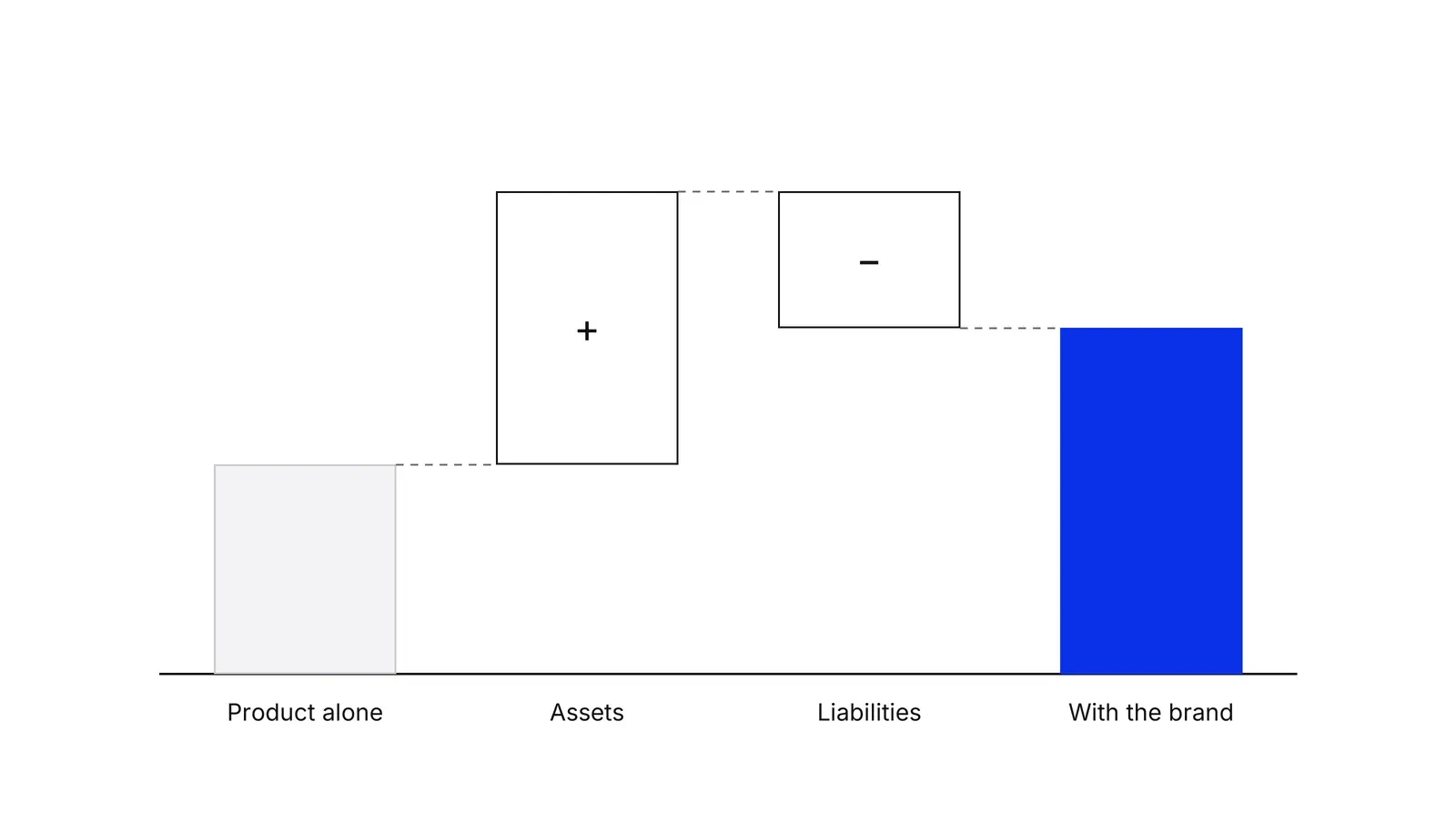
Marketing choices can create liabilities without anyone intending it. Yoo, Donthu and Lee found in a 2000 study that frequent price deals go with lower brand equity, while heavy advertising, higher prices, good store image and wide distribution go with higher equity. A promotion that lifts this month’s sales can quietly train customers to wait for the next discount.
How do you measure Aaker’s brand equity?
Measurement starts with a customer survey and ends with market data. In a 1996 California Management Review article, Aaker proposed ten sets of measures in five categories: loyalty, perceived quality, associations, awareness and market behavior. He also warned that the measures are hard to apply and the results need careful reading.
Academic researchers turned the four customer-side groups into survey scales. Boonghee Yoo and Naveen Donthu published a multidimensional scale in 2001 that many later studies use. Pappu, Quester and Cooksey tested a four-dimension model in 2005 with real consumers across six brands and found awareness and associations work as separate dimensions. A 2015 study by Christodoulides, Cadogan and Veloutsou surveyed 1,829 consumers in the UK, Germany and Greece and reached a less tidy result: awareness, associations and loyalty could not always be told apart. In practice, read the five scores together as a diagnostic profile and do not add them up into one total.
Loyalty scores also need context. The double jeopardy pattern, studied in a 2013 meta-analysis by Habel and Lockshin across 37 product categories, links a brand’s number of buyers to how often they buy it. Small brands tend to have fewer buyers who also buy a little less often, so a low loyalty score may reflect size rather than a weak brand.
From customer scores to money
Customer scores do not give a number for the balance sheet, and Aaker’s model does not claim to. Financial methods estimate that number separately. Carol Simon and Mary Sullivan proposed in Marketing Science in 1993 a way to estimate brand equity from a firm’s market value, as the extra cash flow branded products earn over unbranded ones. The ISO 10668 standard for monetary brand valuation, summarised by Brand Finance, requires valuers to consider financial, behavioural and legal parameters. Aaker’s five groups map onto the last two: customer attitudes on one side, trademarks and other legal rights on the other.
Aaker and Keller compared
Aaker and Keller are the two names most often attached to brand equity, and they worked together early on: the Tuck School profile of Keller notes that he teamed up with Aaker in the 1980s to write about brand extensions. Their models answer different questions.
| Aaker, 1991 | Keller, 1993 and 2001 | |
|---|---|---|
| Point of view | The company that owns the brand | The customer’s mind |
| Definition | Assets and liabilities linked to the name and symbol | The differential effect of brand knowledge on consumer response to marketing |
| Parts | Loyalty, awareness, perceived quality, associations, other assets | Brand awareness and brand image; later six building blocks in four steps |
| Order | No sequence, five parallel groups | A pyramid built from the bottom up |
| Best for | Auditing what the brand owns and where it is weak | Planning how to build a brand step by step |
Keller’s 2001 Marketing Science Institute report added the pyramid: identity, meaning, response and relationships, resting on six building blocks. Many teams use both, Aaker’s list to audit and Keller’s pyramid to plan. Aaker’s 1996 book Building Strong Brands moved on to brand identity, which is a separate model from the equity one.
Brand equity audits fit into the measurement layer of our marketing operational system, next to retention and price data. For how brands express their associations through character, see brand archetypes, and for comparing perceived positions against rivals, the brand positioning map.
How to apply Aaker brand equity model, step by step
- Fix the brand and the market. Name the brand you are auditing and the customers and rivals you compare it with. A payments company selling to small online shops and one selling to marketplaces have different rivals and different awareness gaps. Result: one sentence naming the brand, the customer group and the two or three rivals.
- Collect the evidence you already have. For each of the five assets, write down what you already know: repeat purchase and churn for loyalty, search volume and direct traffic for awareness, reviews and complaint rates for perceived quality, what customers say in interviews for associations, and the trademark and contract list for other assets. Result: a one-page table with a number or a quote in each row, and the empty rows marked.
- Survey customers against rivals. Ask the same questions about your brand and each rival: unaided and aided recall, rating of quality, the words that come to mind, intent to buy again and willingness to pay more. Use the same scale for every brand so the gaps are comparable. Result: a score for each asset, for each brand, from the same respondents.
- Mark the liabilities. Look for the places where the brand subtracts value: a negative association that comes up often, a quality complaint repeated in reviews, a trademark you do not own in a market you sell in. Result: a short list of liabilities, each with the evidence behind it.
- Pick one or two assets to build. Choose the asset with the largest gap to rivals that also matters to the purchase. A brand with high awareness and low perceived quality needs proof of quality, not more reach. Tie each choice to a budget line and an owner. Result: one or two named assets, the actions that will move them and the metric for each.
- Re-measure twice a year. Repeat the survey with the same questions and the same rivals every six months, and put the scores next to retention and price data. Result: a trend line per asset that shows whether the money spent on the brand moved anything.
Examples
A payments company with an awareness lead and a quality gap
Illustrative, no real company implied. A payments provider for online shops surveys 400 merchants. Unaided recall is 38% against 22% for its closest rival, yet only 41% rate its reliability as good, against 63% for the rival, because a two-day outage last year still appears in reviews. The audit names perceived quality as the weak asset and the outage story as a liability. The team stops buying reach, publishes monthly uptime figures and builds a migration guide for merchants who left. The next survey checks whether the reliability score moves.
A dental clinic chain that owned less than it thought
Illustrative, no real chain implied. A chain of six dental clinics believes its brand is strong because patients return. The audit shows that seven in ten returning patients name their dentist, not the clinic brand, when asked why they come back, so the loyalty sits with individual doctors. It also finds the chain never registered its name as a trademark in a neighbouring region it plans to enter. The chain registers the mark, adds the clinic name to treatment plans and recall messages, and tracks how many patients name the clinic in the next survey.
Which source of equity mattered in Korea's mobile phone market
Srinivasan, Park and Chang (2005, Management Science) measured brand equity in Korea's digital cellular phone market as the extra annual contribution a brand earns over an unbranded product. They split it into three sources, close to Aaker's groups: awareness, biased perception of attributes and preference that is not explained by attributes. Awareness contributed the most, followed by non-attribute preference. The study shows how to put a value on each source instead of treating brand equity as one number.
When to use it
Use it when a company spends real money on brand and needs to know what that spend is building, before a rebrand or a name change, when entering a new market where the brand is unknown, or when a buyer or investor asks what the brand is worth. It suits growing and large companies with enough customers to survey and enough history to compare.
When not to use it
Skip it before product-market fit, when there are too few customers for a survey to mean anything and the product, not the brand, is the open question. It is also the wrong tool for a monetary valuation on its own: an accountant or auditor will need a financial method such as those described in ISO 10668, with the five assets as inputs.
Common mistakes
- Measuring only awareness because it is the easiest number to buy, then calling it brand equity.
- Counting loyalty that belongs to something else, such as a contract lock-in, a single salesperson or a doctor, as loyalty to the brand.
- Forgetting the liabilities. A negative association or a quality complaint subtracts value, and a survey that only asks positive questions will not find it.
- Running frequent price promotions to lift volume. Yoo, Donthu and Lee (2000) found that frequent price deals go with lower brand equity.
- Treating the five groups as fully separate scores. A cross-country study by Christodoulides and colleagues (2015) found consumers do not always tell awareness, associations and loyalty apart.
FAQ
What are the five components of Aaker's brand equity model?
They are brand loyalty, brand awareness, perceived quality, brand associations and other proprietary brand assets. The last group covers assets such as patents, trademarks and channel relationships. Aaker set them out in Managing Brand Equity (1991) and described them as assets and liabilities that add to or subtract from the value of a product.
What is the difference between Aaker's and Keller's brand equity models?
Aaker treats brand equity as a set of assets a company owns, including legal and channel assets. Keller, in his 1993 Journal of Marketing paper, defines it from the customer side, as the differential effect of brand knowledge on how consumers respond to marketing. Keller's 2001 pyramid then orders brand building into four steps.
What is Aaker's brand identity model?
It is a separate framework from his 1996 book Building Strong Brands. Brand identity is the image strategists want the brand to have, and brand position is the part of it the company actively communicates. Prophet's summary of the book lists brand-as-person, brand-as-organization and brand-as-symbol perspectives for building that identity.
How do you measure brand equity with Aaker's model?
Aaker's 1996 California Management Review article proposes the Brand Equity Ten: ten sets of measures in five categories, loyalty, perceived quality, associations, awareness and market behavior. In practice teams survey customers about their brand and rivals on the same scale, then add market data such as share, price and distribution.
Is Aaker's brand equity model supported by research?
Partly. Yoo and Donthu (2001) built a widely used survey scale on Aaker's dimensions, and Pappu, Quester and Cooksey (2005) found awareness and associations are distinct. A 2015 study of consumers in the UK, Germany and Greece found awareness, associations and loyalty could not always be separated.
Sources
- David A. Aaker, Managing Brand Equity: Capitalizing on the Value of a Brand Name, Free Press, 1991, Internet Archive record
- Prophet, Book: Managing Brand Equity (summary of David Aaker's book)
- WARC, Aaker's brand equity model
- David A. Aaker, Measuring Brand Equity Across Products and Markets, California Management Review 38(3), 1996
- David A. Aaker, Building Strong Brands, Free Press, 1996, Internet Archive record
- Prophet, Book: Building Strong Brands (summary of David Aaker's book)
- Kevin Lane Keller, Conceptualizing, Measuring, and Managing Customer-Based Brand Equity, Journal of Marketing 57(1), 1993
- Stanford Graduate School of Business, Keller, Conceptualizing, Measuring, and Managing Customer-Based Brand Equity, working paper
- Marketing Science Institute, Keller, Building Customer-Based Brand Equity: A Blueprint for Creating Strong Brands, Report 01-107, 2001
- Tuck School of Business, Inventing the Edge: Kevin Lane Keller
- Marketing Science Institute, Aaker and Keller, Consumer Evaluations of Brand Extensions, 1990
- Boonghee Yoo, Naveen Donthu, Developing and Validating a Multidimensional Consumer-Based Brand Equity Scale, Journal of Business Research 52(1), 2001
- Boonghee Yoo, Naveen Donthu, Sungho Lee, An Examination of Selected Marketing Mix Elements and Brand Equity, Journal of the Academy of Marketing Science 28(2), 2000
- Ravi Pappu, Pascale Quester, Ray Cooksey, Consumer-Based Brand Equity: Improving the Measurement, Journal of Product & Brand Management 14(3), 2005
- George Christodoulides, Leslie de Chernatony, Consumer-Based Brand Equity Conceptualisation and Measurement: A Literature Review, International Journal of Market Research 52(1), 2010
- George Christodoulides, John Cadogan, Cleopatra Veloutsou, Consumer-Based Brand Equity Measurement: Lessons Learned from an International Study, International Marketing Review 32(3/4), 2015
- Carol J. Simon, Mary W. Sullivan, The Measurement and Determinants of Brand Equity: A Financial Approach, Marketing Science 12(1), 1993
- V. Srinivasan, Chan Su Park, Dae Ryun Chang, An Approach to the Measurement, Analysis, and Prediction of Brand Equity and Its Sources, Management Science 51(9), 2005
- Brand Finance and Australian Marketing Institute, Overview of ISO 10668: Brand Valuation, 2011
- Harvard Business Review, Amy Gallo, The Value of Keeping the Right Customers, 2014
- Cullen Habel, Larry Lockshin, Realizing the Value of Extensive Replication: A Theoretically Robust Portrayal of Double Jeopardy, Journal of Business Research 66(9), 2013
Last updated Oct 9, 2026


The compliance layer under fintech marketing operations
A fintech marketing agency can build campaigns. It cannot own the compliance review, the KYC drop-off or the multi-market licensing rules that decide whether a lead ever becomes a customer.

Fractional CMO: what you get, and what has to exist underneath
A fractional CMO brings strategy and judgment. Without reporting, CRM hygiene and a named owner per number, the engagement produces a slide deck instead of a system.

The operations layer behind healthcare patient acquisition
Ads and search bring the request in. What happens between the click and the booked, attended visit decides whether the spend paid off.