Bid strategy and value-based bidding
A bid strategy is the rule an ad platform follows when it prices each auction; value-based bidding feeds it what each conversion is worth, so it buys profit instead of form fills.
Value-based bidding is an automated bid strategy that sets each ad auction bid by the predicted value of the conversion, not by the conversion count. In Google Ads it means Maximize conversion value or Target ROAS; in Meta it means value optimization with Highest value or a minimum ROAS. It works only when the business sends real values back, often from its CRM.
- Origin
- No single inventor; Google Ads Smart Bidding and Meta value optimization, practice-based; studied as auto-bidding research from 2019
- Level
- 401 · Expert
- Fits
- Scale-up, Enterprise
- Time to apply
- two to four weeks to wire values from the CRM; one or two conversion cycles for the strategy to learn
- What you need
- conversion tracking that records a value per conversion, not just a count · a CRM or order system that knows which leads became revenue, and how much · a click ID (GCLID) or hashed email or phone stored with every lead · enough volume: Google asks for 15 conversions in 30 days before Target ROAS on Search · a unit-economics sheet with margin by product, segment or region
A bid strategy is the rule an ad platform follows when it decides how much to bid for you in each auction. Value-based bidding is the family of bid strategies that price each auction by what the resulting conversion is likely to be worth, not by how many conversions it adds. Google sells it as Smart Bidding, which uses its models “to optimize for conversions or conversion value in every auction,” according to Google’s Smart Bidding page. Meta calls it value optimization.
No one person invented it. Search engines sell ads through auctions, and economists Benjamin Edelman, Michael Ostrovsky and Michael Schwarz showed in a 2007 American Economic Review paper that bidding your true value is not an equilibrium in the generalized second-price auction they used. Automated bidding took that calculation away from people. A 2024 survey by Google researchers describes how the platforms now treat a CPA or ROAS target as a constraint on a machine that maximises conversions or value.
The four Smart Bidding strategies
Google offers four automated strategies that learn from conversions. Two maximise a quantity within the budget, two hold a target. In June 2026 Google renamed the target versions back to plain Target CPA and Target ROAS; the bidding behaviour stayed the same.
| Strategy | Maximises | Holds | Needs a value per conversion |
|---|---|---|---|
| Maximize conversions | Number of conversions | Spends the daily budget | No |
| Target CPA | Number of conversions | Average cost per conversion | No |
| Maximize conversion value | Total conversion value | Spends the daily budget | Yes |
| Target ROAS | Total conversion value | Value divided by spend | Yes |
Target ROAS is written as a percentage. Google’s formula is conversion value divided by ad spend, times 100, so $5 of sales for every $1 spent is 500%. A higher target means fewer, more selective auctions; Google warns that a target set too high “may limit the amount of traffic” a campaign gets.
One rule changed in August 2026. Before, a budget-limited campaign with a $10 Target CPA could keep delivering at $5 and look efficient. From 17 August, Google’s update makes such campaigns deliver closer to the target, so that campaign drifts toward $10. Google does not change targets for you. If you want the $5, you set $5.
Why bid on value instead of volume
Bidding on volume treats every conversion as equal, and they rarely are. Two campaigns can buy leads at the same cost while one brings customers worth three times more. Target CPA will spread money between them evenly, because it sees only the count.
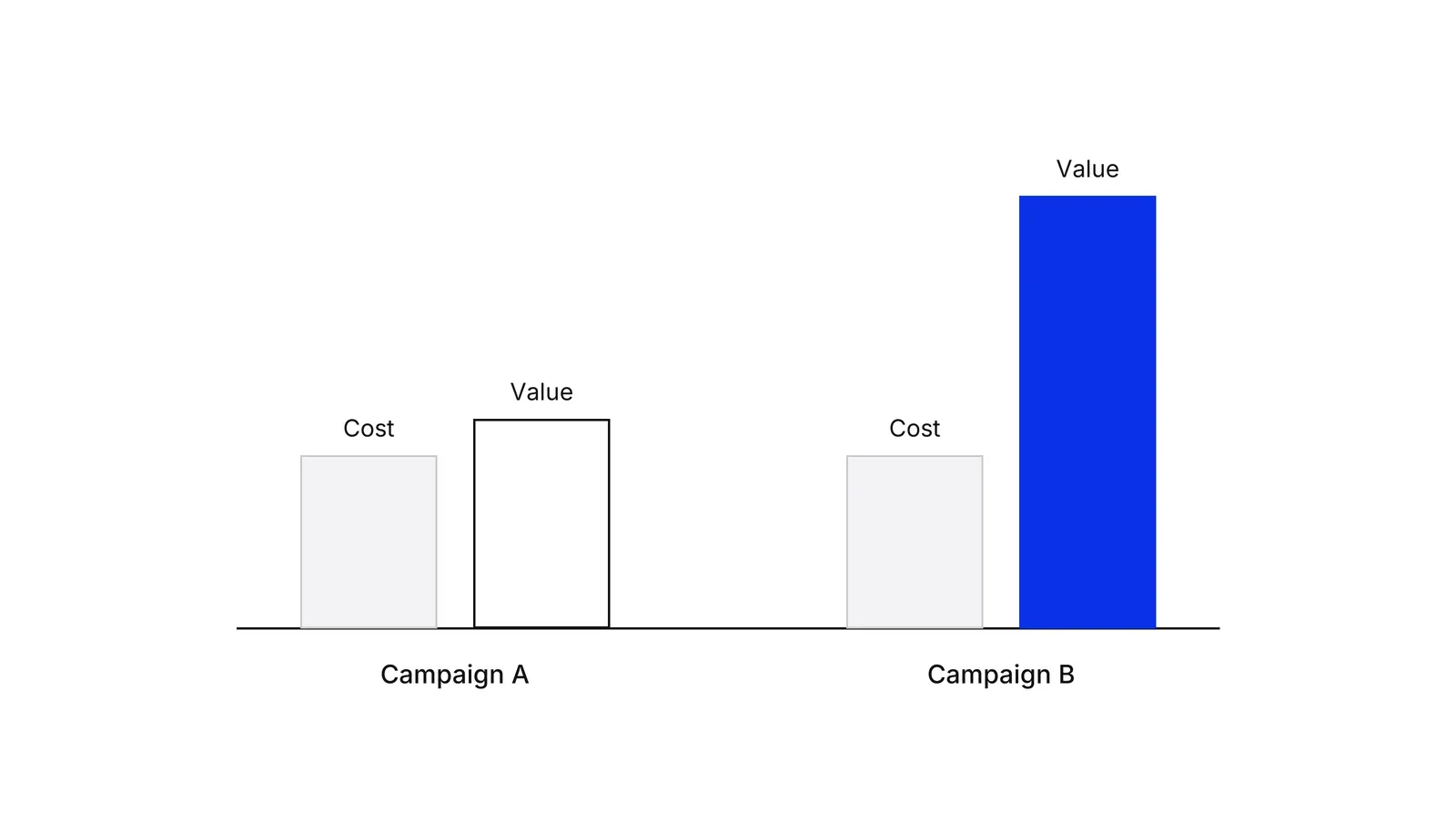
The value you feed in decides what the machine buys. Revenue is the easy choice. Margin is the better one when products differ, and a guide to contribution margin helps here. Lifetime value is the most ambitious. Sunil Gupta, Donald Lehmann and Jennifer Ames Stuart defined customer value in the Journal of Marketing Research as the expected sum of discounted future earnings. Predicting it is hard because many customers never return and spend is skewed, the problem a 2019 Google paper tackles with a zero-inflated lognormal model.
Where the values come from
For a shop, the value is known at checkout and travels with the purchase tag. For a lead business, the value appears weeks later in the CRM, so it has to be sent back. This feedback loop is what makes value-based bidding work for B2B, finance and clinics.
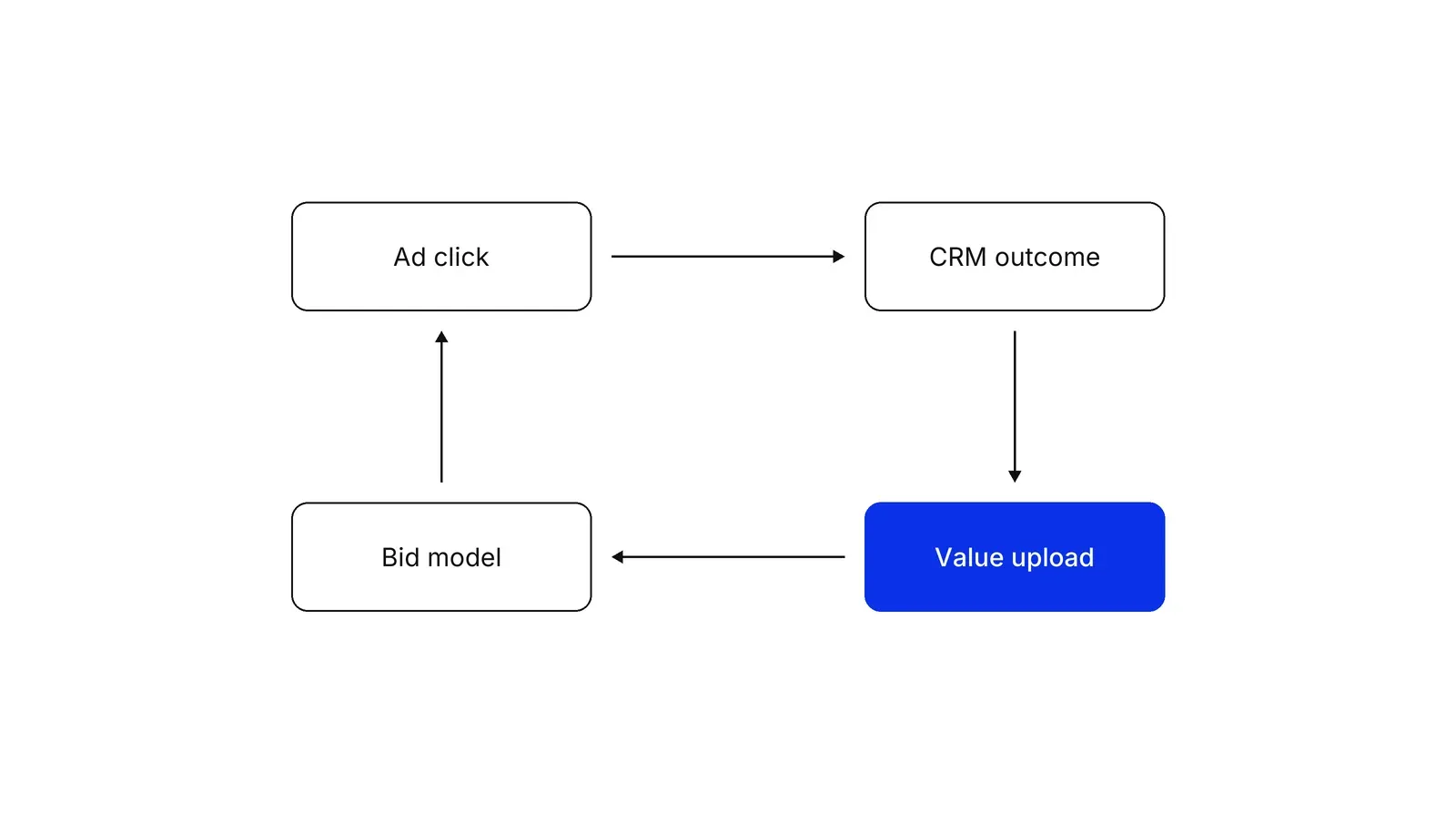
On Google, offline conversion import matches a CRM outcome to the click through the Google Click ID (GCLID) saved with the lead. Enhanced conversions add a hashed email or phone, scrambled with SHA256 before sending, as Google’s documentation explains. Google reports a median 10% increase in conversions for advertisers who combine first-party data with GCLIDs, its own figure. From 15 June 2026, new integrations upload through the Data Manager API instead of the Google Ads API.
On Meta, the Conversions API sends web, app and offline events from your server. Offline events use the action source physical_store. Meta’s offline events guide accepts events up to seven days old per upload and asks for transactions within 62 days of the conversion.
Both platforms let you adjust values without rebuilding tracking. Google’s conversion value rules raise or lower value by location, device or audience, and only Target ROAS and Maximize conversion value optimise to the adjusted figures. Google’s New Customer Value mode, part of its customer lifecycle goals, bids higher for new customers than for existing ones.
How Meta’s value optimization works
Meta’s version sits in the ad set’s optimization goal. When the goal is value, the default strategy appears in Ads Manager as Highest value. Adding a minimum ROAS sets a floor that Meta’s bid strategy reference defines as total purchase value divided by total spend, held on average rather than per auction.
Meta’s value rules do what Google’s value rules do, with hard limits: up to 10 rules per set, raises of up to 1,000% and cuts of up to 90%. When audiences overlap, only the first matching rule applies. Meta also warns that your overall cost per result may increase, which is the point: you are paying more for better customers.
Learning, volume and guardrails
Automated bidding needs data to learn, and it relearns after big changes. Google shows a Learning status after a new strategy, a setting change or a change in which campaigns share it. Its learning period page says calibration typically takes one or two conversion cycles; regional versions of the same page have said two to three, so plan for the longer one when your sales cycle is long. Meta’s API reports each ad set as learning, success or fail, and significant edits send it back to learning.
Two Google controls protect the model. Seasonality adjustments warn the system about short events and work best for one to seven days. Data exclusions remove days when tracking broke, so a dead tag does not teach the model that a campaign stopped working.
Platform ROAS is attributed revenue over spend, not proof the ads caused the sale. Check value-based campaigns with an incrementality test before moving budget on them. In Pushers’ Growth Lab work, the CRM import and the value definition come before any bid change, because a smarter bid on the wrong number buys the wrong customers faster.
How to apply Bid strategy and value-based bidding, step by step
- Decide what one conversion is worth. Pick the number you want the platform to maximise: revenue, gross margin, or predicted lifetime margin. Margin is better than revenue when products carry different margins. Result: one value definition, written down, with the formula.
- Send the value back from where it is known. For ecommerce the value is known at checkout and goes in the tag. For leads it is known weeks later in the CRM, so import qualified-lead and sale events with their values through Google's offline conversion import and Meta's Conversions API. Result: values arriving daily, matched to clicks.
- Run on conversions first, then switch to value. Start with Maximize conversions or Target CPA while value data builds up. Once a campaign meets the platform's thresholds, move it to Maximize conversion value or Target ROAS on Google, or Highest value on Meta. Result: a campaign bidding on value with enough history to learn from.
- Set the target from actual results. Base the first Target ROAS or minimum ROAS on the last 30 days of real return, not on the return you wish for. A target set too high shrinks traffic. Result: a target the system can hit without starving delivery.
- Adjust values for what the platform cannot see. Use Google's conversion value rules or Meta's value rules to raise or lower value by region, device or audience, and Google's new customer goal to pay more for first-time buyers. Result: bids that reflect segment economics without splitting campaigns.
- Protect the model and check the lift. Use seasonality adjustments for short promotions and data exclusions for tracking outages, judge results only after one or two conversion cycles, and test incrementality with a holdout before scaling. Result: a value-based setup you can trust and defend in a budget review.
Examples
A B2B payments provider bidding on first-year margin
Illustrative, no real company implied. A payments provider pays $60 per demo request from search ads. Small online shops convert to paying accounts at 20% and earn about $300 of first-year margin each; importers convert at 10% but earn about $2,400. Expected value per lead is $60 for a shop lead and $240 for an importer lead. On Target CPA both leads look equal at $60. With offline imports of signed accounts and their projected margin, Target ROAS starts bidding up for importer searches and down for shop searches.
A dental clinic importing attended visits
Illustrative, no real clinic implied. A clinic gets 300 booking requests a month from ads, but only 180 patients attend, and implant consultations are worth about ten times a check-up. The clinic stores the GCLID with each booking, then uploads an attended-visit conversion with the treatment plan's expected revenue. The bidding now learns from people who showed up and booked high-value care. The clinic sends only the event, the value and the click ID, never diagnoses, and checks each platform's health data rules first.
An online retailer paying more for new customers
Illustrative. A retailer's repeat buyers already come back through email, so paid search should win new ones. It runs Maximize conversion value with Google's New Customer Value mode, which bids higher for new customers than for existing ones. Its team sets the extra value per new customer from the margin of later orders. ROAS in the report falls slightly, while the share of first-time buyers rises.
When to use it
Use it when conversions differ in value by a factor of two or more, when a CRM or order system knows those values, and when campaigns produce enough conversions for the platform to learn from: on Google, at least 15 conversions in 30 days for Target ROAS on Search and Shopping. It suits scale-ups and enterprises with several products, regions or customer types under one budget.
When not to use it
Skip it when every conversion is worth roughly the same, when you cannot measure value beyond a form fill, or when a campaign gets a handful of conversions a month. In those cases Target CPA or Maximize conversions on a well-defined qualified-lead event does the job with less risk, and value bidding mostly adds noise.
Common mistakes
- Feeding revenue when margins differ widely, so the algorithm chases the expensive, low-margin products.
- Optimising for form fills and importing nothing from the CRM, then wondering why sales say the leads are poor.
- Setting Target ROAS at the return the board wants instead of the return the campaign has been getting, which starves delivery.
- Changing targets, budgets and conversion actions every few days, so the strategy never leaves the learning status.
- Reading platform ROAS as profit. It is attributed revenue over spend, and the real lift needs a holdout test.
FAQ
What is value-based bidding?
Value-based bidding is an automated bid strategy that prices each ad auction by the expected value of the resulting conversion rather than by the number of conversions. In Google Ads it covers Maximize conversion value and Target ROAS. In Meta it is value optimization. It needs each conversion to carry a value, often imported from a CRM.
What is the difference between Target CPA and Target ROAS?
Target CPA aims for an average cost per conversion and treats every conversion as equal. Target ROAS aims for a ratio of conversion value to ad spend, so it bids more for conversions predicted to be worth more. Google's formula is conversion value divided by spend, times 100: $5 of sales per $1 of spend is a 500% target.
How many conversions do you need for Target ROAS?
Google lists at least 15 conversions in the past 30 days for Search and Shopping campaigns, 50 in 35 days per campaign for Demand Gen, and 300 in 30 days for App campaigns. It recommends judging results over periods with at least 50 conversions for Target ROAS, against 30 for other Smart Bidding strategies.
Can lead generation businesses use value-based bidding?
Yes, if they import outcomes. A lead business stores the Google click ID or a hashed email with each lead, then uploads qualified-lead and sale conversions with values through offline conversion import or Meta's Conversions API. Google's own example multiplies the value of leads from one state by two with a conversion value rule.
What is the Highest value bid strategy in Meta?
Highest value is Meta's bid strategy when an ad set's optimization goal is value: it spends the budget to get the most purchase value. Adding a minimum ROAS turns it into a floor, defined by Meta as total purchase value divided by total spend, which Meta tries to keep on average across the ad set.
Sources
- Google Ads Help, About Smart Bidding
- Google Ads Help, About Target CPA bidding
- Google Ads Help, About Target ROAS bidding
- Google Ads Help, About Maximize conversion value bidding
- Google Ads Help, About Maximize conversions bidding
- Google Ads Help, Changes to target based bid strategies (August 2026)
- Google Ads Help, About offline conversion imports
- Google Ads Help, About enhanced conversions
- Google Ads Help, About conversion value rules
- Google Ads Help, About customer lifecycle goals
- Google Ads Help, About seasonality adjustments
- Google Ads Help, About data exclusions
- Google Ads Help, About bid strategy statuses
- Google Ads Help, Duration of the learning period for campaigns and what affects it
- Google Ads API, Upload click conversions
- Google Data Manager API, Google Ads offline conversions
- Google Ads Developer Blog, Updates to Smart Bidding strategy naming and organization, 16 June 2026
- Meta for Developers, Marketing API, Bid strategy
- Meta for Developers, Marketing API, Bidding overview
- Meta for Developers, Marketing API, Value rules
- Meta for Developers, Conversions API
- Meta for Developers, Conversions API for offline events
- Meta for Developers, Ad campaign learning stage info
- Social Media Today, Meta value rules overview, August 2025
- Benjamin Edelman, Michael Ostrovsky, Michael Schwarz, Internet Advertising and the Generalized Second-Price Auction, American Economic Review 97(1), 2007
- Gagan Aggarwal et al., Auto-bidding and Auctions in Online Advertising: A Survey, arXiv, 2024
- Xiaojing Wang, Tianqi Liu, Jingang Miao, A Deep Probabilistic Model for Customer Lifetime Value Prediction, arXiv, 2019
- Sunil Gupta, Donald R. Lehmann, Jennifer Ames Stuart, Valuing Customers, Journal of Marketing Research 41(1), 2004
Last updated Oct 9, 2026


Marketing agency or growth system: when a company outgrows its agency
An agency is the right call while the founder still runs most of the company. Once the business starts copying itself into new locations or markets, it needs a system that sets goals, tests hypotheses and owns the result.

Why healthcare marketing agencies stall: the short, mid and long wins model we use with clinics
Most agencies own the click and nobody owns the front desk. How we structure clinic work in three horizons, the research behind each one, and one year of results.

The compliance layer under fintech marketing operations
A fintech marketing agency can build campaigns. It cannot own the compliance review, the KYC drop-off or the multi-market licensing rules that decide whether a lead ever becomes a customer.