Disruptive innovation
Disruptive innovation is Clayton Christensen's theory of how a smaller entrant with a cheaper, simpler offer starts where incumbents are not looking and later takes their mainstream customers.
Disruptive innovation is a theory by Clayton Christensen of Harvard Business School, first set out with Joseph Bower in 1995. It describes how a smaller entrant starts with a cheaper, simpler product for customers incumbents ignore, either the least demanding or people not buying at all, then improves until mainstream customers switch. Well-run incumbents often miss it because they rationally serve their most profitable customers first.
- Origin
- Clayton M. Christensen, with Joseph L. Bower, 1995 (HBR); 1997 (The Innovator's Dilemma); refined 2015
- Level
- 301 · Advanced
- Fits
- Small and mid-size, Scale-up, Enterprise
- Time to apply
- a half-day workshop for a first scan of your market, then a quarterly review of entrants
- What you need
- a list of your customer segments ranked by how demanding and how profitable they are · a view of who is not buying from anyone in your category, and why · the main performance measure customers judge your product on, with a rough history of how it improved · a list of small entrants and adjacent players, with their prices
Disruptive innovation is a theory of how small companies with fewer resources beat established leaders. The entrant starts with a cheaper, simpler product for customers the leader ignores, then improves it until the leader’s mainstream customers switch. Clayton Christensen, a Harvard Business School professor, and Joseph Bower introduced it in a 1995 Harvard Business Review article, and Christensen expanded it in The Innovator’s Dilemma in 1997.
The idea grew out of Christensen’s doctoral research on the disk drive industry, completed in 1992, the year he joined the HBS faculty. He died in January 2020, according to HBS. The early papers spoke of disruptive technology. Later work uses disruptive innovation, because, as the 2015 restatement puts it, a technology is rarely disruptive or sustaining in itself. What matters is the path a business takes with it.
Sustaining vs disruptive innovation
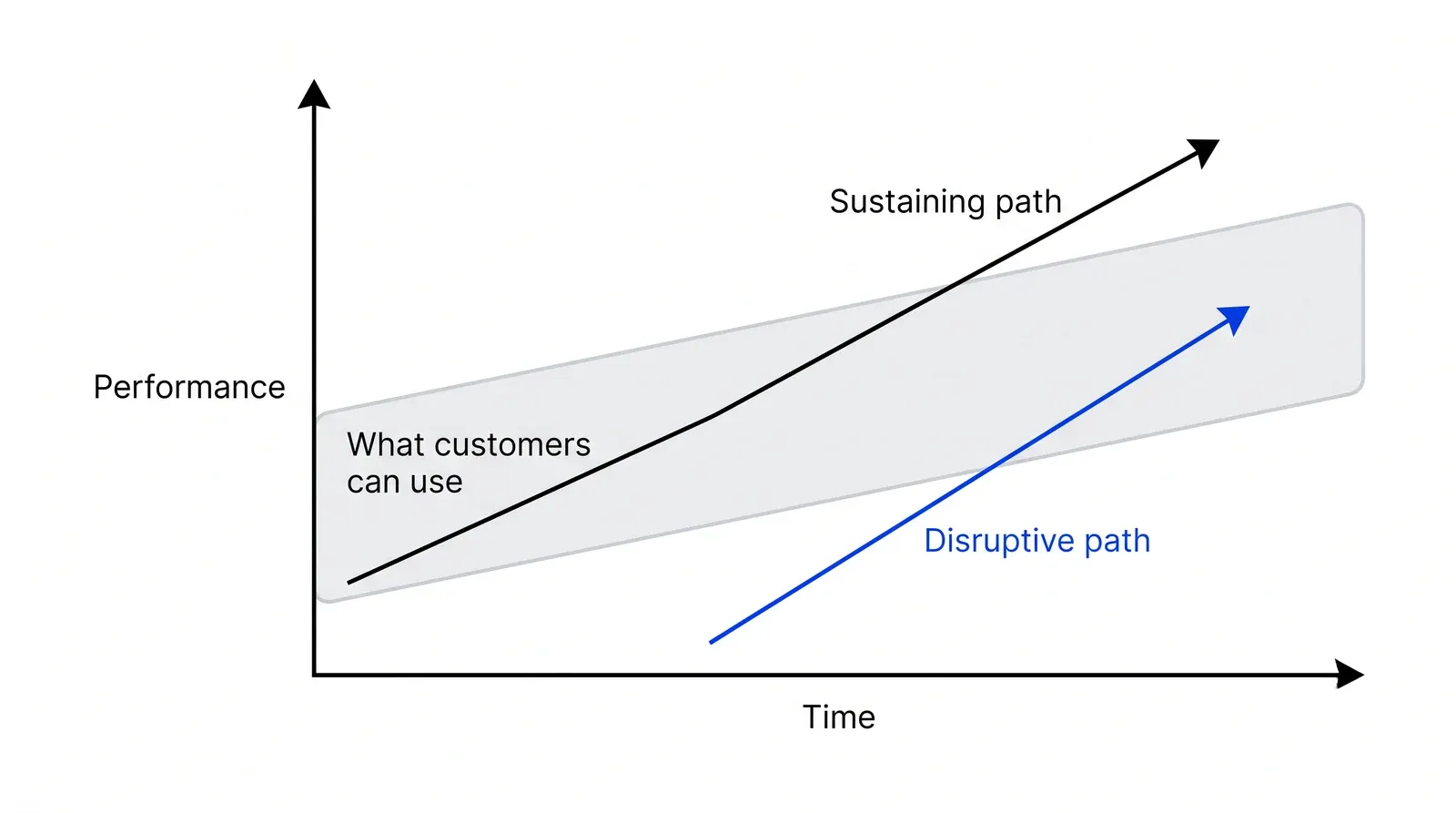
A sustaining innovation makes a good product better for the customers who already buy it. A disruptive innovation is worse on the measure those customers care about, but cheaper, simpler or easier to get. The 2015 article gives the fifth razor blade and a clearer TV picture as sustaining examples. They can be small steps or big breakthroughs; what makes them sustaining is that they sell more to the incumbent’s best customers.
The theory turns on two rates of improvement. Products tend to improve faster than most customers can use, so incumbents overshoot the less demanding segments. A disruptive product starts below what mainstream customers need, then climbs. When it becomes good enough, customers switch and keep the lower price.
| Sustaining innovation | Disruptive innovation | |
|---|---|---|
| Who it serves first | The incumbent’s best, most demanding customers | Low-end customers or people not buying at all |
| How it performs at launch | Better on the measure customers already value | Worse on that measure, better on price or convenience |
| Margins | Usually higher | Usually lower at first |
| What incumbents do | Fight back, and usually win | Retreat upmarket, because it looks unattractive |
Why well-run companies miss it
Incumbents fail because they listen to their customers. Bower and Christensen showed that in disk drives, each new, smaller drive offered far less capacity than the main market needed. The first 8-inch drive held 20 MB when mainframes needed about 200 MB, so mainframe makers turned it down, and the leaders followed their customers’ wishes.
This is rational. Resource allocation favours projects with high margins, large markets and known customers, a mechanism Christensen and Bower set out in a 1996 Strategic Management Journal paper. A small, low-margin market with unclear customers loses every budget meeting. The 1995 article’s advice followed: house the new business in an organization fully independent of the core.
Two footholds: low-end and new-market
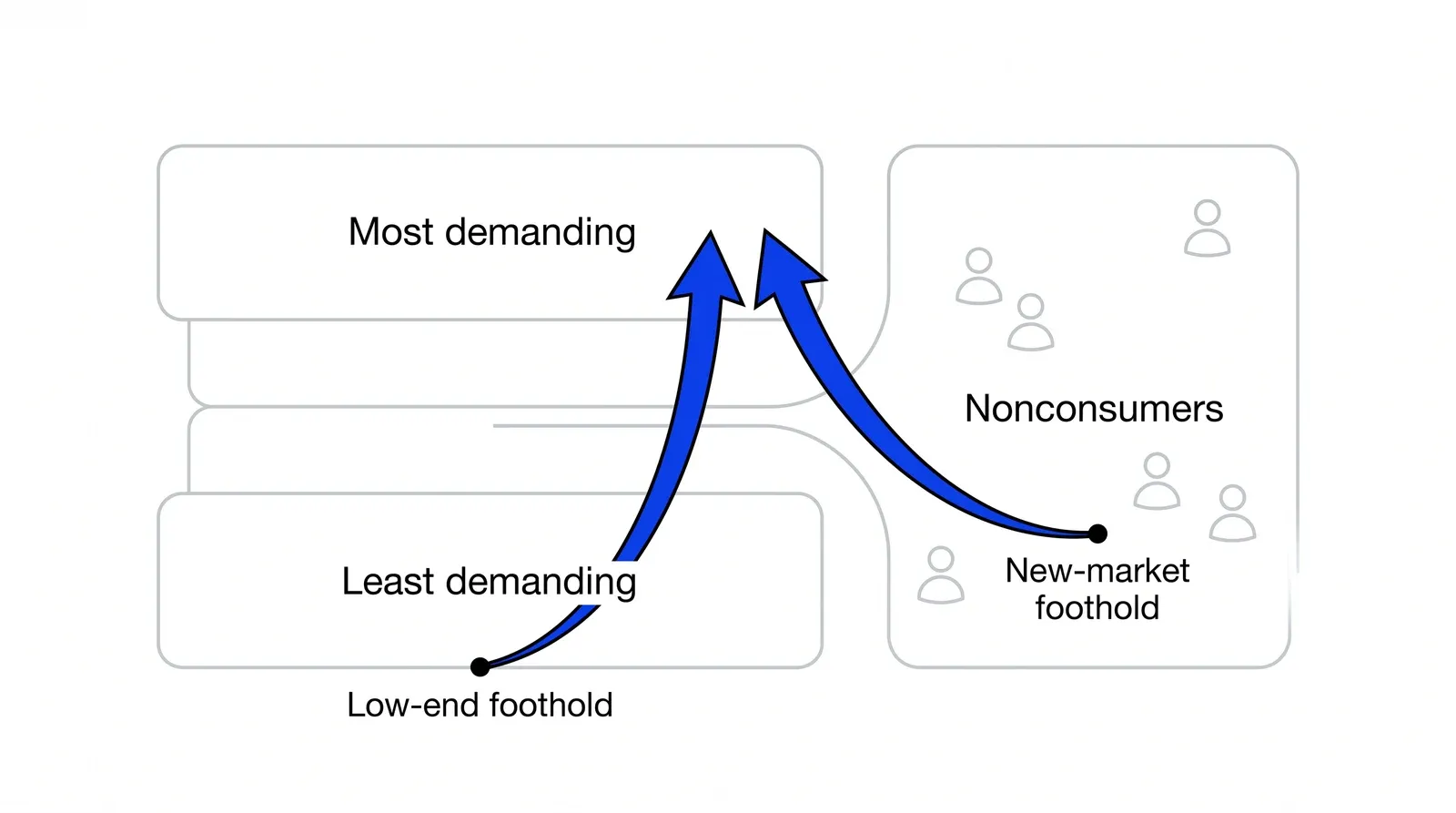
A disruptive innovation starts in one of two places, according to the 2015 article. A low-end foothold serves the least demanding customers of an existing market, the ones incumbents overshoot. Steel minimills began with rebar, the lowest-margin product, then moved up. The Christensen Institute puts their cost advantage at about 20%.
A new-market foothold turns nonconsumers into customers. Xerox sold expensive copiers to large companies, while school librarians and small offices made do with carbon paper. Personal copiers in the late 1970s served them first and later moved into Xerox’s core market.
What does not count as disruption
Christensen and his co-authors spend much of the 2015 article on misuse. Uber, they argue, is not disruptive to taxis: it started in San Francisco with people who already hired rides, and its service was better, not worse. Tesla entered at the high end of the car market, where incumbents are paying attention. Both may succeed, but the theory does not explain them.
The authors list four common errors. Disruption is a process, not a product at a moment. Disrupters often win with a different business model. Success is not part of the definition, so many disruptive attempts fail. The slogan “disrupt or be disrupted” can push incumbents to dismantle a profitable core too early. Christensen himself said people “twist it, and use it to justify whatever” they wanted, in an interview quoted by MIT Sloan Management Review.
Speed varies. Nucor, a minimill, needed more than 40 years to match the revenue of the largest integrated steelmakers; Compaq reached parity with DEC in 12 years. In Christensen’s disk drive data, only 6% of entrants pursuing a sustaining strategy succeeded, the 2015 article notes.
The criticism, and how fair it is
The theory has drawn serious criticism. Jill Lepore, a Harvard historian, argued in The New Yorker in 2014 that it rests on handpicked case studies, read selectively. Seagate, cast as a failing incumbent, doubled its sales between 1989 and 1990 and was the largest disk drive maker by 1997, she wrote. Bucyrus, the excavator maker, grew sales sevenfold between 1962 and 1979, and Caterpillar paid nearly $9 billion for it in 2011, per the same article. She also noted that Christensen’s Disruptive Growth Fund lost 64% in under a year while the Nasdaq lost 50%.
Christensen called the article “a criminal act of dishonesty” and said later work had answered her points, as Knowledge at Wharton reported. Christian Terwiesch of Wharton, quoted in the same piece, was more measured: the model is useful but “not a universal truth.”
In 2015, Andrew King and Baljir Baatartogtokh asked 79 industry experts about 77 cases Christensen had cited. Only 9% matched all four conditions they tested, Tuck reports. Replies in MIT Sloan Management Review argued the theory has more than four elements and that the percentage means little.
Academic studies point the same way. Sood and Tellis, studying 36 technologies in seven markets, found low-end technologies came as often from incumbents as from entrants and rarely disrupted firms. King and Tucci found that disk drive firms with experience in earlier markets were more likely to enter new ones. Danneels raised doubts about the definition and the spin-off advice in 2004.
A fair reading: the core mechanism, rational incumbents ceding unattractive segments, is well described and often seen. The claim that it predicts which firms fail is much weaker. Use it as a lens for which competitors to watch, alongside tools such as Blue Ocean Strategy. In Pushers’ Growth Lab work, the question it raises comes early: which segments is the business overshooting, and what would a cheaper offer for them look like before a rival builds it?
How to apply Disruptive innovation, step by step
- Rank your customers by how demanding they are. Sort segments from most to least demanding, and add a separate line for nonconsumers: people who need the job done but buy nothing in your category because it is too expensive, too complex or too far away. Result: a ladder of segments plus a named nonconsumer group.
- Look for overshoot. Compare how fast your product improves on its main measure with how much of that improvement each segment uses or pays for. If the bottom half of the ladder would happily buy a simpler, cheaper version, you have overshot them. Result: the segments where you deliver more than customers can use.
- List who is entering at the bottom or among nonconsumers. Name the entrants selling to your overshot segments or to nonconsumers, with their price, their business model and how fast their product is getting better. Ignore rivals attacking your best customers with a better product; that is sustaining competition, and incumbents usually win it. Result: a short list of candidate disrupters.
- Test each candidate against the theory. For each entrant, ask three questions taken from Christensen's 2015 restatement: did it start in a low-end or new-market foothold, is it worse than you on the measure your mainstream customers care about, and does its business model look unattractive for you to copy? Result: a yes or no per candidate, with the reasons written down.
- Estimate when the trajectories cross. For each yes, estimate how fast its performance improves and when it will be good enough for your mainstream segment. Steel minimills took decades; personal computers took about twelve years. Result: a rough date or range for each real threat.
- Choose a response and give it its own home. Keep investing in the core business for the customers who still pay for it. If a threat is real, set up a separate unit with its own budget, targets and cost structure to pursue the disruptive model, as Christensen recommends. Critics doubt the spin-off advice, so review it yearly. Result: a named owner, budget and review date for the response.
Examples
Netflix and Blockbuster
Christensen, Raynor and McDonald use Netflix as a textbook case in their 2015 HBR article. When Netflix launched in 1997, its mail-order DVDs took days to arrive, which did not suit Blockbuster's customers who rented new releases on impulse. It appealed to film buffs, early DVD owners and online shoppers. Streaming later let Netflix serve Blockbuster's core customers with a cheaper and more convenient service, and Blockbuster collapsed. The authors argue that if Netflix had attacked Blockbuster's core market head-on, Blockbuster would probably have fought back hard.
Retail clinics in healthcare
The Christensen Institute cites CVS's MinuteClinic as low-end disruption: a walk-in clinic that treats a short list of simple conditions using standard protocols. The 2015 HBR article calls this a process business model, set against the doctor's office, which it calls a solution shop built on years of clinical judgement. Christensen, Bohmer and Kenagy's 2000 HBR article argued that healthcare costs fall when less expensive professionals do more in less expensive settings, such as nurse practitioners treating conditions that once needed a physician.
M-Pesa and mobile money
Safaricom launched M-Pesa in Kenya in 2007. It let anyone with a mobile phone send and receive money without a bank account. A 2018 Christensen Institute post frames it as a market-creating innovation that reached people banks had never served, which is the new-market foothold in Christensen's terms. Whether it disrupts banks is a separate question: the theory only calls it disruption if the service later wins the banks' mainstream customers.
When to use it
Use it when small rivals with cheaper, simpler offers are winning customers you consider unprofitable or unimportant, when your product improves faster than most customers can use, or when you are an entrant deciding where to start. It is most useful for asking which competitors to worry about and which to ignore.
When not to use it
Do not use it to label every successful startup or every shake-up in an industry. It does not explain wins by better products aimed at the incumbent's best customers, such as Uber against taxis or Tesla at the high end of cars, by Christensen's own account. It is also a weak tool for picking stocks or forecasting a single company's future.
Common mistakes
- Calling any successful newcomer disruptive. Success is not part of the definition, and many winners took a sustaining path.
- Treating disruption as an event or a product feature. Christensen describes it as a process that can take decades.
- Ignoring a cheap entrant because its product is worse today, without tracking how fast it is improving.
- Overreacting with disrupt or be disrupted and dismantling a profitable core business before the threat reaches it.
- Treating the theory as settled. Its predictive record is disputed, and serious researchers have found many cases that do not fit.
FAQ
What is disruptive innovation in simple terms?
It is the process by which a smaller company with a cheaper, simpler product starts with customers that market leaders ignore, then improves until mainstream customers switch to it. The leaders usually see the entrant early but choose not to respond, because their best customers do not want the cheaper product at first.
What are examples of disruptive innovation?
Christensen's own examples include smaller disk drives replacing larger ones, steel minimills starting with rebar and moving up to sheet steel, personal computers replacing minicomputers, personal copiers against Xerox, and Netflix against Blockbuster. In healthcare, the Christensen Institute points to retail clinics such as CVS MinuteClinic.
What is the difference between disruptive and sustaining innovation?
A sustaining innovation makes a good product better for the customers who already buy it, such as a clearer TV picture or a new iPhone. A disruptive innovation starts out worse on what those customers value but is cheaper, simpler or more accessible, so it wins overlooked customers first and moves up later.
Is Uber a disruptive innovation?
Not in the taxi market, according to Christensen, Raynor and McDonald in 2015. Uber did not start with low-end customers or nonconsumers, and its service was not worse than taxis. They call it mostly a sustaining innovation, and say its UberSELECT service may be on a disruptive path in the limousine market.
Is the theory of disruptive innovation still valid?
It is still widely used, but contested. Jill Lepore argued in 2014 that its case studies were handpicked and misread. King and Baatartogtokh found only 9% of 77 cases met all four conditions they tested. Christensen and his defenders reply that critics test a narrow, early version of a theory that kept developing.
Sources
- Joseph L. Bower, Clayton M. Christensen, Disruptive Technologies: Catching the Wave, Harvard Business Review, January-February 1995
- Clayton M. Christensen, The Innovator's Dilemma: When New Technologies Cause Great Firms to Fail, Harvard Business School Press, 1997, UW-Madison Libraries record
- Clayton M. Christensen, Joseph L. Bower, Customer Power, Strategic Investment, and the Failure of Leading Firms, Strategic Management Journal 17(3), 1996
- Clayton M. Christensen, Michael E. Raynor, Rory McDonald, What Is Disruptive Innovation?, Harvard Business Review, December 2015
- Clayton M. Christensen, Rory McDonald, Elizabeth J. Altman, Jonathan E. Palmer, Disruptive Innovation: An Intellectual History and Directions for Future Research, Journal of Management Studies 55(7), 2018
- Christensen Institute, Disruptive Innovation
- Harvard Business School Working Knowledge, Clayton M. Christensen, Acclaimed Author and Teacher, Dies at 67, January 2020
- Clayton M. Christensen, The Ongoing Process of Building a Theory of Disruption, Journal of Product Innovation Management 23(1), 2006
- Jill Lepore, The Disruption Machine, The New Yorker, June 23, 2014
- Andrew A. King, Baljir Baatartogtokh, How Useful Is the Theory of Disruptive Innovation?, MIT Sloan Management Review, Fall 2015
- Tuck School of Business at Dartmouth, Deflating Disruption Theory
- MIT Sloan Management Review, Debating Disruptive Innovation
- Knowledge at Wharton, Has Disruptive Innovation Run Its Course?, July 2014
- Erwin Danneels, Disruptive Technology Reconsidered: A Critique and Research Agenda, Journal of Product Innovation Management 21(4), 2004
- Constantinos Markides, Disruptive Innovation: In Need of Better Theory, Journal of Product Innovation Management 23(1), 2006
- Gerard J. Tellis, Disruptive Technology or Visionary Leadership?, Journal of Product Innovation Management 23(1), 2006
- Ashish Sood, Gerard J. Tellis, Demystifying Disruption: A New Model for Understanding and Predicting Disruptive Technologies, Marketing Science 30(2), 2011
- Andrew A. King, Christopher L. Tucci, Incumbent Entry into New Market Niches, Management Science 48(2), 2002
- Ron Adner, When Are Technologies Disruptive? A Demand-Based View of the Emergence of Competition, Strategic Management Journal 23(8), 2002
- Vijay Govindarajan, Praveen K. Kopalle, Disruptiveness of Innovations: Measurement and an Assessment of Reliability and Validity, Strategic Management Journal 27(2), 2006
- Clayton M. Christensen, Richard Bohmer, John Kenagy, Will Disruptive Innovations Cure Health Care?, Harvard Business Review, September-October 2000
- Jason Hwang, Clayton M. Christensen, Disruptive Innovation in Health Care Delivery: A Framework for Business-Model Innovation, Health Affairs 27(5), 2008, PubMed record
- Christensen Institute, M-Pesa: A Tale of Global Prosperity, December 2018
Last updated Oct 9, 2026


Marketing agency or growth system: when a company outgrows its agency
An agency is the right call while the founder still runs most of the company. Once the business starts copying itself into new locations or markets, it needs a system that sets goals, tests hypotheses and owns the result.

Why healthcare marketing agencies stall: the short, mid and long wins model we use with clinics
Most agencies own the click and nobody owns the front desk. How we structure clinic work in three horizons, the research behind each one, and one year of results.

Why channel tests stall after month three
Most paid channel tests do not end with a decision. They end when the budget runs out, the attribution model changes, or everyone quietly stops looking at the dashboard.