Hook model
The Hook Model describes a habit-forming product as a four-step loop of trigger, action, variable reward and investment, and gives a team a checklist for designing repeat use and an ethics test for deciding whether it should.
The Hook Model is a four-step loop, trigger, action, variable reward and investment, that Nir Eyal set out in his 2014 book Hooked to explain how some products become habits. Each pass leaves the user with something stored that makes the next trigger more likely. It fits products people could use often. Its evidence is mostly practitioner-led, and Eyal pairs it with an ethics test.
- Origin
- Nir Eyal, 2014
- Level
- 301 · Advanced
- Fits
- Startup, Scale-up
- Time to apply
- Half a day to map one loop, then a few weeks of cohort data
- What you need
- one core action that a user could repeat, and a usage log for it · retention data by cohort, or at least a count of users who came back within 7 days · one person who can change reminders, the first-use screen and the data a user saves
The Hook Model is a four-step loop that Nir Eyal proposed to explain how some products become habits: a trigger prompts an action, the action brings a variable reward, and the user makes an investment that sets up the next trigger. Eyal developed it on his blog before publishing it in Hooked, which Penguin Random House dates to 4 November 2014. His variable-rewards post carries a March 2012 address, so the ideas are older than the book. The book was edited by Ryan Hoover, and its author has taught at the Stanford Graduate School of Business and the Hasso Plattner Institute of Design. Product managers, founders and growth teams use the model as a checklist for repeat use.
What are the four steps?
Each step has one job, and the loop only works if all four are present.
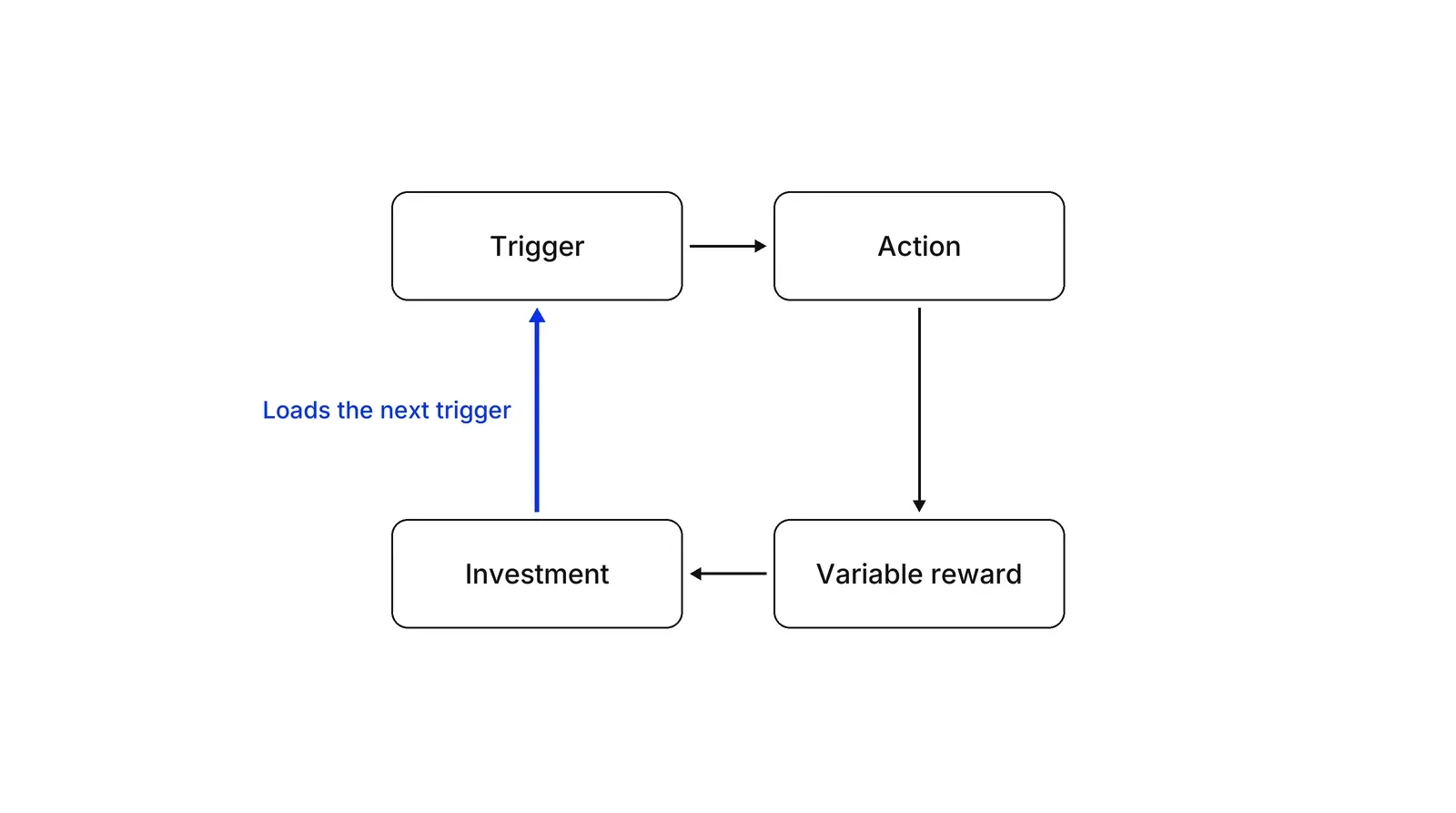
A trigger is the cue that starts the behavior. Eyal separates external triggers, such as an email, a link or an app icon, from internal ones, which come from existing routines and feelings. With repeated use he expects the internal trigger to take over, so the user comes back without a prompt.
The action is the behavior done in anticipation of a reward. Eyal describes it as a mix of motivation and ability and links to Fogg’s site for the idea. The practical rule is the same one BJ Fogg gave at the Persuasive 2009 conference in the Fogg behavior model gives: make the step easy.
The reward has to vary. Eyal argues that unpredictable rewards create wanting where predictable feedback does not, and he compares the effect to slot machines. The investment is what the user gives back: time, data, effort, social capital or money. He stresses that it should improve the product for the next pass, which is why he says it differs from a sales funnel.
What is the habit zone?
The habit zone is the area where an action is frequent enough and valuable enough to become a default. In Eyal’s post the two axes are frequency and perceived utility, and he gives no numeric thresholds. Frequent actions, such as a web search, build habits through repetition. Infrequent ones, such as shopping, need high perceived utility.
This is the first filter, and it removes many products. If users would only need you twice a year, the loop has too few turns to matter, and your effort may be better spent on growth loops that bring new users or on the funnel.
What does the science say about variable rewards?
The research is real, but it was done on animals and on addiction, not on apps. Eyal cites B.F. Skinner’s work on random rewards in his 2012 post and says the dopamine system keeps us searching. The research usually cited for this step, though not by Eyal in the posts we read, includes Schultz, Dayan and Montague, who reported that dopamine neurons in primates track errors in predicted rewards, and the “wanting versus liking” work of Berridge and Robinson. That work holds that dopamine drives wanting, not pleasure, and that cues trigger it.
Berridge and Robinson cite Parkinson’s patients on dopamine-stimulating drugs, who develop compulsive gambling or shopping that typically fades when the medication stops, while rarely reporting intense pleasure. They also call the evidence for behavioral addictions “emerging” and the mechanisms “not yet understood.” The step from a monkey or a drug cue to a notification is a hypothesis.
Why does investment matter?
Investment raises the value of the product to the person who built it. In the IKEA effect studies, Norton, Mochon and Ariely found that people value what they made more, but only when they finished it. Creations that were destroyed or left incomplete lost the effect. That is a design rule: a saved preference or a logged result helps, an abandoned setup does not. Eyal’s investment post names stored value as the mechanism, with Evernote, Salesforce and Pandora as examples, and cites a Harvard Business School working paper on people who picked their own lottery numbers.
Is the Hook Model manipulative?
It can be, and Eyal says so. His “Art of Manipulation” post in 2012 introduced the manipulation matrix, a test for makers built on two questions: will I use the product myself, and will it help users materially improve their lives. He wrote that it moves the question from whether you can hook users to whether you should. On his habit page he adds: “If used to exploit, habits can turn into wasteful addictions.”
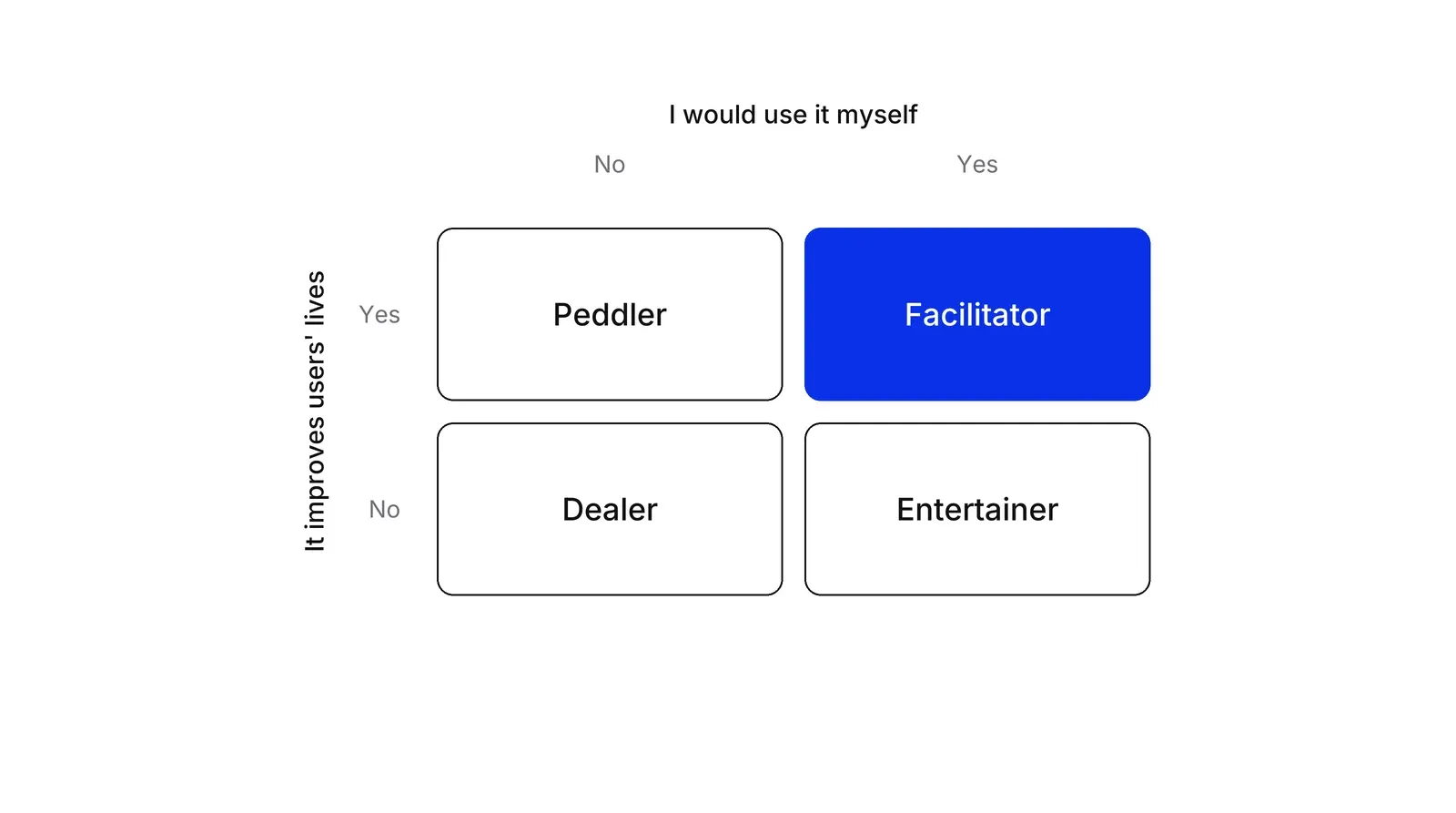
The matrix is a self-assessment by the maker, so its answers are only as honest as the person asking. Outside evidence is more sobering. In a randomized experiment by Hunt and colleagues, 143 undergraduates who limited social media to 10 minutes per platform per day for three weeks reported less loneliness and depression than controls, while both groups showed lower anxiety and fear of missing out, which the authors link to simply monitoring use. In Allcott and colleagues, people paid to deactivate Facebook for four weeks reported higher well-being and kept using it far less after the experiment ended, with a registered trial design. Both studies concern social networks, not every product the model is applied to.
Eyal’s later book Indistractable, published by BenBella and written with Julie Li, and reviewed by Publishers Weekly in June 2019, turns to the user’s side: managing the internal triggers that pull people off task. It does not answer what a maker owes a user who is being pulled.
Rules are catching up. The US Federal Trade Commission’s 2022 staff report defines dark patterns as design practices that “trick or manipulate users into making choices.” Article 25 of the EU’s Digital Services Act bars online platforms from designing interfaces that “deceive or manipulate” users. A crawl by Mathur and colleagues of about 53,000 product pages on 11,000 shopping sites found 1,818 dark pattern instances of 15 types, on 183 sites. Those cover deception in shops, not habit loops as such, but a team should read them before building one.
How strong is the evidence?
Thin. We found no peer-reviewed controlled test of the Hook Model as a whole, and Eyal’s own pages cite no such study. The parts are borrowed from stronger work: Fogg’s model for action, reward research for the third step, the IKEA effect for the fourth. Habits themselves take time: in Lally and colleagues, 96 volunteers needed between 18 and 254 days to reach 95 percent of their peak automaticity for a daily behavior. And a review by Panova and Carbonell found too little support to call heavy smartphone use an addiction, preferring “problematic use.”
Treat the model as a vocabulary and a set of hypotheses. Check each step with your own cohort data before you rebuild a product on it.
How does it relate to other models?
| Fogg behavior model | Hook Model | Growth loops | |
|---|---|---|---|
| Question | Why did this behavior happen now? | Why do users come back? | Why does growth compound? |
| Unit | One moment | One user, repeated | A whole user base |
| Key parts | Motivation, ability, prompt | Trigger, action, reward, investment | New user, action, output, new users |
The Hook Model sits between the two: it uses Fogg for one turn and feeds retention into loops, which you can count with AARRR metrics. The levers it uses overlap with the behavioral economics in funnels toolkit, including defaults and effort cost. A Growth Lab plan starts from the retention step that is failing and asks the matrix question before any build (see how we work).
How to apply Hook model, step by step
- Check the habit zone first. Write down how often a user could reasonably do the core action and how valuable it feels each time. Eyal's habit zone needs enough of both, with no fixed threshold. A daily check-in and an annual renewal need different designs, and the second may not suit a hook at all. Result: one line saying how frequent and how useful the action is.
- Name the internal trigger. Find the feeling or situation that should make a user open the product without a prompt: boredom, uncertainty, a free minute, a worry about a number. Interview five recent repeat users and ask what was going on just before they came back. Result: one internal trigger, written as a feeling.
- Shorten the path from trigger to action. Count taps, fields and decisions between the trigger and the first useful result. Remove steps until the action is the simplest thing the user can do in anticipation of a reward. Result: a step count before and after, with the target action reachable in a few taps.
- Choose what varies in the reward. Decide which part of the reward should differ from visit to visit: new content, a different insight, a progress marker, a message from a person. A reward that is identical every time stops pulling. Result: one variable element, and a check that it still delivers something useful each time.
- Design an investment that improves the next visit. Ask for a small input that makes the product better for that user next time: a saved preference, a logged result, a connection to a colleague. Make sure the user can finish it, since an unfinished task adds nothing. Result: one investment step, and a note on which trigger it will load.
- Run the manipulation matrix and a well-being check. Answer Eyal's two questions about your product: would you use it yourself, and does it materially improve users' lives. Then ask a sample of repeat users whether they wish they used it less. Result: a written verdict, and a change if the answer is uncomfortable.
- Measure return cycles. Track how many users come back unprompted within a set window and how many times per week, by signup cohort. Compare cohorts before and after each change. Result: a retention curve per cohort and a decision on which step to work on next.
Examples
Pinterest, as Eyal tells it
Documented, but a story, not data. In [Eyal's walk-through](https://www.nirandfar.com/how-to-manufacture-desire/), a user called Barbra sees a family photo on Facebook (external trigger), clicks it and lands on Pinterest (action), scrolls a mix of expected and surprising images for 45 minutes (variable reward), then pins and follows (investment). Her saved pins and follows tie her to the site and prime the next visit. Eyal wrote the persona; it is an illustration of the loop, not a measured result.
Amazon price comparison and the habit zone
Documented in Eyal's account. In [his habit zone post](https://www.nirandfar.com/habit-zone/), shopping is an infrequent action, so a habit needs high perceived utility. He argues competitive price information gives shoppers that utility, even when Amazon does not make the sale. Google search sits at the other end: so frequent that repetition builds the habit. The point for a team is to ask which of the two levers your product has.
A physiotherapy clinic's exercise app
Illustrative, with arithmetic only. A clinic has 300 patients with home exercises, and 90 of them (30 percent) complete three sessions a week. The team picks a pain-free-day feeling as the internal trigger, lets patients choose their own reminder time (investment), makes one tap start the session (action), and shows a progress marker plus an occasional note from the therapist (variable reward). It then tracks whether the 30 percent moves, and checks with the manipulation matrix that the app helps patients recover, not just return.
When to use it
Use it when your product serves a need that recurs often, such as tracking, communicating, learning, or checking a number, and when retention is your bottleneck. It gives a team a shared vocabulary for why users return and which step is weak. It also forces the ethics question before the build, which is cheaper than answering it after.
When not to use it
Skip it for products used rarely or once, such as a mortgage or a tax filing, where a hook has nothing to hold on to. Avoid it when the goal is for users to finish quickly and leave. Be careful in regulated or health settings, where a design that works on impulse can fall under rules on manipulative interfaces. The model is a design aid with thin tests behind it, so treat results as hypotheses.
Common mistakes
- Adding variable rewards to a product people use rarely. Without frequency or high perceived utility there is no habit to build, and the reward only adds noise.
- Making the investment a chore. People value what they build only when they finish it, so a half-finished setup flow adds nothing and can drive users off.
- Treating notifications as the whole model. External triggers start the loop, but the aim is an internal trigger that needs no prompt.
- Reading engagement as value. A user who returns often may wish they did not, so pair return rate with a question about whether the product helps.
- Calling a habit an addiction, or the reverse, without evidence. Reviews of smartphone use find the addiction label poorly supported, while the experiments on social media find real well-being effects.
FAQ
What is the Hook Model?
It is a four-step loop from Nir Eyal's book Hooked: trigger, action, variable reward and investment. Eyal proposed it to explain how products bring users back without heavy advertising. Each pass through the loop should leave the user with something stored in the product, which makes the next trigger more likely.
What are the four phases of the Hook Model?
A trigger prompts a behavior, either external, such as an email or icon, or internal, such as a feeling. The action is the simplest behavior done in anticipation of a reward. The variable reward varies from visit to visit. The investment is time, data or effort the user puts in that improves the product for next time.
Is the Hook Model manipulative?
It can be used that way. Eyal's own manipulation matrix, published in 2012, asks makers whether they would use the product and whether it improves users' lives, and sorts them into facilitator, peddler, entertainer or dealer. Regulators now also target manipulative interface design, so the question is a legal one as well.
How is the Hook Model different from the Fogg behavior model?
Fogg's model explains one moment: a behavior happens when motivation, ability and a prompt meet. The Hook Model describes a repeating loop and adds reward and investment. Eyal's own page links its action step to Fogg's model, so the Hook Model builds on it, not the other way round.
What is the habit zone?
The habit zone is Eyal's name for the area where an action is frequent enough and useful enough, in the user's eyes, to become a default. He gives no numeric thresholds. Frequent actions can become habits through repetition, while infrequent ones need high perceived utility.
Sources
- Nir Eyal, Hooked: How to Build Habit-Forming Products, Portfolio/Penguin Random House, 2014
- Nir Eyal, Hooked book page, nirandfar.com
- Nir Eyal, The Hooked Model: How to Manufacture Desire in 4 Steps, nirandfar.com
- Nir Eyal, Getting Your Product Into the Habit Zone, nirandfar.com
- Nir Eyal, Variable Rewards: Want To Hook Users? Drive Them Crazy, nirandfar.com (2012)
- Nir Eyal, User Investment: Make Your Users Do the Work, nirandfar.com
- Nir Eyal, The Art of Manipulation, TechCrunch, 1 July 2012
- Nir Eyal, Indistractable, nirandfar.com
- Publishers Weekly, review of Indistractable (BenBella, 2019)
- BJ Fogg, Fogg Behavior Model, behaviormodel.org
- BJ Fogg, A behavior model for persuasive design, Persuasive 2009 (ACM)
- Schultz, Dayan and Montague, A neural substrate of prediction and reward, Science, 1997
- Berridge and Robinson, Liking, wanting, and the incentive-sensitization theory of addiction, American Psychologist, 2016
- Norton, Mochon and Ariely, The IKEA effect: when labor leads to love, Journal of Consumer Psychology, 2012
- Lally, van Jaarsveld, Potts and Wardle, How are habits formed, European Journal of Social Psychology, 2010
- Hunt, Marx, Lipson and Young, No more FOMO: limiting social media decreases loneliness and depression, Journal of Social and Clinical Psychology, 2018
- Allcott, Braghieri, Eichmeyer and Gentzkow, The welfare effects of social media, American Economic Review, 2020 (NBER Working Paper 25514)
- Panova and Carbonell, Is smartphone addiction really an addiction?, Journal of Behavioral Addictions, 2018
- Mathur and colleagues, Dark patterns at scale: findings from a crawl of 11K shopping websites, CSCW, 2019
- US Federal Trade Commission, Bringing Dark Patterns to Light, staff report, September 2022
- European Union, Regulation (EU) 2022/2065 (Digital Services Act), Article 25
Last updated Oct 9, 2026


Marketing agency or growth system: when a company outgrows its agency
An agency is the right call while the founder still runs most of the company. Once the business starts copying itself into new locations or markets, it needs a system that sets goals, tests hypotheses and owns the result.

Why healthcare marketing agencies stall: the short, mid and long wins model we use with clinics
Most agencies own the click and nobody owns the front desk. How we structure clinic work in three horizons, the research behind each one, and one year of results.

Why channel tests stall after month three
Most paid channel tests do not end with a decision. They end when the budget runs out, the attribution model changes, or everyone quietly stops looking at the dashboard.