Entity SEO and the Knowledge Graph
Entity SEO is the practice of making your brand, people and products unambiguous to search engines, so they can match what the web says about you to one known thing in their knowledge graph.
Entity SEO is the practice of describing your brand, people and products as distinct, identifiable things rather than strings of keywords. Search engines store such things in a knowledge graph, and Google's version has held billions of entities since 2012. You help it recognise yours with consistent naming, Organization structured data with sameAs links, reference profiles such as Wikidata, and a verified knowledge panel where one exists.
- Origin
- Google (announced by Amit Singhal); schema.org vocabulary and Wikidata supply the identifiers, 2012
- Level
- 301 · Advanced
- Fits
- Small and mid-size, Scale-up
- Time to apply
- One day for the audit and markup, then a few weeks for outside profiles to settle
- What you need
- write access to your home page template · your legal name, registration number and the profiles you control · a Google account that can verify your site in Search Console
Entity SEO is the practice of making your brand, people and products identifiable to search engines as distinct things, so that every mention of you on the web can be matched to one record. A search engine keeps such records in a knowledge graph: a database of things and the relationships between them. The term is a practitioner’s label, not a Google product.
Why search moved from strings to things
Google announced its Knowledge Graph on 16 May 2012, in a post by Amit Singhal titled “things, not strings”. At launch it held more than 500 million objects and 3.5 billion facts about them. The example was Tom Cruise: his panel answers 37 percent of the next queries people ask about him. The first problem it solved was ambiguity: a query for “Taj Mahal” could mean the monument or the musician, and the graph lets Search tell which. The post names Freebase, Wikipedia and the CIA World Factbook among its public sources, and uses Marie Curie to show how a summary of birth, education and discoveries appears.
Scale has grown since. A 2020 Google post reports over 500 billion facts about five billion entities, drawn from hundreds of web sources, licensed databases and structured markup that site owners publish. The research paper Knowledge Vault (KDD 2014, New York, 24 to 27 August) by Xin Luna Dong and eight co-authors at Google describes how facts extracted from web text, tables and page structure are fused with prior knowledge and given a probability of being correct. Freebase, one of the 2012 sources, ran from 2007 to 2015, Google’s archive page says, and its archived dump of about 1.9 billion facts is no longer maintained.
The dates that matter, from the sources above:
| Year | Event | Source |
|---|---|---|
| 2007 to 2015 | Freebase runs as an open data project | Google for Developers |
| 2012 | Knowledge Graph launches with 500 million objects and 3.5 billion facts | Amit Singhal, Google |
| 2014 | Knowledge Vault paper presented at KDD, New York | Dong et al., Google |
| 2020 | JSON-LD 1.1 becomes a W3C Recommendation on 16 July | W3C |
| 2020 | Google reports over 500 billion facts about five billion entities | Google, 20 May |
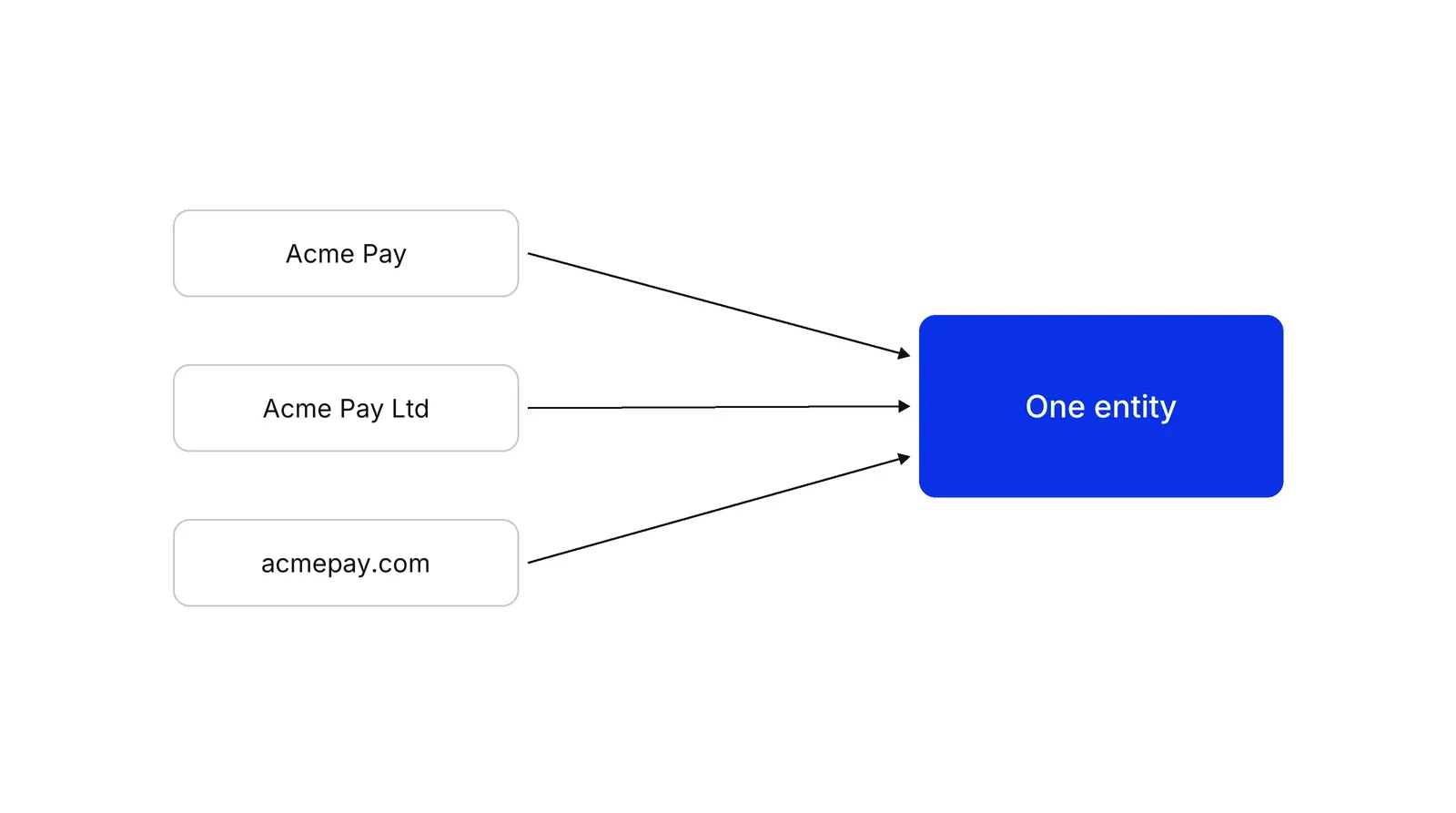
An entity is a distinct, identifiable thing: a company, a person, a product, a place. In a knowledge graph it has an ID, a type, attributes and links to other entities. The survey by Hogan and 17 co-authors, published in ACM Computing Surveys 54(4) in 2021, covers how such graphs handle identity, schema and context.
How entities are identified
Each system gives an entity its own ID. The table shows three.
| System | Who runs it | Identifier you see | Can you edit it? |
|---|---|---|---|
| Google Knowledge Graph | Machine ID such as kg:/m/0dl567, the example for Taylor Swift in the Search API |
No. You can claim some panels and send feedback | |
| Wikidata | Wikimedia community | Q-number, such as Q42 for Douglas Adams | Yes, if you follow its notability and sourcing rules |
| Your site’s markup | You | The url and @id in JSON-LD |
Yes, fully |
Google’s Natural Language API shows the same idea in a tool: for well-known entities found in text, it can return a Knowledge Graph machine ID (mid) and a Wikipedia URL, alongside a type such as PERSON or LOCATION and a salience score. Wikidata is open. Its item for Douglas Adams is Q42, the standard example in its own introduction. Each item has a Q-number and each property a P-number (P69 means “educated at”), the data is published under CC0, and every statement must carry a source. You can read it through the Wikidata Query Service (SPARQL), the MediaWiki Action API (up to 50 entities per request) or full dumps, as its data access page explains. Its notability test accepts an item that has a valid Wikimedia sitelink, describes a clearly identifiable entity with serious public references, or fills a structural need.
Markup is your side of the conversation
Organization structured data tells Google who you are on your own page. Google’s documentation says it helps Google understand an organization’s administrative details and tell it apart from other organizations. It lists name, url, sameAs, logo (at least 112x112 pixels) and legalName as recommended, plus identifiers such as iso6523Code, a code built from an International Code Designator and the identifier, where 0060 marks a DUNS number, 0088 a GLN and 0199 a LEI. Google’s page prefers iso6523Code over the older leiCode field, which follows ISO 17442. Schema.org defines the same fields plus taxID, vatID, naics and globalLocationNumber, and also parentOrganization and subOrganization for group structures.
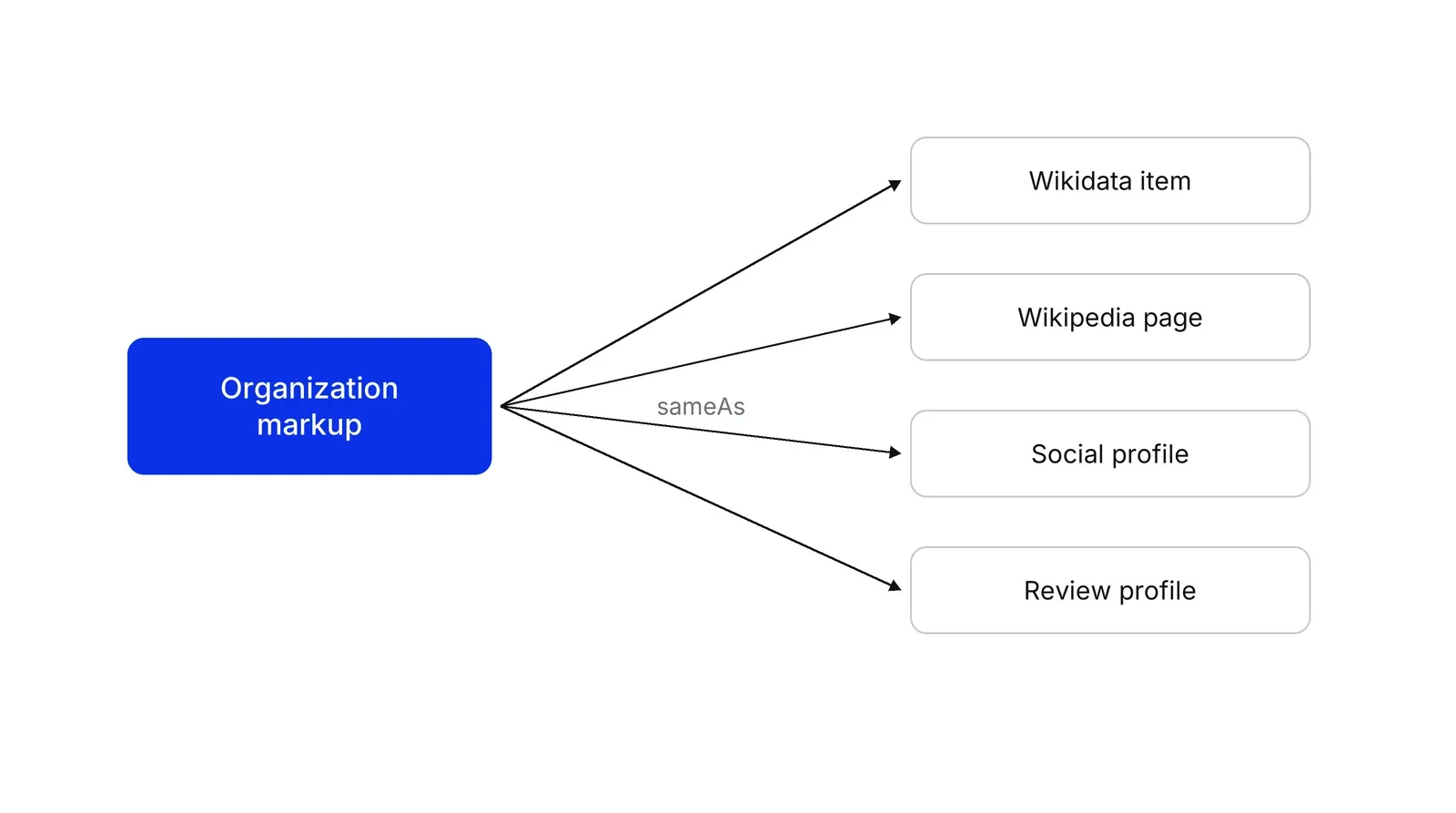
The sameAs property carries the weight of identity. Schema.org defines it as the URL of a reference page that unambiguously indicates the item’s identity, with Wikipedia, Wikidata and an official site as examples. Google’s guide says it can point to a social or review profile.
Two related pieces help. Google builds site names from home page content and references to it, and WebSite markup with name and alternateName carries the most weight, with the advice to stay consistent and to repeat the markup on every duplicate home page, such as the HTTP and HTTPS or www and non-www versions. For people, ProfilePage markup names the person or organization a page is about and accepts sameAs, with mainEntity as the one required property. All of it is written in JSON-LD, the format Google recommends in its structured data introduction.
Knowledge panels and what you can control
A knowledge panel is the information box Google shows for an entity. Many can be claimed. Google’s help page tells the subject to search for themselves, click “Claim this knowledge panel” if it appears, and sign in to an official profile such as YouTube or Search Console. Not every panel is claimable, and verification does not give direct editing control: you suggest changes through Feedback, with links to supporting pages. If someone else already verified the panel, Google emails the current owners, and after 3 business days without a reply it becomes claimable again. Owners and managers can add users, while contributors can only suggest changes. Local businesses manage details through a Business Profile. Google also says Twitter and Facebook associations are stored automatically.
Google’s guidelines say correct markup does not ensure a rich result, and markup must describe content visible to readers. No Google page we found says entity markup lifts rankings. Judge the work by whether the entity is recognised correctly.
Check what Google already holds
The Knowledge Graph Search API returns matching entities as schema.org JSON-LD, with a name, types, description and a result score. The REST reference lists 7 parameters: query, ids, languages, types, prefix, limit and indent. Results are typed with schema.org types such as Person, Organization and Place. It is read-only, defaults to 20 results (up to 500 with the limit parameter), returns individual EntitySearchResult items rather than graphs, and Google says it is not suitable as a production-critical service. Its newer home is the Enterprise Knowledge Graph, which can also reconcile your own tables of entities.
Entity work sits beside E-E-A-T and technical SEO: identity first, then evidence of trust, then a crawlable site. A Growth Lab plan starts from the entity sheet this work produces.
How to apply Entity SEO and the Knowledge Graph, step by step
- Settle one name and one description. Write down the exact brand name, any alternate names, the legal name, and a one-sentence description. Use those same strings everywhere you control. Result: a one-page entity sheet that every profile and page copies from.
- Look yourself up as an entity. Search your brand in Google and note whether a knowledge panel appears and what it says. Then query the Knowledge Graph Search API with your name and `limit=5` and read the type, description and ID that come back, if any. Result: a baseline.
- Add Organization markup to the home page. Publish JSON-LD with name, url, a logo of at least 112x112 pixels, legalName and an iso6523Code such as a DUNS number with the 0060 prefix. Add WebSite markup with name and alternateName for the site name. Result: a machine-readable statement of who you are on the page you control.
- Link the profiles that prove you are you. List the 3 to 5 official social, review and registry profiles in sameAs, and make sure each one names the same business and links back to your site. Result: a two-way set of links that lets a machine confirm the match.
- Create or fix the reference records. If you meet Wikidata's notability rules, create or correct your item with sourced statements. Claim any panel and Business Profile you are eligible for, and send feedback for wrong facts with supporting links. Result: reference records that agree with your entity sheet.
- Recheck every 3 months. Repeat the lookup, compare the panel and API output with your sheet, and fix mismatches at the source. Result: a short change log.
Examples
A payments startup with a name clash
Illustrative. A payments company called Acme Pay, licensed in 2 countries, shares its name with a loyalty app. Searching the brand returns mixed results. The team publishes Organization markup with its legal name, registry identifier and sameAs links to its LinkedIn page and licence register entry, and aligns the name on every profile. Google promises no panel, so the team tracks the lookup, not rankings.
A dental clinic with three locations
Illustrative. A clinic group has 1 brand and 3 addresses in 2 cities. It marks up the group as 1 Organization on the home page, each of the 3 branches as LocalBusiness with address and opening hours on its own page, and links branches to the parent through parentOrganization. Each branch claims its Business Profile. Result: 4 correctly linked things rather than 3 near-identical names.
A founder-led consultancy
Illustrative. A consultancy sells through its founder's name. The site gets a ProfilePage for the founder with sameAs links to her conference bios and professional profiles. Because a person may have a claimable panel, she checks for the claim button and verifies through an official profile if offered. Result: the person and the company are described consistently and joined by markup.
When to use it
Use it when your brand name is shared with other things, when search shows nothing about you, or when facts about you in search or AI answers are wrong or mixed with someone else's.
When not to use it
Skip it if the site cannot be crawled, if content quality is the real problem, or if you hope markup will force a knowledge panel. Google says structured data does not guarantee any feature.
Common mistakes
- Treating a knowledge panel as the goal. Google builds panels from many sources and does not describe a paid or markup-only route.
- Inconsistent names. Brand, legal name, handle and domain all differ across profiles, so machines cannot tell they refer to one thing.
- sameAs links to pages that do not identify you. A link to a listing for a different business adds noise.
- Marking up facts nobody can see. Google's guidelines say not to mark up content that is not visible to readers, and misleading markup can trigger a manual action.
- Building a Wikidata item for a business that fails the notability rules. Unsourced items may be deleted.
FAQ
What is entity SEO?
Entity SEO is optimizing for things rather than keywords: making your brand, people and products clearly identifiable so a search engine can match them to one entry in its knowledge graph. In practice it means consistent naming, Organization structured data, sameAs links to reference profiles and accurate third-party records.
What is the Google Knowledge Graph?
It is Google's database of real-world things and the relationships between them. Google announced it on 16 May 2012 and described its growth on 20 May 2020. It powers knowledge panels and helps Search tell apart things that share a name.
How do I get a knowledge panel?
You cannot request one directly. Google creates panels from the sources it trusts, and not all are claimable. If a panel for you exists, look for the Claim this knowledge panel button and verify through an official profile such as YouTube or Search Console. Local businesses manage details through a Business Profile.
Does sameAs markup improve rankings?
Google's documentation describes sameAs as pointing to other pages with information about the organization and does not claim a ranking effect. Its stated purpose is to help Google tell your organization apart from others. Treat it as identity data.
Do I need a Wikidata item?
Only if you meet at least 1 of its 3 notability criteria: a valid sitelink to a Wikimedia project, a clearly identifiable entity described by serious public references, or a structural need. Every statement must also carry a source. No source says Google requires one.
Sources
- Google, The Keyword, Amit Singhal, Introducing the Knowledge Graph: things, not strings, May 16, 2012
- Google, The Keyword, A reintroduction to our Knowledge Graph and knowledge panels, May 20, 2020
- Google Search Central, Organization structured data
- Google Search Central, Introduction to structured data markup
- Google Search Central, General structured data guidelines
- Google Search Central, Site names in Google Search
- Google Search Central, Profile page structured data
- Google Search Central, Local business structured data
- Google for Developers, Knowledge Graph Search API
- Google for Developers, Knowledge Graph Search API REST reference (entities.search)
- Google Cloud, Enterprise Knowledge Graph overview
- Google Cloud, Natural Language API, Analyzing entities
- Google Knowledge Panel Help, Get verified on Google
- Google for Developers, Freebase data dumps
- Dong et al., Knowledge Vault: A Web-Scale Approach to Probabilistic Knowledge Fusion, KDD 2014
- Hogan et al., Knowledge Graphs, ACM Computing Surveys 54(4), 2021
- Schema.org, sameAs property
- Schema.org, Organization type
- Schema.org, Data model
- W3C, JSON-LD 1.1, Recommendation of July 16, 2020
- Wikidata, Introduction
- Wikidata, Notability policy
- Wikidata, Verifiability policy
- Wikidata, Data access
Last updated Oct 9, 2026


The compliance layer under fintech marketing operations
A fintech marketing agency can build campaigns. It cannot own the compliance review, the KYC drop-off or the multi-market licensing rules that decide whether a lead ever becomes a customer.

Fractional CMO: what you get, and what has to exist underneath
A fractional CMO brings strategy and judgment. Without reporting, CRM hygiene and a named owner per number, the engagement produces a slide deck instead of a system.

The operations layer behind healthcare patient acquisition
Ads and search bring the request in. What happens between the click and the booked, attended visit decides whether the spend paid off.