Operating model design
Operating model design is the work of choosing how processes, people, structure, technology, locations, suppliers and management routines fit together so that a strategy gets delivered every day.
An operating model is the design of how an organization delivers its strategy day to day: which processes it runs, who does the work and decides, where, with which systems and suppliers, and how performance is managed. Operating model design chooses these parts together so they reinforce each other, using tools such as the Operating Model Canvas, Ross's four models or Galbraith's Star Model.
- Origin
- Andrew Campbell, Mikel Gutierrez and Mark Lancelott (Operating Model Canvas); Jeanne Ross (standardization and integration models); Jay Galbraith (Star Model); McKinsey (Organize to Value), 2005; 2017; 2025
- Level
- 401 · Expert
- Fits
- Scale-up, Enterprise
- Time to apply
- A 2-day workshop for a first draft of one function, then 2 to 4 weeks to test it with the people who run the work
- What you need
- a written strategy: target customers, the offer and how the business earns money · a map of the main value chains, from customer request to delivered result · a cross-functional group of 6 to 10 leads who run the work today · one executive who owns the final decisions on trade-offs
An operating model is the description of how an organization turns its strategy into daily work: the processes it runs, who does them and who decides, where, with which systems and suppliers, and how results are tracked. There is no single inventor and no single list of parts. Andrew Campbell, Mikel Gutierrez and Mark Lancelott count six elements, McKinsey counts twelve, and MIT researcher Jeanne Ross boils the idea down to two choices. This page puts the three side by side and ends with a path for designing one.
How is an operating model different from a business model?
A business model says what you sell, to whom and how money comes in. An operating model says how the organization delivers that again and again. The two are easy to blur, and so is the org chart, which is only one part of an operating model.
| The question it answers | Typical output | |
|---|---|---|
| Strategy | Where do we compete, and how do we win? | Choices about customers, offer and advantage |
| Business model | Who pays, for what, and how does money come in? | A Business Model Canvas |
| Operating model | How do we deliver this, repeatedly and at scale? | Value chains, six-element canvas, decision rights |
| Org chart | Who reports to whom? | A structure diagram |
Van Haren Publishing describes the Operating Model Canvas as a tool that sits between strategy and the operational decisions needed to run an organization, covering the operating side of the Business Model Canvas: activities, resources and partners. Campbell adds a warning on his Ashridge site. The formal design is one thing, and the organization people actually experience is the formal design plus informal behavior.
The Operating Model Canvas: six elements
The Operating Model Canvas, published by Campbell, Gutierrez and Lancelott in 2017, extends the three operating elements of the Business Model Canvas to six, remembered as POLISM. All six hang off the value proposition.
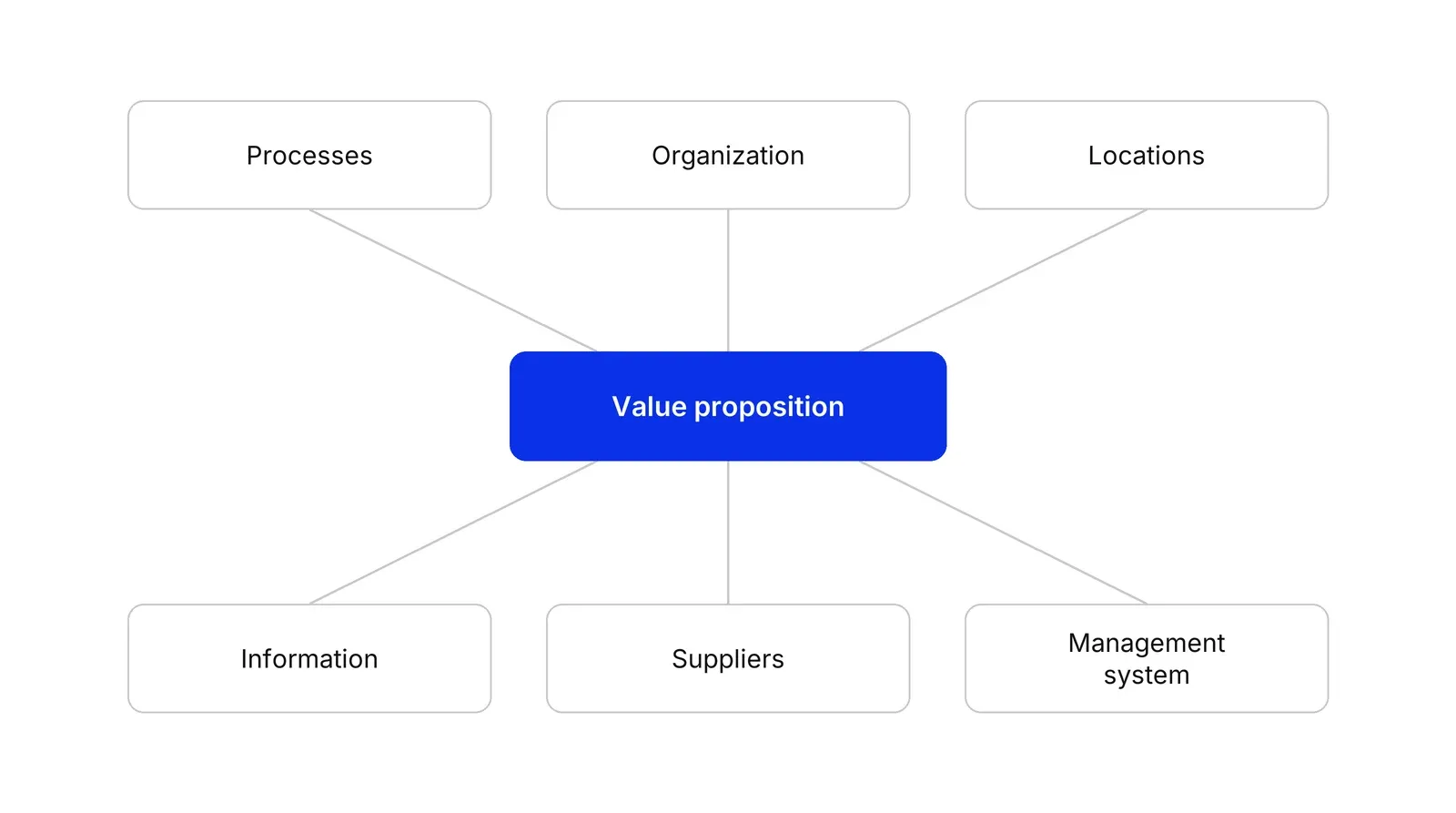
Per Van Haren Publishing, processes are the work needed to deliver the value proposition. Organization covers the people who do the work, their structure, supporting functions and decision powers. Locations are where the work is done. Information means the software applications that support it. Suppliers are outside parties whose involvement is needed. The management system covers planning, budgeting, performance monitoring and controls.
Campbell pairs the canvas with a value chain map that records each process, its customer and its value proposition (see value chain). He also notes that process improvement often needs wider operating model changes to succeed, which is why the canvas looks beyond processes. Michael Hammer made the case for redesigning work in his 1990 Harvard Business Review article on reengineering.
Ross’s two choices and four models
MIT CISR defines an operating model in the narrowest useful way: the necessary level of business process integration and standardization for delivering goods and services to customers. Jeanne Ross’s 2005 research briefing says companies make two choices. How standardized should processes be across units, whether business units, regions, functions or segments? How integrated should they be across those units?
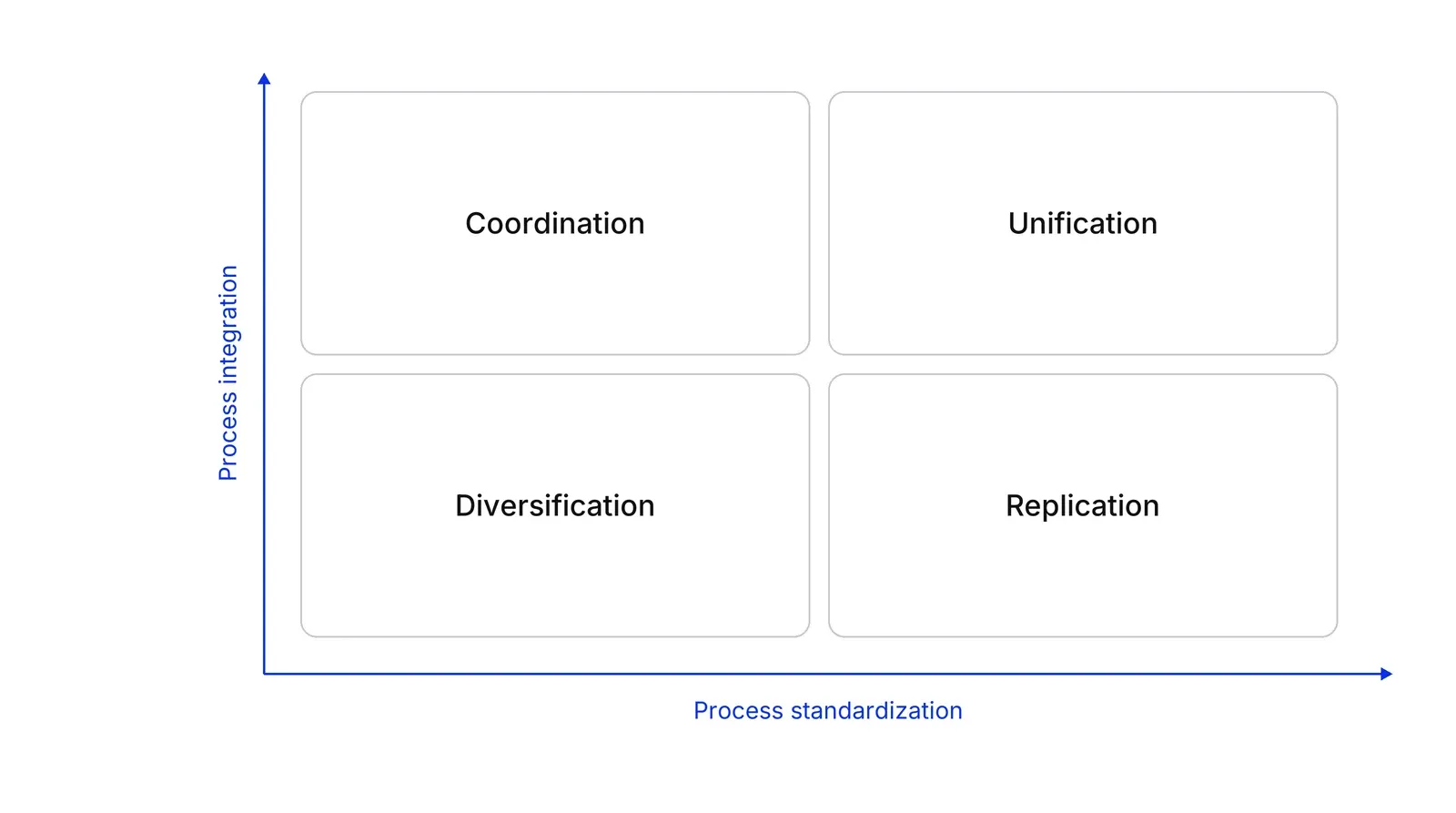
Ross, Peter Weill and David Robertson developed this into the four models of the 2006 book Enterprise Architecture as Strategy. The briefing gives an example for each.
| Model | Standardization | Integration | Example in the briefing |
|---|---|---|---|
| Diversification | Low | Low | Carlson, related but autonomous hospitality businesses |
| Coordination | Low | High | Toyota Europe, sharing product data across country units |
| Replication | High | Low | Marriott, same systems and processes, little interaction between units |
| Unification | High | High | Delta Air Lines, standardized global business |
All four are viable. Ross notes that most companies can find processes that fit every model, yet should select one to guide management thinking, and that large firms can use different models at different levels. Johnson & Johnson, in her example, operates in the Diversification quadrant overall, with a Coordination model in its US pharmaceutical group.
Galbraith’s Star Model and McKinsey’s twelve elements
Jay Galbraith’s Star Model has five design policies: strategy, structure, processes, rewards and people. His consultancy states that organization design involves more than structure, that different strategies produce different organizations and that all the policies must align. Its site dates the model to the 1960s, while some secondary sources say 1982, so treat the date as unsettled. Galbraith’s 2002 book Designing Organizations sets out the approach.
McKinsey’s Organize to Value system, published in the McKinsey Quarterly in June 2025, has twelve elements. They include purpose, structure, processes, technology, rewards and talent. The authors present it as a refresh of the 7-S framework, and call a company’s unique combination of choices across the twelve its operating model fingerprint. In a McKinsey survey of 757 senior executives, 89 percent of organizations still used a traditional hierarchical structure, two-thirds had redesigned their operating model in the past two years and half planned to do so again. McKinsey says even high performers have a 30 percent gap between their strategy’s full potential and what they deliver, which it attributes to operating model shortcomings.
BCG, on its organization strategy page, argues that classic operating model fixes fall short and recommends shared, enterprise-wide platforms that remove duplication, silos and handoffs. McKinsey’s 2026 follow-up on AI reaches a similar conclusion from the other side: no single best model exists, and results come from intentional design choices that are executed well.
Why fit matters more than any single element
Every framework above asks for alignment, and the idea is old. Alfred Chandler’s 1962 Strategy and Structure tied organizational form to strategy, Lawrence and Lorsch’s 1967 study of differentiation and integration looked at how units divide and join up work, and Waterman, Peters and Phillips argued in Structure is not organization in 1980 that structure is one lever among several. Michael Porter wrote in 1996 that competitive advantage grows from the entire system of activities, and that fit has three levels: consistency between each activity and the strategy, reinforcement among activities, and optimization of effort. Nadler and Tushman’s congruence model, as summarized in University of Alberta course notes, holds that the more consistent an organization’s components are with one another, the more effective it is. Mintzberg’s 1980 synthesis concluded that effective organizations tend to adopt a consistent configuration that fits their environment.
So a design review is mostly a search for contradictions. A structure that pushes decisions to teams works badly with a reward system that pays only for company-level results. A single customer view needs shared data, not just a shared slogan.
A design path in practice
Campbell’s approach on the Ashridge site starts with purpose: define the customer, the offer and the activities needed to excel, then map the value chains. Keep design principles to fewer than 10, ideally three to seven. Default to decentralization and centralize only when the gain clearly outweighs the loss of flexibility. Make no compromises on the capabilities you must deliver, and design explicitly for the handoffs most likely to fail.
Two pieces of the management system deserve their own tools. Decisions: Paul Rogers and Marcia Blenko of Bain argued in 2006 that companies unable to make and carry out the right decisions quickly lose ground whatever their strategy, so assign decision roles with a RACI matrix or similar. Cadence: the meetings and reviews that run the model are covered in operating rhythm. For commercial teams, revenue operations and growth team structure apply the same logic to one function.
If the function you are designing is marketing and revenue operations, a Marketing-Operational System plan is a reasonable place to start.
How to apply Operating model design, step by step
- Restate the strategy in operating terms. Write down who the customers are, what you deliver to them and how the business earns money. Then derive 3 to 7 design principles, such as 'decisions about a customer are taken by the team that serves that customer'. Campbell advises keeping fewer than 10. Result: a one-page brief and a short, ranked list of principles.
- Map the value chains. Draw the main chains of work that deliver your offer, each with its customer and what it must deliver. Mark the steps where the customer feels quality. Result: a map of the work the model has to support, including the steps where you cannot compromise.
- Choose standardization and integration. For each area, decide how alike the processes must be across units and how tightly data and handoffs must be linked, using Ross's two choices. Pick one default model for the company and name the exceptions. Result: a stated position, such as 'standardized onboarding, locally run sales'.
- Draft the six elements. In a workshop, fill in the Operating Model Canvas: processes, organization, locations, information, suppliers, management system. Add decision rights with a RACI chart and the meeting rhythm. Result: a first draft of the canvas for each value chain.
- Test the fit. Read the draft across the elements. Does the reward system push people toward the behavior the structure expects? Which handoffs between units are likely to fail? Result: a list of conflicts and weak links, each with a proposed fix.
- Pilot, then sequence. Run the new model in one team or one value chain, measure it against the principles, and fix what breaks before widening. Result: a roadmap with owners and a review date, and a design that has survived contact with real work.
Examples
Buurtzorg, home nursing in the Netherlands
Documented. A 2015 article in Global Advances in Health and Medicine by Mary Jo Kreitzer, Karen Monsen, Sharda Nandram and Jos de Blok describes self-managing neighborhood teams of up to 12 nurses, each caring for 50 to 60 patients. A small support layer of back-office staff and coaches replaces middle management, and one shared web platform handles scheduling, documentation and billing. The authors report that the model grew from one team at launch in 2007 to hundreds of teams within a few years. Seen through the canvas, the organization element, the information element and the management system were all designed around the same principle: let the team decide, and give it shared data.
ING Netherlands, a bank reorganized into squads
Documented. In a 2017 McKinsey Quarterly interview, ING's Peter Jacobs and Bart Schlatmann describe the shift in June 2015 to about 350 nine-person squads grouped into 13 tribes, with no particular financial pressure behind it. Customer behavior was changing, and the bank wanted to organize around customer journeys. Schlatmann says the bank re-selected every employee for the new set-up, with a stronger weighting for mind-set than for experience, and that nearly 40 percent ended up in a different role. The change touched structure, people, rewards and ways of working together, not just the org chart.
A clinic group with four sites
Illustrative. The group sells the same services in every site, so it chooses a Replication-style model: one booking process, one price list and one patient record system, with sites rarely sharing staff. Marketing, however, needs a single patient view across sites to see which campaign brought which patient, which is an integration choice. The team writes this down as a deliberate exception and sets a data standard for patient and campaign IDs, while leaving local clinical scheduling to each site.
When to use it
Use it when the strategy has changed and the way work is organized has not: a new market, a merger, a move from services to product, a jump in scale or a new technology such as AI that changes who does what. It also fits when a function keeps getting reorganized without improving, because the problem may sit in processes, rewards or data, not in the boxes on the chart.
When not to use it
Skip a full redesign when the problem is one broken process or one weak team. Fix the process first, using a method such as value stream mapping or a RACI chart. Avoid it too when nobody senior will accept trade-offs, because every operating model gives something up. Do not run it as a big-bang redesign without pilots; the Operating Model Canvas works best as a living draft.
Common mistakes
- Redrawing the org chart and calling it an operating model. McKinsey's research found 89 percent of the organizations in its sample still used a traditional hierarchical structure, and structure is only one of twelve elements it asks leaders to design.
- Designing each element alone. Porter argued that advantage comes from the whole system of activities, so a clever process with a mismatched reward system loses to a plain, consistent set.
- Skipping design principles. Without 3 to 7 ranked principles, every disagreement turns into a debate about taste. Campbell advises testing each principle for relevance and ranking them.
- Ignoring behavior. Campbell warns that 'Culture eats design for lunch!' The formal design is only half of what people experience, so test it against how people actually work.
- Standardizing everything. Campbell defaults to keeping capabilities inside the value chain they serve and centralizing only when the gain clearly outweighs lost flexibility and customer focus.
FAQ
What is an operating model?
An operating model is the blueprint for how an organization delivers its strategy in daily work. MIT CISR defines it narrowly as the level of process integration and standardization a company needs. Wider definitions, such as Campbell's canvas or McKinsey's 12 elements, add organization, locations, information, suppliers and the management system.
What is the difference between a business model and an operating model?
A business model describes what you sell, to whom and how money comes in. An operating model describes how the organization delivers that repeatedly. Van Haren's description of the Operating Model Canvas places it between strategy and operational decisions, covering the operating side of the Business Model Canvas: activities, resources and partners.
What are the elements of an operating model?
It depends on the author. Campbell, Gutierrez and Lancelott use six: processes, organization, locations, information, suppliers and the management system. Galbraith's Star Model uses five policy areas. McKinsey's Organize to Value system lists twelve, from purpose and structure to rewards and talent. The lists overlap more than they differ.
Is an operating model the same as an operating system?
No. People searching 'operating model' often land on computer operating systems, such as Windows or the kernel. In management, an operating model is a design for how a business or function runs, covering people, processes, technology and governance. A company may also use the phrase 'operating system' loosely for its management routines, but that is a metaphor.
How often should an operating model be redesigned?
Treat it as a living design, not a one-off project. In McKinsey's 2024 survey of 757 senior executives, two-thirds of organizations had redesigned their operating model in the previous two years and half planned another in the next two. Campbell recommends fast redesign with review-based design authorities instead of heavy approval gates.
Sources
- McKinsey Quarterly, A new operating model for a new world, June 2025
- McKinsey Quarterly, The key to AI value is hiding in plain sight: Your operating model, September 2026
- McKinsey Quarterly, ING's agile transformation, January 2017
- Boston Consulting Group, Organizational strategy: operating model and organization design
- Ashridge Hult, Andrew Campbell on operating models
- Van Haren Publishing, Operating Model Canvas (Campbell, Gutierrez, Lancelott, 2017)
- MIT CISR, Jeanne W. Ross, Forget Strategy: Focus IT on Your Operating Model, Research Briefing V(3C), December 2005
- MIT CISR, Jeanne W. Ross, Peter Weill, David C. Robertson, Enterprise Architecture as Strategy, Harvard Business School Press, 2006
- Galbraith Management Consultants, The Star Model
- Jay R. Galbraith, Designing Organizations: An Executive Guide to Strategy, Structure, and Process, Jossey-Bass, 2002, Internet Archive record
- Michael E. Porter, What Is Strategy?, Harvard Business Review, November 1996
- Paul Rogers, Marcia W. Blenko, Who Has the D? How Clear Decision Roles Enhance Organizational Performance, Harvard Business Review, January 2006
- Alfred D. Chandler Jr., Strategy and Structure: Chapters in the History of the Industrial Enterprise, MIT Press, 1962, Internet Archive record
- Henry Mintzberg, Structure in 5's: A Synthesis of the Research on Organization Design, Management Science 26(3), 1980
- David A. Nadler, Michael L. Tushman, A model for diagnosing organizational behavior, Organizational Dynamics 9(2), 1980
- Yonatan Reshef, University of Alberta, The congruence model (course notes, after Nadler and Tushman)
- Robert H. Waterman Jr., Thomas J. Peters, Julien R. Phillips, Structure is not organization, Business Horizons 23(3), 1980
- Paul R. Lawrence, Jay W. Lorsch, Differentiation and integration in complex organizations, Administrative Science Quarterly 12(1), 1967
- Mary Jo Kreitzer, Karen A. Monsen, Sharda Nandram, Jos de Blok, Buurtzorg Nederland: A Global Model of Social Innovation, Change, and Whole-Systems Healing, Global Advances in Health and Medicine 4(1), 2015
- Michael Hammer, Reengineering Work: Don't Automate, Obliterate, Harvard Business Review, July 1990
Last updated Oct 9, 2026


Fractional COO or embedded operations team? How to choose at Series A
The two models solve different problems: how to tell which one your company needs, and what each costs in time and control.

What operational systems successful fintech startups use: lessons from ten companies
Starling, Monzo, Qonto, bunq, Lunar, Pleo, Tide, Ramp, Mercury and Column scaled on four operating systems. Regulators' findings show what breaks when one of them lags behind growth.

What a revenue operations manager actually owns
Pipeline definitions, CRM hygiene, forecasting and the handoffs between marketing, sales and success. What the role covers, and how it differs from sales ops.