Crossing the chasm
Crossing the chasm is Geoffrey Moore's playbook for taking a new technology product from its first enthusiastic buyers to the cautious mainstream by winning one narrow segment completely before moving on.
Crossing the chasm is a go-to-market strategy from Geoffrey Moore's 1991 book of the same name. Moore argues that new technology products often stall after selling to visionary early adopters, because mainstream pragmatists want proof and references from peers like themselves. The fix is to pick one narrow beachhead segment, deliver a complete whole product for it, dominate it, then expand to adjacent segments.
- Origin
- Geoffrey A. Moore, 1991; revised 1999; 2014 edition
- Level
- 301 · Advanced
- Fits
- Startup, Scale-up
- Time to apply
- two to three weeks to choose a beachhead and map its whole product, then several quarters to win it
- What you need
- a list of every deal so far, with industry, use case and who signed · notes from calls with mainstream prospects who said no or not yet · a founder or head of growth who can say no to deals outside the chosen segment
Crossing the chasm is a strategy for taking a new technology product from its first buyers to the mainstream market. Its central claim is that sales often stall between the two, and that the way across is to win one narrow segment completely before going anywhere else. Founders, product marketers and venture investors use it to decide whom to sell to after the first wave of enthusiasts.
The idea comes from Geoffrey Moore’s book Crossing the Chasm, published by HarperBusiness in 1991 with a foreword by Regis McKenna. A revised edition came out in 1999. A 2014 edition changed the subtitle to “Marketing and Selling Disruptive Products to Mainstream Customers”. Moore followed it in 1995 with Inside the Tornado, about what happens after the crossing. His consultancy, The Chasm Group, later published a fieldbook by Paul Wiefels on applying both books.
Why the chasm opens
The chasm opens because the last group that buys early and the first group that buys in volume want different things. Moore builds on Everett Rogers’ adoption curve, covered on our page on diffusion of innovations. His change was to put a break into that curve, between early adopters and the early majority.
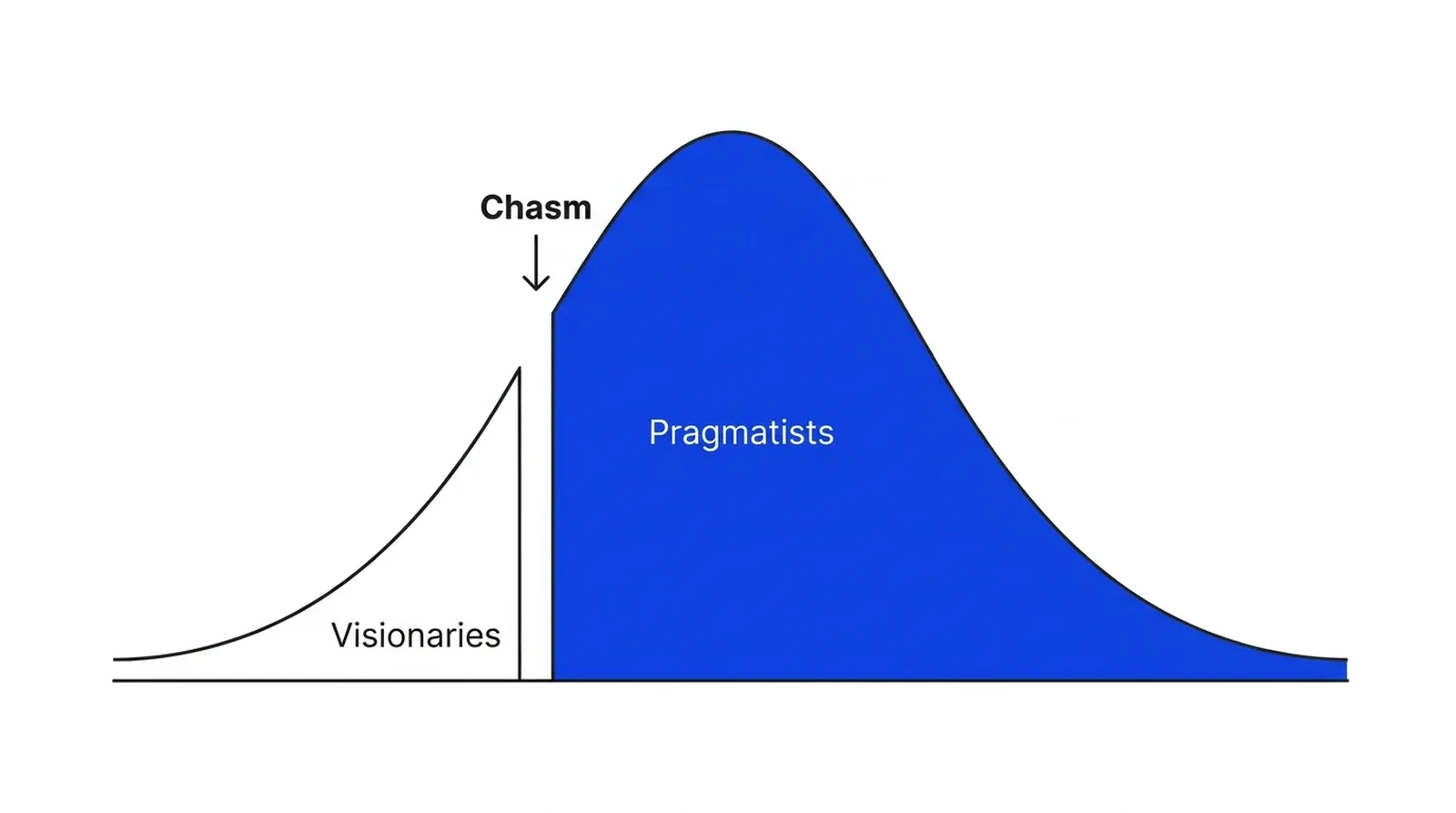
Moore calls early adopters visionaries. In his 2009 conference slides they want a dramatic advantage, accept high risk and will fill the gaps in an unfinished product themselves. The early majority are pragmatists. They want steady productivity gains, prefer the market leader and insist on references from trusted colleagues. On the same slides Moore puts it plainly: “Pragmatists don’t trust visionaries as references.”
That creates a trap. A 2008 Naval Postgraduate School report on defence technology calls it a Catch-22: pragmatists will not buy until their peers recommend the product, and no peer can recommend it until someone buys. The report notes that the military calls the same gap the valley of death. A product stuck there can cross, stall with partial adoption, or lose the customers it had.
Is the chasm real?
Market data shows a dip in many product launches, and the most common explanation is two groups of buyers. The evidence does not say every product has one.
| Study | Data | Finding |
|---|---|---|
| Goldenberg, Libai and Muller, 2002 | Consumer electronics | A “saddle” of peak, trough and recovery in one-third to one-half of cases |
| Van den Bulte and Joshi, 2007 | 33 data series | A two-segment model fits better and can produce a dip or chasm |
| Chandrasekaran and Tellis, 2011 | 10 products, 19 countries | Saddle in 148 product-country pairs, on average 9 years after takeoff, with a 29% sales drop |
The details matter for planning. Goldenberg and colleagues found that when the two buyer groups talk to each other a lot, the share of simulated cases with a saddle fell below 5%. Chandrasekaran and Tellis found chasms explained the dip for information and entertainment products, while business cycles explained it for kitchen and laundry appliances. In their data the dip came at about 30% market penetration, well past the 16% that Rogers’ first two adopter groups add up to.
The D-Day strategy: one beachhead
Moore’s answer is to stop selling to everyone and invade one segment. The 1999 edition’s table of contents follows a military analogy: the D-Day analogy, target the point of attack, assemble the invasion force, define the battle, launch the invasion. MIT’s Bill Aulet, who teaches the same idea, notes that the term beachhead is named after the battle of Normandy.
A good beachhead has pragmatists in pain. Moore’s slides describe the target as a pragmatist executive who can redirect existing budget to fix an urgent, mission-critical problem. The segment should be small enough to lead, because a leader’s customers become the references the next buyers ask for. Aulet adds a test that fits this logic: customers in the segment should talk to each other, so word of mouth carries.
Narrow can mean very narrow. Documentum, a document software company, picked one process in one industry, preparing new drug applications for the US regulator, according to the International Directory of Company Histories. Documentum estimated that each week of delay cost a drug company about $5 million in revenue, and drug makers became most of its sales: 70% of 1994 revenue. Revenue went from $2 million (1993) to over $45 million (1996), the year of its stock market listing.
The whole product
The whole product is everything the target customer needs to get the result they bought for, beyond the core product. Moore’s slides define it as the “minimum set of products and services” that fulfils the customer’s compelling reason to buy. That can mean integrations with legacy systems, installation, consulting, support and products from partners.
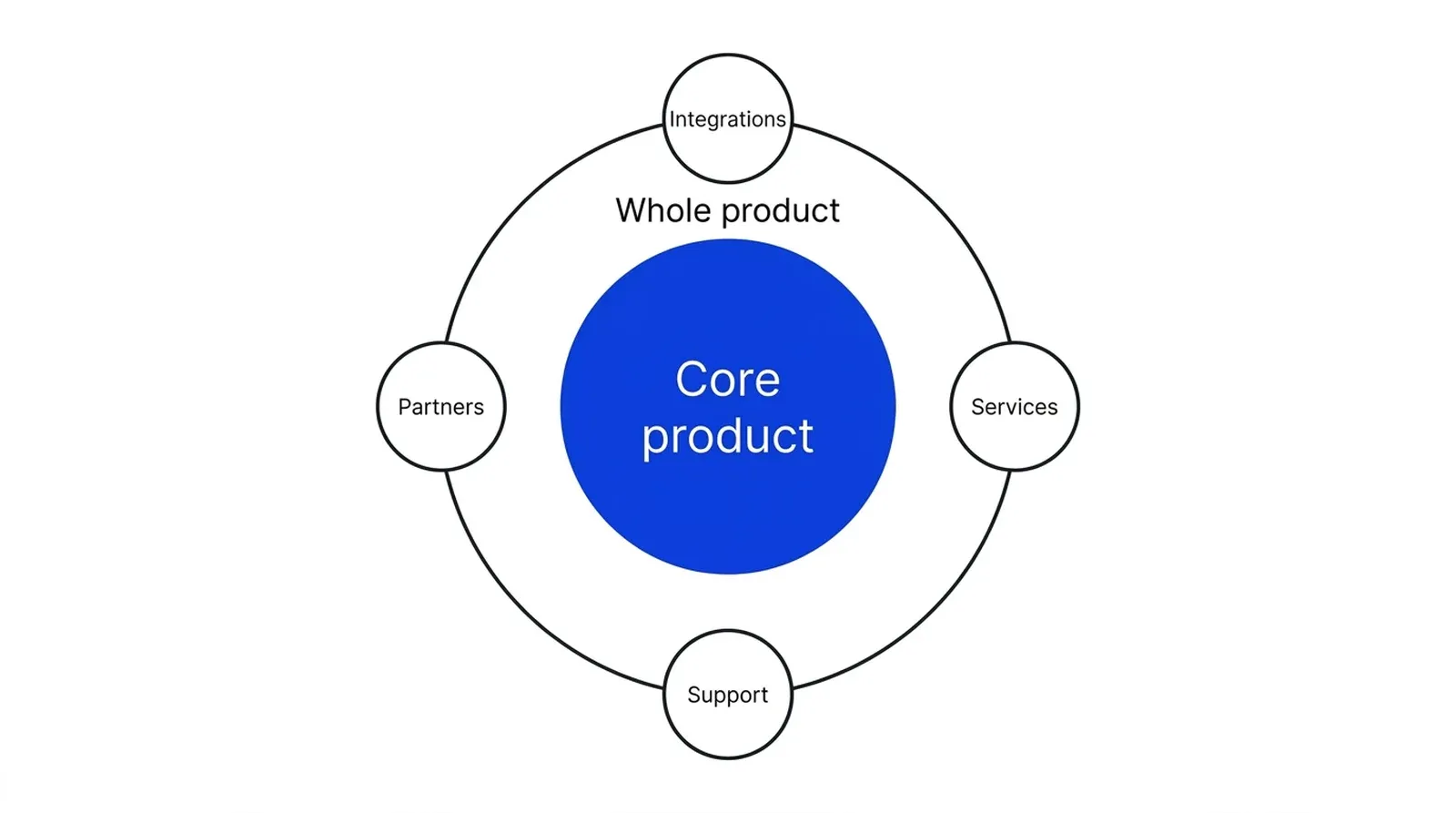
Visionaries assemble the missing pieces themselves. Pragmatists will not. In a podcast interview, Moore says that with pragmatists “you have to bring what we call the whole product.” He adds that they rely heavily on peer referencing. His slides name the common mistake: committing to the top ten feature requests from many customers and finishing none. That leaves the vendor, in the words of the slides, with 80% of many solutions and 100% of none.
The idea that customers buy more than the core is older than Moore. Theodore Levitt opened a 1980 Harvard Business Review article with the line “There is no such thing as a commodity.” Moore’s contribution was to tie the whole product to one segment at a time.
Once the segment and the whole product are set, the claim you make to that buyer is a positioning statement. The best-known template for it is credited to this book.
After the crossing: bowling alley and tornado
Moore’s later market development model, shown on the same slides, runs from the early market through the chasm, the bowling alley, the tornado and main street to total assimilation. The bowling alley sits right after the chasm: the company moves from its first niche to neighbouring ones. In the tornado, mainstream demand grows fast and, in Moore’s words on the slides, vendors must compete fiercely to be number one. Each stage changes who buys and why.
| Stage | Target customer | Reason to buy | Whole product |
|---|---|---|---|
| Early market | Visionary executive who can create new budget | A dramatic break from the status quo | A custom project |
| Crossing the chasm | Pragmatist executive who can redirect existing budget | An urgent, mission-critical problem | An end-to-end solution to that problem |
| Tornado | Pragmatist manager spending current budget | Make the existing organization more productive | Standards-based systems that just work |
The table comes from Moore’s 2009 slides. It shows why one sales playbook rarely works across stages.
Where it fits and where it does not
Moore wrote for B2B technology, where buyers check references with peers. The Kellogg case on OnePlus shows teams applying it to consumer products, but the research above suggests the dip is smaller when early and mainstream buyers mix freely, as they often do in consumer markets. Treat the chasm as a risk to test in your own sales data rather than a law. In our Growth Lab work, the beachhead choice comes before the channel plan, because the segment decides which channels and references matter.
How to apply Crossing the chasm, step by step
- Check whether you are at the chasm. Look at the last 12 months of sales. Signs of the chasm: early deals were custom projects for one enthusiastic executive each, every customer is in a different industry, and new prospects ask for references you cannot give. Result: a yes or no on whether the stall comes from the chasm or from a weak product.
- List and score candidate segments. Write down every segment where a specific buyer has a specific, urgent problem your product addresses. Score each on four questions: does the buyer have budget and real pain, can you deliver everything they need within a year, do buyers in it talk to each other, and is it small enough for you to become the leader. Result: a ranked list with the top three marked.
- Choose one beachhead. Pick the single segment where you can win fastest and whose references will carry weight in the next segment. Write down the target customer, their compelling reason to buy and the cost of doing nothing. Result: one segment, in one sentence, approved by the founder.
- Map and complete the whole product. List everything the target customer needs to get the result: integrations, data migration, training, compliance documents, support hours, partners. Mark each item as build, partner or service, and give it an owner and a date. Result: a whole product map with no item left without an owner.
- Define the battle and the claim. Name the alternative the pragmatist uses today, often a competitor or a manual process, and write the claim that beats it for this segment. Result: a positioning statement and one page of proof points aimed at the beachhead buyer.
- Launch in the segment and collect references. Sell only through the channels this segment trusts, at a price it can approve, and turn every live customer into a reference within the segment. Track your share of the segment, not total revenue. Result: a monthly count of referenceable customers and share of the target segment.
- Move to the next segment. Once you lead the beachhead, pick an adjacent segment where either the same buyers or the same use case carry over, so most of the whole product and references transfer. Result: the next segment named, with a list of what must be added to the whole product.
Examples
Documentum and new drug applications
According to the International Directory of Company Histories, Documentum CEO Jeff Miller brought in Geoffrey Moore for a month in late 1993. Staff sessions identified 75 business processes the document software could serve, then narrowed them to one: assembling new drug applications for the US Food and Drug Administration, which could run to hundreds of thousands of pages. Documentum estimated a drug company lost about five million dollars in revenue for every week of delay. Merck and Glaxo were early customers, and within three years of the choice Documentum had listed its shares on the stock market.
OnePlus and the move beyond fans
A 2016 Kellogg School of Management case by Mohanbir Sawhney and Pete Goodman describes the smartphone maker OnePlus in early 2016. Technology enthusiasts had bought its first two phones, and the founders had to decide which segments to target next, how to position the brand and which channels to use, without losing the core fans. The case shows the chasm decision in a consumer market: the same three questions of segment, claim and channel.
A payments start-up choosing a beachhead
Illustrative, no real company implied. A B2B payments start-up has 14 customers in 11 industries, each signed by an enthusiastic executive. It scores segments and picks freight brokers in one country: about 600 firms, a painful 30-day wait to pay carriers, and owners who talk at the same trade events. To lead the segment, it sets a goal of 25% share, or 150 brokers. At 6 new brokers a month, that takes 25 months, so it adds an integration with the two most used freight management systems, which every pragmatist broker asked for, to speed up sales.
When to use it
Use it when a technology product has early customers but sales have stalled, when every customer looks different from the last, or when you are planning the launch of a new category and need to decide whom to sell to after the first enthusiasts. It fits B2B products best, where buyers check references with peers.
When not to use it
Skip it for products that extend an existing category, which mainstream buyers already understand and buy without a leap of faith. It also helps little before anyone has bought, because the beachhead choice depends on what early deals taught you, and for cheap consumer goods where word of mouth crosses segments quickly.
Common mistakes
- Picking a beachhead that is too big, such as all mid-sized companies, where you cannot become the leader or produce references that other buyers recognize as peers.
- Shipping most of what several segments need instead of everything one segment needs. Moore warns that pragmatists will not buy partial solutions.
- Using visionary customers as references for pragmatists, who do not trust them.
- Treating the whole product as a product team task when much of it is partners, services and documentation.
- Leaving the beachhead before you lead it, because a bigger segment looks more attractive.
FAQ
Who wrote Crossing the Chasm and when?
Geoffrey A. Moore, a technology marketing consultant and author, wrote Crossing the Chasm. The first edition (HarperBusiness, 1991) carried a foreword by Regis McKenna. A revised edition followed (1999), and the 2014 edition changed the subtitle to Marketing and Selling Disruptive Products to Mainstream Customers. Moore's sequel is Inside the Tornado (1995).
What is the chasm in Crossing the Chasm?
The chasm is the gap between early adopters and the early majority in the adoption of a new technology. Early adopters are visionaries who buy into a big idea and accept gaps. The early majority are pragmatists who want a proven, complete solution and references from peers, so sales can stall between the two groups.
What is the whole product in Crossing the Chasm?
The whole product is the minimum set of products and services a target customer needs to get the result that made them buy. Besides the core product, it can include integrations, installation, training, support and partner products. Moore argues that pragmatists will not buy until the whole product exists for their use case.
What is the D-Day strategy in Crossing the Chasm?
It is Moore's analogy for entering the mainstream. Like the Allied landing in Normandy, a company concentrates all its force on one narrow beachhead segment, wins it, and uses it as a base to move into neighbouring segments. The book's chapters follow the analogy: target the point of attack, assemble the invasion force, define the battle and launch.
Is Crossing the Chasm still relevant?
Research supports the core idea for some products. Studies of consumer electronics and other products found a sales dip after early growth in many cases, and linked it to two groups of buyers adopting at different speeds. The same research shows the dip is not universal, and business cycles explain some of it.
Sources
- Geoffrey A. Moore, Crossing the Chasm, author's book page
- Open Library, Geoffrey A. Moore, Crossing the Chasm, HarperBusiness, 1991, foreword by Regis McKenna
- Open Library, Geoffrey A. Moore, Crossing the Chasm, revised edition, HarperBusiness, 1999, table of contents
- Internet Archive, Geoffrey A. Moore, Crossing the Chasm, HarperBusiness, 1991
- Internet Archive, Geoffrey A. Moore, Crossing the Chasm: Marketing and Selling Disruptive Products to Mainstream Customers, HarperBusiness, 2014
- Internet Archive, Geoffrey A. Moore, Inside the Tornado, HarperBusiness, 1995
- Open Library, Paul Wiefels, The Chasm Companion: A Fieldbook to Crossing the Chasm and Inside the Tornado, 2002
- Geoffrey A. Moore, Crossing the Chasm Part 1: Describing the Chasm, slides, NDIA Robotics Conference, 2009
- thoughtbot, Giant Robots Smashing Other Giant Robots, episode 248, Geoffrey A. Moore, Crossing the Chasm, transcript
- Lenny's Podcast, Geoffrey Moore on finding your beachhead, crossing the chasm, and dominating a market, January 2024
- Everett M. Rogers, Diffusion of Innovations, Free Press of Glencoe, 1962, UW-Madison Libraries record
- Theodore Levitt, Marketing Success Through Differentiation of Anything, Harvard Business Review, January 1980
- MIT Sloan Executive Education, Bill Aulet, Launching a successful start-up 3: the beachhead market
- Peter Coughlan, Nicholas Dew, William Gates, Crossing the Technology Adoption Chasm: Implications for DoD, Naval Postgraduate School, 2008
- Jacob Goldenberg, Barak Libai, Eitan Muller, Riding the Saddle: How Cross-Market Communications Can Create a Major Slump in Sales, Journal of Marketing 66(2), 2002
- Christophe Van den Bulte, Yogesh V. Joshi, New Product Diffusion with Influentials and Imitators, Marketing Science 26(3), 2007
- Deepa Chandrasekaran, Gerard J. Tellis, Getting a Grip on the Saddle: Chasms or Cycles?, Journal of Marketing 75(4), 2011
- Barak Libai, Vijay Mahajan, Eitan Muller, Can You See the Chasm? Innovation Diffusion According to Rogers, Bass, and Moore, Review of Marketing Research 5, 2009
- Suzan Kardong-Edgren, You may have heard of diffusion of innovation, but did you know about Moore's Chasm?, Clinical Simulation in Nursing, 2009
- Ed Dinger, Documentum, Inc., International Directory of Company Histories, via Encyclopedia.com
- Mohanbir Sawhney, Pete Goodman, OnePlus: Crossing the Chasm in the Smartphone Market, Kellogg School of Management Cases, 2016
Last updated Oct 9, 2026


Marketing agency or growth system: when a company outgrows its agency
An agency is the right call while the founder still runs most of the company. Once the business starts copying itself into new locations or markets, it needs a system that sets goals, tests hypotheses and owns the result.

Why healthcare marketing agencies stall: the short, mid and long wins model we use with clinics
Most agencies own the click and nobody owns the front desk. How we structure clinic work in three horizons, the research behind each one, and one year of results.

Why channel tests stall after month three
Most paid channel tests do not end with a decision. They end when the budget runs out, the attribution model changes, or everyone quietly stops looking at the dashboard.