Issue tree
An issue tree is a diagram that splits one key question into smaller questions, level by level, until each branch is small enough to answer with data.
An issue tree is a diagram that breaks one key question into smaller sub-questions, level by level, so each branch can be checked separately. A diagnostic tree asks why something happened, a solution tree asks how to reach a goal, and a hypothesis tree starts from a proposed answer. Consultants at McKinsey use it to structure problems.
- Origin
- McKinsey consulting practice; set out in print by Charles Conn and Robert McLean, 2019 (Wiley book)
- Level
- 201 · Tool
- Fits
- Small and mid-size, Scale-up, Enterprise
- Time to apply
- 60 to 90 minutes for a first tree
- What you need
- one question written as a sentence, with a number, a period and a scope · a whiteboard or a sheet of paper · the metrics that belong to the question, pulled for two periods · one person who knows the process and one who will challenge the branches
An issue tree is a diagram that splits one key question into smaller questions, level by level, until each branch is small enough to check with data. Charles Conn and Robert McLean, who learned the method at McKinsey, use such trees to show the parts of a problem so a team can divide the work. The idea is simple. The skill is in choosing the first split.
Where does the issue tree come from?
It comes from management consulting, and we found no primary source that dates the first issue tree. What is documented is how it is taught. In Conn and McLean’s book, the tree is step two of a seven-step cycle: define the problem, disaggregate it, prioritise, plan the work, analyse, synthesise and tell the story. Conn calls it his favourite step, in a McKinsey podcast with Hugo Sarrazin.
The same shape appears in other fields. Engineers use fault trees, which NASA’s handbook describes as a deductive method that starts from an undesired top event. In science, John Platt’s 1964 paper on strong inference describes a branching sequence of rival hypotheses, each experiment excluding some of them.
Diagnostic tree or solution tree?
A diagnostic tree asks why something happened, and its branches are causes. A solution tree asks how to reach a goal, and its branches are ways to get there. Conn and McLean name logic trees, hypothesis trees and decision trees as types, and sources use different names for the why and how versions, so these two labels are ours.
| Diagnostic tree | Solution tree | Hypothesis tree | |
|---|---|---|---|
| Root | Why did X happen? | How do we reach Y? | We should do Z |
| Branches | Possible causes | Ways to get there | Conditions that must hold |
| Ends with | A cause you can verify | An action you can test | A fact that supports or refutes |
| Use when | A number moved | You have a goal | You already hold an answer |
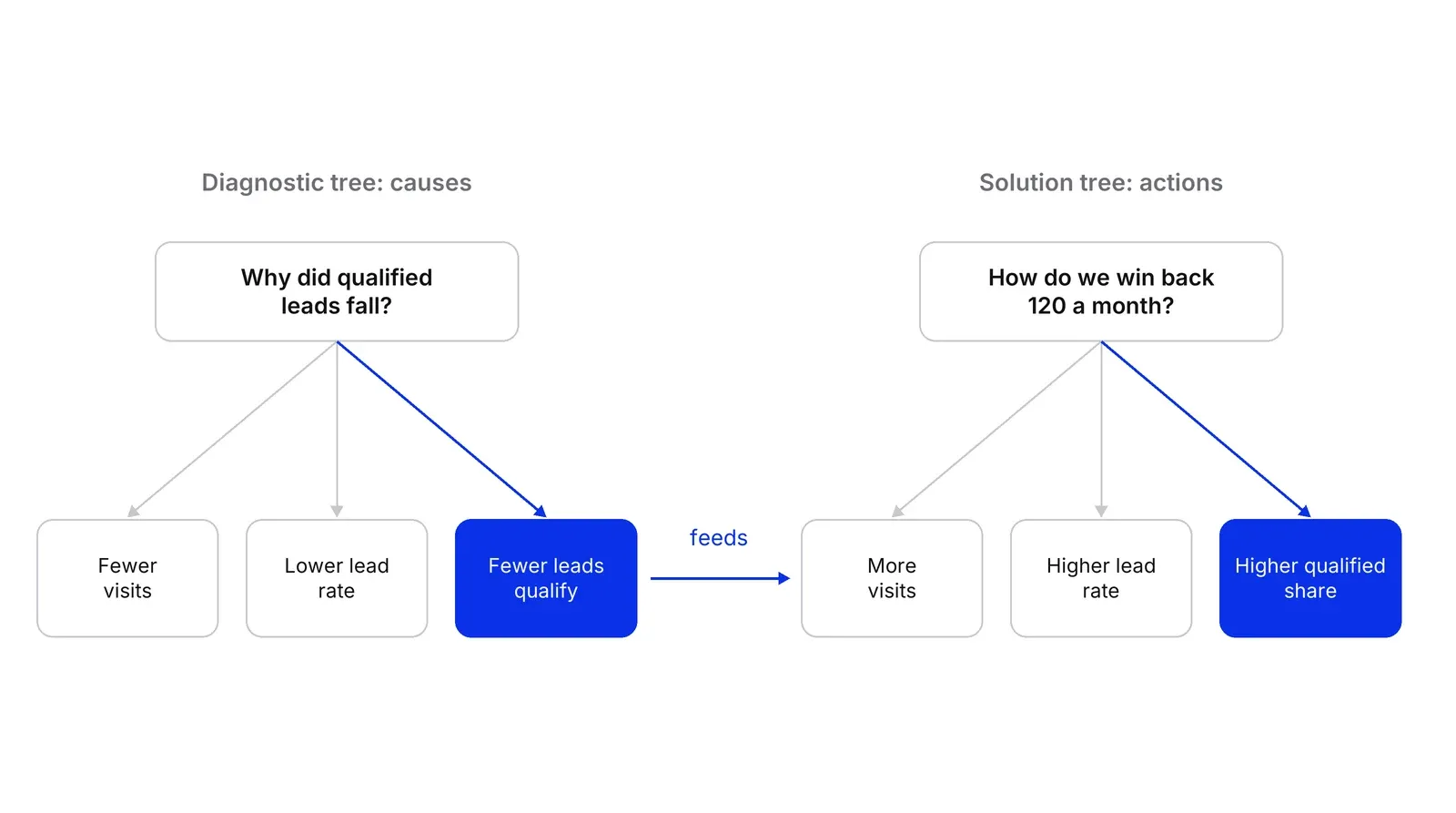
The most reliable first split is arithmetic. Conn describes starting almost every business problem with a profit tree: revenue is price times quantity, cost splits into variable and fixed. Branches that multiply or add are collectively complete by construction, and you can compute which one moved.
What is a hypothesis tree?
A hypothesis tree starts from a proposed answer and lists the conditions that must all be true for it to hold. In Conn and McLean’s solar-panel case, Rob McLean began with “we should install solar now” and listed what had to be true: an acceptable payback, for example. He used the hypothesis to bring out arguments for and against it, not to defend it.
The same logic sits behind Platt’s strong inference: write rival hypotheses, then run the test that rules some out. Conn and McLean add a working habit, asking the team for the “one-day answer” at any point, a best current view that later work revises. A hypothesis tree is the faster option when time is short and someone already has a view.
How does the issue tree relate to MECE?
MECE means the branches are mutually exclusive and collectively exhaustive: nothing sits in two branches and nothing is missing. It is the test for each split. Conn and McLean say a well-built tree captures everything relevant, and Barbara Minto’s course includes checking that a stated grouping is accurate and complete.
Treat it as a check, not a law. NASA’s handbook says a fault tree is tailored to one top event and does not cover every possible failure. In marketing, channel splits are the usual trap: “paid”, “organic” and “email” feel complete until a share of traffic arrives as “direct” or “other”. Add that branch.
Worked example: why did qualified leads fall?
Take a B2B company, illustrative numbers only. Qualified leads fell from 400 to about 280 a month. Before drawing anything, check that the drop is real. Google lists reporting glitches and data anomalies among the causes of a traffic drop, and says recent ad conversions are often incomplete because some people have not converted yet. Consent settings matter too: consent mode models conversions Google cannot observe.
If the drop holds, split by formula: qualified leads equal visits times the visitor-to-lead rate times the qualified share. September against August gives 36,000 visits against 40,000, a rate of 2.5% in both months, and a qualified share of 31% against 40%. Two branches barely moved. The third explains most of the fall, since 0.9 times 1.0 times 0.775 is about 0.70.
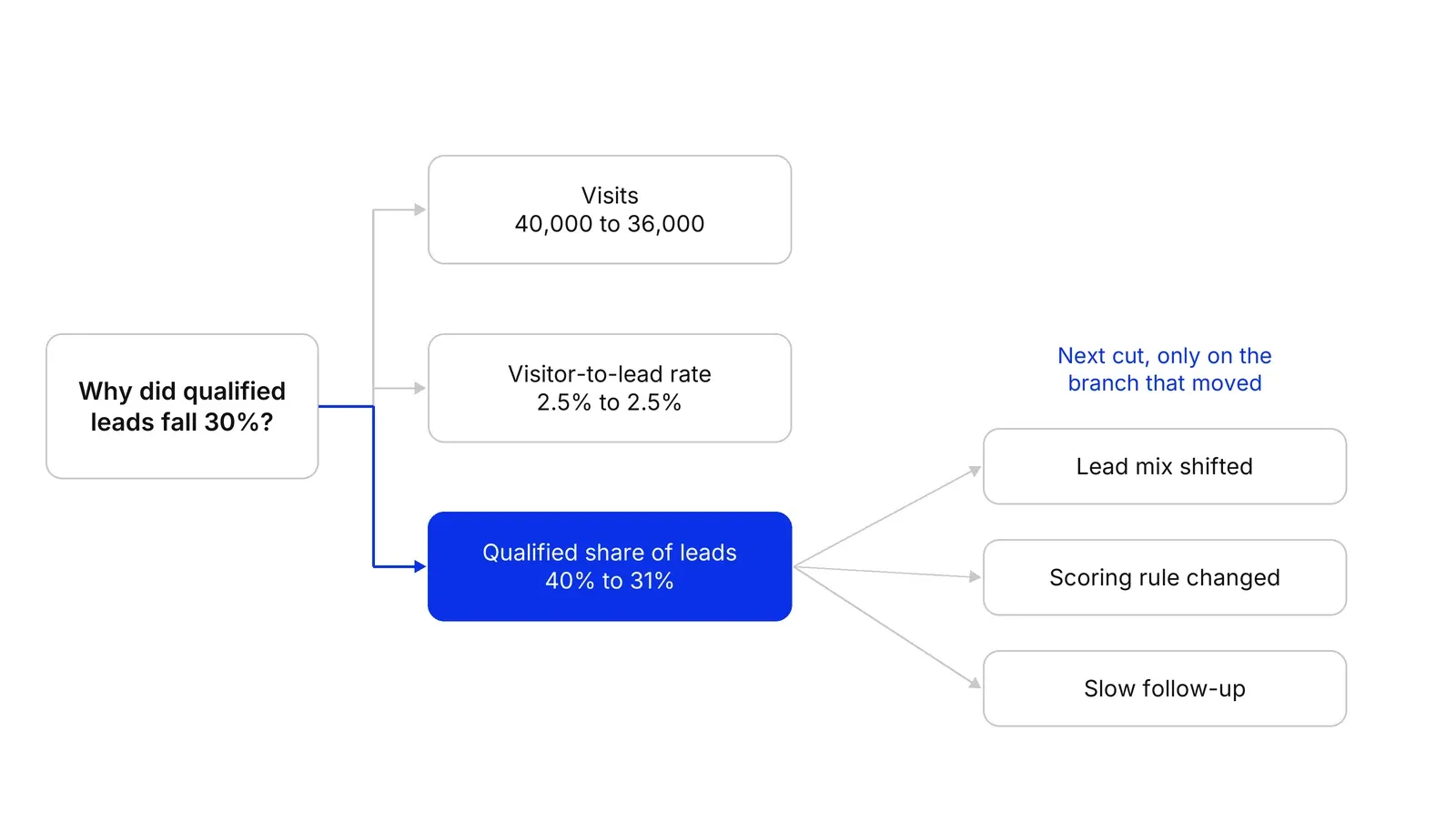
Now cut the blue branch again. A qualified lead is one that has passed a vetting step (HubSpot defines a marketing qualified lead as one marketing has judged ready for sales), three questions follow. Did the mix of sources shift towards weaker leads? Did someone change the scoring rule? Did sales follow up more slowly? Each can be answered from a report in an afternoon. The solution tree then mirrors the finding: the cause that moved becomes the goal, and the actions become branches.
What does research say about splitting problems?
Decomposition helps, with limits. In a 1975 experiment with 151 subjects, Armstrong, Denniston and Gordon found that people judged better when they split a problem into parts, most of all when they knew little about it. MacGregor and Armstrong found in 1994 that it improved accuracy for extreme and uncertain values, while for other problems it often gave less accurate predictions.
Recent machine-learning work points the same way. Zhou and colleagues report that least-to-most prompting, which solves a problem as a sequence of simpler subproblems, reached at least 99% on a compositional benchmark where chain-of-thought prompting reached 16%. Yao and colleagues report 74% for a tree-based search on a puzzle task where chain-of-thought solved about 4%. Wei and colleagues and Khot and colleagues report related gains from intermediate steps and modular sub-tasks.
Where do issue trees go wrong?
They go wrong at the root and at the weighting. Wedell-Wedellsborg’s survey of 106 executives found 85% saying their organisations were bad at diagnosing problems. A tree makes an agreed question easier to answer, but cannot fix a disputed one; the literature on problem structuring methods reviews tools for that harder case.
Neighbouring tools cover what a tree does not. A 5 whys chain follows one path through the causes, and an Ishikawa diagram lists causes by category without arithmetic. A KPI tree is the standing version of a diagnostic tree, kept as a company’s metrics. For solutions, working backwards starts from the desired outcome, and a pre-mortem tests a plan by listing how it could fail.
A Growth Lab plan starts from the one question that matters most this quarter, and a tree like this is a natural way to cut it into work: see Growth Lab.
How to apply Issue tree, step by step
- Write the key question. State what you need to decide or explain, with a number, a time period and a scope. 'Why did qualified leads fall from 400 to about 280 between August and September?' works. 'Why is marketing underperforming?' does not. Result: one question the whole group accepts.
- Choose the type of tree. Use a diagnostic tree when something changed and you need the cause, a solution tree when you have a goal and need options, and a hypothesis tree when you already hold a likely answer and want to test it. Result: a root that matches the job.
- Make the first split and check it. Cut the question into two to five branches, using a formula if one exists (revenue is price times quantity) or a clean category scheme (paid, organic, direct, other). Check that no item sits in two branches and that nothing is missing. Result: a first level that adds up.
- Test the data before you branch further. Compare two periods on every first-level branch. Check first that the change is real and not a tracking or reporting artifact. Result: a short list of branches that actually moved.
- Prioritise the branches. Conn and McLean rank branches by two questions: how much does this branch matter to the outcome, and how far can we move it? Drop the rest for now. Result: one or two branches to cut again.
- Cut again until a branch is testable. Split the chosen branch the same way and stop when a leaf can be confirmed or rejected with one query, one call or one small test. Result: leaves that can each be checked.
- Give each leaf an owner and a date. Write who checks it, with what data, by when. Result: a work plan, not a picture.
Examples
Sydney Airport: is capacity enough?
A documented case in Conn and McLean's book. They split capacity into supply of landing slots minus demand, then supply into runways, runway capacity and utilisation. Utilisation breaks into operating hours, planes per hour and people per plane. Hours were fixed by curfew, so the useful branches were planes per hour and plane size.
Truckgear: should the start-up raise its price?
A documented case in the same book, built with a profit-lever tree. A 7% price rise would add $385,000 in cash profit if unit sales held, and a drop of 650 units would cancel it. The tree turned a debate into two numbers to research: customer price sensitivity and dealer margins.
A payments company: why did card approvals fall?
Illustrative. Approval rate splits into attempts declined by the issuer, attempts blocked by the company's own risk rules, and technical failures. Say the total fell from 91% to 87%. If the risk-rule branch accounts for three of the four points, the next cut is by rule, and the 'fix' branch becomes a review of one threshold, not a campaign to win customers back.
When to use it
Use it when a question is too big to answer in one go and several people need to work on parts of it: a metric fell, a plan needs options, a decision rests on several conditions. It suits the first hour of any analysis, before anyone pulls a report.
When not to use it
Skip it when the answer is one known step away, or when people disagree about what the question is. Problem structuring methods are aimed at that second case. Decomposition can also hurt: for quantities you already know well, splitting them into parts has produced less accurate estimates.
Common mistakes
- Solving the wrong question. In an HBR survey of 106 executives, 85% said their organisations were bad at problem diagnosis. A tidy tree under a vague root is still a tidy answer to the wrong question.
- Branches that overlap or leave gaps. If 'paid traffic' and 'campaign changes' sit side by side, the same drop gets counted twice. Add an 'other' branch and check it.
- Treating every branch as equal. McKinsey's Hugo Sarrazin says branches do not carry equal weight because they take equal space on the page.
- Drawing one tree and stopping. Conn says he likes two or three different cuts of the same problem, because each can show something different.
- Ending with a diagram. A tree with no owners, data pulls and dates changes nothing.
FAQ
What is an issue tree?
An issue tree is a diagram that splits one key question into sub-questions, each into smaller ones, until a branch can be answered with data. Conn and McLean, who learned it at McKinsey, use it to disaggregate problems in step two of a seven-step method.
What is the difference between a diagnostic and a solution tree?
A diagnostic tree asks why something happened and its branches are possible causes. A solution tree asks how to reach a goal and its branches are ways to get there. The labels are ours. Sources call these why trees and how trees, or use other names for them.
What is the difference between an issue tree and a hypothesis tree?
An issue tree breaks a question into parts without presuming an answer. A hypothesis tree starts from a proposed answer and lists the conditions that must all hold. Conn and McLean's solar-panel case begins with 'we should install now' and tests the criteria that would support or disprove it.
Is an issue tree the same as a decision tree?
No. Conn and McLean list decision trees as one type of logic tree, used to walk through complex choices with branching outcomes. An issue tree usually splits a question into components. Both are drawn as branches, which is why the names get mixed up.
Do the branches have to be MECE?
Ideally, yes: the branches should not overlap and should cover the whole. Formula trees get this from arithmetic. Category trees need a check and an 'other' branch. NASA's fault tree handbook notes that fault trees are tailored to one top event and are not exhaustive, so treat MECE as a goal you check.
Sources
- McKinsey, How to master the seven-step problem-solving process (podcast transcript, Conn and Sarrazin), September 2019
- Wiley, Charles Conn and Robert McLean, Bulletproof Problem Solving: The One Skill That Changes Everything, 2019
- Wiley, Bulletproof Problem Solving, chapter 1 excerpt: Learn the Bulletproof Problem Solving Approach
- Barbara Minto, The Minto Pyramid Principle course
- Barbara Minto, About the Minto Pyramid Principle
- Thomas Wedell-Wedellsborg, Are You Solving the Right Problems?, Harvard Business Review, January-February 2017
- NASA, Fault Tree Handbook with Aerospace Applications, Version 1.1, 2002
- John R. Platt, Strong Inference, Science 146(3642), 1964
- J. Scott Armstrong, William B. Denniston, Matt M. Gordon, The Use of the Decomposition Principle in Making Judgments, Organizational Behavior and Human Performance 14(2), 1975
- Donald G. MacGregor, J. Scott Armstrong, Judgmental Decomposition: When Does It Work?, International Journal of Forecasting 10, 1994
- John Mingers, Jonathan Rosenhead, Problem structuring methods in action, European Journal of Operational Research 152(3), 2004
- Denny Zhou et al., Least-to-Most Prompting Enables Complex Reasoning in Large Language Models, arXiv, 2022
- Shunyu Yao et al., Tree of Thoughts: Deliberate Problem Solving with Large Language Models, arXiv, 2023
- Tushar Khot et al., Decomposed Prompting: A Modular Approach for Solving Complex Tasks, arXiv, 2022
- Jason Wei et al., Chain-of-Thought Prompting Elicits Reasoning in Large Language Models, arXiv, 2022
- Google Search Central, Debugging drops in Google Search traffic
- Google Ads Help, Find out how long it takes for your customers to convert
- Google Ads Help, conversion modeling through consent mode
- HubSpot Knowledge Base, Use lifecycle stages
- Gary Klein, Performing a Project Premortem, Harvard Business Review, September 2007
Last updated Oct 9, 2026


The compliance layer under fintech marketing operations
A fintech marketing agency can build campaigns. It cannot own the compliance review, the KYC drop-off or the multi-market licensing rules that decide whether a lead ever becomes a customer.

Fractional CMO: what you get, and what has to exist underneath
A fractional CMO brings strategy and judgment. Without reporting, CRM hygiene and a named owner per number, the engagement produces a slide deck instead of a system.

The operations layer behind healthcare patient acquisition
Ads and search bring the request in. What happens between the click and the booked, attended visit decides whether the spend paid off.