Scaling Up (Rockefeller Habits)
Scaling Up is Verne Harnish's management system for growing companies: four decisions on people, strategy, execution and cash, a one-page plan and a fixed meeting rhythm.
Scaling Up is a management system for growing companies created by Verne Harnish. It organizes the work of a leadership team around four decisions, People, Strategy, Execution and Cash, supported by short tools such as the One-Page Strategic Plan and the Rockefeller Habits checklist. It grew out of his book Mastering the Rockefeller Habits, first published 2002, and became Scaling Up with the 2014 edition.
- Origin
- Verne Harnish, 2002; relaunched 2014
- Level
- 301 · Advanced
- Fits
- Small and mid-size, Scale-up
- Time to apply
- two days for a first plan, then one quarter to test the meeting rhythm
- What you need
- the executive team in one room for a first working session · last year's revenue, profit and cash balance · a list of the company's recurring meetings
Scaling Up is a management system for companies that have outgrown founder-led management. Verne Harnish, who founded the Entrepreneurs’ Organization and the firm now called Scaling Up, built it around four decisions: People, Strategy, Execution and Cash. It began as the 2002 book Mastering the Rockefeller Habits, listed by one retailer as published by Gazelles Inc in March 2002, and was relaunched in 2014 as Scaling Up, subtitled Rockefeller Habits 2.0. Nearly everything we can cite about it comes from Harnish’s company or from coaches who teach it, and we flag that wherever it matters.
What are the four decisions?
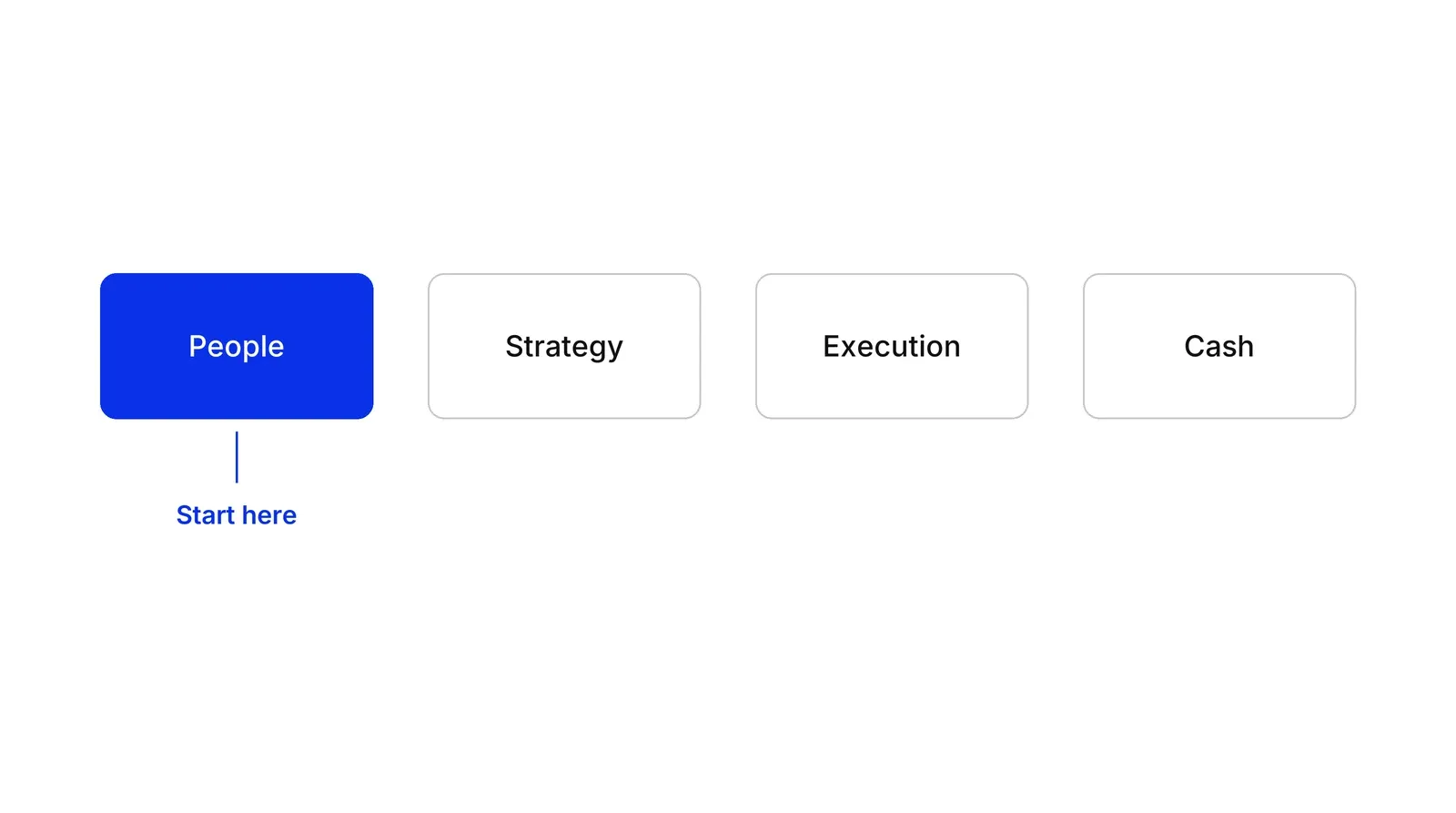
The four decisions are the questions the system says a leadership team has to answer as the company grows: who is accountable, where the company is headed, how work gets done each quarter, and where the cash comes from. Scaling Up’s own tool list sorts its worksheets under those four headings.
| Decision | Question | Main tools |
|---|---|---|
| People | Who owns what? | Function Accountability Chart, One-Page Personal Plan |
| Strategy | Where are we going and why? | One-Page Strategic Plan, 7 Strata, SWT |
| Execution | How do we get it done each quarter? | Rockefeller Habits Checklist, Who What When |
| Cash | How do we fund growth? | Cash Acceleration Strategies, Power of One |
The function accountability chart is the People tool. It asks who is accountable for each essential process and how that person is held to account, starting with the executive team.
What are the Rockefeller Habits?
The Rockefeller Habits are ten practices, written as a checklist a company scores itself against. Coaches who teach them, such as Monkhouse and Company, word them as follows in paraphrase. The executive team is healthy and aligned. Everyone is aligned with the one thing to accomplish this quarter. Information moves through a regular communication rhythm. Every facet of the company has someone accountable. Employee input is collected on a regular basis. Customer feedback is reported as often as financial data. Core values and purpose are alive. Employees can describe the strategy. Everyone can say whether they had a good day or week. Plans and performance are visible to all.
The name comes from Harnish’s reading of John D. Rockefeller as a disciplined operator, which is his interpretation and not a documented study of Rockefeller’s methods. The Scaling Up coaching blog says that the habits are numbered but need not be adopted in order, and that Habit 1 is the one to settle first. The same page says clients improved markedly, with no data attached.
What is on the One-Page Strategic Plan?
The One-Page Strategic Plan, or OPSP, is a single template that runs from purpose down to one quarter’s work. The left side holds core values and purpose, the middle holds 3 to 5 year targets and one-year goals, and the right side holds quarterly actions, priorities and who is accountable. The top lists KPIs under six headings: employees, customers, shareholders, make or buy, sell and record keeping, per a Scaling Up-style consultancy.
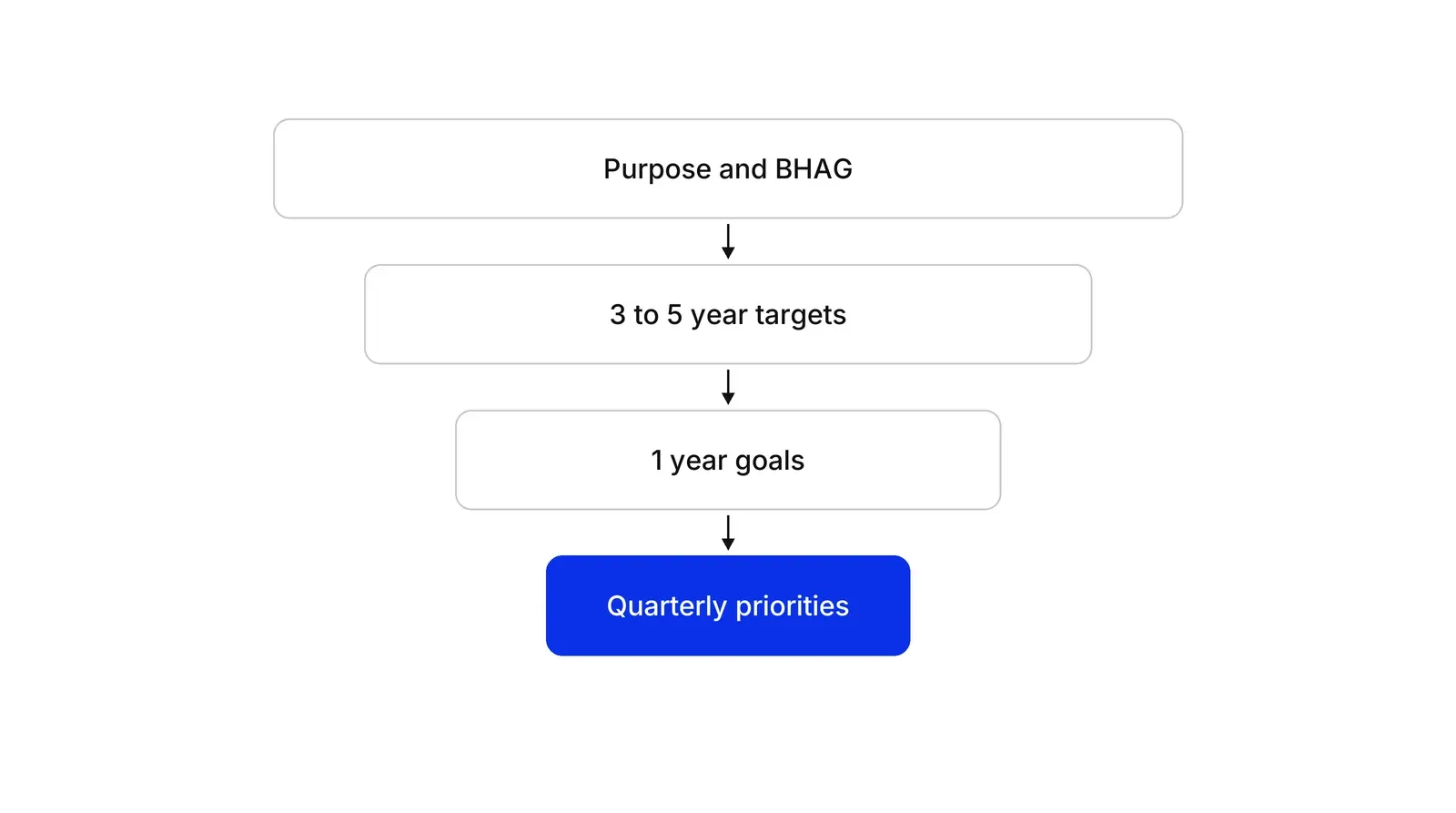
The plan borrows from earlier work. BHAG, a big hairy audacious goal, is a term from Collins and Porras’s 1996 Harvard Business Review article, whose central idea is that core purpose and values stay fixed while strategy adapts. The Scaling Up form carries a trademark note crediting them. The sandbox, a narrow market the company can own, echoes the hedgehog concept: the overlap of what you are passionate about, what you can be best at, and what drives your economic engine. For turning a plan into a hierarchy of goals, see OGSM.
How does Scaling Up handle cash?
Scaling Up treats cash as a decision of its own, and its tool is built on the cash conversion cycle, the days between paying for inputs and collecting from customers. The Cash Acceleration Strategies tool breaks that cycle into four stages and asks the team for improvement ideas at each. The goal is to fund growth from the company’s own cash instead of outside money. Our cash flow page covers the mechanics.
The concern behind it is backed by outside data. The JPMorgan Chase Institute found that the median small business held 27 cash buffer days, in a sample of 597,000 Chase accounts from 2015. CB Insights found that 70% of 431 venture-backed shutdowns ran out of capital, although it calls that the final cause, not the root problem.
What does the evidence say?
Little independent evidence exists for Scaling Up as a package. The company’s site says more than 102,000 organizations have used it, which counts users, not results, and has no comparison group. We searched for outside studies and found none.
Several ideas inside it do have support. Sull, Homkes and Sull report that two-thirds to three-quarters of large organizations struggle with execution, the gap the habits target. A randomized field experiment in India, Does Management Matter, found that free consulting on modern management practices raised productivity at large textile plants by 11%. That tests consulting, not this system. Greiner and Churchill and Lewis describe growth in stages that each bring new management problems, and Bain’s growth paradox says growth creates complexity that slows growth, with about one in nine companies sustaining profitable growth for a decade. Kaplan and Norton argued that the measures a company picks shape behavior, the logic behind the habit of numbers everyone can read. See also the balanced scorecard.
How does it relate to other frameworks?
Scaling Up is a package, and most of its parts have standalone cousins. Its meeting rhythm is covered by operating rhythm, its one-priority discipline by the 4 Disciplines of Execution, and its numbers by a KPI tree. The Entrepreneurial Operating System is a similar all-in-one system for growing companies.
If a leadership team wants growth work run on one quarterly priority and a short list of numbers, a Growth Lab plan is one way to begin.
How to apply Scaling Up (Rockefeller Habits), step by step
- Score the ten Rockefeller Habits. Have each leader mark which habits the company really practises. The result is a short list of gaps, and the executive team habit usually comes first.
- Name one owner for every function. Draw a function accountability chart: each essential process gets one named person. Where two people share a box or a box is empty, you have found a People decision to make.
- Fill in the one-page plan from left to right. Write core values and purpose, then 3 to 5 year targets, then one-year goals. The result is one page that every team member can read in five minutes.
- Pick this quarter's single priority. Choose the one thing that must happen in the next 90 days, plus three to five supporting priorities with an owner each. Everything else waits.
- Fix the meeting rhythm. Schedule a short daily huddle, a weekly team meeting and a monthly management session, each with one job. See operating rhythm for how to design them.
- Map your cash cycle and pick one move. Trace the days between paying for work and collecting from the customer, then choose one change for the quarter, such as faster invoicing. The result is a cash number you can track.
Examples
A three-location dental clinic group
Illustrative. Daily revenue is about 9,900. The leaders find that two locations have no named owner for insurance claims, so claims sit for 40 days. They name one owner, set the quarter's single priority as cutting claim delay to 25 days, and review the number in a weekly meeting. A 15-day cut frees about 148,000 in cash (15 days at 9,900), which they route into the next one-year goal.
A payments startup at 60 people
Illustrative. Fast hiring has left the compliance, support and engineering heads with overlapping duties. The leadership team redraws the accountability chart so each function has one owner, writes values and a three-year target on one page, and sets one quarterly priority: halve the time to approve a new merchant. The daily huddle shrinks to 15 minutes and the weekly meeting reviews only that number and blocked work.
When to use it
Use it when a company of roughly 10 to 500 people has outgrown founder-led management: priorities multiply, meetings sprawl, and nobody can say who owns what or how much cash the next quarter needs. It gives a leadership team a ready-made set of one-page tools and a rhythm to adopt.
When not to use it
Skip it when the company has not found a repeatable way to win customers, because the plan, habits and meetings assume a business worth scaling. Skip it too if the team will not hold the weekly meetings, or if you need proof that the package itself raises results: we found no independent study of it.
Common mistakes
- Filling in the one-page plan once and filing it, instead of using it to choose the quarter's priority.
- Starting with strategy before the executive team agrees and works well together, which the habits place first.
- Setting a dozen quarterly priorities, so the single most important one disappears.
- Copying the tools without the weekly rhythm, so nobody reviews the numbers.
- Treating vendor success counts and testimonials as evidence that the system works.
FAQ
What is Scaling Up by Verne Harnish?
Scaling Up is a management system for growing companies. It asks leadership teams to make four decisions, on people, strategy, execution and cash, and supplies tools for each, including the One-Page Strategic Plan and the Rockefeller Habits checklist. Harnish's first book on it dates from 2002; the Scaling Up edition followed in 2014.
What are the Rockefeller Habits?
They are ten practices Harnish says growing companies need, among them a healthy executive team, one shared priority per quarter, a regular communication rhythm, named accountability for every function, and customer feedback tracked as often as financials. Employees should also know the strategy and whether they had a good week. Habit 1 comes first.
What is the One-Page Strategic Plan?
The One-Page Strategic Plan is Scaling Up's template that puts values, purpose, 3 to 5 year targets, one-year goals and quarterly priorities on one sheet. It also lists KPIs for employees, customers and shareholders, and for making, selling and record keeping. Its BHAG term comes from Jim Collins and Jerry Porras.
Is there evidence that Scaling Up works?
We found no independent study of Scaling Up itself. The evidence offered is from the vendor: a user count of over 100,000 organizations, and coach testimonials. Parts of the approach have outside support, such as research on management practices and on why execution fails, but that does not test the package.
How is Scaling Up different from EOS?
Both give growing companies a set of one-page tools and a meeting rhythm, and both use quarterly priorities called rocks. Scaling Up adds the four decisions and a detailed cash toolkit; EOS packages its own components under different names. Read the EOS page for its structure before choosing.
Sources
- Scaling Up, company home page: the Four Decisions, tools and books
- Scaling Up, Growth Tools by decision: People, Strategy, Execution, Cash
- Scaling Up, Mastering the Rockefeller Habits book page
- Scaling Up coaches, Mastering the Rockefeller Habits
- Scaling Up coaches, Function Accountability Chart
- Scaling Up coaches, Cash Acceleration Strategies
- Monkhouse and Company, What are the Rockefeller Habits and why use them
- Rhythm Systems, The Rockefeller Habits and your strategic plan
- Porchlight Book Company, Mastering the Rockefeller Habits listing
- Larry Greiner, Evolution and Revolution as Organizations Grow, Harvard Business Review
- Neil Churchill, Virginia Lewis, The Five Stages of Small Business Growth, Harvard Business Review, 1983
- James Collins, Jerry Porras, Building Your Company's Vision, Harvard Business Review, 1996
- Jim Collins, The Hedgehog Concept
- Donald Sull, Rebecca Homkes, Charles Sull, Why Strategy Execution Unravels, Harvard Business Review, 2015
- Robert Kaplan, David Norton, The Balanced Scorecard, Harvard Business Review, 1992
- Chris Zook, James Allen, The 3 Things That Keep Companies Growing, Bain and Company, 2016
- Bain and Company, Founder's Mentality: the growth paradox
- CB Insights, Top reasons startups fail
- JPMorgan Chase Institute, Cash flows, balances and buffer days
- Nicholas Bloom and coauthors, Does Management Matter: Evidence from India, NBER Working Paper 16658
Last updated Oct 9, 2026


Fractional COO or embedded operations team? How to choose at Series A
The two models solve different problems: how to tell which one your company needs, and what each costs in time and control.

What operational systems successful fintech startups use: lessons from ten companies
Starling, Monzo, Qonto, bunq, Lunar, Pleo, Tide, Ramp, Mercury and Column scaled on four operating systems. Regulators' findings show what breaks when one of them lags behind growth.

What a revenue operations manager actually owns
Pipeline definitions, CRM hygiene, forecasting and the handoffs between marketing, sales and success. What the role covers, and how it differs from sales ops.