Rolling forecast and Beyond Budgeting
Beyond Budgeting replaces the annual budget with relative goals, continuous planning and resources released as needed, and a rolling forecast, which always looks the same distance ahead, is its most common planning tool.
Beyond Budgeting is a management model, set out by Jeremy Hope and Robin Fraser, that replaces the annual budget with relative goals, continuous planning and resources released when needed. A rolling forecast is its most common tool: a forecast that always covers the same number of periods ahead. Together they help a team plan when conditions change faster than a yearly budget.
- Origin
- Jeremy Hope and Robin Fraser (Beyond Budgeting Round Table); earlier practice under Jan Wallander at Handelsbanken, 2003 (Harvard Business Review article and book); Handelsbanken from 1970
- Level
- 401 · Expert
- Fits
- Scale-up, Enterprise
- Time to apply
- One quarter to run a first rolling forecast beside the existing budget
- What you need
- the current budget and the last two quarters of actuals · a finance lead who owns the forecast and a business owner for each major line · a list of the five to ten drivers that move revenue and cost
Beyond Budgeting is a management model that replaces the annual budget with relative goals, continuous planning and resources released when they are needed. Jeremy Hope and Robin Fraser, directors of the Beyond Budgeting Round Table, argued for it in a Harvard Business Review article in February 2003 and in a Harvard Business School Press book the same year. A rolling forecast is the tool most teams try first, because it can sit beside a budget without removing it.
What is a rolling forecast?
A rolling forecast is a forecast whose horizon stays the same length. A budget made in January covers twelve months, and by July it covers six. A rolling forecast made in July still covers twelve, ending next June. When a period closes, a new one is added at the far end and the rest is revised.
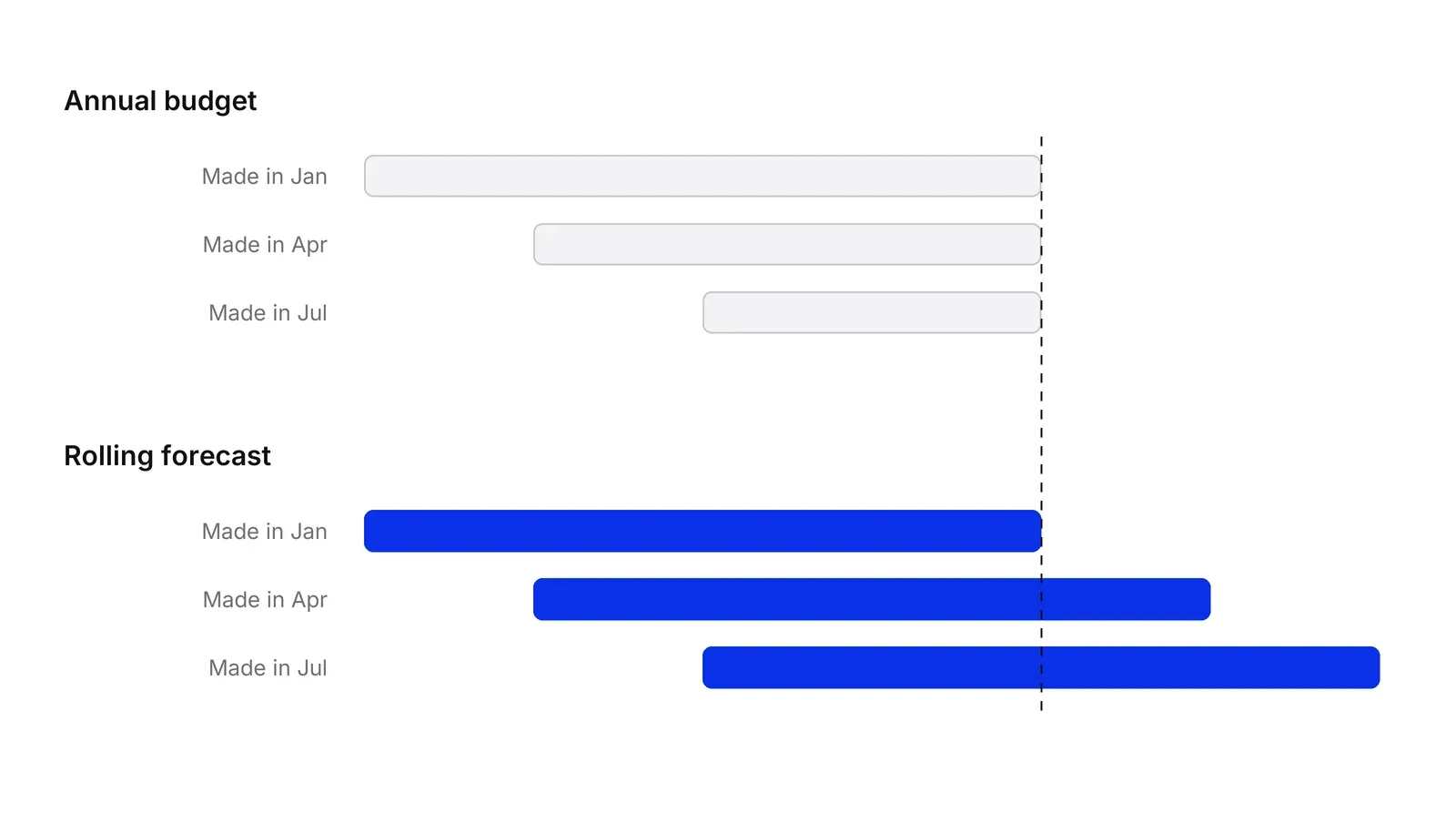
The right horizon depends on the business. A Hackett Group presentation hosted by IBM places cash flow and advertising among short-cycle functions, and research and development and plant construction among long-cycle ones. It also says companies with the best practice move toward event-driven updates, and it advises building the model on a few business drivers instead of ledger accounts. The cash flow forecast usually needs the shortest horizon, and a financial model for growth is a natural home for the drivers. How to score the forecast itself is covered in forecasting and time series.
Why one budget number cannot do three jobs
A budget is asked to be a target, a forecast and a resource allocation at the same time. Bjarte Bogsnes, who led the change at Statoil, describes this as the same number with conflicting purposes: a target is what we want to happen, a forecast is what we think will happen. A good target is ambitious, a good forecast is unbiased and a good allocation follows need. One number cannot be all three, so people shade the forecast to keep the target safe.
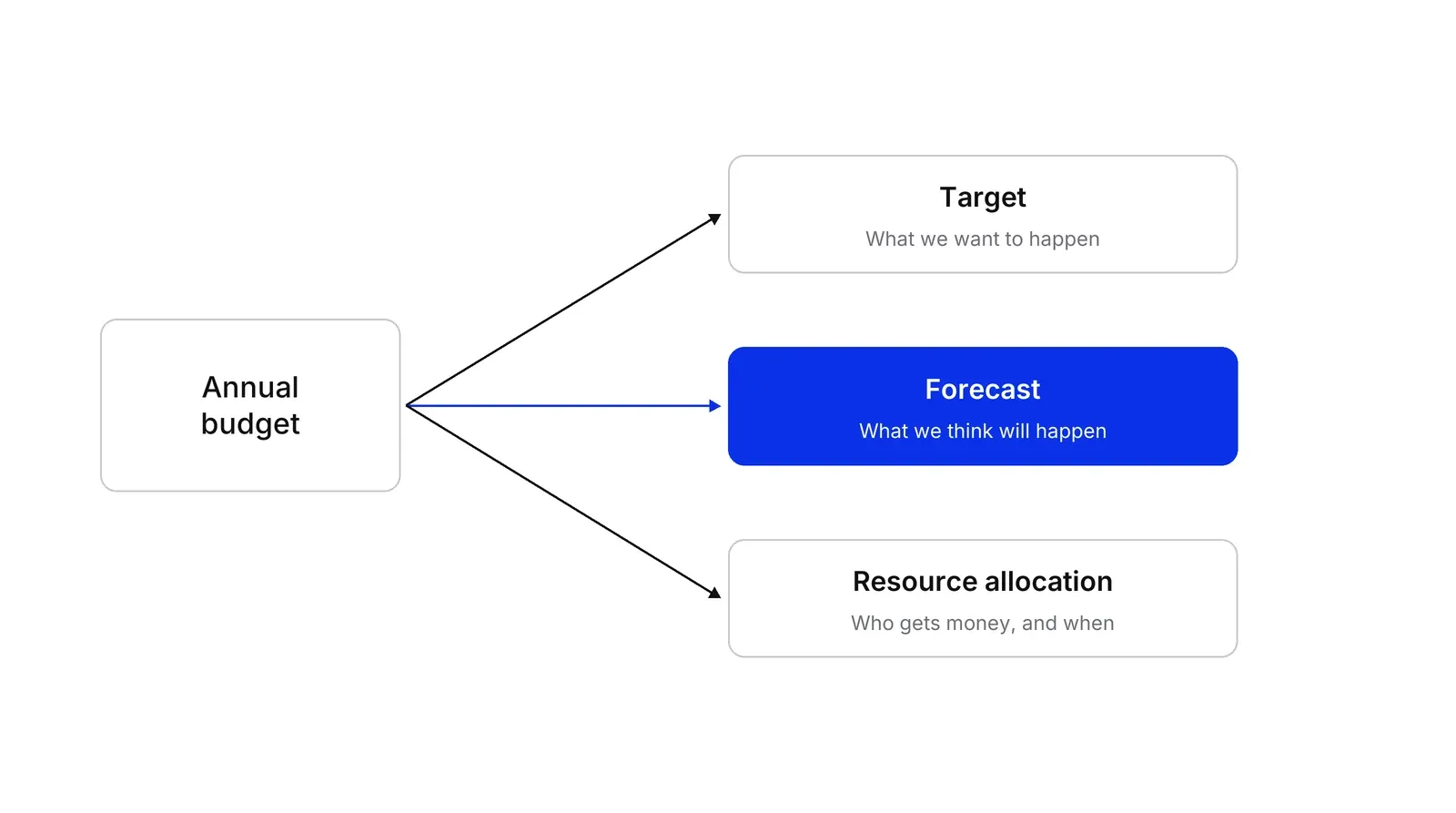
Michael Jensen put the incentive problem sharply in 2003. He argued that pay tied to budgets pays people to distort them, and his remedy was to keep budgets but take them out of pay and promotion formulas. Beyond Budgeting goes further and splits the budget itself. Statoil separated the three purposes so each could have its own numbers, update frequency and time horizon.
The 12 principles
Bogsnes lists twelve principles in two groups of six: leadership and process. The leadership group covers values, performance climate, transparency, network organisation, autonomy and customer focus. The process group is where a finance team feels the change.
| What the budget does today | Beyond Budgeting principle |
|---|---|
| Fixes targets in an annual performance contract | Set relative goals for continuous improvement |
| Pays for meeting the fixed target | Reward shared success based on relative performance |
| Plans once a year, top down | Make planning continuous and inclusive |
| Coordinates through the annual cycle | Coordinate interactions dynamically |
| Allocates money once a year | Make resources available as needed |
| Controls through variance against plan | Base controls on relative indicators and trends |
The wording follows Bogsnes’s Statoil slides. In practice, “as needed” often means funding in tranches with a decision point, which is the logic of capital allocation, and a quarterly release is the simplest version, as in quarterly planning.
How Statoil and Handelsbanken did it
Bogsnes dates Statoil’s change to 2005, when the company started to change its management processes, including abolishing traditional budgeting. Its model, Ambition to Action, links a few strategic objectives to five to ten KPIs and to actions with a forecast of their outcome, and the slides count more than 1,400 of them across the company. KPIs are relative where possible, such as unit cost against peers or a place in the first quartile.
Statoil was about to adopt a rolling forecast and then saw that it still had a fixed frequency and horizon. It chose what Bogsnes calls dynamic forecasting: updates driven by events, looking as far ahead as each unit needs. He adds that dynamic does not mean more often, it means at the right time.
Handelsbanken is the older case. Jan Wallander became its chief executive in 1970 and later wrote Budgeting, an unnecessary evil. The bank says it aims for profitability above the average of its peers and that each branch decides locally. Harvard’s Dennis Campbell credits the flat hierarchy, empowered branch managers and a strong culture, not bonuses.
Budget, rolling forecast and Beyond Budgeting compared
| Annual budget | Rolling forecast | Beyond Budgeting | |
|---|---|---|---|
| What it is | A fixed annual plan | A forecast with a constant horizon | A management model with 12 principles |
| Main question | Did we hit the plan? | What do we expect next? | Are we improving against peers and trend? |
| Link to targets and pay | Usually direct | Usually none | Relative goals, shared rewards |
| Can it replace the budget? | Not applicable | Not for evaluation and motivation, per Lorain’s survey | Yes, with the other principles in place |
What the research found
Most companies have not dropped budgets. Libby and Lindsay’s survey of 558 North American organisations found that among those using budgets for control, 94% did not plan to abandon them, and the median value score was 70 out of 100. The same paper reports that 88% of the 78 US respondents asked agreed that the problems lie more in how budgets are used than in budgets themselves. In Denmark, Sandalgaard’s survey found 4% of the largest companies had abandoned the annual budget and 11% were considering it. Earlier, Ekholm and Wallin found few Finnish firms planning to abandon it.
Where firms did drop budgets, the work did not vanish. Henttu-Aho and Järvinen studied five industrial companies and found planning, control and evaluation still existed under new tools. Some firms separated targets from forecasts, and others kept them connected in a simpler budget. Matějka, Merchant and O’Grady compared 80 adopters with 121 other organisations and found adopters were more decentralised and used relative targets, but many still struggled to leave a fixed annual budget for decisions.
Reversals happen too. Bukh and colleagues describe a Scandinavian bank that dropped its corporate budget for about two years and then brought back a fixed one, with quarterly forecasts beside it. In a model by Stephen Hansen, all departments favoured rolling forecasts, while support for Beyond Budgeting varied with the parameters. Frow, Marginson and Ogden found in one case that budgets and flexibility can coexist.
We found no controlled trial showing that dropping budgets raises profit. The evidence is surveys, field studies and cases, and the Publishers Weekly review of the original book noted that the authors lean on case summaries and their own sources. The model itself has also moved: Becker, Messner and Schäffer show it shifted from a full replacement of budgeting toward more pragmatic framings. A Growth Lab plan starts from the same pragmatic version: split the three jobs and forecast the few drivers that matter.
How to apply Rolling forecast and Beyond Budgeting, step by step
- Split the budget into its three jobs. Write down what your budget is used for: setting targets, predicting results and releasing money. Give each job its own owner and its own number. Result: three documents or columns, so the forecast is no longer shaded to protect a target.
- Pick the horizon from lead times. Ask how far ahead each area has to commit: ad spend, hiring, inventory, a plant or a licence. Short-cycle areas need a short horizon, long-cycle areas a long one. Result: a horizon in months for each area, not one number for the company.
- Reduce the forecast to a few drivers. Replace ledger-level detail with five to ten drivers, such as pipeline, headcount, active customers and cost per unit. Result: a one-page model a manager can update in an hour.
- Set the update rhythm and the triggers. Choose a calendar update, monthly or quarterly, and list the events that force an early one: a lost major client, a price change, a regulatory ruling. Result: a short list of triggers and a named person who calls the update.
- Set goals against something that moves. Where you have a peer group, a prior period or another team to compare with, express the goal as a relative one: unit cost against the best quartile, conversion against last quarter. Result: goals that stay meaningful when the market shifts.
- Release money in stages. Fund initiatives in tranches with a decision point and agreed criteria, instead of one annual allocation. Result: a list of gates, each with a go or stop rule.
- Run one cycle beside the budget. Keep the old budget for one quarter, run the rolling forecast in parallel and compare forecast error, hours spent and decisions changed. Result: evidence for your own company before anything is switched off.
Examples
A payments company planning headcount
Illustrative. A fintech with 120 staff builds its budget in November for the next calendar year. By July the budget covers six months, and a new market licence changes the hiring plan. With a rolling forecast the finance lead updates a 15-month view every month, using five drivers: active merchants, payment volume, support tickets per merchant, compliance headcount and cost per verification. Hiring decisions are taken on the latest forecast, while the board still sees the annual target as a fixed reference.
A clinic group comparing sites
Illustrative. A group of eight clinics sets each site a fixed revenue target in January. Two sites miss because a competitor opens nearby, and one site beats its target easily because it was set low. The group switches to relative goals: cost per patient visit against the group's best quartile, and no-show rate against the site's own previous quarter. A site is judged on whether it is improving against peers, and equipment budgets are released when a site shows a case with expected patient volume.
Handelsbanken, a documented case
Hope and Fraser's book features the Swedish bank Svenska Handelsbanken as a case of life without budgets. The bank is decentralised, aims for profitability above the average of its peer banks, and according to Harvard Business School professor Dennis Campbell, quoted in Fortune, its branch managers care about the cost-to-income ratio without a personal bonus riding on it.
When to use it
Use a rolling forecast when the business changes faster than the yearly plan: volatile demand, long lead times for capital, frequent price or regulatory changes, or an annual budget that is stale by spring. Move toward Beyond Budgeting when budget negotiations eat management time, targets are padded, and teams have enough information and trust to act without sign-off.
When not to use it
Skip the full model when information is poor, when managers cannot yet read their own numbers, or when lenders, regulators or owners demand a fixed annual budget as a commitment. In those cases keep the budget and add a rolling forecast beside it. A rolling forecast also adds work if nobody changes a decision because of it.
Common mistakes
- Treating it as a scheduling change. Updating the budget every quarter and calling it a rolling forecast keeps the same detail, the same bias and a heavier workload. The Hackett Group material hosted by IBM calls the rolling forecast no silver bullet and says no one approach fits every company.
- Keeping pay tied to the forecast. If bonuses depend on beating the number, people have a reason to shade it. Jensen argued this in his European Financial Management paper and proposed removing budgets from pay formulas.
- Using one horizon for every area. A cash forecast and a capacity plan look ahead very different distances.
- Dropping the budget before building trust and information. Bukh, Ringgaard and Sandalgaard describe a Scandinavian bank that dropped its corporate budget and brought a fixed version back after about two years.
- Forecasting every line item. Hundreds of ledger lines make the update slow, and a slow update is an old update.
FAQ
What is a rolling forecast in simple words?
A rolling forecast is a forecast that always looks the same distance ahead. Every time a month closes, you add a new month at the far end and revise the rest. An annual budget covers six months by July, while a 12-month rolling forecast made in July still covers twelve.
Is Beyond Budgeting the same as having no budget?
No. Bjarte Bogsnes, who led the change at Statoil, calls the name misleading: the aim is a more agile organisation, not the removal of numbers. The model separates targets, forecasts and resource allocation, so what disappears is the single fixed annual contract that tries to do all three.
How often should a rolling forecast be updated?
Monthly or quarterly is the usual calendar rhythm, but Hackett Group material suggests the best-run companies move toward event-driven updates. Bogsnes makes the same point about Statoil: dynamic does not mean more often, it means at the right time. Match the rhythm to how fast your decisions change.
Do most companies still use annual budgets?
Yes. Libby and Lindsay surveyed 558 North American organisations and found that nearly all of those using budgets for control had no plan to abandon them. A Danish survey of the largest companies found only a small minority had dropped the annual budget. Most firms adapt budgets rather than abandon them.
What is the difference between a rolling forecast and a rolling budget?
A rolling forecast predicts what is expected to happen and can be updated freely. A rolling budget extends the budget as a commitment. Stephen Hansen's 2011 model treats rolling budgets and Beyond Budgeting as separate alternatives, and found every department in his model favoured rolling forecasts.
Sources
- Jeremy Hope, Robin Fraser, Who Needs Budgets?, Harvard Business Review, February 2003
- Publishers Weekly, review of Jeremy Hope and Robin Fraser, Beyond Budgeting, Harvard Business School Press, 2003
- Bjarte Bogsnes, Beyond Budgeting: an agile management model, Ambition to Action - the Statoil journey, slides (hosted by the Agile Alliance)
- Wiley, Bjarte Bogsnes, Implementing Beyond Budgeting, 2nd edition, 2016
- Rebels Guide to Project Management, Beyond Budgeting: an interview with Bjarte Bogsnes, part 1
- Rebels Guide to Project Management, Beyond Budgeting: an interview with Bjarte Bogsnes, part 2
- Theresa Libby, R. Murray Lindsay, Beyond budgeting or budgeting reconsidered? A survey of North-American budgeting practice, Management Accounting Research 21(1), 2010
- Stephen C. Hansen, David T. Otley, Wim A. Van der Stede, Practice developments in budgeting: an overview and research perspective, Journal of Management Accounting Research 15, 2003
- Michael C. Jensen, Paying People to Lie: the Truth about the Budgeting Process, European Financial Management 9(3), 2003
- Natalie Frow, David Marginson, Stuart Ogden, Continuous budgeting: reconciling budget flexibility with budgetary control, Accounting, Organizations and Society 35(4), 2010
- Katarina Østergren, Inger Stensaker, Management control without budgets: a field study of Beyond Budgeting in practice, European Accounting Review 20(1), 2011
- Tiina Henttu-Aho, Janne Järvinen, A field study of the emerging practice of Beyond Budgeting in industrial companies, European Accounting Review 22(4), 2013
- Michal Matejka, Kenneth A. Merchant, Winnie O'Grady, An empirical investigation of beyond budgeting practices, Journal of Management Accounting Research 33(2), 2021
- Jan Wallander, Budgeting - an unnecessary evil, Scandinavian Journal of Management 15(4), 1999
- Bo-Goran Ekholm, Jan Wallin, Is the annual budget really dead?, European Accounting Review 9(4), 2000
- Stephen C. Hansen, A theoretical analysis of the impact of adopting rolling budgets, activity-based budgeting and beyond budgeting, European Accounting Review 20(2), 2011
- European Accounting Association, Moving beyond Beyond Budgeting (summary of Bukh, Ringgaard, Sandalgaard, European Accounting Review, 2024)
- Niels Sandalgaard, The prevalence of Beyond Budgeting in Denmark, Manufacturing Accounting Research Conference, 2009
- Marie-Anne Lorain, Should rolling forecasts replace budgets in uncertain environments?, in Performance Measurement and Management Control, Emerald, 2010
- Sebastian D. Becker, Martin Messner, Utz Schäffer, The interplay of core and peripheral actors in the trajectory of an accounting innovation: insights from Beyond Budgeting, Contemporary Accounting Research 37(4), 2020
- Utz Schäffer, Sebastian Becker, There are many ways to do Beyond Budgeting, Controlling & Management Review 6/2023
- Fortune, This bank refuses to pay out lavish banker bonuses and it's doing just fine, July 2020
- Handelsbanken, Our values
- The Hackett Group via IBM Cognos, Best practices in implementing a rolling forecast, 2009
Last updated Oct 9, 2026


How to calculate channel payback and unit economics
A CAC number that only marketing believes will not survive a finance review. This guide calculates channel payback so both teams work from the same model.

Fractional CFO vs finance operations: which gap do you actually have
A fractional CFO is a person. Finance operations is a system. Companies searching for one are often missing the other, or both.