Onboarding framework
The onboarding framework is a staged process that takes a new customer, client or patient from sign-up to a first real result and a routine of use, with one owner and one clock for each stage.
The onboarding framework is a staged process for taking a new customer from sign-up to a first real result and then to regular use. It defines the first value moment, removes every step that delays it, assigns an owner to each stage and hands the customer on with a written plan. It applies to software, B2B services, banks and clinics.
- Origin
- No single author: shaped by customer success practice (Gainsight, Intercom) and behavior research (B.J. Fogg), Practice, no single date
- Level
- 201 · Tool
- Fits
- Startup, Small and mid-size, Scale-up
- Time to apply
- A week to map and measure the current path, then 2 to 4 weeks for the first redesign
- What you need
- sign-up or purchase data for the last 3 months, with dates of each early step · one agreed result that counts as first value · an owner for each stage, from sales to long-term support
The onboarding framework is a staged process that takes a new customer from sign-up or purchase to a first real result, and then to regular use. It has no single inventor. It grew out of customer success teams, product design and behavior research, and its parts are now used for software, B2B services, banks and clinics. The core idea is simple: the first weeks decide whether a customer stays, so design them on purpose.
Why the first weeks carry so much weight
Early contact does more than later contact. Samaha, Kozlenkova, Moffett and Palmatier studied 201,398 new customers of a Fortune 500 firm. Face-to-face contact had 19 times the effect on share of wallet in the first month that it had two years later, and email had 14 times.
More help does not always help, though. A 2025 field study with a B2B software provider found that bundling more add-ons reduced retention during onboarding, and a survey in the same paper points to perceived complexity as the likely cause. Leaner communication channels made the attrition worse. Early attention should be frequent and simple.
Retention itself is worth the effort. Reichheld and Sasser wrote in 1990 that companies can boost profits by almost 100% by retaining just 5% more customers. Onboarding is the first place that retention is won or lost.
The four stages
Onboarding runs through four stages. Gainsight describes five steps: welcome and setup, education, personalized guidance, early success and a transition to the long-term team. The version below merges them into four so each has one owner and one clock.
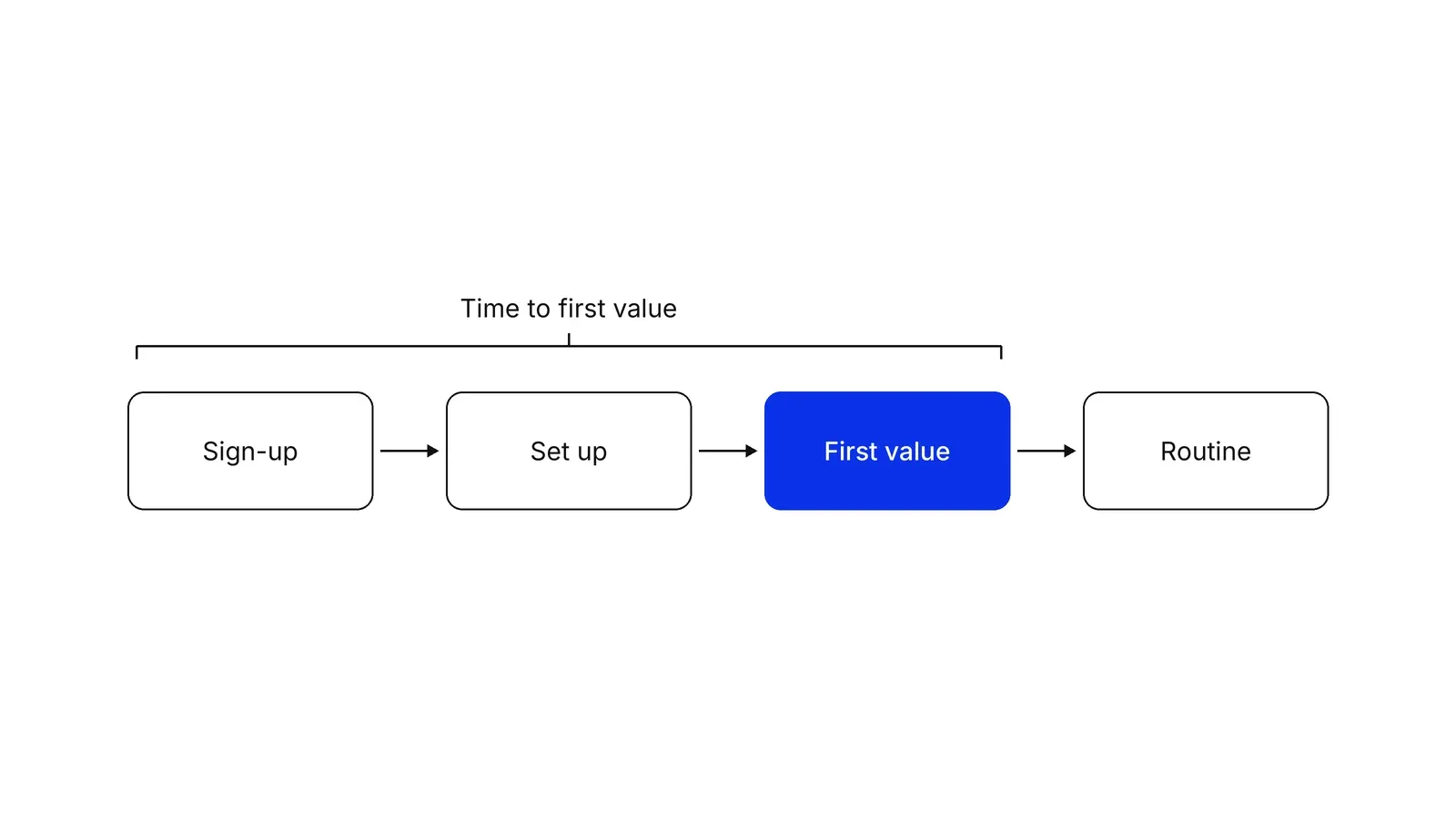
- Sign-up. The customer commits and gives the minimum details.
- Set up. The account, data, access or identity checks are done.
- First value. The customer gets the result they came for.
- Routine. The customer uses the product again without prompting, and the account passes to long-term care.
Time to first value is the gap between the first and third stage. It is the number to watch, because it is where most of the avoidable loss sits.
Choosing the first value milestone
The first value milestone is the earliest point that predicts the customer will stay. Rachitsky and Timen, drawing on over 500 survey responses, advise picking a point early in the lifecycle and testing it: users who reach it should retain at least twice as well as users who do not. Finishing sign-up is usually too early to predict anything.
Intercom frames the same choice as a job. Its writers say onboarding should lead new users to the job they hired the product to do, and that teaching every feature is best saved for later. A clinic’s job is a treatment the patient understands and can follow. A bank’s is money that moves.
Cutting effort before adding help
Most onboarding problems are effort problems. The Fogg Behavior Model says a behavior happens when motivation, ability and a prompt come together at the same moment, and that high motivation can offset low ability. A new customer’s motivation is high on day one and falls fast, so the quickest gain is to raise ability by making each step easier. A friction audit shows which steps lose the most people.
Three tactics work in this order.
- Defer. Nielsen’s progressive disclosure shows only the most important options first and reveals specialist ones on request.
- Pre-fill. Intercom recommends templates and sensible defaults to cut setup, and delaying account creation where the product allows it.
- Show progress. Nunes and Drèze found that giving people artificial advancement toward a goal made them more persistent. Their test turned an eight-step task into a ten-step task with two steps already marked done.
Be careful with tutorials. Nielsen Norman Group tested four mobile apps with 70 users and found that reading a tutorial did not make tasks faster. Readers rated the tasks harder, 4.92 against 5.49 on a seven-point scale, and the authors suggest making the interface easier instead. The Hook model covers what keeps people coming back once they are through.
Human help or self-serve
Use people where first value is complex or valuable and a self-serve path where it is not. Superhuman is a documented case. Gaurav Vohra, who helped build its growth engine, wrote that more than 65% of new customers fully moved their email over after human-led onboarding, which he put at more than double the rate for users given no onboarding. After about three years of building in-product onboarding, a required full-screen setup replaced a checklist and completion rose from 30% to over 98%. The sequence matters: humans first to learn what works, then software.
Handing over
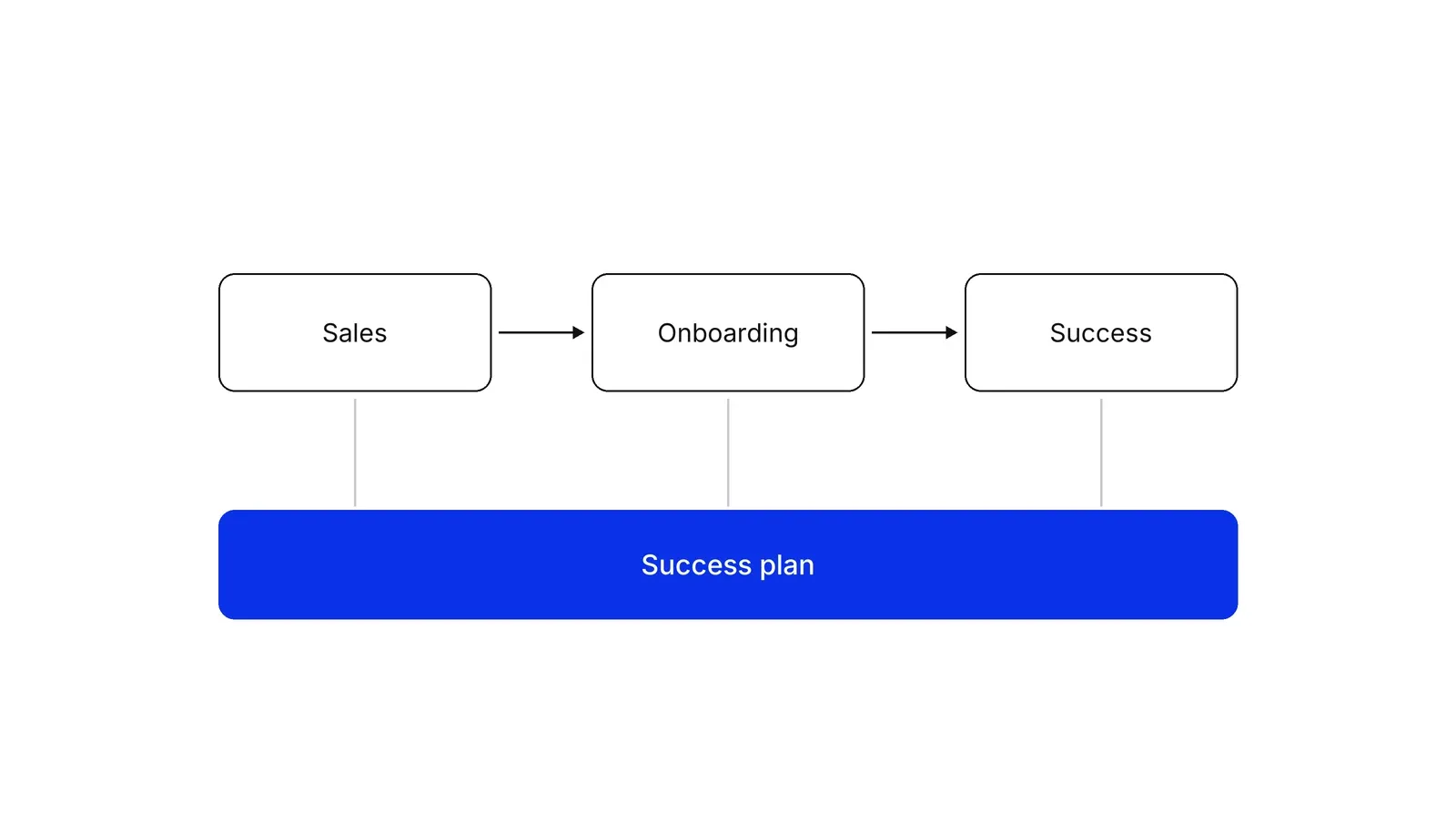
In B2B, the main risk is the gap between sales, onboarding and long-term care. Gainsight advises a joint plan with milestones and a handoff to the long-term success team. One written plan, owned by the customer, travels through each change of owner. Customer success takes over from there.
Onboarding in banks and clinics
Regulated and clinical onboarding has extra steps that cannot be cut, so the aim is to make them smooth and to order them well.
Banks. Signicat’s survey of 3,500 adults in six European countries found that almost 40% of financial services applications were abandoned in 2019, down from a 52% peak in 2018. NIST defines identity proofing as resolution, validation and verification of identity evidence. FATF’s 2020 guidance says non-face-to-face onboarding with reliable digital ID may carry standard or lower risk, and that tiered due diligence can tie the level of account access to how much has been completed. That makes it possible to deliver a first value earlier, with limits.
Clinics. The first visit needs two things: that the patient arrives, and that the patient understands. A Cochrane review of eight trials with 6,615 participants found text message reminders improved attendance against no reminders, with low to moderate certainty. For understanding, the AHRQ toolkit recommends teach-back: asking the patient to say in their own words what they need to do. It cites studies finding that 40 to 80% of what patients are told in a visit is forgotten at once. Hibbard and colleagues’ Patient Activation Measure describes four stages from belief that the patient’s role matters to staying the course under stress, which is a useful frame for a follow-up plan. None of this replaces clinical judgment.
Onboarding compared with its neighbours
| Term | What it covers | Where it ends |
|---|---|---|
| Onboarding | The whole guided path, with owners and handovers | When the customer is self-sufficient |
| Activation | One measured point that predicts retention | At that point |
| Implementation | Technical setup in B2B | When the system is live |
| Adoption | Continued use of features | Never; it is tracked ongoing |
A Growth Lab plan starts from a timed path and a first value definition, so a team sees where customers are lost before it designs a fix.
How to apply Onboarding framework, step by step
- Define first value. Write one sentence that says what a new customer has done or received when the product has first paid off. For software it is an action, for a bank an open and funded account, for a clinic a completed first visit with a plan the patient can repeat back. Check that people who reach it stay longer than people who do not. Result: one measurable milestone.
- Map the path and time it. List every step between sign-up and that milestone, with the median time and the share of people who finish each one. Add the steps nobody designed, such as waiting for a verification email or a callback. Result: a timed path with the biggest drop-off marked.
- Remove, then defer, then guide. For each step ask three questions in order. Can it go? Can it wait until after first value? If it must stay, can we pre-fill it, offer a template or ask for less? Only then add guidance. A friction audit finds the worst steps fast. Result: a shorter path.
- Split human and digital help by value. Give live help to customers whose first value is complex or whose contract is large, and a self-serve path with prompts to the rest. Decide the rule in advance, for example by plan size or product complexity. Result: a written routing rule and a named owner for each route.
- Set the handover plan. At each change of owner, from sales to onboarding to long-term success, pass on one written plan: the customer's goal, the first value date, the people involved and the next review. Result: no customer has to explain their goal twice.
- Review at 30, 60 and 90 days. Check time to first value, completion of onboarding and early support volume against the plan, and ask the customer what nearly stopped them. Change one thing at a time. Result: a monthly list of fixes, ranked by the drop-off they remove.
Examples
A clinic onboarding new patients
Illustrative. A dental clinic sees 400 new patients a month and wants more of them to complete the treatment plan. It defines first value as a completed first visit where the patient can say back what was agreed. Before the visit, the patient fills in the history form online and gets a text reminder. At the visit, the dentist uses teach-back for the plan. A week later the front desk checks in by message. The path is shorter before the visit and checked after it.
A B2B payments product
Illustrative. A payments company signs a mid-size merchant. Sales records the merchant's goal in a success plan before the contract closes. Onboarding handles identity checks and integration with a named engineer. First value is the first live payment settled. The plan then passes to a success manager with the settled volume target and a 30-day review.
A bank's account opening
Illustrative. A bank splits identity checks into tiers. A new customer can open an account with basic details and use limited functions right away, while higher limits unlock when stronger identity evidence is verified. First value is the first successful transfer. The bank times each stage and treats abandoned applications as a defect to investigate.
When to use it
Use it when customers sign up or buy and then go quiet, when support tickets in the first weeks repeat the same questions, or when a product has several steps between purchase and result. It suits software, services with a setup phase, regulated products with identity checks and clinics with a first-visit routine.
When not to use it
Skip a full redesign when the product delivers value in the first minute with no setup, because there is little path to shorten. Do not use it to fix a weak offer: if customers reach first value and still leave, the problem lies in the product or the fit. In that case start with customer success and the cohort data.
Common mistakes
- Treating the welcome tour as onboarding. A tour ends when the screens run out, while onboarding ends when the customer gets a result.
- Choosing a first value milestone nobody tested. If people who reach it leave as often as those who do not, pick another.
- Asking for everything at sign-up. Fields and setup that are not needed for the first result belong after it.
- Handing over with no plan. The new owner restarts discovery and the customer repeats their goal.
- Making human help optional with no reminder. Superhuman reported that attendance at its onboarding calls fell from 100% to about 15% when they became optional.
FAQ
What is customer onboarding in simple words?
Customer onboarding is everything a company does between a person signing up or paying and that person getting the result they came for. It includes setup, teaching, checks and early contact. Gainsight defines it as getting new customers to realize the value of a product or service, and it ends when the customer is self-sufficient.
How is onboarding different from activation?
Onboarding is the whole guided process, including setup, handover and early follow-up. Activation is one measured point inside it: the first action or result that predicts the customer will stay. Lenny Rachitsky and Yuriy Timen suggest testing that point by checking that people who reach it retain at least twice as well.
How does onboarding work in a bank?
A bank collects details, then verifies identity before it opens full access. NIST's guidance defines identity proofing as resolution, validation and verification of evidence. FATF says remote onboarding with a reliable digital ID can carry standard or lower risk, and that access can be tiered by how much due diligence is complete.
How long should customer onboarding take?
It depends on the product, so no single benchmark holds. Gainsight suggests quick wins within the first 30 to 60 days and reviews at 30, 60 and 90 days. Measure your own time to first value, then shorten it by removing steps before adding help. A self-serve tool needs minutes, an enterprise rollout months.
What metrics show whether onboarding works?
Gainsight lists time to first value, onboarding completion rate, feature adoption, satisfaction scores, early support volume and customer effort score. Start with time to first value and completion by stage. Add retention by cohort to confirm that customers who finish onboarding stay longer than those who do not.
Sources
- Stephen A. Samaha, Irina V. Kozlenkova, Jordan W. Moffett, Robert W. Palmatier, Multichannel Customer Onboarding, Marketing Science Institute working paper, 2019
- Lena Steinhoff, Jisu J. Kim, Vamsi K. Kanuri, Robert W. Palmatier, Unintended consequences of selling B2B digital subscription add-ons for customer onboarding, Journal of the Academy of Marketing Science 53(5), 2025
- Frederick F. Reichheld, W. Earl Sasser Jr., Zero Defections: Quality Comes to Services, Harvard Business Review, 1990
- Bain & Company, synopsis of Zero Defections: Quality Comes to Services
- Gainsight, Customer Onboarding: Best Practices and Actionable Tips
- Nick Mehta, Dan Steinman, Lincoln Murphy, Customer Success: How Innovative Companies Are Reducing Churn and Growing Recurring Revenue, Wiley, 2016
- Robbie Allan, How to retain more users with value-based onboarding, Intercom Blog, 2018
- Robbie Allan, Hook trial users from their first use, Intercom Blog, 2019
- Lenny Rachitsky, Yuriy Timen, What is a good activation rate?, Lenny's Newsletter, 2022
- B.J. Fogg, Fogg Behavior Model, behaviormodel.org
- Stanford Behavior Design Lab, Fogg Behavior Model
- Nielsen Norman Group, Mobile Tutorials: Do They Help or Hurt?
- Jakob Nielsen, Progressive Disclosure, Nielsen Norman Group, 2006
- Joseph C. Nunes, Xavier Drèze, The Endowed Progress Effect: How Artificial Advancement Increases Effort, Journal of Consumer Research 32(4), 2006
- Gaurav Vohra, Superhuman's onboarding playbook, First Round Review, 2025
- Signicat, digital onboarding abandonment study, reported by FStech, 2019
- NIST, SP 800-63A: Digital Identity Guidelines, Enrollment and Identity Proofing
- Financial Stability Board, FATF Guidance on Digital Identity, March 2020
- AHRQ, Health Literacy Universal Precautions Toolkit, 2nd edition: Tool 5, Use the Teach-Back Method (excerpt)
- Institute for Health Care Advancement, Teach-Back Training
- Ipek Gurol-Urganci and colleagues, Mobile phone messaging reminders for attendance at healthcare appointments, Cochrane Database of Systematic Reviews, 2013
- Judith H. Hibbard, Jean Stockard, Eldon R. Mahoney, Martin Tusler, Development of the Patient Activation Measure (PAM), Health Services Research 39(4), 2004
Last updated Oct 9, 2026


Marketing agency or growth system: when a company outgrows its agency
An agency is the right call while the founder still runs most of the company. Once the business starts copying itself into new locations or markets, it needs a system that sets goals, tests hypotheses and owns the result.

Why healthcare marketing agencies stall: the short, mid and long wins model we use with clinics
Most agencies own the click and nobody owns the front desk. How we structure clinic work in three horizons, the research behind each one, and one year of results.

Why channel tests stall after month three
Most paid channel tests do not end with a decision. They end when the budget runs out, the attribution model changes, or everyone quietly stops looking at the dashboard.