Demand generation vs demand capture
A way to split B2B marketing into two jobs, creating demand among buyers who are not looking yet and capturing demand from buyers who already are, so each gets its own channels, content, metrics and budget.
Demand generation vs demand capture is a B2B marketing model that separates two jobs. Demand creation builds interest among the large group of buyers who are not in the market yet, through social content, podcasts and communities. Demand capture converts the small group already searching, through paid search, review sites and pricing pages. Chris Walker of Refine Labs popularised the split.
- Origin
- Popularised by Chris Walker, Refine Labs; no single documented coinage, Refine Labs founded 2019
- Level
- 301 · Advanced
- Fits
- Small and mid-size, Scale-up
- Time to apply
- one week to sort channels and add a self-reported field; two quarters to read the results
- What you need
- a list of marketing spend by channel for the last 12 months · an open text field asking how the buyer heard about you on your demo or contact form · closed-won deals linked back to the first form fill · a sales lead who will read the self-reported answers with you every month
Demand generation vs demand capture is a model that splits B2B marketing into two jobs. Demand creation, which Refine Labs treats as the core of demand generation, builds interest among buyers who are not looking for a solution yet. Demand capture converts buyers who already are. The two jobs need different channels, different content and different ways of keeping score.
The contrast has no documented inventor. Chris Walker made it popular in B2B software after he founded Refine Labs in 2019, through the agency’s work and his State of Demand Gen podcast. He told Typeform he has run a fully ungated content strategy since 2016, on the view that content exists to be consumed, not to collect emails. Walker stepped away from Refine Labs in 2025; CEO Megan Bowen now owns it. Most of the numbers attached to this model come from the agency itself, and this page labels them that way.
What counts as creation and what counts as capture?
Capture reaches people who are already shopping; creation reaches people who are not. Refine Labs’ demand philosophy describes three stages: creation, mostly through paid social such as LinkedIn and Meta; capture, through search engines and review sites; and conversion, the handoff to sales.
| Demand creation | Demand capture | |
|---|---|---|
| Audience | Right profile, not shopping now | Searching, comparing, asking for prices |
| Channels | Social content, podcasts, communities, events, PR | Paid search, review sites, retargeting, pricing page |
| Content | Useful on its own, no form | Proof, comparisons, a fast way to talk to sales |
| Main metric | Reach in target accounts, branded search, self-reported mentions | Cost per qualified opportunity, win rate |
| Time to effect | Months to years | Days to weeks |
The size of each audience is the core of the argument. John Dawes of the Ehrenberg-Bass Institute, writing for the LinkedIn B2B Institute, estimates that about 95% of business buyers are out of the market at any given time. Peter Weinberg and Jon Lombardo show the arithmetic in Marketing Week: if 80% of companies switch business banks about once every five years, roughly 20% are in market in a year and about 2% in a month. Capture can only reach that slice.
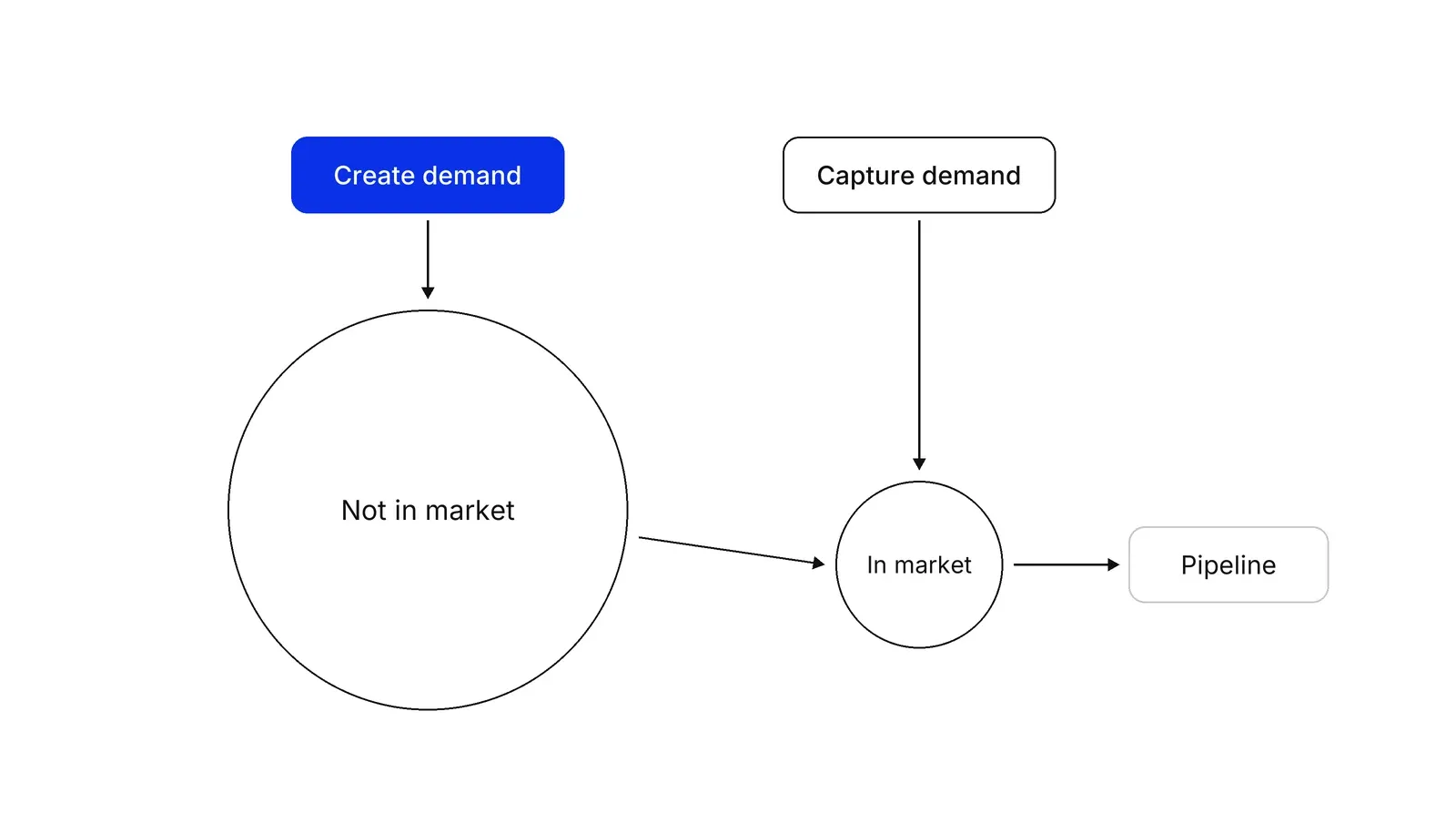
Dawes’s report describes the mechanism. Advertising to out-of-market buyers builds memory links between the brand and buying situations, and those links fire when a buyer later enters the market. Creation is the work of building them before the buyer starts to search.
Why do companies over-fund capture?
Because capture is what tracking software can see. A buyer hears about a vendor on a podcast, sees three LinkedIn posts, asks a peer in a private chat, and months later types the company name into Google. Software records the last digital step. Google Analytics files a visit with no referrer under Direct, defined as arriving via a saved link or by entering your URL. The podcast gets no credit, so the next budget review cuts it.
Refine Labs tested this on its own pipeline. Over 12 months it made an open text question, “How did you hear about us?”, mandatory on its strategy call form and compared the answers with HubSpot’s attribution across 620 conversions. In the 2024 write-up by Megan Bowen, software credited about 78% of conversions to web search; buyers mentioned web search 12% of the time, and named social, podcasts, word of mouth and communities in about 85% of mentions.
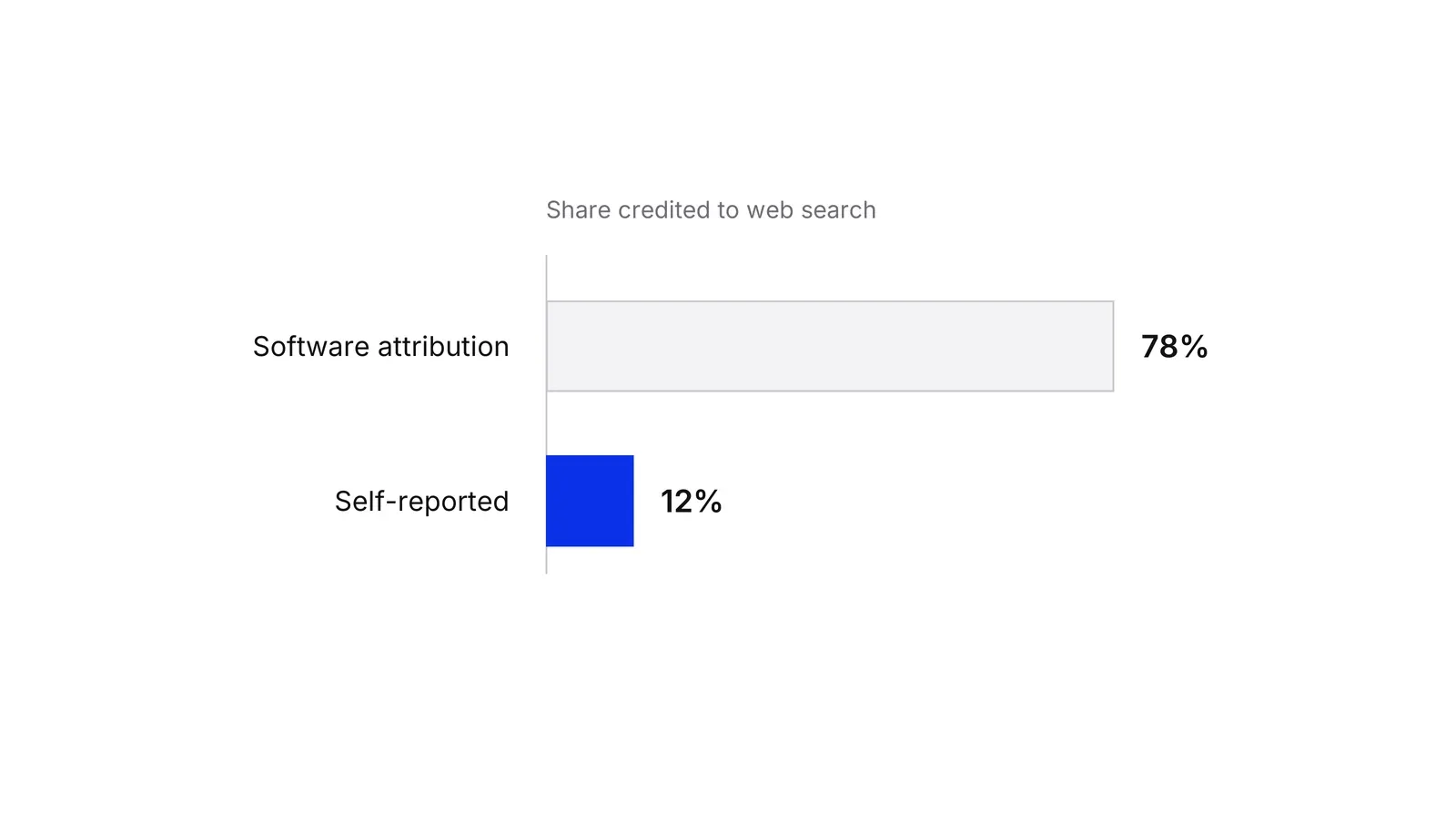
Treat these as practitioner numbers. They describe one agency selling this model, measured on its own buyers, and the agency’s 2023 account of the same study reports different headline figures: a 90% gap and 53% of revenue credited to its podcast. No independent replication has been published. Self-reports have their own bias: Recast, which builds marketing mix models, notes that people misremember, favour recent touchpoints and overweight memorable channels.
What does independent research say?
Peer-reviewed studies support the mechanism without testing the model by name. They show that demand created in one channel often gets credited to a capture channel.
- TV advertising for financial services brands raised Google searches and shifted people from generic to branded keywords, with an elasticity of 0.17, according to Joo, Wilbur, Cowgill and Zhu in Management Science.
- In a Yahoo experiment with a large retailer, online display ads raised purchases by about 5%, and 78% of that lift came from people who never clicked, so click-based reports would have missed most of it.
- At eBay, brand keyword ads showed no measurable short-term benefit, while non-brand search helped new and infrequent buyers, per Blake, Nosko and Tadelis.
- Across 15 Facebook experiments, standard observational methods often failed to match randomised results.
Capture still matters. In Bing experiments, Simonov, Nosko and Rao found a brand’s own search ads added only 1% to 4% of clicks when no rival bid on the name. When rivals bid and the brand stayed out, those rivals took 18% to 42% of the clicks. Stopping capture can hand created demand to a competitor.
How should the budget split?
Nobody has tested an optimal creation to capture ratio. Refine Labs says it puts 60% to 70% of paid media into creation and about 30% into capture, which is a house rule. The nearest evidence is Binet and Field’s B2B analysis for the LinkedIn B2B Institute. They write that businesses need brand activity to create demand and activation to convert it, and found results peaked at about 46% brand and 54% activation. The history and limits of that data are on our page about the long and the short of it.
The two splits do not measure the same thing. Refine Labs’ creation includes targeted LinkedIn content that Binet and Field might count as activation. Start from your own numbers instead: what share of spend sits in intent channels today, and how fast is the cost per opportunity rising there? If you plan paid media by stage, the paid media funnel maps TOFU roughly to creation and BOFU to capture.
Then measure with two ledgers and one experiment. Keep software attribution for capture, add the self-reported field for creation, track branded search volume, and where the platform allows, run a Conversion Lift test that withholds ads from a control group. Building that measurement into one reporting system is part of Pushers’ marketing operational system work.
How to apply Demand generation vs demand capture, step by step
- Sort every channel into creation or capture. Ask one question per channel: does it reach people who are looking for a solution now, or people who are not? Paid search, review sites, retargeting and the pricing page are capture. Social content, podcasts, events, communities and PR are creation. Result: a two-column table of channels with last year's spend in each.
- Add a self-reported attribution field. Put a required open text question, 'How did you hear about us?', on the form that signals buying intent, such as a demo request. Do not offer a dropdown; it pushes answers into your own categories. Result: a monthly list of answers you can code into channels.
- Compare the two ledgers. Each month, set what the software credits next to what buyers wrote, for every converted lead and every closed deal. Large gaps on the same deals show where software is crediting the last click for demand created elsewhere. Result: a two-column report that sales and finance can read.
- Give each side its own metric. Judge capture on cost per qualified opportunity and win rate from intent channels. Judge creation on reach in your target accounts, engaged audience, branded search volume and self-reported mentions. Result: no creation channel is cut for failing a last-click test it was never built to pass.
- Move budget in steps and test it. Shift 10% to 20% of spend from saturated capture to creation, keep capture funded so buyers who search can find you, and hold out one region or segment where possible. Result: a split you can defend with your own pipeline data after two quarters.
Examples
Splash, event marketing software (vendor-reported)
Refine Labs' published case study says Splash moved from a feature-led, conversion-focused plan to separate creation, capture and conversion programs. It refocused Google Ads on high-intent buyers, used LinkedIn with zero-click content for creation, and tracked self-reported attribution. The agency reports an 83% increase in high-intent opportunities and a 32% lower cost per qualified one. These are the agency's own figures, with no dates or control group.
A B2B payments platform with rising search costs
Illustrative. A payments platform spends 40k a month, 32k of it on paid search and review-site listings. Cost per qualified demo has doubled in a year because the same few in-market buyers see five competitors. The team moves 8k to LinkedIn video and a podcast for finance leads at merchants of the right size. After two quarters, 30% of demo requests name the podcast or a LinkedIn post, while software credits most of them to direct traffic and branded search.
A private clinic chain
Illustrative. A clinic chain funds only search ads on procedure names. Bookings stall because searches for those procedures in the city are flat. It adds short educational video about symptoms that come before a visit, aimed at the whole local audience. It tracks branded search volume and the answer to 'How did you hear about us?' at booking, and keeps search ads running so the new interest has somewhere to land.
When to use it
Use it when a B2B team funds mostly search, review sites and retargeting, cost per opportunity keeps rising, and leadership asks why the pipeline will not grow with spend. It also helps when channels such as podcasts or founder content get cut because attribution software shows no revenue from them.
When not to use it
Skip the creation half when demand already exceeds what you can deliver, or when the budget can fund only one channel well; capture what exists first. It fits poorly where buying is impulsive and frequent, as in most consumer goods, where brand and activation models such as Binet and Field's describe the trade-off with more evidence.
Common mistakes
- Treating creation as a reason to stop capture. Buyers who search for you and find a competitor's ad first are lost demand you already paid to create.
- Taking self-reported answers as ground truth. People forget, credit the last thing they remember and name memorable channels.
- Calling gated lead magnets demand generation. A form fill from someone who wanted a PDF is a lead, not a buyer.
- Moving all budget at once and judging creation after one month, when most buyers are months or years from a purchase.
- Quoting the Refine Labs measurement gap as if it were independent research. It is one agency's data about its own pipeline.
FAQ
What is the difference between demand generation and demand capture?
Demand generation, or creation, builds interest among people who are not shopping yet, so they think of you when they are. Demand capture converts people who are already looking, through search ads, review sites and sales-ready pages. Creation fills the future pipeline; capture harvests the current one.
Is demand generation the same as lead generation?
No. In the Refine Labs model, lead generation pulls contact details through gated content and form fills, then hands the names to sales. Demand generation pushes useful content into the market with no form, and counts buyers who later ask to talk. Many teams still use demand gen to mean lead gen, which causes confusion.
What is the 95:5 rule in B2B marketing?
It is John Dawes's estimate, published with the LinkedIn B2B Institute, that about 95% of a category's business buyers are not in the market at any given time and about 5% are. It follows from long purchase cycles: if companies switch banks about every five years, only about 2% are in market in a given month.
How much budget should go to demand creation?
No tested figure exists for this split. Refine Labs says it puts 60% to 70% of paid media into creation, which is its own practice. Binet and Field's B2B analysis found results peaked at about 46% brand and 54% activation, and warned against following the ratio too precisely.
How do you measure demand creation?
Use two ledgers. Software attribution shows where buyers converted. A required open question, 'How did you hear about us?', on the demo form shows where they first heard of you. Add branded search volume and, where you can, a holdout test that withholds ads from a control group.
Sources
- Refine Labs, Chris Walker
- Refine Labs, Megan Bowen ownership update, July 2025
- SaaStock, How to improve demand gen for your SaaS business with Chris Walker, 2022
- Typeform, Meaningful: interview with Chris Walker, 2024
- Refine Labs, The Refine Labs demand philosophy, Stephanie Crugnola, 2024
- Refine Labs, The attribution mirage, Megan Bowen, 2024
- Refine Labs, Hybrid attribution framework, 2023
- Refine Labs, Splash success story
- Recast, How did you hear about us surveys and the limits of measurement, Shaifali Agrawal, 2023
- Google Analytics Help, Default channel group (Direct)
- Google Ads Help, About Conversion Lift
- Ty Heath, LinkedIn B2B Institute, The 95-5 rule
- Peter Weinberg, Jon Lombardo, Marketing Week, The 95:5 rule is the new 60:40 rule, 2021
- Ehrenberg-Bass Institute, John Dawes, Advertising effectiveness and the 95-5 rule
- Ehrenberg-Bass Institute, The 95:5 rule is the new 60:40 rule
- Les Binet, Peter Field, The 5 Principles of Growth in B2B Marketing, LinkedIn B2B Institute, 2019 (PDF)
- LinkedIn B2B Institute, WARC, Lions, The B2B Effectiveness Code
- Mingyu Joo, Kenneth C. Wilbur, Bo Cowgill, Yi Zhu, Television Advertising and Online Search, Management Science 60(1), 2014
- Randall A. Lewis, David H. Reiley, Online ads and offline sales, Quantitative Marketing and Economics, 2014 (UC Berkeley lecture abstract)
- Thomas Blake, Chris Nosko, Steven Tadelis, Consumer Heterogeneity and Paid Search Effectiveness, NBER working paper 20171
- Andrey Simonov, Chris Nosko, Justin M. Rao, Competition and Crowd-Out for Brand Keywords in Sponsored Search, Marketing Science 37(2), 2018
- Brett R. Gordon, Florian Zettelmeyer, Neha Bhargava, Dan Chapsky, A Comparison of Approaches to Advertising Measurement: Evidence from Big Field Experiments at Facebook
Last updated Oct 9, 2026

Marketing agency or growth system: when a company outgrows its agency
An agency is the right call while the founder still runs most of the company. Once the business starts copying itself into new locations or markets, it needs a system that sets goals, tests hypotheses and owns the result.

Why healthcare marketing agencies stall: the short, mid and long wins model we use with clinics
Most agencies own the click and nobody owns the front desk. How we structure clinic work in three horizons, the research behind each one, and one year of results.

The compliance layer under fintech marketing operations
A fintech marketing agency can build campaigns. It cannot own the compliance review, the KYC drop-off or the multi-market licensing rules that decide whether a lead ever becomes a customer.