Theory of constraints
The theory of constraints says every system is limited by one constraint, so improving anything else changes little; you find that constraint, squeeze it, line everything else up behind it, and only then add capacity.
The theory of constraints is a management method from Eliyahu Goldratt, set out in his 1984 novel The Goal. It holds that the output of any system is capped by one constraint, such as a slow machine, a sales team's calendar or a review queue. Teams find it, get more from it, subordinate other work to it, then add capacity and repeat.
- Origin
- Eliyahu M. Goldratt, with Jeff Cox (The Goal), 1984
- Level
- 301 · Advanced
- Fits
- Small and mid-size, Scale-up, Enterprise
- Time to apply
- an afternoon to find the constraint, then a few weeks per cycle
- What you need
- stage-by-stage numbers for the process: volume in, volume out, capacity and queue length · one owner who can move people and budget between stages · a profit figure per finished unit, such as per signed customer
The theory of constraints (TOC) is a management method which says that the output of any system is limited by a small number of constraints, usually one, and that effort spent anywhere else barely moves the result. Eliyahu Goldratt introduced it to a wide audience in his 1984 novel The Goal, where a plant manager has three months to save a factory. The Lean Enterprise Institute defines a constraint as a factor that stops a company reaching its goals.
Where does the theory of constraints come from?
It grew out of factory scheduling and then widened. Shams-ur Rahman’s 1998 review dates Goldratt’s development of the theory to the late 1970s and describes two parts: a philosophy of ongoing improvement and a thinking process for solving problems. David Dugdale and Colwyn Jones trace the path from the OPT scheduling software, through a focus on production bottlenecks, to constraints in any part of a business. A Darden School case note places the bottleneck ideas in The Goal and in Goldratt’s later book The Race.
What are the five focusing steps?
The five focusing steps are the repeating routine at the centre of TOC. The Theory of Constraints Institute words them as: identify the system’s constraint, exploit it, subordinate everything else to it, elevate it, and prevent inertia from becoming the constraint.
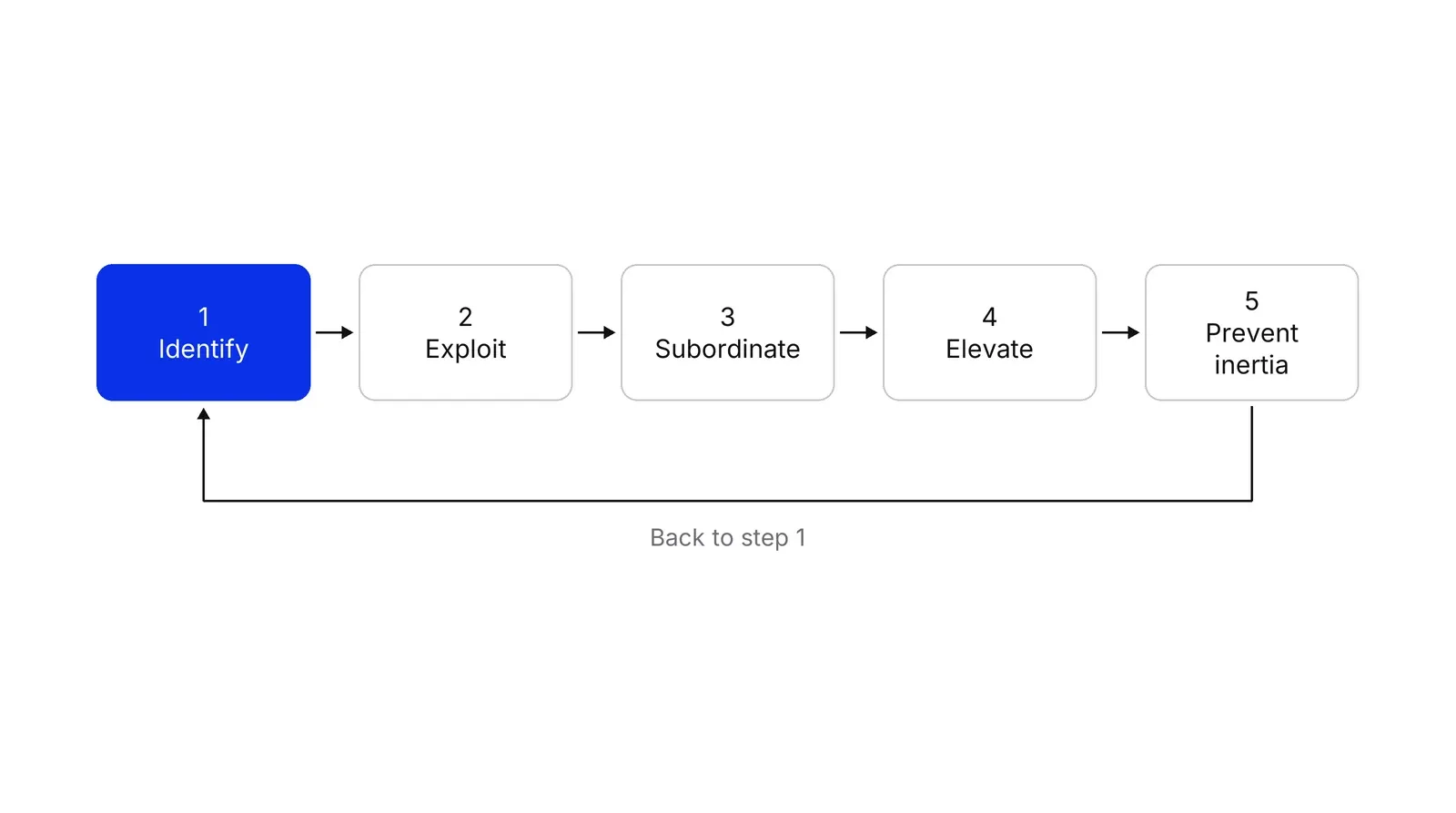
The order matters. Exploit means getting more from what you already have, so it costs little. Elevate means adding capacity, so it usually costs money. A team that jumps to elevation pays for something a cheaper step might have delivered. The fifth step exists because a lifted constraint moves: the old rules that protected it start to slow the new one.
How do you apply it to a marketing and sales funnel?
Treat each funnel stage as a station and ask how many customers a month it can support at current conversion rates. The shortest bar sets the output of the whole funnel. The Institute notes that permanent constraints typically include sales and marketing, and EBSCO’s summary lists even a market competitor as a possible constraining link.
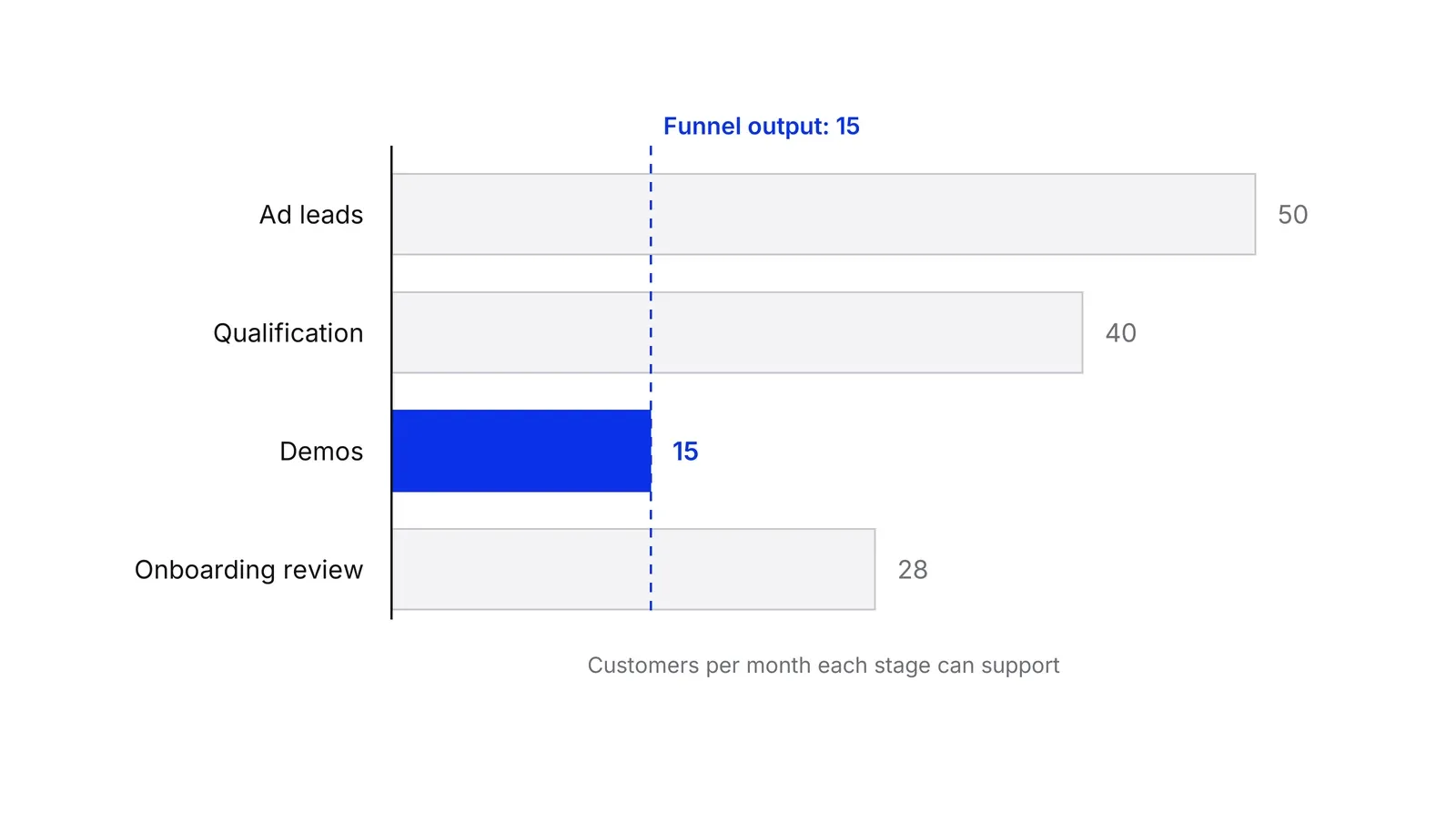
In the illustrative payments funnel above, ads support 50 customers a month and demos only 15. Doubling the ad budget changes nothing about the output; it grows a queue. Cutting no-shows from 25% to 10% raises demos held from 30 to 36 and customers from 15 to 18 with no new spend. The next step is the rope: limit lead release to what the demo stage can absorb. Herman and Goldratt’s sales chapter describes the same moves as limiting the release of incoming opportunities and removing disruptions to flow.
Subordinating also changes how other teams are judged. If the demo calendar is full, a marketing team measured on lead volume will keep sending leads that wait, and a qualification team measured on calls made will book slots nobody can honour. Both should be measured on what the constraint can use.
Conversion data tells you where people drop. Capacity data tells you where work waits. Use funnel analysis for the first and the stage table above for the second. When the constraint is the number of reps, sales capacity planning gives the hiring arithmetic. The same logic sits behind WIP limits on a Kanban board: Little’s Law says throughput equals work in progress divided by cycle time, so piling more work into a stage lengthens the wait without raising output, provided the system is stable.
What is throughput accounting?
Throughput accounting is the way TOC measures decisions. Its three measures are, in EBSCO’s wording, throughput, investment and operating expense. ACCA defines throughput as selling price less direct material cost, ranks products by throughput per hour of the bottleneck, and expects the throughput accounting ratio to be above 1.
For a funnel, throughput is profit per signed customer after truly variable costs. Our mapping of inventory is the pile of open leads and opportunities, and operating expense is the team and tools. A new account executive is judged by the customers added at the constraint, not by how busy the team looks. Dugdale and Jones found that in the UK transformational change to throughput accounting was likely only in companies in extreme circumstances; elsewhere it was adopted as one technique among others.
What does the evidence say?
The evidence is positive and thin. Mabin and Balderstone reviewed over 80 reported TOC applications, found significant operational and financial gains and found no reported failures; most reports came from manufacturing, and we note that unsuccessful projects are less likely to be written up. Mahesh Gupta and Lynn Boyd argue that TOC meets the tests of a good theory, but has mostly not been tested empirically. A 2019 bibliometric review counted 1,009 journal articles since 1984.
There are known limits. Gerhard Plenert showed that a TOC product-mix procedure is inefficient when several resources are constrained and proposed integer programming instead. Balakrishnan, Cheng and Trietsch describe an academic debate over how much of TOC is new. Sales-specific claims rest mostly on practitioner books such as the 2004 Cash Machine and handbook chapters, and we found no independent replication of the funnel results.
Theory of constraints and lean
| Theory of constraints | Lean | |
|---|---|---|
| Main question | Which one stage limits output? | Which activities add no value? |
| Typical first move | Raise output at the constraint | Remove waste along the flow |
| Scope of attention | One stage at a time | Every stage |
Both look at the whole system rather than one part, as the Lean Enterprise Institute notes, and they combine well: the constraint shows which waste is worth removing first.
A Growth Lab plan starts from a stage-by-stage capacity table like the one above.
How to apply Theory of constraints, step by step
- Identify the constraint. Line up the stages from first touch to cash. For each, write the most units it can pass per month and where work waits. The stage with the longest queue and the lowest ceiling is the candidate. Result: one named constraint, backed by a number.
- Exploit it. Get more out of the constraint without spending: remove tasks that do not need it, stop it idling, keep poor-quality work from reaching it. Result: a list of changes with the extra output each should free up.
- Subordinate everything else. Set the pace of every other stage to what the constraint can take. Stop releasing more work than it can process, and keep a small buffer in front of it so it never waits. Result: a release rule for upstream stages and a buffer size.
- Elevate the constraint. If it is still the limit after step 2, add real capacity: hire, buy, automate, or add a second shift. Only now do you spend money. Result: an approved investment sized against the extra output.
- Prevent inertia and go back to step 1. When the constraint moves, the old rules that protected it become friction. Re-measure every stage and name the new constraint. Result: a monthly review date and a fresh stage table.
Examples
A B2B payments startup funnel
Illustrative. Ad spend supports 50 new customers a month, qualification calls 40, onboarding review 28. Two account executives book 40 demo slots a month in total. A quarter of bookings are no-shows, so 30 demos happen, and half close: 15 customers. Demos are the constraint. Reminders and a booking deposit cut no-shows to 10%, giving 36 demos and 18 customers at no extra cost (exploit). Ad spend is capped at what demos can absorb (subordinate). A third account executive lifts demo capacity to 27 customers a month (elevate). Onboarding review at 28 is now almost the limit, so the cycle restarts there.
A dental clinic front desk
Illustrative. A clinic's ads and referrals produce 300 enquiries a month. Two coordinators can each handle 110 calls and messages, so 220 get answered and 80 do not. The constraint is the front desk, not the ads. Exploiting it means moving insurance paperwork to someone else and adding online booking for routine slots. Buying more ads at this point would only lengthen the unanswered pile.
A documented sales funnel case
Mauricio Herman and Rami Goldratt describe a case that applies flow concepts to a sales funnel in the Theory of Constraints Handbook. The chapter reports a hit rate that rose from 11% to 40% and an average cycle that fell from 32 to 17 days. It is one case, published by a TOC vendor, so treat it as an illustration of the method, not as a benchmark.
When to use it
Use it when work flows through several stages and output has stalled even though most stages look busy: a funnel with plenty of leads and few customers, a project pipeline, a clinic with long waits, an onboarding queue. It suits operations managers and heads of marketing or sales who control more than one stage.
When not to use it
Skip it when there is no flow to constrain, such as one-off creative work, or when you cannot move people or budget between stages. With several binding constraints at once, a simple rule of thumb can misallocate; use linear programming for the mix. It also says little about customer demand quality: for that use funnel analysis and customer research.
Common mistakes
- Improving a stage that is not the constraint. Faster lead generation in front of a full demo calendar adds a bigger queue, not more customers.
- Treating busy as constrained. A stage can look overloaded because upstream dumps work on it in batches; check the numbers before naming it.
- Skipping straight to elevation. Buying capacity before exploiting what you have turns a free fix into a large bill.
- Naming a constraint once and stopping. After step 4 the limit moves, and rules built around the old one start to cost output.
- Measuring local efficiency. A team scored on utilisation will keep itself busy with work the system does not need.
FAQ
What is the theory of constraints in simple terms?
It is the idea that a process can only produce as much as its slowest stage allows. Find that stage, get the most from it, set every other stage to its pace, then add capacity if you still need more. After that, find the next slowest stage and repeat. Gains elsewhere do not increase total output.
What are the five focusing steps?
Identify the system's constraint, exploit it, subordinate everything else to it, elevate it, and prevent inertia from becoming the constraint. The last step means going back to the first once the old constraint is lifted. The Theory of Constraints Institute publishes this wording.
Which book explains the theory of constraints?
The Goal by Eliyahu Goldratt and Jeff Cox, first issued by North River Press, is the usual starting point. It is a novel about a plant manager saving a factory. For sales, Klapholz and Klarman's The Cash Machine (2004) applies the method to selling. The Theory of Constraints Handbook (2010) is the reference.
What is throughput accounting?
It is the accounting that goes with the theory of constraints. Throughput is selling price less direct material cost, and teams rank decisions by throughput earned per hour of the constraint. ACCA expects a ratio of return per factory hour to cost per factory hour above 1. It treats labour as largely fixed in the short term.
How is the theory of constraints different from lean?
Both look at the whole system, but they aim differently. The Lean Enterprise Institute says lean concentrates on finding and removing waste, while the theory of constraints concentrates on removing or managing constraints to improve throughput. In practice a team can use the constraint to decide which waste to remove first.
Sources
- Eliyahu M. Goldratt and Jeff Cox, The Goal: A Process of Ongoing Improvement, North River Press, 3rd revised edition 2004 (ESCP library record)
- Theory of Constraints Institute, The Five Focusing Steps
- Victoria J. Mabin and Steven J. Balderstone, The performance of the theory of constraints methodology, International Journal of Operations & Production Management 23(6), 2003
- Shams-ur Rahman, Theory of constraints: a review of the philosophy and its applications, International Journal of Operations & Production Management 18(4), 1998
- Mahesh C. Gupta and Lynn H. Boyd, Theory of constraints: a theory for operations management, International Journal of Operations & Production Management 28(10), 2008
- Lynn Boyd and Mahesh Gupta, Constraints management: what is the theory?, International Journal of Operations & Production Management 24(4), 2004
- Seonmin Kim, Victoria Jane Mabin and John Davies, The theory of constraints thinking processes: retrospect and prospect, International Journal of Operations & Production Management 28(2), 2008
- John Davies, Victoria J. Mabin and Steven J. Balderstone, The theory of constraints: a methodology apart?, Omega 33(6), 2005
- Lucas Martins Ikeziri, Fernando Bernardi de Souza, Mahesh C. Gupta and Paula de Camargo Fiorini, Theory of constraints: review and bibliometric analysis, International Journal of Production Research 57(15-16), 2019
- Jim A. McCleskey, Forty years and still evolving: the theory of constraints, American Journal of Management 20(3), 2020
- Jaydeep Balakrishnan, Chun Hung Cheng and Dan Trietsch, The theory of constraints in academia: its evolution, influence, controversies, and lessons, Operations Management Education Review 2, 2008
- I. S. Rota and F. B. de Souza, A proposal for a theory of constraints-based framework in sales and operations planning, Journal of Applied Research and Technology 19(2), 2021
- David Dugdale and T. Colwyn Jones, Throughput accounting: transforming practices?, British Accounting Review 30(3), 1998
- Gerhard Plenert, Optimizing theory of constraints when multiple constrained resources exist, European Journal of Operational Research 70(1), 1993
- W. Burke Mewborne III and James R. Freeland, Evolution of Eli Goldratt's theories of management: from chicken coops to the theory of constraints, Darden School of Business, 1991
- ACCA, Throughput and constraints (Financial Management study resource)
- Lean Enterprise Institute, Theory of constraints (lexicon)
- EBSCO Research Starters, Theory of constraints (TOC)
- James F. Cox and John Schleier, Theory of Constraints Handbook, McGraw-Hill, 2010
- Mauricio Herman and Rami Goldratt, Less is more: applying the flow concepts to sales, Chapter 21 of the Theory of Constraints Handbook
- Richard Klapholz and Alex Klarman, The Cash Machine: Using the Theory of Constraints for Sales Management, North River Press, 2004
- H. J. James Choo, Little's Law: a practical approach to understanding production system performance, Project Production Institute Journal, 2016
Last updated Oct 9, 2026


Fractional COO or embedded operations team? How to choose at Series A
The two models solve different problems: how to tell which one your company needs, and what each costs in time and control.

What operational systems successful fintech startups use: lessons from ten companies
Starling, Monzo, Qonto, bunq, Lunar, Pleo, Tide, Ramp, Mercury and Column scaled on four operating systems. Regulators' findings show what breaks when one of them lags behind growth.

Marketing agency or growth system: when a company outgrows its agency
An agency is the right call while the founder still runs most of the company. Once the business starts copying itself into new locations or markets, it needs a system that sets goals, tests hypotheses and owns the result.