Management by objectives (MBO)
Management by objectives (MBO) is a system in which each manager agrees a few measurable objectives with their boss, derived from the company's goals, and is reviewed against them at set intervals.
Management by objectives (MBO) is a management system in which every manager agrees a small set of measurable objectives with their superior, derived from the company's goals, and then reviews results against them at set intervals. Peter Drucker named it in The Practice of Management (1954). A 1991 meta-analysis found productivity gains in 68 of 70 studies, but only where top management used it seriously.
- Origin
- Peter F. Drucker (named and systematised it; earlier roots are disputed), 1954
- Level
- 301 · Advanced
- Fits
- Scale-up, Enterprise
- Time to apply
- One planning cycle: about a week to cascade objectives, then reviews every month or quarter
- What you need
- three to five company objectives that leadership will stand behind · managers who can negotiate their own objectives with their boss · a way to measure each objective that the person being measured can see
Management by objectives (MBO) is a management system in which each manager agrees a few measurable objectives with their superior, derived from the company’s goals, and is reviewed against them at set intervals. Peter Drucker introduced the term in his 1954 book The Practice of Management. Robert Kaplan of Harvard Business School quotes Drucker’s central demand: every manager, from the “big boss” to the production foreman, needs clearly spelled-out objectives that derive from the goals of the enterprise.
Where did MBO come from?
Drucker named it, but the history is less tidy than the usual story. The common account says MBO was first implemented at General Electric in 1952 (see David’s 2013 genealogy). That genealogy argues instead that it descends from the “systematic management” movement that Du Pont began in the late 19th century and fits the multidivisional company structure. We could not check the 1952 date against a primary source, so treat it as the common account, not settled fact.
Drucker asked for objectives in every area where results decide the survival of the business. In Harry Levinson’s summary, those areas are market standing, innovation, productivity, physical and financial resources, profitability, manager performance and development, worker performance and attitudes, and public responsibility. He also wanted each manager to take part in setting the objectives of the unit above them, and to know what they would be measured against and how.
How the MBO cycle works
The cycle has three moves. Company objectives are set first. Each unit then drafts its own objectives and negotiates them with the level above. Each person ends up with objectives that trace upward to the company’s goals. Results are reviewed at set intervals, and the next cycle starts from what the review found.
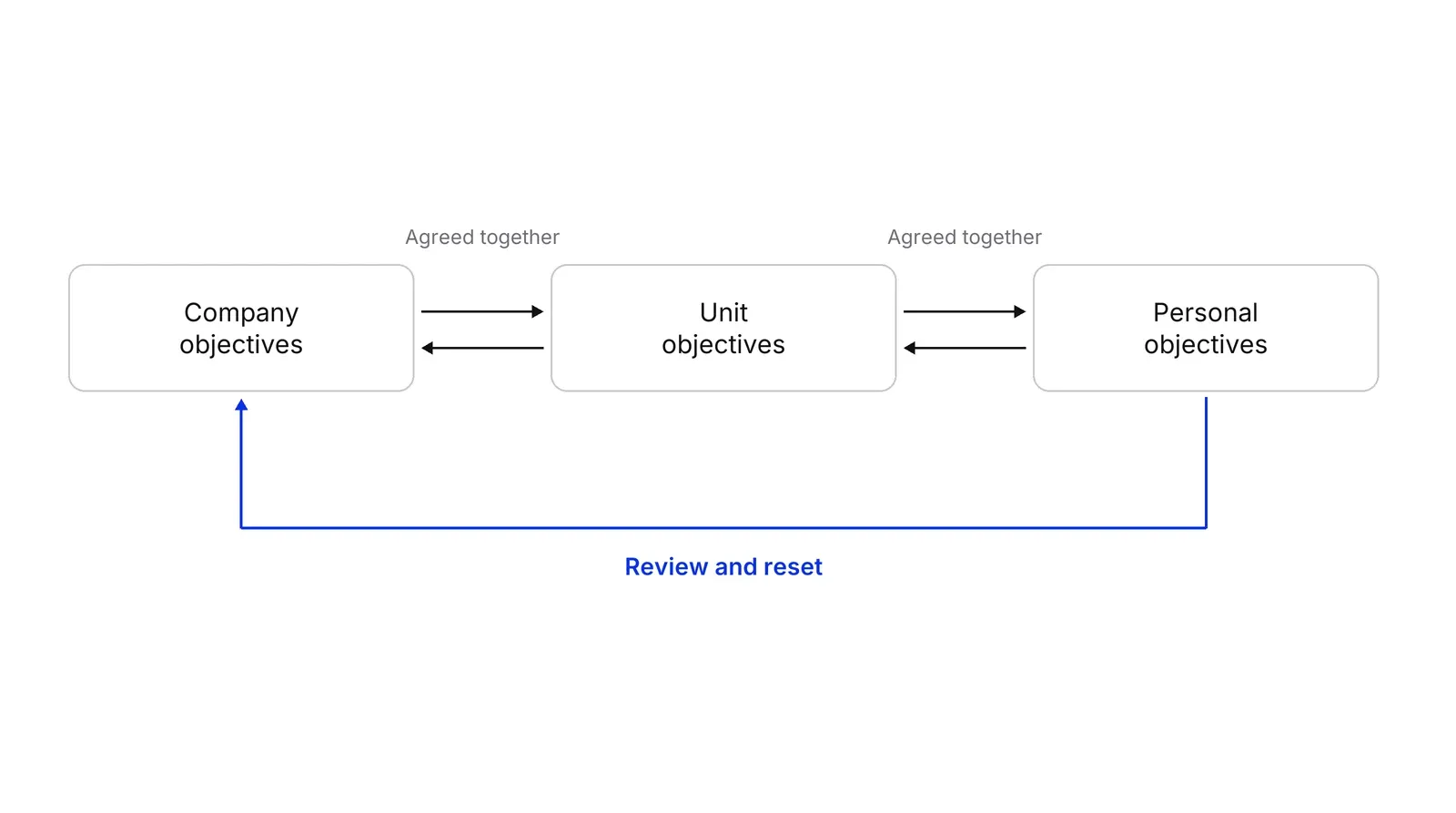
The second half of Drucker’s name for it, self-control, is the part most later versions dropped. In Levinson’s reading, Drucker held that the data should be fed back to the manager for self-control, not used by superiors as a control device. Kaplan observes where the system ended up: for half a century MBO mostly became a bureaucratic exercise run by the human resources department, built on local goals rarely informed by business strategy.
Does MBO work?
The best-known evidence is a 1991 meta-analysis by Robert Rodgers and John Hunter in the Journal of Applied Psychology. Its abstract, as indexed by OpenAlex, states the prediction: because goal setting, participation in decision making and objective feedback each raise productivity, their combination in MBO should too. The result matched: 68 of 70 studies showed productivity gains. OpenStax’s management textbook reports that only 2 showed losses and that the mean gain exceeded 40 percent.
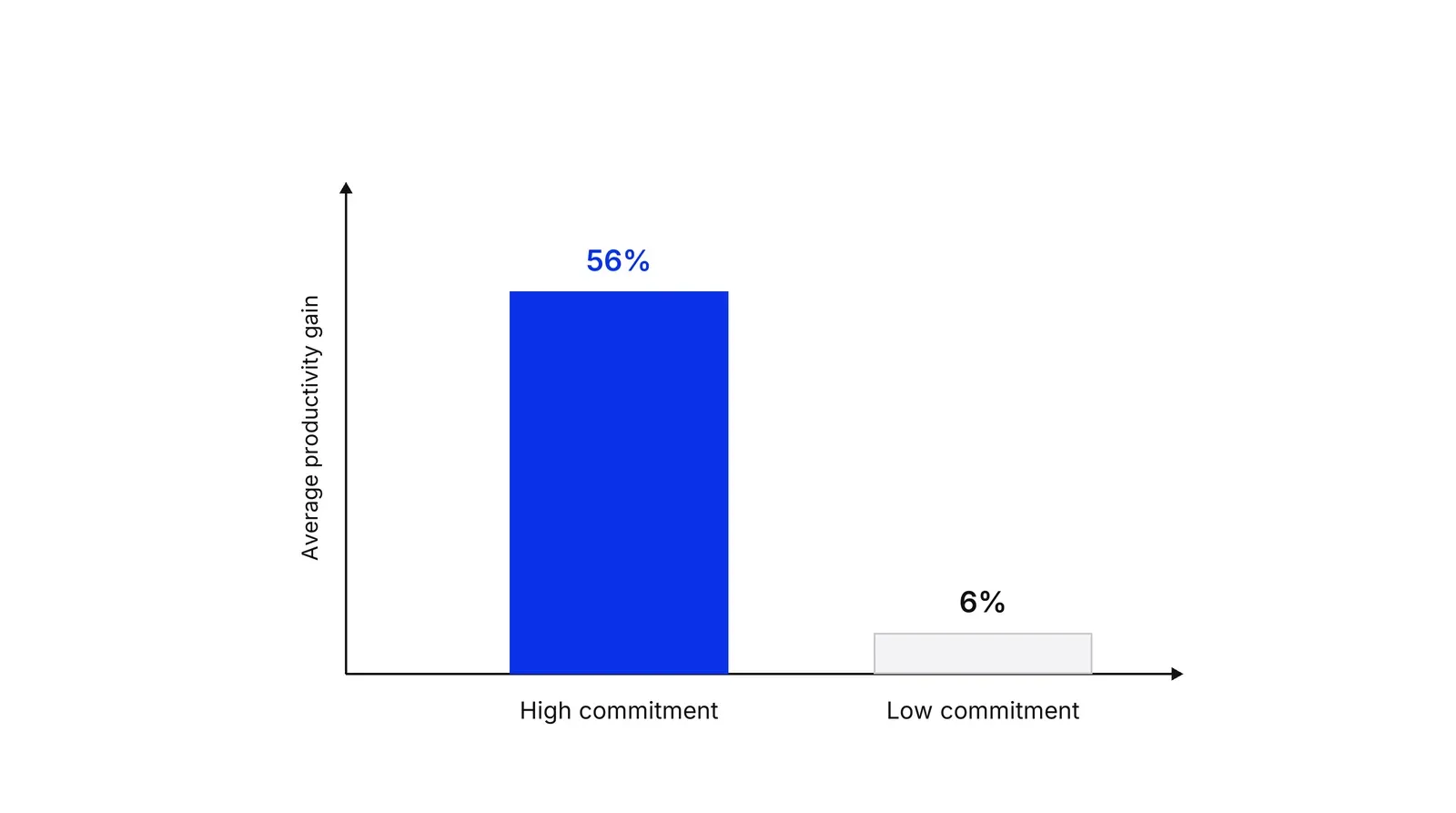
The size of the gain depended on the top team. Secondary accounts, including a 2023 paper by Jenna Butler, Thomas Zimmermann and Christian Bird, report an average gain of 56 percent where top-management commitment was high and 6 percent where it was low. We read the 1991 abstract only in part, so we could not check those two figures in the paper itself. A 1993 follow-up by Rodgers, Hunter and Debra Rogers, covering 18 studies, found a similar pattern for job satisfaction: a gain of about a third of a standard deviation under high commitment, and little improvement under moderate or low commitment.
The wider goal-setting research points the same way. A 1981 review by Edwin Locke and colleagues found that specific, challenging goals led more often to higher performance than easy goals or “do your best” goals, with 90 percent of studies showing positive or partly positive results. Locke and Gary Latham’s 2002 review adds two refinements. Goals combined with feedback beat goals alone. And an assigned goal works as well as a participatively set one if the reason for it is given, while a goal assigned tersely does worse. They also cite Locke, Alavi and Wagner’s finding that the main benefit of participation is cognitive, because it stimulates the exchange of information, not that it motivates. So the negotiation step in MBO earns its place by surfacing what each side knows.
Where MBO goes wrong
Harry Levinson’s 1970 Harvard Business Review article “Management by Whose Objectives?” argued that typical MBO efforts increase friction, bitterness and mistrust between managers and staff, and called the usual practice industrial engineering under a new name. His 1972 critique went further. Where MBO relies on rewards and punishments, he wrote, the measurable gets all the attention and a person’s task becomes narrower and faster. It also ignores what the person wants from their own career, and the rivalry between boss and subordinate.
Later research documents the side effects. Ordóñez and colleagues list a narrow focus on goal areas, a rise in unethical behavior, distorted risk preferences, damage to culture and reduced intrinsic motivation, and note that MBO focuses people on ends over means. Steven Kerr’s 1975 paper describes reward systems that pay for one behavior while the organization hopes for another. Michael Jensen argued in 2003 that paying people against budgets or targets makes them lie in the budget and then game the result. A 1999 meta-analysis of 128 experiments by Edward Deci and colleagues found that performance-contingent rewards undermined intrinsic motivation, with an effect size of d = -0.28. Harvard Business Review’s 2016 summary of the performance-management shift says more than a third of U.S. companies had abandoned traditional appraisals. Deming went furthest: according to Quality Digest, his eleventh point said to eliminate management by objectives and numerical goals and substitute leadership. The mechanism is the one in Goodhart’s law: once a number decides pay, the number is what gets worked on.
MBO compared with OKR
OKR is MBO’s best-known descendant, and the two are often confused. According to John Doerr’s WhatMatters site, Andy Grove built OKR at Intel on Drucker’s MBO, first calling it “iMBOs”. He tied each objective to key results, moved from an annual to a quarterly cycle and separated the system from compensation.
| Classic MBO | OKR | |
|---|---|---|
| Cycle | Usually annual | Quarterly |
| Shape | Objectives with targets | One objective with key results |
| Link to pay | Often tied to appraisal | Kept apart from compensation |
| Ambition | Targets meant to be met | Google treats 0.6 to 0.7 as the sweet spot |
Read OKR for how to write them, and KPI vs OKR for where ongoing metrics fit.
Making MBO hold up
Two fixes address most of the damage. The first is strategy: the balanced scorecard was built in part to link objectives to a strategy, where MBO’s objectives tended to stay local. The second is rhythm: the 4 Disciplines of Execution adds lead measures, a visible scoreboard and a weekly accountability meeting, which keep objectives alive between yearly reviews. Steven Kerr and Steve Landauer describe two stretch-goal programs built on this base: General Electric aimed at organizational effectiveness, and Goldman Sachs used personal action plans for professional development. Add one rule of your own: keep the number and the pay decision in separate conversations, and give the person their own data first.
A Growth Lab plan starts from the same question MBO asks: which few results matter this period, and who owns each one.
How to apply Management by objectives (MBO), step by step
- Fix the company objectives. Leadership writes three to five objectives for the period. Drucker asked for objectives in every area where results decide the survival of the business, which he listed as market standing, innovation, productivity, resources, profitability, manager performance, worker performance and public responsibility. Result: a short list that every unit can trace its work to.
- Let each manager draft their unit's objectives. Each manager proposes what the unit will deliver and what it needs from other units, then negotiates the draft with their boss. Drucker wanted managers to take part in setting the objectives of the unit above them. Result: unit objectives that the manager helped write and understands.
- Write each objective as a result, a measure and a date. State the result, how it will be measured, and the date. Add the contribution the unit expects from other units, so a missed objective can be traced to its cause. Result: objectives that can be checked without an argument.
- Agree the plan and give the person the data. The person owns the action plan and sees their own numbers first. Drucker's idea of self-control meant the data goes to the person doing the work, not to the boss as a control device. Result: people who correct themselves before anyone has to correct them.
- Hold reviews on a fixed rhythm. Meet monthly or quarterly for a short conversation: where the person stands against each objective, what is blocking them, what changed in the business. Revise an objective when the facts change. Result: objectives that stay live between planning cycles.
- Appraise results and talk about the person's own goals. At the end of the cycle, compare results with objectives and ask where the person wants to go next. Keep this conversation separate from a mechanical pay formula where you can. Result: an honest year-end discussion and the input for the next cycle.
Examples
A payments company
Illustrative. The company objective is to make merchant payouts reliable. The head of operations proposes: cut the share of payouts delayed beyond one working day from 8% to 3% by the end of Q4. Compliance asks for a matching unit objective: review flagged payouts within four hours, and the two heads agree what each owes the other. The operations lead's personal objective is to rebuild the bank-file schedule by the end of the quarter. Each level can see how its number serves the one above.
A dental clinic group
Illustrative. The group objective is a higher return rate for patients treated in the last year. The front-desk manager takes: book the next visit before the patient leaves for seven in ten appointments, up from four in ten. She sees her own booking figures weekly and adjusts her scripts without waiting for a review. The medical director owns a separate objective on follow-up quality, so booking volume is never the only measure of a good visit.
Sears auto repair, 1990s (documented, a warning)
Ordóñez, Schweitzer, Galinsky and Bazerman report that Sears set a sales goal of $147 an hour for auto repair staff, which led to overcharging and unnecessary repairs. Chairman Edward Brennan acknowledged that the goal-setting process had created an environment where mistakes did occur. The lesson is to pair a hard number with a quality objective and to watch what happens at the edges.
When to use it
Use it when a company has outgrown informal direction: several levels of management, units that depend on each other, and managers who each hold a different picture of what matters. It works best where results can be measured and where senior leaders are willing to use the system themselves.
When not to use it
Skip it when the work cannot be measured without distorting it, when the goals change every few weeks, or when leadership will not take part. It also fits badly where the main aim is to rank people for pay. If you need fast quarterly experiments, look at OKR instead.
Common mistakes
- Treating it as a form-filling exercise run by HR. Robert Kaplan notes that MBO mostly became a bureaucratic exercise based on local goals rarely linked to strategy.
- Assigning objectives from above with no discussion and no reason given. Latham and Erez found a tersely assigned goal gave worse results than one explained.
- Tying pay mechanically to hitting the number. Michael Jensen showed that pay linked to budgets and targets makes people game both.
- Measuring only what is easy to count. Levinson warned that unmeasured parts of a job get less attention.
- Leaving senior leaders out. The best-known meta-analysis found large gains only where top management was strongly committed.
FAQ
What is management by objectives in simple terms?
It is a way of running a company in which a manager and their boss agree what the manager will deliver, how it will be measured and by when, with each objective linked to the company's goals. Progress is checked at regular reviews, and the person sees their own results first.
Who created management by objectives?
Peter Drucker named it in The Practice of Management (1954). Albert David's 2013 genealogy argues the ideas descend from the systematic management movement that Du Pont began in the late 19th century. The commonly cited first implementation was at General Electric (1952).
Does MBO actually work?
The main evidence is a 1991 meta-analysis by Rodgers and Hunter. It found productivity gains in 68 of 70 studies, with far larger gains where top management was strongly committed. Critics such as Levinson, Deming and Jensen point to gaming, mistrust and narrow focus when MBO is tied to rewards and punishments.
What is the difference between MBO and OKR?
OKR descends from MBO. Andy Grove adapted it at Intel, paired each objective with measurable key results, ran it quarterly instead of annually, and separated it from compensation. Google also treats OKR scores as not equal to performance evaluation, and 0.6 to 0.7 is its target range.
Sources
- Peter F. Drucker, The Practice of Management, Harper & Brothers, 1954, Internet Archive record
- Robert S. Kaplan, Conceptual Foundations of the Balanced Scorecard, Harvard Business School Working Paper 10-074, 2010
- Harry Levinson, Management by Whose Objectives?, Harvard Business Review, 1970 (reprinted January 2003)
- Harry Levinson, Management by Objectives: A Critique, Training and Development Journal, April 1972, ATD
- Robert Rodgers, John E. Hunter, Impact of management by objectives on organizational productivity, Journal of Applied Psychology 76(2), 1991
- Robert Rodgers, John E. Hunter, Debra Rogers, Influence of top management commitment on management program success, Journal of Applied Psychology 78(1), 1993
- OpenStax, Principles of Management, 17.7 Management by objectives: a planning and control technique
- Albert David, Management Innovation, a Genealogical Perspective: The Case of Drucker's Management by Objectives and Self-Control, HAL, 2013
- Edwin A. Locke, Gary P. Latham, Building a practically useful theory of goal setting and task motivation, American Psychologist 57(9), 2002
- Edwin A. Locke, Karyll N. Shaw, Lise M. Saari, Gary P. Latham, Goal setting and task performance: 1969-1980, Psychological Bulletin 90(1), 1981
- Lisa D. Ordóñez, Maurice E. Schweitzer, Adam D. Galinsky, Max H. Bazerman, Goals Gone Wild, Academy of Management Perspectives 23(1), 2009
- Edward L. Deci, Richard Koestner, Richard M. Ryan, A meta-analytic review of experiments examining the effects of extrinsic rewards on intrinsic motivation, Psychological Bulletin 125(6), 1999
- Steven Kerr, On the folly of rewarding A, while hoping for B, Academy of Management Journal 18(4), 1975
- Steven Kerr, Steve Landauer, Using stretch goals to promote organizational effectiveness and personal growth: General Electric and Goldman Sachs, Academy of Management Perspectives 18(4), 2004
- Michael C. Jensen, Corporate budgeting is broken, let's fix it, Harvard Business Review, November 2001
- Michael C. Jensen, Paying people to lie: the truth about the budgeting process, European Financial Management 9(3), 2003
- Mike Micklewright, Quotality!, Quality Digest, 2010 (on Deming's point 11)
- Google re:Work, Set goals with OKRs
- WhatMatters (John Doerr), OKR meaning, definition and example
- Jenna Butler, Thomas Zimmermann, Christian Bird, Objectives and Key Results in Software Teams, arXiv, 2023
- Peter Cappelli, Anna Tavis, The performance management revolution, Harvard Business Review, October 2016
Last updated Oct 9, 2026


Fractional COO or embedded operations team? How to choose at Series A
The two models solve different problems: how to tell which one your company needs, and what each costs in time and control.

What operational systems successful fintech startups use: lessons from ten companies
Starling, Monzo, Qonto, bunq, Lunar, Pleo, Tide, Ramp, Mercury and Column scaled on four operating systems. Regulators' findings show what breaks when one of them lags behind growth.

What a revenue operations manager actually owns
Pipeline definitions, CRM hygiene, forecasting and the handoffs between marketing, sales and success. What the role covers, and how it differs from sales ops.