Packaging and bundling
Packaging and bundling decide which products and features are sold together, in which sellable units and at what price, so that the total a seller collects rises when buyers value parts differently.
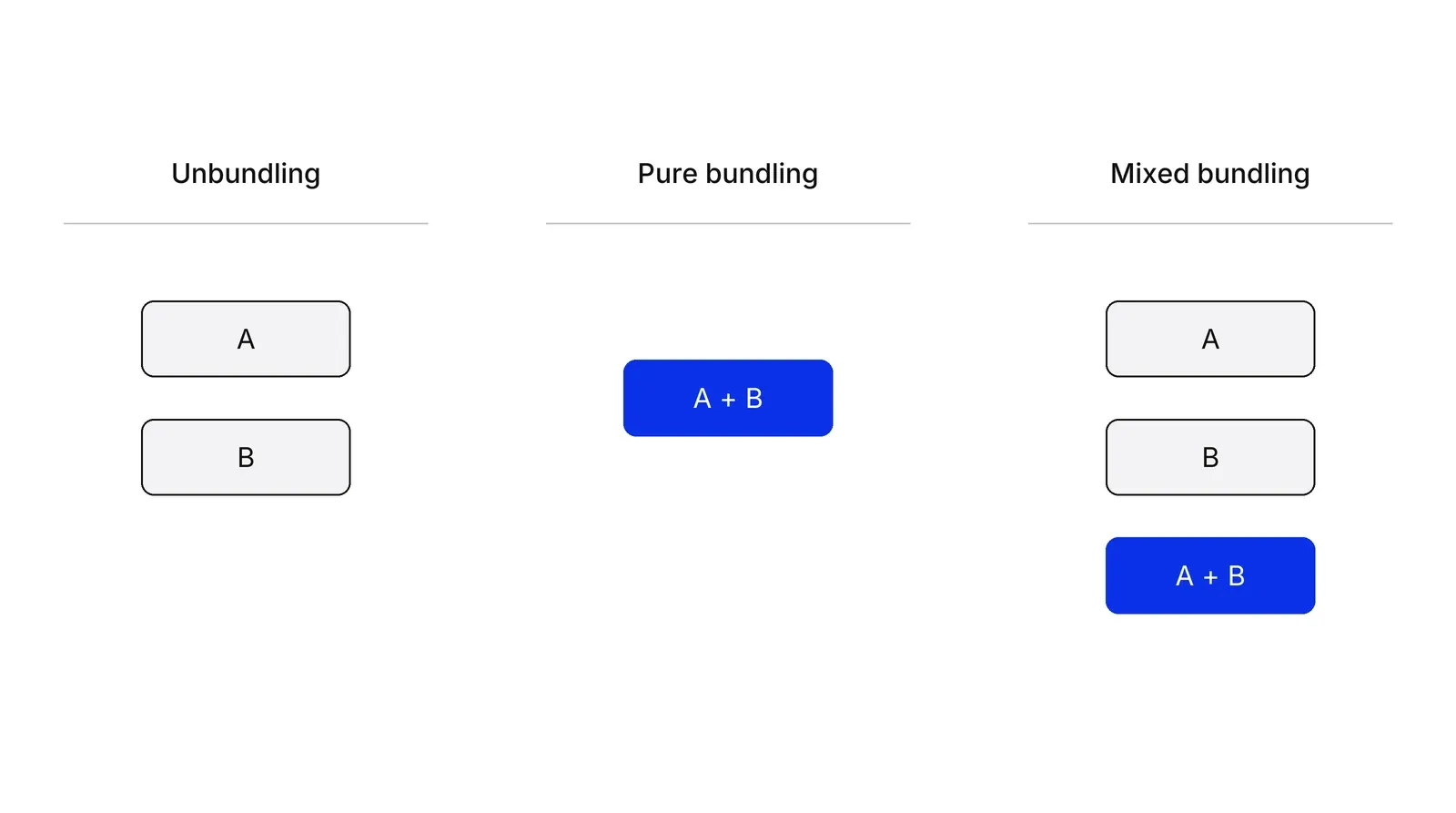
Product bundling is selling two or more products as one package. Pricing economists distinguish pure bundling (only the package is sold), mixed bundling (the package and the parts are sold) and unbundling (only parts). Bundles earn more when customers value the parts in opposite ways or when extra parts cost almost nothing to deliver, and they backfire when delivering unused parts is costly.
- Origin
- William Adams and Janet Yellen (formal analysis); George Stigler's film block-booking note is the earlier precedent. Modern marketing synthesis by Stefan Stremersch and Gerard Tellis, 1976; 2002
- Level
- 301 · Advanced
- Fits
- Small and mid-size, Scale-up
- Time to apply
- one to two weeks for a first bundle design, plus a test period
- What you need
- a list of what you sell today, with the cost of delivering each part · sales or usage data showing which customers buy which parts · a way to test: a survey of buyers, or a live split test
Product bundling is the sale of two or more separate products as one package. Packaging is the working name for the same decision inside a company: which features, services or products sit together in which plan, add-on or pack, and at what price. Academic work uses “bundling”, practitioners use “packaging”, and we treat them as one topic.
The formal analysis starts with economists William Adams and Janet Yellen in 1976, who compared three ways of selling. Haghpanah and Hartline trace the question back to George Stigler’s 1963 note on the Loew’s case, where the Supreme Court ruled film block booking a Sherman Act violation in United States v. Loew’s in 1962.
Three ways to put products on the shelf
A seller can sell only the parts, only the package, or both. Stremersch and Tellis name these unbundling, pure bundling and mixed bundling, following Adams and Yellen. Pure bundling is also called tying in the legal literature.
Their paper adds a second split. A price bundle is separate products sold together at a discount with no change to the products. A product bundle integrates the parts so that the whole is worth more than the sum, as their multimedia PC example shows. The first is a pricing and promotion tool a marketing team can launch quickly. The second needs product development.
| Price bundle | Product bundle | Customized bundle | |
|---|---|---|---|
| What changes | Price only | Parts are integrated | Buyer picks M of N parts |
| Who can launch it | Marketing, in days | Product and engineering | Pricing and product |
| Value for the buyer | A discount | Extra value from integration | Choice at a fixed price |
The third column comes from Hitt and Chen, who show that letting buyers choose up to M goods from N for one price beats both separate selling and pure bundling when goods carry some cost or tastes differ.
Why a bundle can earn more
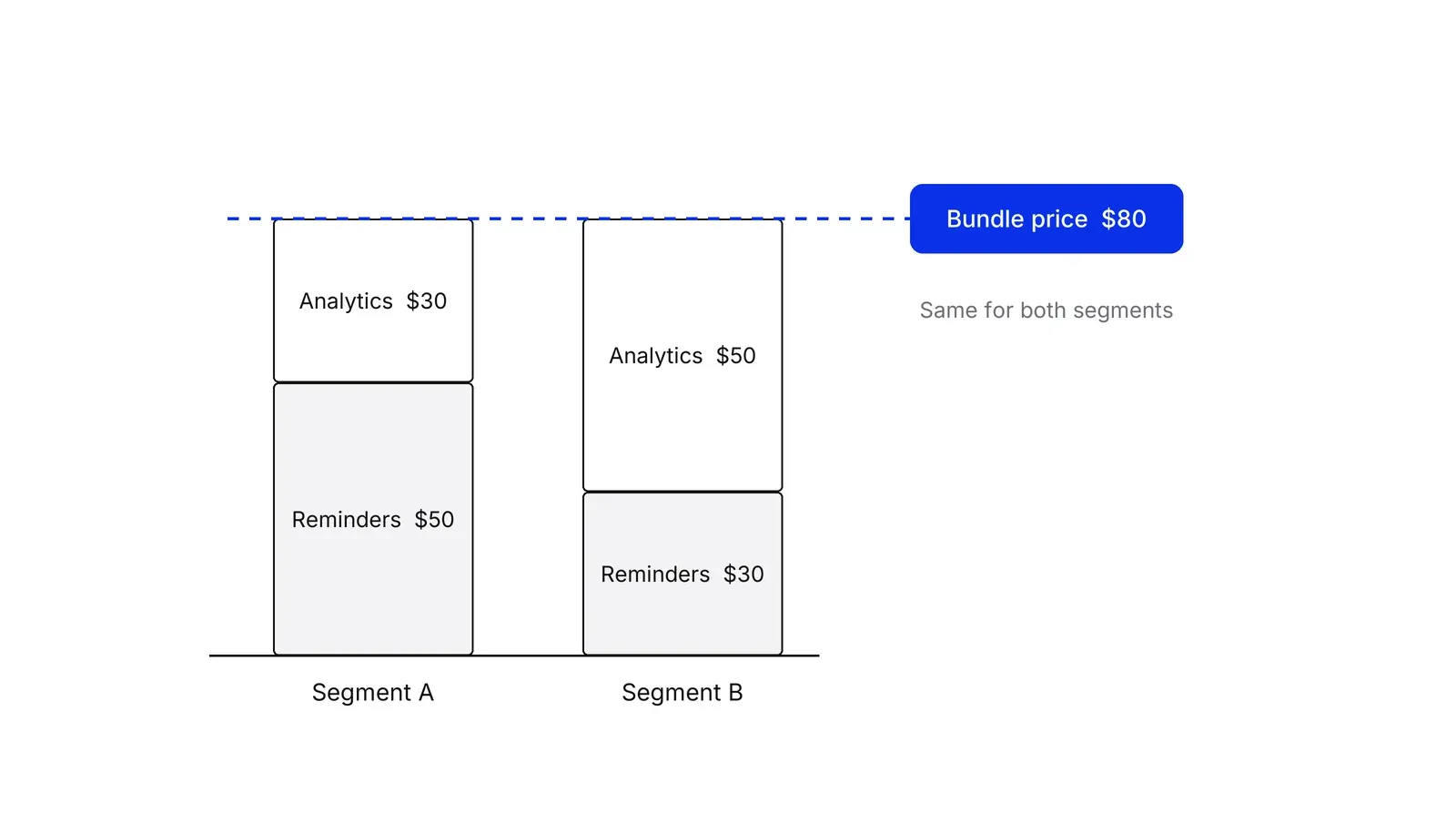
A bundle earns more when customers value the parts in opposite ways. Stremersch and Tellis state it as a proposition: a price bundle, pure or mixed, yields higher revenue than separate sales if valuations are asymmetric, meaning one segment values product X more and another values product Y more.
The reason is arithmetic. If both segments value the pair at the same total, one bundle price captures everyone, while separate prices must be set low enough to reach the segment that values each part least.
Real data is rarely this neat. McAfee, McMillan and Whinston and Schmalensee studied how the correlation between customers’ values changes the gain. Haghpanah and Hartline show that pure bundling is optimal when customers who value the whole package most also value the smaller packages relatively more, and is not optimal in the opposite case.
The zero-cost case: bundles of digital goods
Bundling large sets of goods that cost almost nothing to deliver is powerful because a seller can predict a customer’s value for the set better than for any single item. Bakos and Brynjolfsson call this the predictive value of bundling and ground it in the law of large numbers.
In their uniform-valuation illustration, a single good has a standard deviation of about 0.29 and the average over 20 goods about 0.06, so valuations bunch near the mean and one price reaches most buyers. They report higher profit per good as the bundle grows. They also state that the result depends on very low marginal cost; for ordinary goods, producing parts the buyer does not use can cancel the gain.
Their 2000 follow-up argues that larger bundlers can outbid smaller ones for content. Nalebuff argues that bundling is also an entry barrier, with gains from deterring rivals that exceed the price discrimination gains. That is the point where bundling meets competition law.
How buyers read a bundle
Buyers do not add up a bundle the way a spreadsheet does. Yadav found that people anchor on the part they find most important and adjust for the rest. Janiszewski and Cunha found that where a discount is shown matters, with reference points specific to each product. Stremersch and Tellis propose showing one bundle price rather than a list of part prices, and splitting the saving into several visible savings. Anchors work here as they do in price anchoring and the decoy effect.
Paying up front can also change what people do afterwards. Soman and Gourville studied how buyers assess the cost of services sold in a package and how that affects willingness to use them. That matters for memberships and plans: a bundle that is bought but not used rarely gets renewed.
What can go wrong
The risks are cost, unbundling and law. On cost, Eppen, Hanson and Martin treat bundles like new products and advise bundling items with high contribution margins and using pure bundles only when parts work better together.
On unbundling, Elberse’s research on music found that when buyers could pick single songs instead of albums, revenue fell; labels typically needed 8 to 10 digital songs to match one album’s revenue.
On law, a tie can be unlawful when two distinct products are forced together by a seller with market power, as the Supreme Court explained in Jefferson Parish v. Hyde and held that market power must be proven in Illinois Tool Works v. Independent Ink. Stremersch and Tellis classify mixed bundling as lawful. This is general information, not legal advice, and rules differ by country.
How it relates to tiering and offers
A tier is a bundle of features, so good-better-best tiering is packaging applied to one product. Offer architecture covers the wider design of what the buyer gets, value-based pricing sets the price level, and competitive pricing checks the bundle against rivals. For a current practitioner view, Rafi Mohammed’s 2025 HBR article argues bundles can add value through convenience and perks without being discounts. A Growth Lab plan starts from the segment data that bundle design needs.
How to apply Packaging and bundling, step by step
- List the parts and their delivery cost. Write every product, feature or service you could put in a package, with what each one costs you to deliver to one more customer. Parts that cost almost nothing to add are the best bundle candidates. Result: a one-page inventory with a delivery cost per part.
- Group customers by what they value. Use purchase history, usage data or a survey to see which customers care most about which part. You are looking for segments that rank the parts in opposite order. Result: two to four segments with the parts each one values most.
- Check how the values relate. For each pair of parts, ask whether customers who value one highly value the other lowly or highly. Opposite ranking favours a bundle, the same ranking does not. Result: a short list of pairs worth bundling and pairs to leave alone.
- Choose the form. Decide between pure bundling, mixed bundling and a pick-any-M-of-N pack. Keep the parts on sale next to the bundle unless you have a reason not to. Result: a named form for each candidate bundle.
- Set one bundle price and show the saving. Price the bundle from the segment totals, not from a flat percentage off. Show one bundle price and the saving against buying the parts one by one. Result: a bundle price, a stated saving, and a price page draft.
- Test usage, not only sales. Run the bundle with a sample of buyers and compare revenue, take-up of the bundle, and use of the included parts. Result: a go or no-go decision backed by revenue and usage.
Examples
A clinic software vendor (illustrative)
Illustrative arithmetic, no real company. A vendor sells Reminders and Analytics. Solo clinics value Reminders at $50 and Analytics at $30. Clinic chains value Reminders at $30 and Analytics at $50. There are 100 of each and delivery costs nothing extra. Sold separately, the best price for each product is $30, so 200 customers buy each and revenue is $12,000. A bundle at $80 sells to all 200 customers and brings in $16,000.
A payments provider with agreeing segments (illustrative)
Illustrative arithmetic. A provider sells card acceptance and automated payouts. Large merchants value each at $50 and small merchants at $30, 100 of each. Separately, the best price is $30 for each, so revenue is $12,000. A bundle at $60 also brings in $12,000, and at $100 only the large merchants buy and revenue is $10,000. Both groups rank the products the same way, so the bundle adds nothing.
The Disney streaming bundle, 2019
Disney announced in August 2019 that Disney+, Hulu and ESPN+ would be sold together for $12.99 a month from 12 November, about $5 less than the services cost separately, per CBS News. It is a price bundle in Stremersch and Tellis's sense: separate services at a discount, with no change to the services themselves.
When to use it
Use it when your customers split into groups that value the parts differently, when an extra part costs you little to deliver, or when buyers find it tedious to assemble the set themselves. It fits software modules, memberships, service plans and subscription content.
When not to use it
Skip it when every customer values the parts in the same order, when delivering an unused part costs real money, or when you hold market power over one product and would force a second one on buyers who do not want it. In that case get legal advice before you start.
Common mistakes
- Bundling parts that every customer ranks in the same order, so the bundle only gives away revenue.
- Filling a bundle with weak parts to make the saving look big, which tells buyers which parts to skip.
- Setting the bundle price as a flat percentage off the parts without checking what each segment will pay.
- Judging a bundle by sales alone and ignoring whether buyers use what they bought.
- Making a bundle compulsory when you dominate one of the products in it, which can turn a pricing tactic into an antitrust problem.
FAQ
What is product bundling?
It is selling two or more separate products as a single package. Economists William Adams and Janet Yellen defined it as selling goods in packages. Stremersch and Tellis later split it into price bundling, a discounted package of unchanged products, and product bundling, where the parts are integrated.
What is the difference between pure and mixed bundling?
In pure bundling the seller offers only the package. In mixed bundling the seller offers the package and each part separately. Stremersch and Tellis show mixed bundling beats pure bundling only when buyers' valuations of the whole package vary; otherwise pure bundling earns at least as much.
Why does bundling raise revenue?
When customers value the parts in opposite ways, their values for the whole set are closer together than their values for each part. One bundle price then fits more of them. Adams and Yellen made this point, and Bakos and Brynjolfsson extended it to large bundles of low-cost digital goods.
Is bundling legal?
Selling a bundle is usually lawful. Under US case law a tie can be unlawful when two distinct products are forced together by a seller with market power, per the Supreme Court in Jefferson Parish (1984). Stremersch and Tellis classify mixed bundling as legal. Check local competition law before bundling a product you dominate.
What is the difference between packaging and bundling?
Bundling is the research term for selling products together. Packaging is the practitioner term for deciding which features sit in which plan, tier or add-on. A tier is a bundle of features, so the two overlap. Good-better-best tiering is the usual form of packaging a single product.
Sources
- William Adams, Janet Yellen, Commodity Bundling and the Burden of Monopoly, Quarterly Journal of Economics 90(3), 1976
- Stefan Stremersch, Gerard Tellis, Strategic Bundling of Products and Prices, Journal of Marketing 66(1), 2002
- Yannis Bakos, Erik Brynjolfsson, Bundling Information Goods: Pricing, Profits, and Efficiency, Management Science 45(12), 1999
- Yannis Bakos, Erik Brynjolfsson, Bundling and Competition on the Internet, Marketing Science 19(1), 2000
- Preston McAfee, John McMillan, Michael Whinston, Multiproduct Monopoly, Commodity Bundling, and Correlation of Values, Quarterly Journal of Economics 104(2), 1989
- Richard Schmalensee, Gaussian Demand and Commodity Bundling, Journal of Business 57(1), 1984
- Nima Haghpanah, Jason Hartline, When Is Pure Bundling Optimal?, working paper, 2020
- Lorin Hitt, Pei-yu Chen, Bundling with Customer Self-Selection, Management Science 51(10), 2005
- Barry Nalebuff, Bundling as an Entry Barrier, Quarterly Journal of Economics 119(1), 2004
- R. Venkatesh, Wagner Kamakura, Optimal Bundling and Pricing under a Monopoly, Journal of Business 76(2), 2003
- Gary Eppen, Ward Hanson, R. Kipp Martin, Bundling: New Products, New Markets, Low Risk, MIT Sloan Management Review, 1991
- Manjit Yadav, How Buyers Evaluate Product Bundles: A Model of Anchoring and Adjustment, Journal of Consumer Research 21(2), 1994
- Chris Janiszewski, Marcus Cunha, The Influence of Price Discount Framing on the Evaluation of a Product Bundle, Journal of Consumer Research 30(4), 2004
- Dilip Soman, John Gourville, Transaction Decoupling: The Effects of Price Bundling on the Decision to Consume, Marketing Science Institute working paper, 1998
- Anita Elberse, Tracks of My Tears: Reconstructing Digital Music, Harvard Business School Working Knowledge
- Rafi Mohammed, It's Time to Try Bundled Pricing, Harvard Business Review, September 2025
- Rafi Mohammed, The Good-Better-Best Approach to Pricing, Harvard Business Review, September-October 2018
- United States v. Loew's Inc., 371 U.S. 38, Supreme Court of the United States, 1962
- Jefferson Parish Hospital District No. 2 v. Hyde, 466 U.S. 2, Supreme Court of the United States, 1984
- Illinois Tool Works Inc. v. Independent Ink, Inc., 547 U.S. 28, Supreme Court of the United States, 2006
- CBS News, Disney's Disney+, Hulu and ESPN+ bundle will cost $12.99 per month, August 2019
Last updated Oct 9, 2026


Marketing agency or growth system: when a company outgrows its agency
An agency is the right call while the founder still runs most of the company. Once the business starts copying itself into new locations or markets, it needs a system that sets goals, tests hypotheses and owns the result.

Why healthcare marketing agencies stall: the short, mid and long wins model we use with clinics
Most agencies own the click and nobody owns the front desk. How we structure clinic work in three horizons, the research behind each one, and one year of results.

Why channel tests stall after month three
Most paid channel tests do not end with a decision. They end when the budget runs out, the attribution model changes, or everyone quietly stops looking at the dashboard.