Porter's generic strategies
Porter's generic strategies is a framework for choosing how a company will beat its rivals: by having the lowest cost, by being different enough to charge more, or by doing either for one narrow segment.
Porter's generic strategies is a framework from Michael Porter's 1980 book Competitive Strategy that names three ways to outperform rivals in an industry: cost leadership, differentiation and focus, with focus later split into cost focus and differentiation focus. Porter argued that a company which tries to do all of them at once ends up stuck in the middle, with no advantage at all.
- Origin
- Michael E. Porter, 1980; focus split into two in 1985
- Level
- 201 · Tool
- Fits
- Small and mid-size, Scale-up, Enterprise
- Time to apply
- one working session for a first choice, then a quarterly check of whether budgets still match it
- What you need
- unit cost and price data for your business and two or three direct rivals · a short list of what your best customers say they pay for, in their words · one person who can say no to projects that do not fit the chosen strategy
Porter’s generic strategies is a framework for choosing how a company will beat its rivals inside one industry. Michael Porter, a Harvard Business School professor, set it out in his 1980 book Competitive Strategy, in the same volume as the five forces. He named three options: cost leadership, differentiation and focus. In his 1985 book Competitive Advantage he split focus into cost focus and differentiation focus, which is why some textbooks list three strategies and others list four. Both counts describe the same idea.
The framework is called generic because it applies to any business, from an airline to a dental clinic. Porter’s institute at Harvard sums up the logic in plain terms: a company earns above-average profit either by commanding a premium price or by having lower costs than its rivals.
Two choices behind the strategies
Each generic strategy is the answer to two questions. First, what is the source of your advantage, lower cost or something customers will pay more for? Second, how wide is your target, the whole industry or one segment of it? Cross the two and you get four boxes.
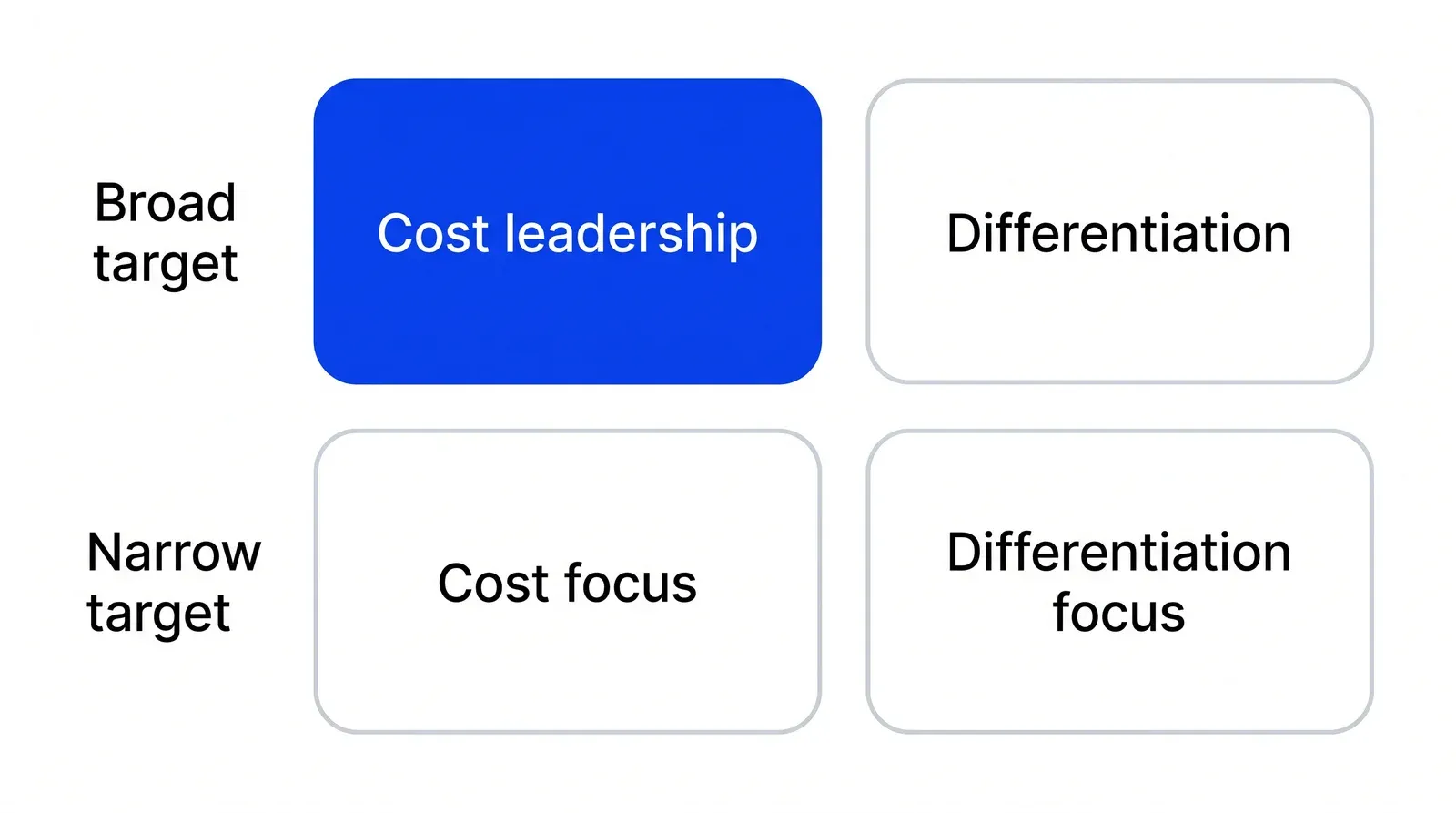
| Strategy | Target | Advantage | What it requires | Main risk |
|---|---|---|---|---|
| Cost leadership | Whole industry | Lowest cost | Scale, process discipline, tight cost control, a simple product | A rival with a new technology or cheaper inputs undercuts you |
| Differentiation | Whole industry | A premium customers will pay | Something rivals cannot copy quickly: brand, service, technology | The premium shrinks as rivals copy, or customers stop valuing it |
| Cost focus | One segment | Lowest cost for that segment | A segment whose needs let you strip out what broad players must carry | Broad players lower their own price for the segment |
| Differentiation focus | One segment | The best fit for that segment | Deep knowledge of one customer group, built into the product | The segment is too small, or broad players start serving it well |
Cost leadership: what it requires
Cost leadership means having the lowest cost in the industry, and it is often confused with having the lowest price. A low price is a choice anyone can make. A low cost is a position few can reach, built from scale, simpler products and processes that rivals have not matched.
Wise, the UK money transfer company, is a public example from payments. Its FY22 results say it has engineered away marginal costs and passed the savings on, bringing the average price of a cross-border transfer down to 0.61%. In healthcare, where Govindarajan and Ramamurti’s 2013 Harvard Business Review study presents India as an unexpected source of health care innovation, Roland Berger’s 2018 profile of Narayana Health put a coronary bypass at about $5,500 there against roughly $106,385 in the US, with surgeons doing about 30 operations a week. Both cases run on volume. Cost leadership rarely works for a company that cannot become one of the largest in its market.
Differentiation: what it requires
Differentiation means offering something customers value enough to pay more for, at a cost that leaves a margin on top. The test is whether customers actually pay the premium. A payments gateway that settles funds same day for online pharmacies, when rivals take three days, is differentiated only if pharmacies accept a higher fee for it and the faster settlement costs less to run than the extra fee brings in.
Porter’s 1996 article “What Is Strategy?” adds the condition that makes differentiation last: trade-offs. When serving one set of customers well means doing something incompatible with serving another, rivals cannot copy your position without giving up their own.
Focus: cost focus and differentiation focus
Focus means choosing a narrow segment and serving it better or more cheaply than broad competitors can. Cost focus strips out everything that segment does not need. Differentiation focus builds the product around one group’s specific needs.
Shouldice Hospital near Toronto is the textbook case of focus in healthcare. It repairs only hernias, about 7,500 a year according to The Globe and Mail in 2006, using a three-day process designed around that one operation. James Heskett’s 1983 Harvard Business School case on it had sold 258,902 copies by then. A general hospital cannot organize itself that way without giving up everything else it does.
What does stuck in the middle mean?
Stuck in the middle is Porter’s name for a company that tries to be cheap and distinctive at once and ends up with neither a cost advantage nor a premium. It earns lower returns than rivals who made a clear choice. Harvard’s Institute for Strategy and Competitiveness says Porter calls this “the kiss of death.”
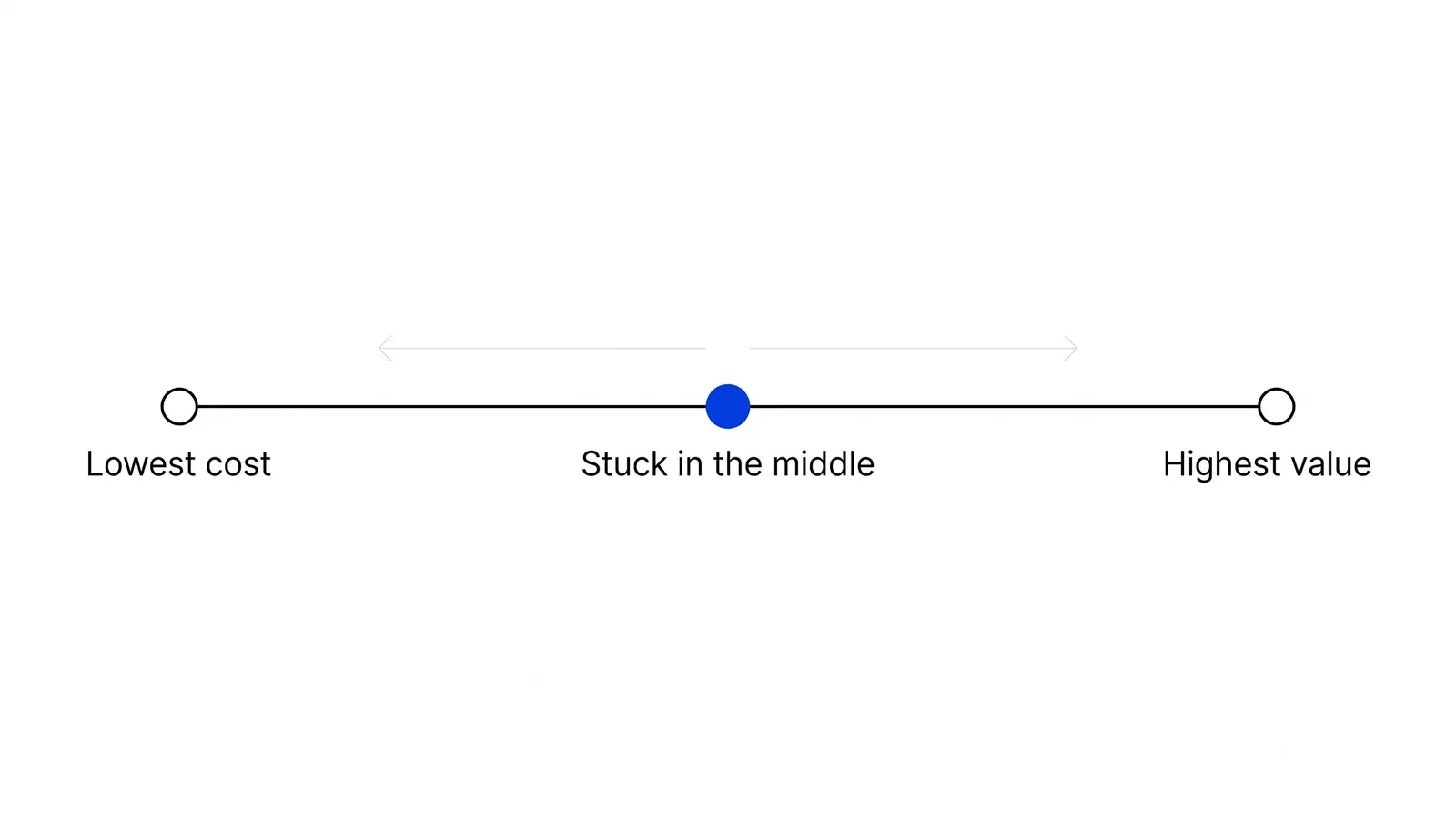
His clearest example is in “What Is Strategy?”. Continental Airlines launched Continental Lite to copy Southwest’s low-cost service on some routes while staying a full-service airline elsewhere. Porter says the attempt to compete in two ways at once carried “an enormous straddling penalty.”
Does the evidence back the stuck in the middle claim?
The evidence is split, and has been for four decades. Gregory Dess and Peter Davis (1984) found that firms do cluster into groups matching Porter’s strategies. Two 1988 papers in the Academy of Management Review, by Charles Hill and by Alan Murray, argued that cost leadership and differentiation are not mutually exclusive and that combining them can work under some conditions.
Colin Campbell-Hunt’s 2000 meta-analysis in the Strategic Management Journal pooled the earlier studies. He found that cost and differentiation are useful for describing strategies, but the claim about which designs perform better had not been supported. Stewart Thornhill and Roderick White (2007) studied 2,351 businesses across four sectors and found pure strategies never did less well than hybrids and often did better. A 2009 study of 164 Spanish firms by Eva Pertusa-Ortega and colleagues found the opposite: hybrid strategies tended to go with higher performance. Rajiv Banker and colleagues (2014), using 12,849 firm-year observations, found differentiation sustains performance longer than cost leadership but with riskier, less stable earnings.
| Study | Sample | Finding on hybrids |
|---|---|---|
| Thornhill and White, 2007 | 2,351 businesses | Pure strategies never did worse, often better |
| Pertusa-Ortega et al., 2009 | 164 Spanish firms | Hybrids tended to perform better |
| Campbell-Hunt, 2000 | Meta-analysis | Performance claim not supported either way |
Blue Ocean’s challenge
W. Chan Kim and Renée Mauborgne’s 2004 Harvard Business Review article “Blue Ocean Strategy” goes further. Their idea of value innovation is “the simultaneous pursuit of differentiation and low cost,” and their own materials describe competition-based strategy as making the value-cost trade-off, where a blue ocean strategy breaks it. Their lead example, Cirque du Soleil, grew by reinventing the circus instead of fighting rivals inside the existing market. Kim, Nam and Stimpert made a similar case for online retail in a 2004 Journal of Management paper, arguing that firms combining cost leadership and differentiation should outperform those that pick one.
A fair reading of all this: drifting into the middle is still dangerous, while a deliberate hybrid built on one real advantage can work.
How it fits with the five forces
Generic strategies answer how to win inside an industry; Porter’s five forces answers how much profit that industry allows on average. Run the five forces first, then choose a strategy that defends you against the strongest force. In Pushers’ Growth Lab work, this choice comes before any channel plan, because a cost leader and a differentiator should not be buying the same customers.
How to apply Porter's generic strategies, step by step
- Pick the battlefield. Name the industry and the customers you compete for. A cross-border payments company selling to freelancers and one selling to mid-sized importers face different rivals and different price sensitivity. Result: one sentence that defines the market you are choosing a strategy for.
- Measure where you stand on cost. Compare your unit cost (cost per transaction, per patient visit, per order) with the cheapest serious rival. If you are not within reach of the lowest cost in the market, cost leadership is not on the table. Result: a yes or no on whether cost leadership is realistic.
- Find what customers would pay more for. List the attributes your best customers value and rivals do not deliver, then check whether any of them supports a price premium larger than what it costs you to provide. Result: zero, one or two attributes that could carry a differentiation strategy.
- Decide how wide to aim. Choose between the whole market and one segment with needs the broad players serve badly, such as one procedure, one country corridor or one customer type. Result: a broad or narrow target, written down with the segment named.
- Write down what you will stop doing. Each strategy rules out activities that serve the others. A cost leader cuts features nobody pays for; a differentiator refuses to match the cheapest price. Result: a list of three to five things the company will no longer fund.
- Check budgets against the choice every quarter. Compare where money and people actually went with the strategy you chose. Drift toward everything for everyone is how companies end up in the middle without deciding to. Result: a quarterly note that either confirms the strategy or flags the projects that contradict it.
Examples
Wise and cost leadership in money transfers
Wise, the UK money transfer company, states its mission as making cross-border money movement faster, easier, cheaper and more transparent. Its FY22 results say it has engineered away marginal costs and passed the savings to customers, cutting the average price of a cross-border transfer to 0.61% in the fourth quarter of FY22. By the first quarter of FY25 its cross-border take rate stood at 0.64%, about 5% lower than the previous quarter, according to the company. Lower cost per transfer funds lower prices, which bring more volume, which lowers cost again. That loop is what cost leadership looks like when it works.
Narayana Health and cost leadership in cardiac surgery
Narayana Health, the Indian hospital group, is the most cited healthcare case of cost leadership. Roland Berger's 2018 profile put a coronary bypass at about $5,500 at Narayana against roughly $106,385 in the US. The report traces the gap to volume, with surgeons doing about 30 operations a week, roughly double the average at other major Indian hospitals, and to central purchasing of about 80% of supplies, which cut inventory costs by 15% to 40%.
A dermatology clinic choosing a focus
Illustrative, no real clinic implied. A dermatology clinic in a city of 500,000 competes with two hospital departments and a dozen general clinics. It cannot match the hospitals on cost per visit, and its general service is no better than anyone else's. It narrows to acne and acne scarring for patients aged 16 to 30, builds treatment protocols, before and after records and online booking for that group only, and stops offering cosmetic injections. That is differentiation focus: a premium for being the best option for one segment, while the broad players remain the default for everyone else.
When to use it
Use it when a company is growing but margins are flat and nobody can say in one sentence why customers choose it, when a leadership team argues about whether to cut prices or add features, or before entering a market where you need to decide what kind of player to be. It forces one explicit choice about the source of advantage and the width of the target.
When not to use it
Skip it when the question is which industry to enter or exit, which is what Porter's five forces and portfolio tools are for. It also helps little for a company that has not yet found product-market fit, since there is no stable cost position or proven premium to build a strategy on.
Common mistakes
- Calling a company a cost leader because its prices are low, when its costs are not the lowest in the market and the low price is eating its margin.
- Claiming differentiation on attributes customers do not pay for, such as an award or a feature list, without checking that the price premium exceeds the cost of providing it.
- Choosing focus as a polite word for being small, without naming a segment whose needs the broad players serve badly.
- Adding projects from every strategy at once, a cheaper plan here and a premium tier there, until the company is stuck in the middle without anyone deciding it.
- Treating stuck in the middle as a law. The research is split, and a deliberate hybrid built on one real advantage is different from drift.
FAQ
What are Porter's generic strategies?
They are three ways to gain an advantage over rivals that Michael Porter set out in Competitive Strategy in 1980: cost leadership, differentiation and focus. In Competitive Advantage in 1985 he split focus into cost focus and differentiation focus, so many textbooks list four. Each one pairs a source of advantage with a broad or narrow target.
What does stuck in the middle mean in Porter's strategy?
It describes a company that tries to be both the cheapest and the most distinctive and ends up neither. Porter argued such a firm has no cost advantage and no price premium, so it earns below-average returns. Harvard's Institute for Strategy and Competitiveness quotes him calling it the kiss of death.
Can a company pursue cost leadership and differentiation at the same time?
Porter said only in rare cases, and his 1996 article on Continental Lite shows the cost of trying. Later research is mixed. Thornhill and White found pure strategies never did worse than hybrids across 2,351 businesses, while a study of 164 Spanish firms found hybrids performed better. Blue Ocean Strategy argues companies should break the trade-off on purpose.
What is the difference between cost focus and differentiation focus?
Both target one narrow segment. Cost focus serves that segment more cheaply than broad rivals can, for example a no-frills clinic for one routine procedure. Differentiation focus serves it better than broad rivals do and charges a premium, for example a hernia-only hospital such as Shouldice in Canada.
How do Porter's generic strategies relate to the five forces?
Five forces tells you how much profit an industry structure allows on average. Generic strategies tell you how one company can earn more than that average inside the same industry. Porter presented both in Competitive Strategy in 1980, and teams usually run five forces first, then choose a generic strategy.
Sources
- University of Cambridge, Institute for Manufacturing, Porter's generic competitive strategies
- Michael E. Porter, Competitive Strategy: Techniques for Analyzing Industries and Competitors, Free Press, 1980, Internet Archive record
- Michael E. Porter, Competitive Advantage: Creating and Sustaining Superior Performance, Free Press, 1985, Open Library record
- Michael E. Porter, What Is Strategy?, Harvard Business Review, November-December 1996
- Institute for Strategy and Competitiveness, Harvard Business School, Strategic Positioning
- Institute for Strategy and Competitiveness, Harvard Business School, Business Strategy
- Gregory G. Dess, Peter S. Davis, Porter's (1980) Generic Strategies as Determinants of Strategic Group Membership and Organizational Performance, Academy of Management Journal 27(3), 1984
- Danny Miller, Peter H. Friesen, Porter's (1980) Generic Strategies and Performance: An Empirical Examination with American Data, Part I, Organization Studies 7(1), 1986
- Charles W. L. Hill, Differentiation versus Low Cost or Differentiation and Low Cost: A Contingency Framework, Academy of Management Review 13(3), 1988
- Alan I. Murray, A Contingency View of Porter's Generic Strategies, Academy of Management Review 13(3), 1988
- Colin Campbell-Hunt, What Have We Learned About Generic Competitive Strategy? A Meta-Analysis, Strategic Management Journal 21(2), 2000
- Eonsoo Kim, Dae-Il Nam, J. L. Stimpert, The Applicability of Porter's Generic Strategies in the Digital Age, Journal of Management 30(5), 2004
- Stewart Thornhill, Roderick E. White, Strategic Purity: A Multi-Industry Evaluation of Pure vs. Hybrid Business Strategies, Strategic Management Journal 28(5), 2007
- Eva M. Pertusa-Ortega, José F. Molina-Azorín, Enrique Claver-Cortés, Competitive Strategies and Firm Performance: Pure, Hybrid and Stuck-in-the-Middle Strategies in Spanish Firms, British Journal of Management 20(4), 2009
- Rajiv D. Banker, Raj Mashruwala, Arindam Tripathy, Does a Differentiation Strategy Lead to More Sustainable Financial Performance than a Cost Leadership Strategy?, Management Decision 52(5), 2014
- W. Chan Kim, Renée Mauborgne, Blue Ocean Strategy, Harvard Business Review, October 2004
- Blue Ocean Strategy (Kim and Mauborgne), Value Innovation
- Blue Ocean Strategy (Kim and Mauborgne), What Is Blue Ocean Strategy
- Wise plc, FY22 results for the year ended 31 March 2022
- Wise plc, Q1 FY25 results, 16 July 2024
- Roland Berger, Think:Act, Smart surgery and low-cost health care in India, 2018
- Vijay Govindarajan, Ravi Ramamurti, Delivering World-Class Health Care, Affordably, Harvard Business Review, November 2013
- The Globe and Mail, Hernia hospital teaches Harvard about service, January 2006
Last updated Oct 9, 2026


Marketing agency or growth system: when a company outgrows its agency
An agency is the right call while the founder still runs most of the company. Once the business starts copying itself into new locations or markets, it needs a system that sets goals, tests hypotheses and owns the result.

Why healthcare marketing agencies stall: the short, mid and long wins model we use with clinics
Most agencies own the click and nobody owns the front desk. How we structure clinic work in three horizons, the research behind each one, and one year of results.

Why channel tests stall after month three
Most paid channel tests do not end with a decision. They end when the budget runs out, the attribution model changes, or everyone quietly stops looking at the dashboard.