Brand Key
The Brand Key is Unilever's one-page model for defining a brand, running from the market and the consumer through benefits and proof to a single discriminator and a brand essence.
The Brand Key is a one-page brand positioning model used at Unilever. It records eight headings: the competitive environment, the target, the consumer insight, the benefits, the brand's values and personality, the reasons to believe, the discriminator and the brand essence. Many versions add root strengths as a ninth. Teams use it to give every brand in a portfolio the same brief format.
- Origin
- Unilever, internal brand management practice; no named inventor in public sources, Documented by Kapferer in 2004; practitioner sources say the 1990s, unconfirmed by Unilever
- Level
- 301 · Advanced
- Fits
- Scale-up, Enterprise
- Time to apply
- two to four weeks for a first Brand Key: interviews and data review, two workshops, then a test against current advertising and packaging
- What you need
- market share and switching data for the category, and the substitutes customers consider · qualitative research with the target: at least a dozen interviews or a set of focus groups · a list of the brand's verifiable proof points, such as formulation, patents, test results or heritage · a brand owner who can sign off the discriminator and the essence
The Brand Key is a one-page model for defining a brand, used at Unilever across its portfolio. It records where the brand competes, whom it serves, what truth about those people it answers, what it offers and why anyone should believe it, the single reason to choose it, and the brand essence that sums it all up.
Public documentation is thin, and that shapes this page. Unilever has never published the model. The fullest outside account comes from Jean-Noël Kapferer, who in the 2004 edition of The New Strategic Brand Management describes Unilever’s 60-page internal guide to the Brand Key. Its opening line, he reports, says the Brand Key “builds on and replaces the brand positioning statement.” Practitioner sites such as Brand Holosphere date the model to the mid-1990s. We found no Unilever source that confirms a date or names an inventor.
What are the parts of a Brand Key?
Kapferer lists eight headings, in this order. Each one answers a question, and later boxes depend on earlier ones.
| Heading | Question it answers |
|---|---|
| Competitive environment | Which alternatives does the customer weigh, including substitutes? |
| Target | Who are we for, described by needs and attitudes? |
| Consumer insight | What truth about the target does the category not answer? |
| Benefits | What does the brand do for them, functionally and emotionally? |
| Values and personality | What does the brand stand for, and how does it behave? |
| Reasons to believe | What facts make the benefits credible? |
| Discriminator | What is the single most compelling reason to choose us? |
| Brand essence | What few words hold all of it together? |
The headings group into layers that run from the outside in: the market, the consumer, the brand, the one reason to choose, and the essence at the centre. A 2006 Gabler manual of international marketing calls the brand essence “the lynchpin of the brand key.” Write it last, once every other box can support it.
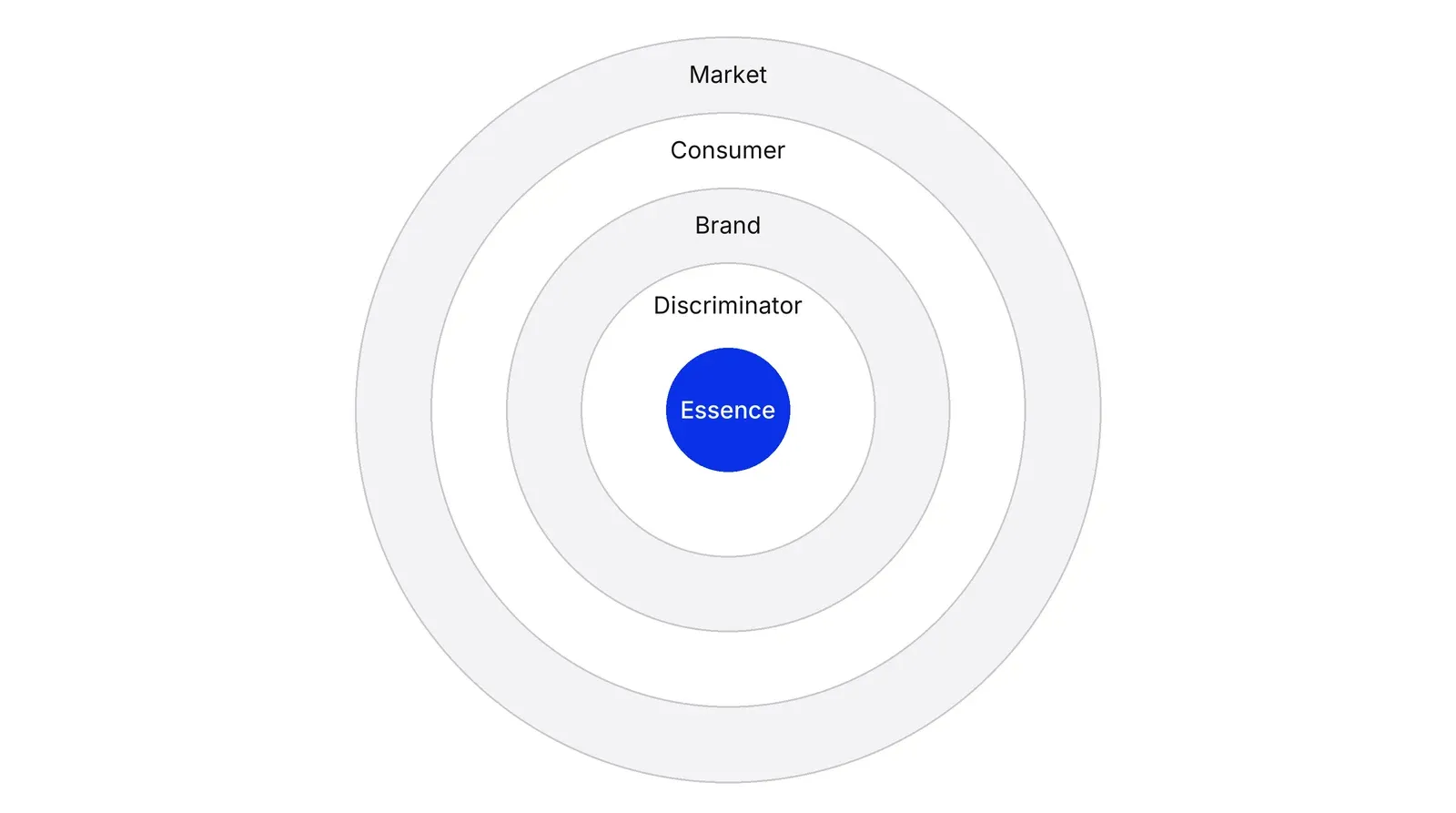
The model packages ideas that predate it. Positioning as a place in the customer’s mind comes from Al Ries and Jack Trout’s 1981 book Positioning, and Keller’s 1993 brand equity paper explains why the associations in those boxes matter. The competitive environment draws on a third idea. Kevin Lane Keller, Brian Sternthal and Alice Tybout argued in Harvard Business Review in 2002 that managers often neglect the frame of reference a brand works in. You cannot name a reason to choose a brand until you know what it is being chosen against. The values and personality box relates to Jennifer Aaker’s brand personality research, which found five dimensions, from sincerity to ruggedness, in how people describe brands.
Eight headings or nine?
Sources disagree on whether root strengths belong in the model. Kapferer’s list of eight does not include them. Practitioner summaries such as Marcom Models add root strengths as the first of nine: the brand’s origin, its original product and what it has always been good at. Umbrex lists root strength too, but leaves it out of the order in which the key is built.
In practice the ninth box is useful for an old brand with a real heritage and close to empty for a new one. If your brand has a founding product or a competence that still sets it apart, record it. If not, skip the box and say so.
How the insight leads to the discriminator
The middle of the key works as a chain. An insight names a tension the customer feels. A benefit answers it. A reason to believe proves the benefit. The discriminator picks the one reason that matters most against rivals.
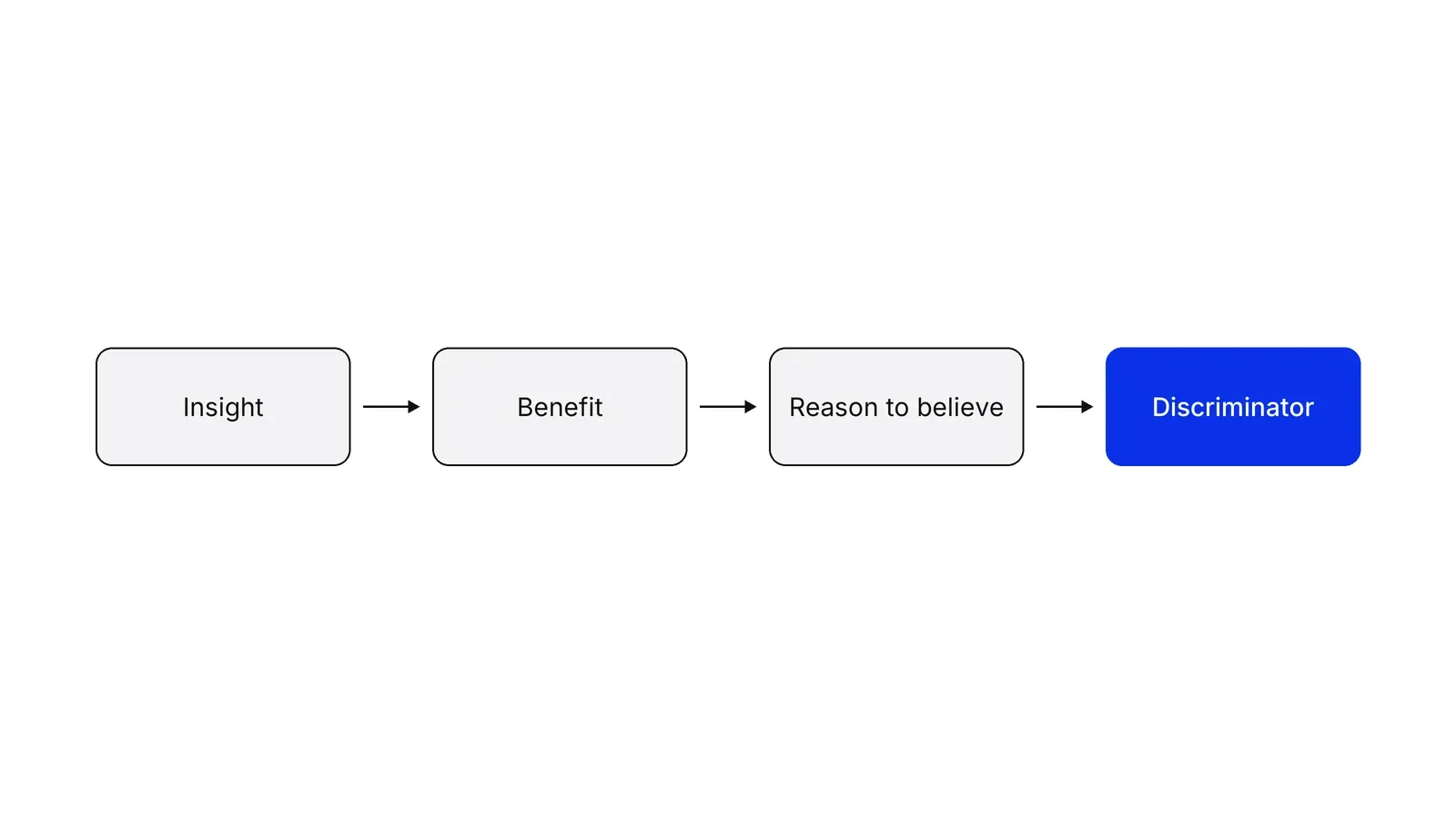
The clearest documented example comes from Unilever Belgium’s insight team, writing in an ESOMAR collection published by Wiley in 2007. For Dove soap they gave the insight that soap leaves skin feeling tight and dry, and the discriminator that Dove contains a quarter hydrating cream. The insight is something a customer would say. The discriminator is a product fact that answers it.
Kapferer defines the discriminator as the “single most compelling reason to choose.” The box takes one reason. A team that writes three has not made the choice the model asks for.
Who uses the Brand Key
Unilever uses it for brands it buys as well as brands it builds. McKinsey’s Jesko Perrey and co-authors write in Power Brands, first published in German as Mega-Macht Marke in 2011, that after Unilever acquired Ben & Jerry’s, developing a Brand Key for it was one of the first tasks. The deal itself was announced on 12 April 2000, at about $326 million, according to the joint press release. Kapferer’s 2012 edition adds that Unilever writes a key for the masterbrand and for each sub-brand.
The format has spread beyond Unilever. Nigel Hollis of Millward Brown writes in The Meaningful Brand of brand keys “like the ones used by Unilever, Kellogg, and Diageo.” Dutch textbook authors Rik Riezebos and Jaap van der Grinten give the model its own appendix in Positioneren.
Brand Key, positioning statement or brand platform?
The three overlap, and teams often hold all of them.
| Brand Key | Positioning statement | Brand platform | |
|---|---|---|---|
| Length | One page, eight or nine boxes | One or two sentences | A short document |
| Starts from | The market and the consumer insight | The target and the category | Purpose and values |
| Forces | One discriminator and one essence | One point of difference | Five internal decisions |
| Best for | Product brands in a multi-brand portfolio | Quick alignment on one offer | A company brand with staff and partners as audiences |
A positioning statement fits inside the key; the key adds the insight, the proof and the personality. A brand platform starts from purpose and values and suits a company brand better. In Pushers’ marketing-operational system work, the test of any of these documents is whether briefs, packaging and sales scripts actually follow it.
Criticism
The model has critics, and their points help you use it well. Douglas Holt and Douglas Cameron, in Cultural Strategy, describe a team whose research was boiled down into the eight text boxes of a brand key. They present it as standard practice at large consumer goods companies and as an example of what they call mindshare marketing, which they criticise for keeping brands competing on the same functional and emotional benefits.
A second challenge comes from the Ehrenberg-Bass Institute. Work by Jenni Romaniuk, Byron Sharp and Andrew Ehrenberg, summarised by the institute, found that most buyers do not see the brands they buy as very different from rivals, yet those brands still sell. That questions how much weight a discriminator can carry. Arkwright’s account of Persil gives an insider’s view. He calls the Brand Key “the safe confines of a positioning tool” and credits the work of assembling it with showing the team its gaps. Read that way, the key is a check on a brand idea, and the idea itself still has to come from research and creative work.
How to apply Brand Key, step by step
- Define where the brand competes. Write down the competitive environment as customers see it: direct rivals, substitutes and the option of doing nothing. A hand-wash brand competes with bar soap and with shower gel, not only with other hand washes. Result: a short list of the alternatives the brand has to beat.
- Describe the target and find the insight. Describe the target by needs and attitudes, not only age and income, then look in the research for a truth about them that the category has not answered. Test each candidate: would a customer recognise it in their own words? Result: one target description and one consumer insight.
- Fill the brand boxes from the insight. Write the benefits that answer the insight (functional and emotional), the values and personality the brand will show, and the reasons to believe, the facts that make the benefits credible. Cut any benefit that has no reason to believe behind it. Result: three filled boxes that each trace back to the insight.
- Choose one discriminator. From the benefits and proof, pick the single most compelling reason to choose this brand over the alternatives named in step one. If the team cannot agree on one, the positioning is not finished. Result: one sentence that a salesperson or a packaging designer can use.
- Write the essence last. Sum the key up in a few words that every other box supports. Writing it first tends to produce a slogan that the boxes then have to justify. Result: a brand essence the whole team can repeat.
- Test it against what the brand already does. Lay the current pack, ads, website and sales script next to the key and mark anything that contradicts it. Fix the materials or fix the key. Result: a Brand Key that matches what customers actually see, and a list of changes.
Examples
Dove's insight and discriminator
In a 2007 ESOMAR collection of market research case studies, Unilever Belgium's insight team gave examples of how brands are built on a consumer insight and a brand discriminator. For Dove soap, the insight was that soap leaves skin feeling tight and dry. The discriminator was that Dove contains a quarter hydrating cream, so it does not. The two boxes form a pair: a problem the customer feels, and a fact about the product that answers it.
Persil and the limits of the form
David Arkwright, a former global vice president for Persil and Omo at Unilever, wrote a 2013 book on how the Dirt is Good idea took shape. He describes putting the team's new thinking about parenting into a positioning tool, the Brand Key, and says that assembling the key showed the team where the gaps were. Unilever's own brand history dates the Dirt is Good idea to the early 2000s, after decades of advertising whiteness and then science.
A dental clinic group writing its first key
Illustrative, no real company implied. A group of six dental clinics competes with independent dentists and with doing nothing until it hurts. Target: working parents who postpone their own check-ups. Insight: they book for their children but feel there is never a free hour for themselves. Benefit: family appointments in one visit. Reason to believe: parallel chairs and a booking system that books two patients at once. Discriminator: the whole family seen in one hour. Essence: dentistry that fits family time.
When to use it
Use it when a company runs several brands and needs one format for briefing agencies, product teams and markets; when a brand is being acquired, launched or repositioned and the team must agree its positioning in writing; or when marketing materials across countries have drifted apart. It suits product brands in consumer markets, where the model was built.
When not to use it
Skip it for a startup that has not yet found what customers buy it for, because the boxes will be filled with guesses. It is a weak fit for a corporate brand that must speak to investors, staff and regulators as well as customers, where a brand platform or an identity model covers more ground. Do not use it as a substitute for research: a key filled in a workshop without customer data only records opinions.
Common mistakes
- Writing the essence first and then filling the other boxes to justify it, which produces a slogan with decoration around it.
- Listing reasons to believe that customers cannot check or do not care about, such as internal process names.
- Choosing several discriminators. The box asks for the single most compelling reason to choose, and a list means the team has not decided.
- Treating the consumer insight as a demographic fact. 'Women aged 25 to 40' is a target; an insight is a truth about how they feel or behave that the category ignores.
- Filling in the key once and filing it. A key that never gets checked against packaging and advertising stops describing the brand.
FAQ
What is the Unilever Brand Key?
It is the one-page format Unilever uses to define each of its brands. Jean-Noël Kapferer describes it as part of a 60-page internal guide whose opening says the Brand Key builds on and replaces the brand positioning statement. It lists the market, the target, the insight, the benefits, values, proof, the discriminator and the essence.
What are the elements of the Brand Key model?
Kapferer lists eight headings: competitive environment, target, consumer insight, benefits, values and personality, reasons to believe, discriminator and brand essence. Many practitioner versions add root strengths, the brand's origin and lasting competence, as a ninth element. Unilever has not published the model itself, so the exact wording varies by source.
What is a discriminator in a Brand Key?
The discriminator is the single most compelling reason for the target to choose the brand over the alternatives in its competitive environment. It is usually one sentence. In Unilever's Dove example, the discriminator was that the soap contains a quarter hydrating cream, which answers the insight that ordinary soap dries the skin.
Is the Brand Key the same as a brand wheel?
They are close relatives, and the names are sometimes swapped, especially in translation. Brand wheel is a loose label for several agency models that put a brand essence at the centre with benefits and personality around it. The Brand Key adds the competitive environment and the consumer insight, and forces one discriminator.
What is a reason to believe in branding?
A reason to believe is a verifiable fact that makes a claimed benefit credible: an ingredient, a technology, a test result, a certification or a track record. In a Brand Key each benefit should have at least one. If a benefit has no reason to believe behind it, customers have little cause to accept it.
Sources
- Jean-Noël Kapferer, The New Strategic Brand Management: Creating and Sustaining Brand Equity Long Term, Kogan Page, 2004, Internet Archive record
- Jean-Noël Kapferer, The New Strategic Brand Management: Advanced Insights and Strategic Thinking, 5th edition, Kogan Page, 2012, Internet Archive record
- Douglas Holt, Douglas Cameron, Cultural Strategy: Using Innovative Ideologies to Build Breakthrough Brands, Oxford University Press, 2010, Internet Archive record
- Jesko Perrey, Tjark Freundt, Dennis Spillecke, Power Brands: Measuring, Making, and Managing Brand Success, Wiley, 2015, Internet Archive record
- Jesko Perrey, Thomas Meyer, Mega-Macht Marke: Erfolg messen, machen, managen, Redline, 2011, Internet Archive record
- David Arkwright, The Making of Dirt Is Good: A Personal Journey of Brand Transformation, LID Publishing, 2013, Internet Archive record
- ESOMAR, Market Research Best Practice: 30 Visions for the Future, Wiley, 2007, Internet Archive record
- Nigel Hollis, The Meaningful Brand: How Strong Brands Make More Money, Palgrave Macmillan, 2013, Internet Archive record
- Manual of International Marketing, Gabler, 2006, Internet Archive record
- Rik Riezebos, Jaap van der Grinten, Positioneren: Stappenplan voor een scherpe positionering, 4th edition, Boom, 2018, publisher preview (appendix 1: Brand Key model)
- Rik Riezebos, Jaap van der Grinten, Positioning the Brand: An Inside-Out Approach, Routledge, 2012
- Kevin Lane Keller, Brian Sternthal, Alice Tybout, Three Questions You Need to Ask About Your Brand, Harvard Business Review, September 2002
- Kevin Lane Keller, Conceptualizing, Measuring, and Managing Customer-Based Brand Equity, Journal of Marketing 57(1), 1993
- Jennifer Aaker, Dimensions of Brand Personality, Journal of Marketing Research 34(3), 1997, Stanford GSB record
- Al Ries, Jack Trout, Positioning: The Battle for Your Mind, McGraw-Hill, 1981, Internet Archive record
- Ehrenberg-Bass Institute, Differentiation vs. distinctiveness, i.e. stand out or be distinctive (on Romaniuk, Sharp and Ehrenberg, Australasian Marketing Journal, 2007)
- Unilever and Ben & Jerry's Homemade, joint press release of 12 April 2000, SEC filing
- Unilever, OMO brand page (Dirt Is Good history)
- Umbrex, Brand Key (Unilever), practitioner summary
- Uli Drömann, Brand Holosphere, Unilever Brand Key, 2018, practitioner summary
- Marcom Models, Brand Key, practitioner summary
Last updated Oct 9, 2026


The compliance layer under fintech marketing operations
A fintech marketing agency can build campaigns. It cannot own the compliance review, the KYC drop-off or the multi-market licensing rules that decide whether a lead ever becomes a customer.
Fractional CMO: what you get, and what has to exist underneath
A fractional CMO brings strategy and judgment. Without reporting, CRM hygiene and a named owner per number, the engagement produces a slide deck instead of a system.

The operations layer behind healthcare patient acquisition
Ads and search bring the request in. What happens between the click and the booked, attended visit decides whether the spend paid off.