Brand architecture
Brand architecture is the plan for how a company's brands relate to each other, so every new product gets a name, a role and a clear link to the parent, or a clear distance from it.
Brand architecture is the organizing structure of a company's brand portfolio: which brands exist, what role each plays and how closely each is tied to the parent. David Aaker and Erich Joachimsthaler's 2000 brand relationship spectrum sorts the options into four strategies: a branded house, subbrands, endorsed brands and a house of brands. Teams use it to name new products and clean up cluttered portfolios.
- Origin
- David A. Aaker and Erich Joachimsthaler, 2000 (earlier identity typology: Wally Olins, 1989)
- Level
- 401 · Expert
- Fits
- Scale-up, Enterprise
- Time to apply
- two to four weeks for a portfolio audit and a naming rule; one meeting per new product after that
- What you need
- a full list of every brand, subbrand and product name the company uses, with revenue for each · customer research on what each name means to buyers, even 10 to 15 interviews per brand · the growth plan for the next three years, so the structure has room for what comes next · one executive with the authority to retire or merge brands
Brand architecture is the structure that decides how a company’s brands relate to one another: which names exist, what job each one does and how visible the parent is behind each. David Aaker and Erich Joachimsthaler defined it in their 2000 California Management Review article as the organizing structure of the brand portfolio, one that specifies brand roles and the relationships between brands. The same year they built the idea into their book Brand Leadership.
The question is older than the term. Wally Olins’s 1989 book Corporate Identity sorted companies into three identity structures, monolithic, endorsed and branded, a model that Melewar, Saunders and Balmer tested on UK firms in Malaysia in 2000. What Aaker and Joachimsthaler added was the graded middle: a spectrum with steps between one name for everything and many unrelated names.
The brand relationship spectrum
The spectrum is a line with four strategies on it. At one end is a branded house, where a single master brand covers every offer and the product names are plain descriptors. At the other end is a house of brands, where each brand stands alone and the parent stays out of sight. Subbrands and endorsed brands sit in between, as WARC’s summary of the model describes.
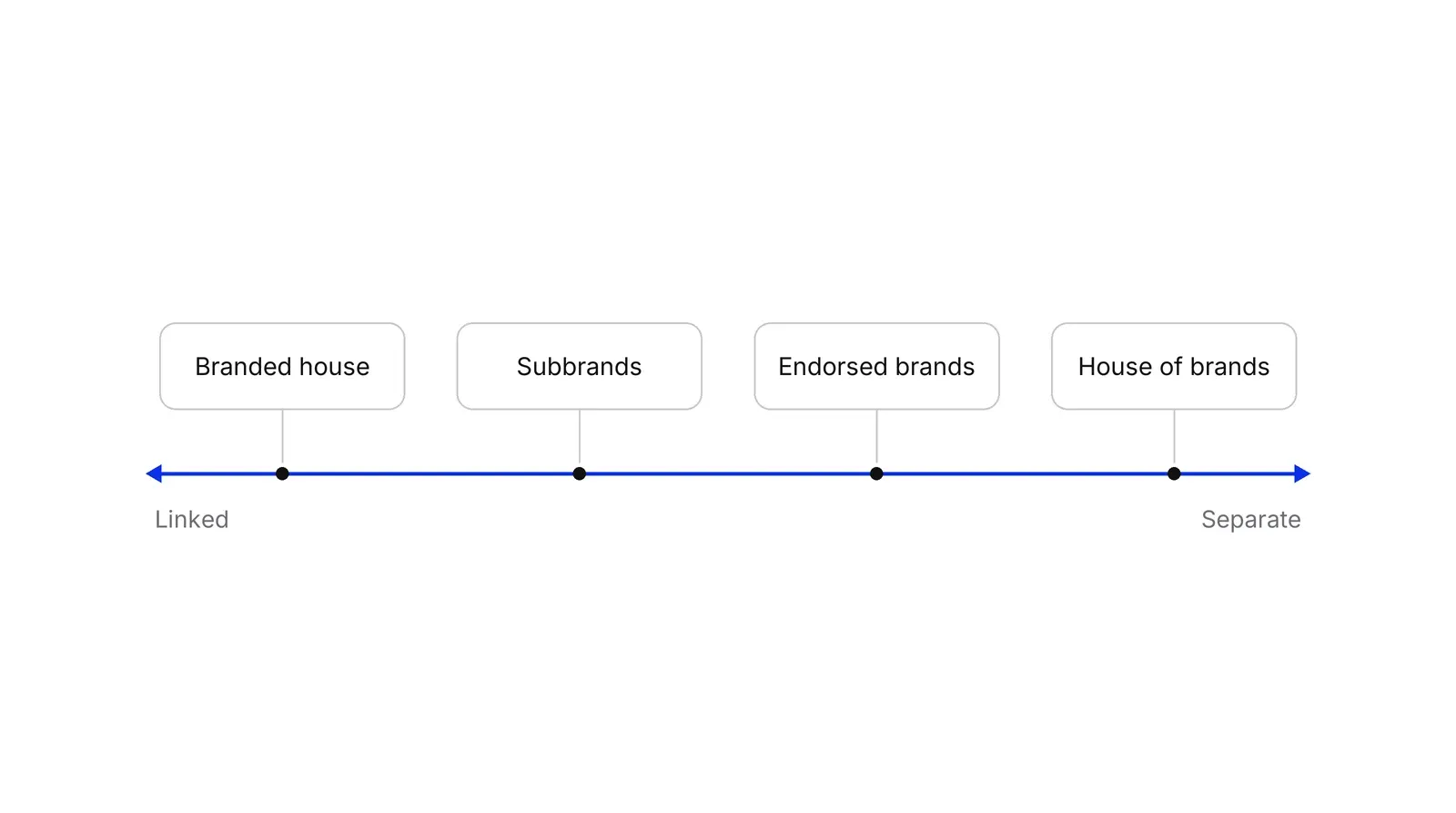
Each strategy splits into sub-strategies, nine in total. The examples below are the standard ones from the original work, as listed by the brand consultancy Vivaldi.
| Strategy | Sub-strategy | Example |
|---|---|---|
| Branded house | Same identity | BMW |
| Branded house | Different identity | Levi’s in Europe and the US |
| Subbrands | Master brand as driver | Buick LeSabre |
| Subbrands | Co-driver | Gillette Mach3 |
| Endorsed brands | Strong endorsement | Courtyard by Marriott |
| Endorsed brands | Linked name | McMuffin |
| Endorsed brands | Token endorsement | Universal Pictures, a Sony company |
| House of brands | Shadow endorser | Lexus, from Toyota |
| House of brands | Not connected | Saturn, from GM |
The driver idea matters here. A driver brand is the one that carries the purchase decision. In a branded house the master brand drives; with a co-driver, the subbrand shares that weight; in a house of brands, the stand-alone brand drives alone.
Branded house: one name does the work
A branded house puts all the marketing money behind one name. Every new product inherits trust it did not have to earn, and every campaign builds the same asset. Aaker’s 2004 article on the corporate brand argues that a corporate brand can differentiate a firm, simplify brand management and build credibility, provided it stays relevant to strategy and away from controversy.
Moving toward a branded house has a price. When FedEx decided in 2008 to rename FedEx Kinko’s as FedEx Office, its 8-K filing announced a charge of about $891 million, of which $515 million was an impairment of the Kinko’s trade name. Mark Ritson, writing in Marketing Week in 2015, saw Coca-Cola’s one-brand approach in the UK as part of a wider shift by large companies toward the corporate brand, driven by cost savings, retailer power and digital media.
House of brands: each brand on its own
A house of brands lets each brand target its own segment with its own promise, and keeps trouble in one brand from spreading to the rest. The cost is that every brand needs its own budget. Johnson & Johnson’s consumer arm shows the logic. Its brands, Tylenol, Neutrogena, Listerine and Band-Aid among them, were strong enough on their own that the business left as Kenvue in 2023 under a corporate name customers had never seen.
Alphabet is a variant at the holding level. Larry Page’s 2015 founders’ letter called it “mostly a collection of companies” and said it was not meant to become a big consumer brand.
Subbrands and endorsed brands: the middle ground
The middle of the spectrum is about buying distance. Aaker sets out the order in his portfolio checklist: a subbrand allows some distance from the master brand, an endorsed brand more, and a new brand the most. He recommends the middle options for vertical moves, when a brand goes much cheaper or much more premium.
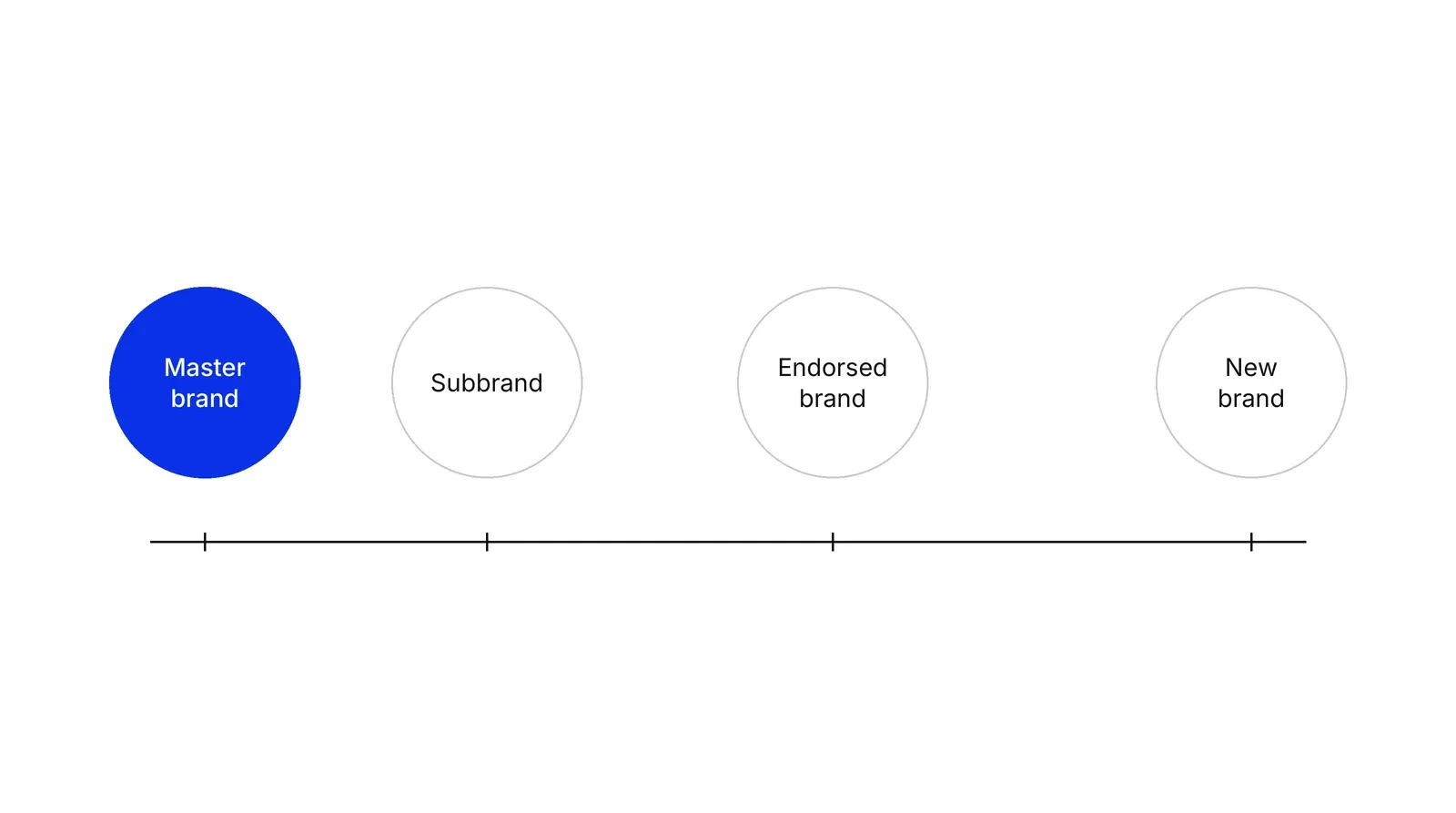
Marriott runs most of the spectrum at once. Its annual report lists more than 30 brand names, including endorsed ones such as Courtyard by Marriott and Fairfield by Marriott next to The Ritz-Carlton and W Hotels, which carry no Marriott name. The shadow endorser is the quietest form: Aaker describes in a Prophet essay how Toyota stays out of sight behind Lexus, so the Lexus buyer gets the self-expressive benefits of the brand.
What does the research say about which pays?
The evidence leans toward corporate branding but is far from settled. Rao, Agarwal and Dahlhoff studied 113 US firms over five years and found, in their 2004 Journal of Marketing paper, that corporate branding was linked to a higher Tobin’s q, a ratio of market value to asset value, and mixed branding to a lower one.
Hsu, Fournier and Srinivasan extended that study in 2016 by adding subbranding and endorsed branding and by measuring stock risk as well as returns. They found the risk and return of the middle strategies differ from what common wisdom assumes. Andreas Strebinger’s study of 75 leading Austrian companies found that industry explained 23% of the variance in branding strategy and company strategy 28%, with service firms leaning toward corporate brands.
Services deserve a note. Rahman, Areni and McDonald found in 2009 that a missing subbrand in services often signals a missed chance to differentiate, a useful warning for banks and clinic groups that put one name on everything.
How it connects to the rest of brand work
Architecture decides how brands relate; it says nothing about what each brand means. That comes from the brand platform, and the value each brand holds can be audited with the Aaker brand equity model. In Pushers’ marketing operational system work, the naming rule from step four sits in the same playbook as the launch process, so product teams apply it before a name reaches a designer.
How to apply Brand architecture, step by step
- List every name in use. Collect every corporate, product, service and feature name from websites, packaging, contracts and app stores. Mark which ones customers actually say when they talk about you. Result: a portfolio map, usually far longer than the leadership team expects.
- Give each brand a role. For each name, write one line on its job: master brand, endorser, subbrand, stand-alone brand or plain descriptor. Aaker's rule is that every brand needs a clear role and should support the others. Result: a list where brands without a role stand out.
- Place each brand on the spectrum. Decide where each sits between branded house and house of brands, and whether that position is a choice or an accident. Look hardest at products whose audience, price level or risk differs from the parent's. Result: the current architecture drawn on one page.
- Write the rule for new products. Turn Aaker's three questions into a decision rule: does the master brand help the new offer, does the offer help the master brand, and is there a compelling reason for a new name? Result: a one-page naming rule that product teams can apply without a meeting.
- Cut, merge or move brands. Retire names with no role, fold weak subbrands into descriptors and move brands along the spectrum where the risk or audience demands it. Budget for the change, since a name that disappears can carry an accounting write-off. Result: a migration plan with dates and owners.
Examples
Square becomes Block: a fintech separates its corporate name
On 1 December 2021 Square, Inc. announced it would change its corporate name to Block. The Square name stayed with the Seller business, while Cash App, TIDAL and the developer platform TBD sat beside it under the new parent, and the Square Crypto unit was renamed Spiral. Jack Dorsey said the company had built the Square brand for its Seller business, which is where it belonged. The move took the company away from a branded house, where one name covered a payments terminal and a consumer money app, toward separate brands under a corporate parent.
Kenvue: consumer health brands leave Johnson & Johnson
In September 2022 Johnson & Johnson named its planned consumer health company Kenvue. The business had $14.6 billion in revenue in 2021, sold under brands such as Tylenol, Neutrogena, Listerine, Band-Aid and Aveeno. Kenvue listed in May 2023 and J&J completed the separation through an exchange offer in August 2023. Kenvue's annual report lists the failure of its rebranding and its continued use of legacy Johnson's branding among its risk factors.
A dental group choosing between one name and many
Illustrative, no real company implied. A dental group runs eight clinics under one name and buys an orthodontics chain with its own following and premium prices. A branded house would rename the chain and pool all marketing behind one name. The group instead picks a strong endorsement, keeping the chain's name with 'part of' the group's name underneath, because the chain's patients chose it for a specialist image the general clinics do not have. It reviews the decision after a year of booking data.
When to use it
Use it when a company is about to launch a product for a new audience or price level, after an acquisition that brings its own brands, when the portfolio has grown faster than anyone planned and customers confuse the names, or before a corporate rename. It helps any time someone asks whether a new offer should carry the parent's name.
When not to use it
Skip it for a company with one product and one name, where the question has not come up yet. It also does not tell you what a brand should stand for; that is the work of positioning and a brand platform. And it cannot rescue a weak product: moving a failing brand along the spectrum rarely changes why customers left.
Common mistakes
- Treating the choice as binary, branded house or house of brands, and ignoring the endorsed and subbrand options in between, which is where many portfolios end up.
- Creating a new brand for every product because it feels safer, then lacking the budget to build any of them.
- Stretching the master brand into a much cheaper or much more premium tier without a subbrand or endorsement to protect it.
- Renaming acquired brands for neatness without counting what the old name was worth to its customers, or the write-off the change may trigger.
- Letting the architecture drift by default, with each product team naming its own launches.
FAQ
What is brand architecture?
Brand architecture is the structure that sets how a company's brands relate to each other: which names exist, what role each plays and how visible the parent is behind each one. Aaker and Joachimsthaler defined it in 2000 as the organizing structure of the brand portfolio, specifying brand roles and the relationships between brands.
What is the difference between a branded house and a house of brands?
A branded house uses one master brand across many offers, with plain descriptors for each, as FedEx does with FedEx Office. A house of brands runs separate stand-alone brands, each built for its own market, with the parent kept in the background, as Kenvue does with Tylenol and Neutrogena. Most companies sit somewhere between the two.
What is an endorsed brand?
An endorsed brand has its own name and identity but carries a visible link to a parent, usually the corporate brand. Courtyard by Marriott is the standard example. Aaker and Joachimsthaler split endorsement into token endorsement, linked names that share a prefix, and strong endorsement, depending on how prominent the parent is.
What are the types of brand architecture?
The brand relationship spectrum names four strategies: branded house, subbrands, endorsed brands and house of brands. Each has sub-strategies, nine in total, from a shadow endorser, where the parent is hidden but known, to a branded house with one identity everywhere. Wally Olins's 1989 identity model used three: monolithic, endorsed and branded.
Which brand architecture strategy is best?
No single strategy wins everywhere. A study of 113 US firms by Rao, Agarwal and Dahlhoff found corporate branding linked to higher Tobin's q and mixed branding to lower. Later work by Hsu, Fournier and Srinivasan showed that risk changes the picture, and a study of 75 Austrian companies found industry shapes much of the choice.
Sources
- David A. Aaker, Erich Joachimsthaler, The Brand Relationship Spectrum: The Key to the Brand Architecture Challenge, California Management Review 42(4), 2000
- David A. Aaker, Erich Joachimsthaler, Brand Leadership, Free Press, 2000, Internet Archive record
- Prophet, Book: Brand Portfolio Strategy by David Aaker
- David Aaker, Prophet, The Power of the Shadow Endorser
- David Aaker, Prophet, 10 Steps to Build a Successful Brand Portfolio Strategy
- David A. Aaker, Leveraging the Corporate Brand, California Management Review 46(3), 2004
- Vivaldi, The Brand Relationship Spectrum
- WARC, SWOCC Book of Brand Management Models, Brand architecture spectrum
- WARC, Nick Liddell, The brand strategy toolkit: Branded House and House of Brands, 2020
- Marketing Week, Mark Ritson, Coke's 'one brand' strategy highlights one of the great marketing themes of our lifetime, 2015
- T. C. Melewar, John Saunders, John M. T. Balmer, The Saliency of Olins' Visual Identity Structure in Relation to UK Companies Operating in Malaysia, Corporate Reputation Review 3(3), 2000
- Sylvie Laforet, John Saunders, How Brand Portfolios Have Changed: A Study of Grocery Suppliers' Brands from 1994 to 2004, Journal of Marketing Management 23(1-2), 2007
- Vithala R. Rao, Manoj K. Agarwal, Denise Dahlhoff, How Is Manifest Branding Strategy Related to the Intangible Value of a Corporation?, Journal of Marketing 68(4), 2004
- Marketing Science Institute, Rao, Agarwal, Dahlhoff, Branding Strategy and the Intangible Value of the Firm, working paper 03-126
- Liwu Hsu, Susan Fournier, Shuba Srinivasan, Brand Architecture Strategy and Firm Value, Journal of the Academy of Marketing Science 44(2), 2016
- Andreas Strebinger, Rethinking Brand Architecture: A Study on Industry, Company- and Product-Level Drivers of Branding Strategy, European Journal of Marketing 48(11), 2014
- Kaleel Rahman, Charles S. Areni, Peter McDonald, Is the Company the Only Meaningful Brand for Services?, Journal of Brand Management 17(3), 2009
- FedEx Corporation, Form 8-K exhibit 99.1, FedEx Kinko's name change and impairment charge, June 2008
- Square, Inc., Square, Inc. Changes Name to Block, December 2021
- Alphabet, 2015 Founders' Letter
- Marriott International, Form 10-K for fiscal year 2024
- Johnson & Johnson, Johnson & Johnson Announces Kenvue as the Name for Planned New Consumer Health Company, September 2022
- Kenvue Inc., Form 10-K for fiscal year 2023
Last updated Oct 9, 2026


The compliance layer under fintech marketing operations
A fintech marketing agency can build campaigns. It cannot own the compliance review, the KYC drop-off or the multi-market licensing rules that decide whether a lead ever becomes a customer.

Fractional CMO: what you get, and what has to exist underneath
A fractional CMO brings strategy and judgment. Without reporting, CRM hygiene and a named owner per number, the engagement produces a slide deck instead of a system.

The operations layer behind healthcare patient acquisition
Ads and search bring the request in. What happens between the click and the booked, attended visit decides whether the spend paid off.