Aggregation theory
Aggregation theory explains why, on the internet, the company that owns the relationship with users can commoditize its suppliers and take most of the profit in a market.
Aggregation theory is Ben Thompson's 2015 explanation of how internet companies win. When distribution, serving an extra user and transactions cost almost nothing, power moves from whoever controls supply to whoever owns the user relationship. Aggregators such as Google, Facebook and Netflix win users with a better experience, attract suppliers on their terms and grow in a self-reinforcing loop.
- Origin
- Ben Thompson (Stratechery), 2015; aggregator tests and levels 2017
- Level
- 401 · Expert
- Fits
- Scale-up, Enterprise
- Time to apply
- half a day to map your value chain and dependencies, then a quarterly review of channel shares
- What you need
- a breakdown of where new customers come from, by channel, for the last 12 months · the terms you accept from each large channel: commission, ranking rules, price clauses, data access · unit economics per channel, so you can see what each one really costs
Aggregation theory is a model of how power works in internet markets: when reaching users costs almost nothing, the company that owns the relationship with users can set terms for everyone who supplies it. Ben Thompson published it on his newsletter Stratechery in July 2015 and sharpened it in Defining Aggregators in 2017. Strategists use it to explain why Google, Facebook and Netflix grew the way they did, and competition lawyers now use its vocabulary to argue about how to regulate them.
What changed when distribution became free
Thompson splits any market into suppliers, distributors and users. Before the internet, distributors made the most money by controlling scarce supply: a taxi firm, in Thompson’s example, tied dispatch together with its own fleet of cars. Because there were always more users than suppliers, owning supply gave the distributor power over both.
The internet removed that scarcity. Thompson’s concept page sums it up as zero distribution costs, zero marginal costs and zero transaction costs. Once anyone can reach any user, the contest moves to who gives users the best experience. The 2015 essay argues that suppliers can then be commoditized: Google did not need to own web pages, it only needed to be where people searched for them.
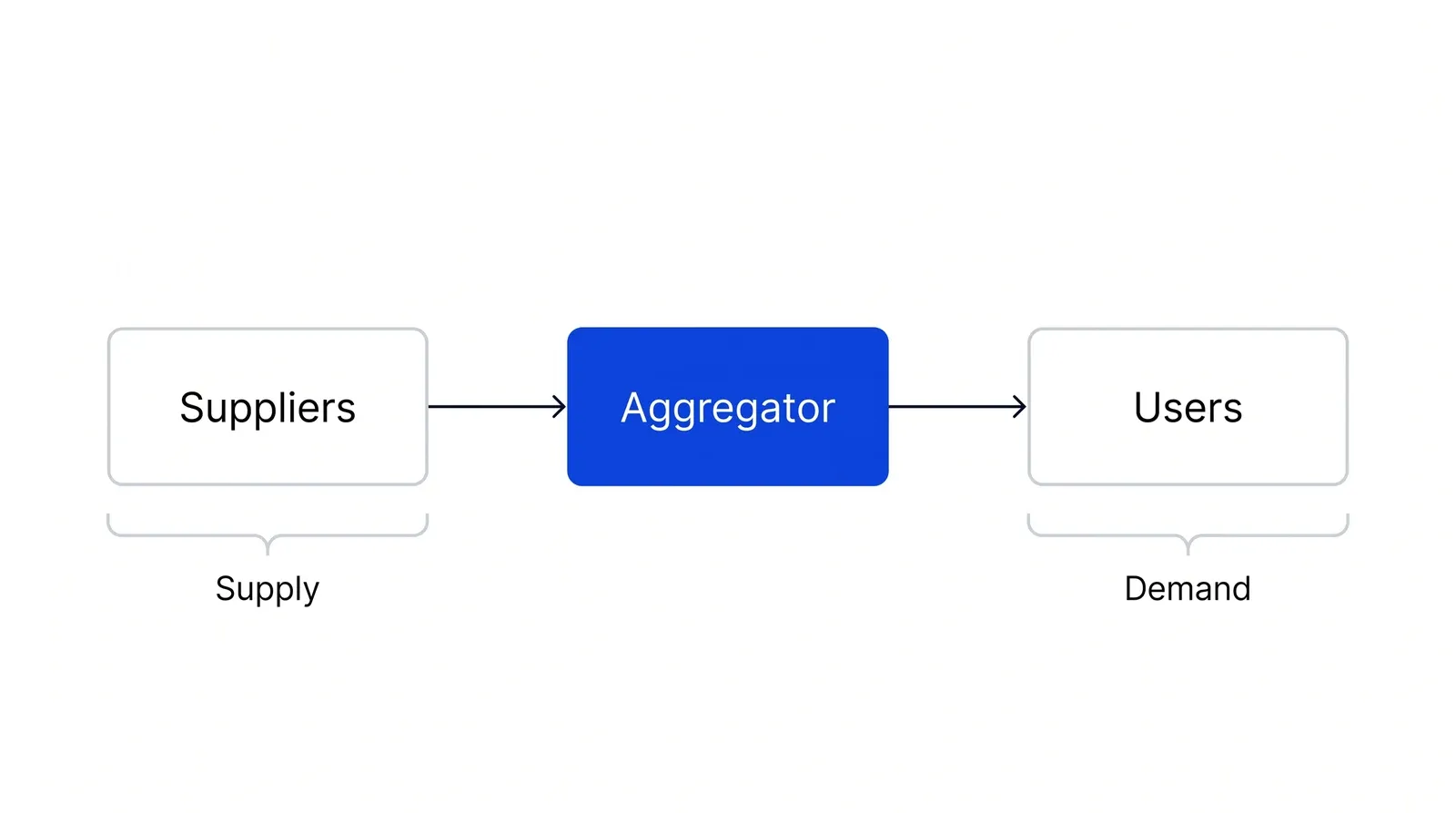
The loop follows from there. A better experience draws more users, more users draw more suppliers, and more suppliers improve the experience again. Thompson says this produces “strong winner-take-all effects”. The same essay lists the incumbents on the losing side: newspapers, book publishers, TV networks, taxi companies and hotels.
The three tests of an aggregator
Thompson’s 2017 essay gives three tests. A company is an aggregator only if it passes all of them:
- It has a direct relationship with users, through an account, a payment or habitual use.
- Serving one more user costs it close to nothing.
- Its network is driven by demand, so each new user makes the next one cheaper to acquire.
The tests exclude a lot of famous companies. Thompson says Amazon’s own retail business fails the second test because every order carries real costs, while its third-party marketplace passes “at least to a degree”. Apple’s hardware business fails too, and Thompson is clear that a company can do very well without being an aggregator.
Three levels, by what supply costs
The same essay ranks aggregators by how much they pay to get supply:
| Level | What the aggregator pays for supply | Example from Thompson |
|---|---|---|
| 1. Supply acquisition | Buys or licenses supply, does not make it | Netflix |
| 2. Supply transaction costs | Pays to onboard suppliers it does not own | Uber, Airbnb in some cities |
| 3. Zero supply costs | Suppliers join on their own at no cost | Google Search, social networks |
Above these sit super-aggregators, which Thompson limits to Facebook and Google: they face no transaction costs with users, suppliers or advertisers. A level 1 aggregator is close to what economists Hagiu and Wright call a reseller, as opposed to a multi-sided platform. The higher the level, the faster supply grows without the aggregator spending more.
Aggregator or platform?
A platform lets suppliers reach their own users; an aggregator stands between them and controls the meeting. Thompson’s test, in The Bill Gates Line, comes from Bill Gates: a platform exists when the value its users gain exceeds the value of the company itself. Windows and Amazon Web Services pass. Google and Facebook do not, because they capture most of the value they help create.
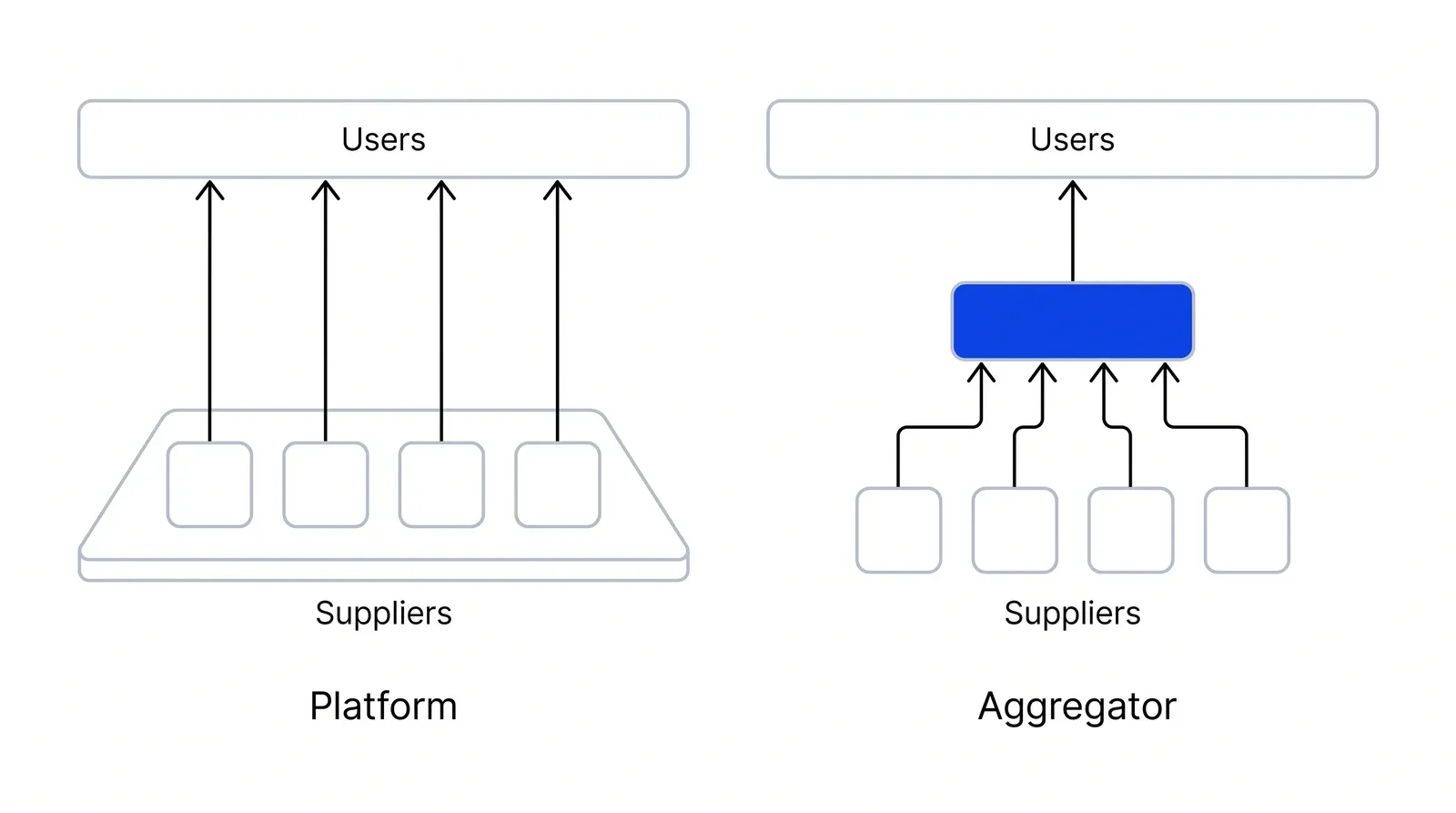
| Platform | Aggregator | |
|---|---|---|
| Position | Underneath suppliers | Between suppliers and users |
| Who owns the user | The supplier | The aggregator |
| Value capture | Suppliers and developers keep most | Aggregator keeps most |
| Can users leave easily? | Rarely | Usually, it is one click away |
Competition lawyer Thibault Schrepel argues in the Journal of European Competition Law & Practice that the law should draw the same line. The economics of two-sided pricing, cold start and market tipping are covered in platform strategy and network effects; this page stays on who controls demand.
What it does to suppliers
Research backs the theory’s warning about supplier dependence, with one caveat. A 2020 Marketing Science study found online travel agents ranked hotels lower when the hotels sold cheaper elsewhere. Zhu and Liu found Amazon more likely to enter the product spaces of popular, highly rated third-party sellers, and small sellers hit by that entry grew less afterwards.
The caveat is that aggregators also send traffic. When a Spanish copyright reform of December 2014 led Google News to shut down in Spain, Athey, Mobius and Pal found its users read about 20% less news overall, and the drop fell mostly on small publishers.
Why regulators struggle with aggregators
Aggregators fit poorly into traditional antitrust, which asks whether consumers pay more. Thompson made this point in 2016: users pick the aggregator because it is better. Lina Khan’s 2017 note in the Yale Law Journal argued that a focus on short-term prices misses this kind of power. The Stigler Committee report called it “bottleneck power”, which arises when users rely on a single provider.
Governments have since written rules aimed at exactly these firms. The EU named six gatekeepers under the Digital Markets Act in September 2023. In the US, a federal court found in August 2024 that Google is a monopolist, and in September 2025 barred its exclusive distribution deals and ordered it to share some search data with rivals. The UK’s CMA gave Google strategic market status in October 2025, noting that more than 90% of UK searches run through it.
Thompson and the regulators disagree on where to act. His 2019 framework says leave aggregators’ ranking choices alone, since users can switch, and block their purchases of potential rivals instead. EU rules go further and regulate ranking and price clauses directly.
Where the theory is unsettled
The open question is AI. Thompson wrote in 2025 that he still wants OpenAI to be an aggregator but does not yet see the business model. For an operator, the diagnosis is what matters today: know which companies own your customers’ first click and what that costs you. In Pushers’ Growth Lab work, that channel dependency map comes before any budget is moved.
How to apply Aggregation theory, step by step
- Draw your value chain. Write down three layers: who supplies the product or content, who distributes it, and who uses it. Put your company in one of them, and name the companies in the other two. Result: a one-line chain such as 'clinics, booking sites, patients' with your place marked.
- Run the three aggregator tests. Check each player in the distribution layer, including yourself, against Thompson's tests: a direct relationship with users, near-zero cost to serve one more user, and acquisition costs that fall as the network grows. Result: a short list of who in your market is a real aggregator and who only looks like one.
- Measure your dependence. For each aggregator, calculate the share of new customers and revenue it brings and what you pay for them, including commission, ad spend and discounts forced by ranking. Result: a table of channels with share of demand and cost per customer.
- Read the terms as well as the price. List the rules the aggregator controls: ranking, price parity, who owns customer data, who may contact the customer after the sale. Check which of them local law now limits, for example the EU Digital Markets Act for designated gatekeepers. Result: a list of terms you can change, terms you must accept and rights you are not yet using.
- Choose a position. Decide whether you will compete for demand yourself (become the aggregator in a niche), differentiate supply so the aggregator needs you more than you need it, or keep using it as a paid channel while building direct demand. Result: one written choice with a target share of demand from aggregators in 12 months.
- Review the share every quarter. Track the share of demand coming through aggregators and the cost per customer from each. A rising share with rising cost means the aggregator is capturing more of your margin. Result: a quarterly line in the board pack with the trend and the action it triggers.
Examples
Hotels on online travel agents
Thompson names hoteliers among the incumbents that lose to aggregators. A 2020 Marketing Science study by Laitenberger, Kesler and Hunold found that online travel agents ranked hotels lower when those hotels charged less on other channels or their own websites. In the EU, regulators stepped in: Booking was designated a gatekeeper under the Digital Markets Act in May 2024, and from 14 November 2024 it must let hotels offer better prices elsewhere, including on their own sites, and give them real-time access to their data.
Comparison shopping sites and Google
In June 2017 the European Commission fined Google 2.42 billion euros for placing its own comparison shopping service at the top of search results while rival services appeared, on average, around page four. The Commission reported that traffic to rivals fell 85% in the UK and up to 92% in Germany. The Court of Justice upheld the fine in September 2024. This is the risk aggregation theory predicts for suppliers that depend on one source of demand.
A dental clinic on a booking aggregator
Illustrative, no real clinic implied. A clinic gets 300 new patients a month, 180 of them (60%) through a booking site that charges 25 euros per booking. That is 4,500 euros a month, and the booking site, not the clinic, holds the patient's first contact. The clinic sets a target of 40% within a year: it adds online booking to its own site, asks every new patient to book follow-ups directly and keeps the aggregator as a paid channel for first visits only. At 40%, the same volume costs a third less in booking fees.
When to use it
Use it when a large share of your demand comes through one or two intermediaries such as search, marketplaces, app stores or booking sites; when you plan a marketplace or comparison product and need to know whether it can become the default; and when you assess an investment or partnership in a digital market.
When not to use it
Skip it for businesses where serving each customer carries real cost and demand is local or relationship-driven, such as most B2B services or physical retail without a digital channel. Thompson's own tests exclude companies with meaningful marginal costs. It is also a poor guide for legal decisions, which turn on specific law, not on the framework.
Common mistakes
- Calling every marketplace or app an aggregator. Most fail at least one of the three tests, usually the zero marginal cost test.
- Treating the aggregator as just another ad channel and ignoring its terms: ranking rules, parity clauses and who owns the customer data.
- Assuming dependence is always bad. Research on Google News in Spain shows aggregators also send real traffic, especially to small publishers.
- Confusing a platform with an aggregator. A platform lets suppliers reach users directly; an aggregator controls the meeting.
- Building a 'we will be the aggregator' plan without a user experience clearly better than going direct.
FAQ
What is aggregation theory in simple terms?
Aggregation theory says that on the internet the winner is the company users go to first. Because distribution is almost free, that company can offer the best experience, gather most users and then attract suppliers on its own terms. Ben Thompson's original essay on Stratechery used Google, Facebook, Amazon, Netflix, Uber and Airbnb as examples.
What is the difference between an aggregator and a platform?
A platform, such as Windows or Amazon Web Services, is a base that suppliers build on and use to reach their own users. An aggregator, such as Google Search, sits between suppliers and users and controls the relationship. Thompson's test is the Bill Gates line: a platform creates more value for others than it keeps.
Is Amazon an aggregator?
Only partly, by Thompson's definition. In his 2017 essay he says Amazon's own retail business is not an aggregator, because it pays real costs to serve each customer. Its third-party marketplace is one to a degree, because Amazon owns the shopper while merchants carry the marginal costs.
Who created aggregation theory?
Ben Thompson, the analyst who writes the Stratechery newsletter, published the essay Aggregation Theory on 21 July 2015. He added the three tests and the levels of aggregation in Defining Aggregators in September 2017. It is an analyst's framework, not a peer-reviewed model, though competition lawyers have since adopted the platform and aggregator distinction.
Is ChatGPT an aggregator?
Unsettled. ChatGPT has a direct relationship with a large number of users, which is the first test. But in a 2025 essay Thompson wrote that OpenAI lacks an aggregator's business model and needs advertising to compete with Google as one. The UK competition regulator already treats Google's AI Overviews as part of its regulated search service.
Sources
- Ben Thompson, Stratechery, Aggregation Theory, 2015
- Ben Thompson, Stratechery, Defining Aggregators, 2017
- Ben Thompson, Stratechery, The Bill Gates Line, 2018
- Ben Thompson, Stratechery, Antitrust and Aggregation, 2016
- Ben Thompson, Stratechery, A Framework for Regulating Competition on the Internet, 2019
- Ben Thompson, Stratechery, Netflix and the Conservation of Attractive Profits, 2015
- Ben Thompson, Stratechery, Is the Internet Different?, 2020
- Stratechery, Aggregation Theory concept page
- Ben Thompson, Stratechery, Conflicts, Consternation, and Code Red, 2025
- Lina M. Khan, Amazon's Antitrust Paradox, Yale Law Journal 126, 2017
- Thibault Schrepel, Platforms or Aggregators: Implications for Digital Antitrust Law, Journal of European Competition Law & Practice 12(1), 2021
- Thibault Schrepel, Google, Facebook, and Amazon are no platforms, Network Law Review, 2020
- Andrei Hagiu and Julian Wright, Multi-sided platforms, International Journal of Industrial Organization 43, 2015
- Susan Athey, Markus Mobius and Jeno Pal, The Impact of Aggregators on Internet News Consumption, NBER Working Paper 28746, 2021
- Ulrich Laitenberger, Reinhold Kesler and Matthias Hunold, Rankings of Online Travel Agents, Channel Pricing, and Consumer Protection, Marketing Science 39(1), 2020
- Feng Zhu and Qihong Liu, Competing with Complementors: An Empirical Look at Amazon.com, Strategic Management Journal, 2018 (HBS working paper 15-044)
- Stigler Center, Chicago Booth, Committee on Digital Platforms: Final Report, 2019
- Digital Competition Expert Panel (Furman review), Unlocking digital competition, HM Treasury, 2019
- Jacques Crémer, Yves-Alexandre de Montjoye and Heike Schweitzer, Competition policy for the digital era, European Commission, 2019
- U.S. Department of Justice, Department of Justice Wins Significant Remedies Against Google, 2025
- European Commission, Commission designates six gatekeepers under the Digital Markets Act, 2023
- European Commission, Commission designates Booking as a gatekeeper, 2024
- European Commission, Booking must comply with all relevant obligations under the Digital Markets Act, 2024
- UK Competition and Markets Authority, CMA confirms Google has strategic market status in search services, 2025
- European Commission, Commission fines Google for abusing dominance as search engine by favouring its comparison shopping service, IP/17/1784, 2017
- Court of Justice of the European Union, Press release 135/24, Google Shopping, Case C-48/22 P, 2024
Last updated Oct 9, 2026


Marketing agency or growth system: when a company outgrows its agency
An agency is the right call while the founder still runs most of the company. Once the business starts copying itself into new locations or markets, it needs a system that sets goals, tests hypotheses and owns the result.

Why healthcare marketing agencies stall: the short, mid and long wins model we use with clinics
Most agencies own the click and nobody owns the front desk. How we structure clinic work in three horizons, the research behind each one, and one year of results.

Why channel tests stall after month three
Most paid channel tests do not end with a decision. They end when the budget runs out, the attribution model changes, or everyone quietly stops looking at the dashboard.