Bowling alley strategy
The bowling alley strategy is Geoffrey Moore's method for growing from one won niche into neighbouring ones, choosing each next segment so that references or partners from the last one carry over.
The bowling alley strategy is Geoffrey Moore's playbook for the stage after a company wins its first mainstream niche. The first segment works as the head pin: once it falls, it helps knock over adjacent segments that share either its customers or its use case. Companies use it to grow niche by niche until the whole category takes off.
- Origin
- Geoffrey A. Moore, 1995 (Inside the Tornado), building on Crossing the Chasm (1991)
- Level
- 301 · Advanced
- Fits
- Startup, Scale-up
- Time to apply
- one to two weeks to map the alley, then a review each time you lead a segment
- What you need
- a list of current customers by industry, geography, profession and use case · your share of the segment you entered first, or a fair estimate · a short list of partners who already sell into neighbouring segments
The bowling alley strategy is a way to grow a new technology business one niche at a time, after it has won its first mainstream segment. Each niche is a pin. The first one, the head pin, is chosen so that winning it helps you win the segments next to it. Founders and heads of growth use it to decide where to go after the beachhead, and in what order.
The idea comes from Geoffrey Moore. After crossing the chasm, which is about winning that first segment, Moore set out what happens next in Inside the Tornado (HarperBusiness, 1995). A 2000 profile in strategy+business summed up his advice: a group of related vertical markets is “the bowling alley”, each market is a pin to knock down, and a company should dominate one niche before it targets another. His 2009 conference slides place the bowling alley right after the chasm and before the tornado, the stage of mass-market demand.
Why niches before the mass market
The alley exists because mainstream buyers in this stage are pragmatists with a specific problem, and each segment needs its own proof. In a 2025 guest post, Moore describes the buyer as a manager responsible for a deteriorating business process. That buyer has budget, but it is tied to the old way of solving the problem, so the sale starts with winning the right to redirect it.
That is slow, one segment at a time, and it rewards focus. Moore advises a single use case in a single industry in a single geography. In a 2024 interview on Lenny’s Podcast, he compared spreading across many customers to moving a match back and forth under a log: nothing catches. You hold the match on the kindling until it burns. “That’s why adjacency is so important,” he said, because the next piece of wood has to be close enough to catch.
The pitch also changes. “In the bowling alley, it’s never about you,” Moore told Lenny Rachitsky. Buyers want to talk about their problem, not watch a demo.
The head pin: choose the first segment for its neighbours
The head pin is the first segment you win, the same one the chasm playbook calls the beachhead. The bowling picture adds one test to the choice. A segment can be attractive on its own and still be a poor head pin, because nothing stands next to it.
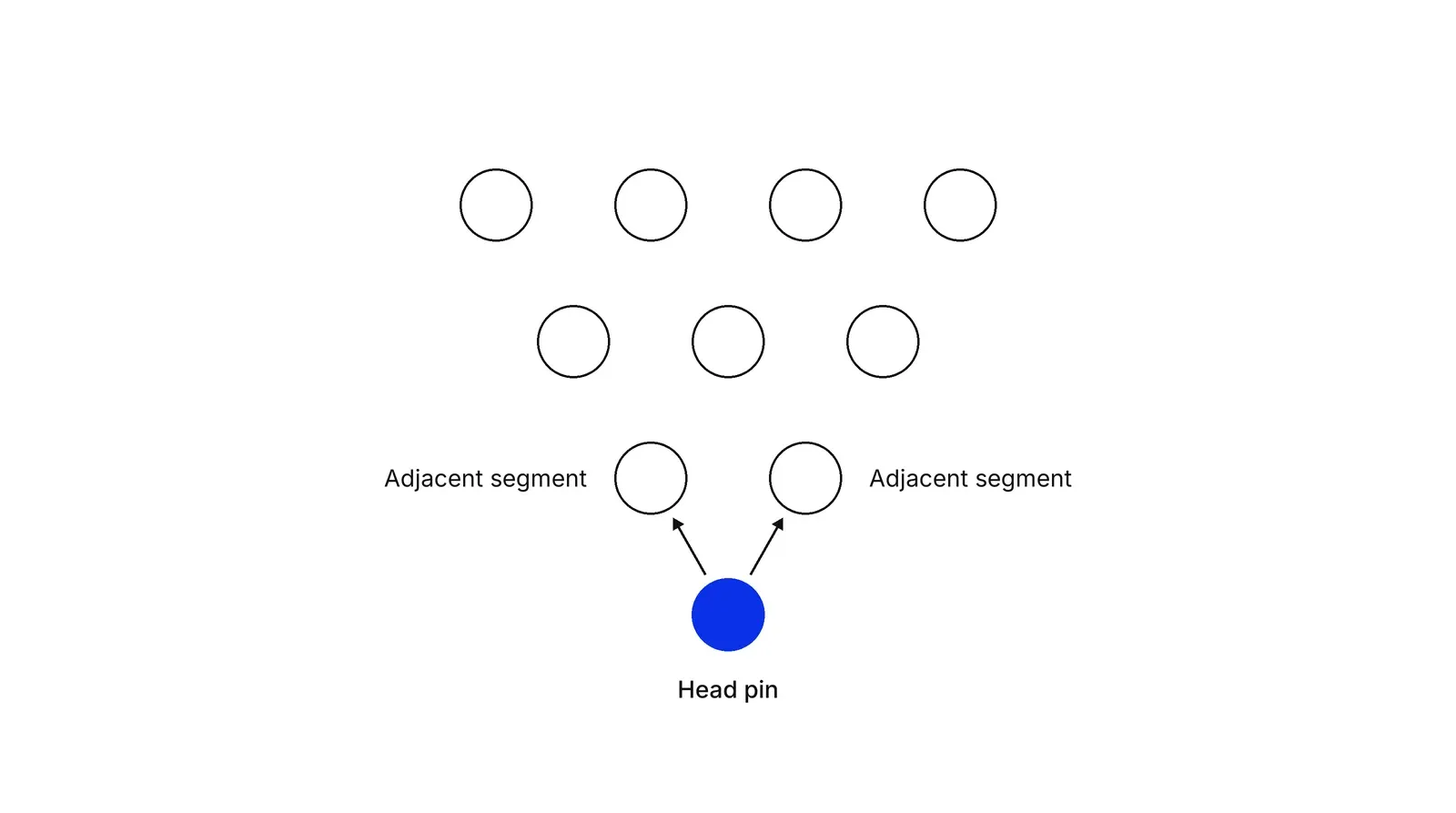
Take Lawson Software. According to strategy+business, Moore asked its team, “Where is your bowling alley?”, and the company chose health care, where hospital back-office systems needed replacing. The International Directory of Company Histories records health care as Lawson’s first vertical in 1995, with retail added as a main market by 1998, and work for the public sector, insurance and professional services started that year. The same directory puts revenue above $100 million in 1996 and at $306 million in fiscal 2000.
Pins knock each other over when buyers in one segment talk to buyers in the next. Research on new product sales supports that logic. Goldenberg, Libai and Muller (2002) modelled two groups of buyers and found that when the groups rarely talked, more than half of simulated launches showed a sales slump between them. When they talked almost as much as within each group, the share fell below 5%.
Two kinds of adjacent move
Moore gives a strict definition. In the 2024 interview, he said an adjacent segment is either “the same customer with a different use case” or the same use case for a different customer base. The two moves are commonly labelled segment-to-segment and application-to-application.
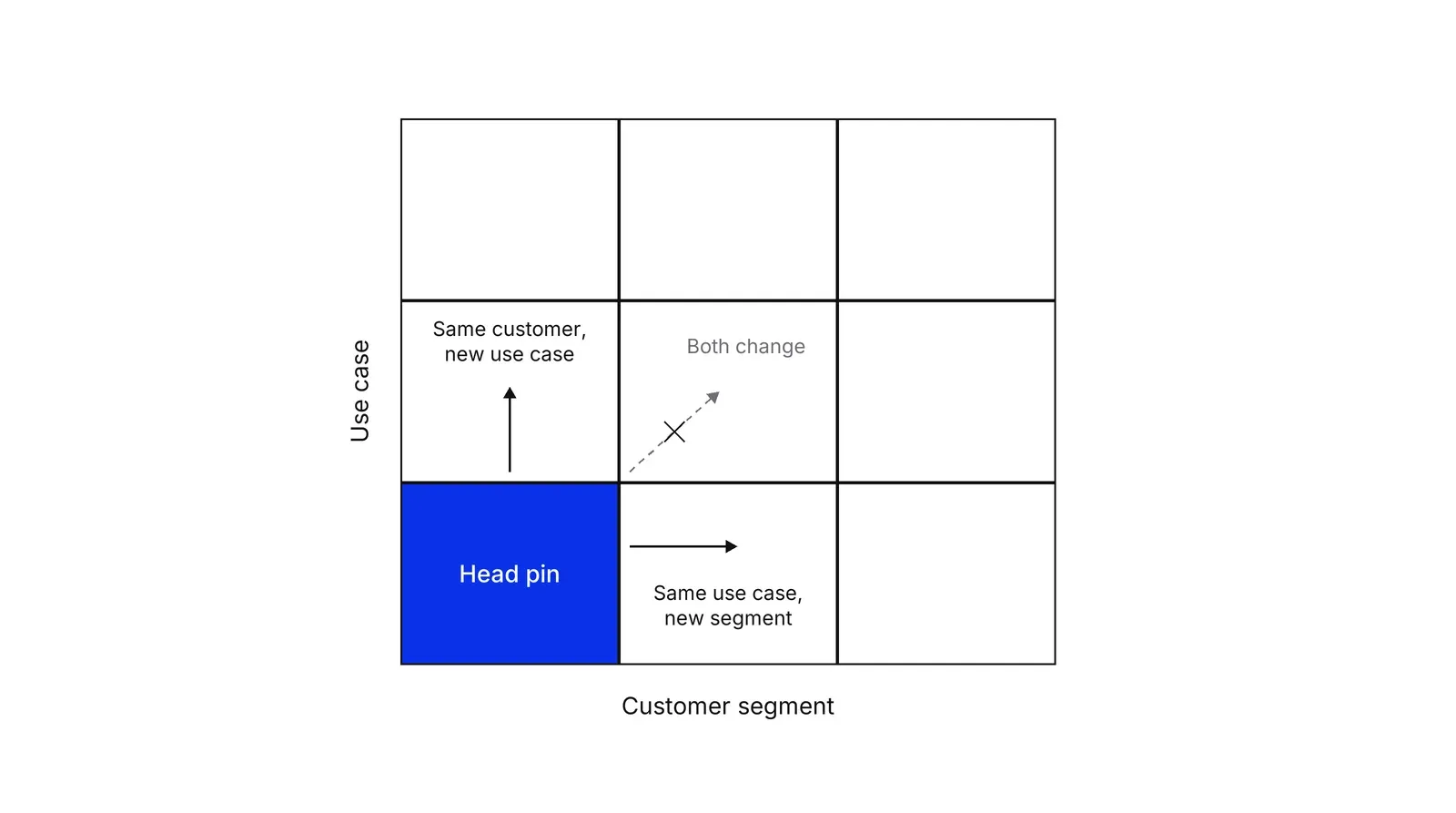
| Move | What stays | What changes | What carries over |
|---|---|---|---|
| Segment-to-segment | The use case | Industry, profession or region | Partners who already serve the new segment, and most of the product |
| Application-to-application | The customer | The problem you solve | Customer references and relationships |
Moore explained why each works. With the same customers, you use your references. With the same use case, partners who built the solution with you say they work with another segment and bring you in. He told Lenny that the alley can take a company from tens of millions of dollars in revenue to hundreds of millions.
A move that changes both the customer and the use case is not adjacent. It resembles diversification in the Ansoff matrix, where Ansoff’s 1957 article set new products for new markets apart from the other growth paths. In Ansoff’s terms, segment-to-segment is close to market development and application-to-application is close to product development.
Documentum: one alley, two accounts
Documentum is Moore’s own example. Its first segment was drug makers assembling new drug applications for the US regulator. In the 2024 interview, Moore recalled the next pins as chemicals, then petrochemicals, then oil and gas, then Wall Street, and said of each step that the use cases “were close enough.”
The International Directory of Company Histories gives a different order after the second pin. It says Documentum entered the commodity and specialty chemical industry in 1995, then aerospace, electronics and automotive manufacturing, then engineering and construction. Both sources agree on chemicals as the second pin and on the pattern: the same document control problem in a new industry. The directory entry shows revenue rising from $2 million in 1993 to over $45 million in 1996.
The consumer version: the bowling pin strategy
Investor Chris Dixon applied the idea to network products in a 2010 post, crediting Moore with the name bowling pin strategy. Facebook is his main case. The Harvard Crimson reported in March 2004 that the site had opened to Columbia, then Stanford, then Yale, with users able to see profiles only at their own school. Harvard Magazine notes that it opened to the general population in 2006.
Dixon contrasts this with Facebook Places, launched to its whole user base at once, which he calls a “carpet bombing strategy.” Andrew Chen of a16z describes the same pattern in an interview with TechCrunch: Tinder took over one campus with a party of about 500 people, then repeated the approach at other schools.
When the alley ends
The alley ends when the category goes horizontal. Moore told Lenny that before the tornado, buyers have no budget for you; once everyone wants the category, budgets arrive at the same time and a market share race starts. A 2015 study of lifecycle risk describes the same shift: vertical markets built in the alley merge into a horizontal mass market in the tornado. Some categories never get there, and Moore notes that in specialized industries a company can stay in the alley and still pass a billion dollars.
Adjacent growth is hard even when done well. A 2003 Harvard Business Review article by Bain’s Chris Zook and James Allen estimates that moves into adjacent markets fail about three-quarters of the time. Changing only one thing per move, customer or use case, is how the bowling alley tries to beat those odds. In our Growth Lab work, the next segment is chosen by what carries over from the last one, before any channel plan.
How to apply Bowling alley strategy, step by step
- Confirm the first pin has fallen. Check that you lead your first segment: customers in it name you as the default choice, and new buyers there come through references. If you are still fighting for that segment, stay there. Result: a written yes or no, with your estimated share of the segment.
- Map the pins around it. Draw a grid with customer segments across and use cases up. Mark the cell you own. List the cells that differ from it in only one way: the same use case for a new industry, profession or region, or a new use case for the customers you already have. Result: three to eight candidate segments, each one move away.
- Score each candidate on what carries over. For a new segment with the same use case, ask whether your partners already sell there and whether your product works with little change. For a new use case with the same customers, ask whether your references and buyers carry over. Add pain, budget and whether buyers in the segment talk to each other. Result: a ranked list with the top two marked.
- Add only what the next segment needs. Write down what the next pin needs that the first did not: integrations, compliance documents, a partner, a sales hire who knows the industry. Give each item an owner and a date. Result: a short gap list for one segment, not a roadmap for five.
- Enter with references from the last pin. Open conversations with the problem you solved for peers next door, backed by named customers or by the partner who brought you in. Track share of the new segment, not total pipeline. Result: a monthly count of customers and referenceable wins in the new segment.
- Watch for the tornado. Each quarter, check whether buyers outside your segments have started asking for the category itself, with budgets set aside for it. When that happens, the niche-by-niche playbook stops working. Result: a quarterly note on whether you are still in the alley or entering mass-market demand.
Examples
Documentum: from drug approvals to chemicals
Documentum's first segment was pharmaceutical companies preparing new drug applications for the US regulator. According to the International Directory of Company Histories, in 1995 it moved into the commodity and specialty chemical industry as an adjacent market, then into manufacturing and then engineering and construction. In a later interview, Moore recalled a slightly different path after chemicals, through petrochemicals and oil and gas to Wall Street, but both accounts describe the same kind of move: similar document problems in a new industry.
Facebook: one campus at a time
Facebook launched at Harvard in February 2004. The Harvard Crimson reported that it opened next to Columbia, then Stanford the next day, then Yale, with profiles visible only within each school. Only later did it open to everyone. Chris Dixon used this rollout as his main example of what he called Moore's bowling pin strategy for products with network effects.
A payments start-up choosing its second pin
Illustrative, no real company implied. A B2B payments start-up leads one segment: freight brokers in one country, paying carriers faster. It has two candidates for the next pin. Freight brokers in a neighbouring country share the use case, and its freight software partner already sells there. The same brokers also want automated invoice collection, a new use case for existing customers. It scores both, picks the neighbouring country first because the partner and the product carry over almost unchanged, and puts invoice collection second.
When to use it
Use it when you lead one mainstream niche and growth there is slowing because the segment is small, or when a board asks where growth comes from after the beachhead. It also fits network products that need density in one community before they are useful in the next.
When not to use it
Skip it before you lead your first segment, because a half-won niche gives you no references to carry. It is also the wrong playbook once the category is in mass-market demand, when Moore advises a broad, standard product and a race for market share instead.
Common mistakes
- Moving to the second pin before the first has fallen, which leaves two half-won segments and no references strong enough for either.
- Choosing the next segment for its size when it shares neither customers nor use case with the first, so nothing carries over and the company starts again from zero.
- Changing the use case and the customer at the same time and calling it adjacent.
- Leading with the product story in a new segment. Moore's advice for this stage is to start with the buyer's problem.
- Staying in niche mode after buyers across the market start asking for the category, and losing the share race to a broader rival.
FAQ
What is the bowling alley strategy?
It is Geoffrey Moore's method for growing after a technology company wins its first mainstream niche. Each niche is a pin. Winning the first one, the head pin, gives you references and partners that help you win the next segment, provided it shares either the same customers or the same use case. The company grows segment by segment.
What is the head pin in the bowling alley?
The head pin is the first segment a company wins in the mainstream market, the same segment Moore calls the beachhead. In bowling, hitting the front pin well knocks down the pins behind it. In the strategy, the first segment is chosen partly for the neighbouring segments its references and partners can help you enter.
What is the difference between the bowling alley and the tornado?
In the bowling alley, buyers have budget for an old solution and must be persuaded to redirect it, so you win one segment at a time with a solution to a specific problem. In the tornado, the whole market wants the category at once, budgets already exist, and Moore advises a standard product and a fast grab for market share.
What are segment-to-segment and application-to-application moves?
They are the two kinds of adjacent move. Segment-to-segment keeps the use case and sells it to a new customer segment, where partners who serve that segment can bring you in. Application-to-application keeps the customer and sells them a new use case, where your existing references and relationships carry over.
Is the bowling alley strategy the same as the bowling pin strategy?
Yes, it is the same idea under a different name. Investor Chris Dixon called it the bowling pin strategy in a 2010 post, crediting Moore, and applied it to consumer and network products such as Facebook, Yelp and Stack Overflow, which started in one dense community before expanding to the next.
Sources
- Geoffrey A. Moore, Crossing the Chasm Part 1: Describing the Chasm, slides, NDIA Robotics Conference, 2009
- Lenny's Podcast, Geoffrey Moore on finding your beachhead, crossing the chasm, and dominating a market, January 2024
- Geoffrey A. Moore, Which Go to Market Playbook Should You Choose?, guest post on Braden Kelley's blog, February 2025
- Internet Archive, Geoffrey A. Moore, Inside the Tornado: Marketing Strategies from Silicon Valley's Cutting Edge, HarperBusiness, 1995
- Geoffrey A. Moore, Inside the Tornado, author's book page
- Geoffrey A. Moore, Crossing the Chasm, author's book page
- Internet Archive, Geoffrey A. Moore, Crossing the Chasm: Marketing and Selling Disruptive Products to Mainstream Customers, HarperBusiness, 2014
- Internet Archive, Paul Wiefels, The Chasm Companion: A Fieldbook to Crossing the Chasm and Inside the Tornado, 2002
- Lawrence M. Fisher, Quaking Up with Geoffrey Moore, strategy+business, issue 19, 2000
- David P. Bianco, Lawson Software, International Directory of Company Histories, via Encyclopedia.com
- Ed Dinger, Documentum, Inc., International Directory of Company Histories, via Encyclopedia.com
- Tamas Koplyay et al., Risk Profiles Along the Lifecycle in Dynamic Markets, Management and Production Engineering Review 6(3), 2015
- MIT Sloan Executive Education, Bill Aulet, Launching a successful start-up 3: the beachhead market
- Chris Zook, James Allen, Growth Outside the Core, Harvard Business Review, December 2003
- Bain & Company, Chris Zook, Beyond the Core, book page
- H. Igor Ansoff, Strategies for Diversification, Harvard Business Review, September-October 1957
- Jacob Goldenberg, Barak Libai, Eitan Muller, Riding the Saddle: How Cross-Market Communications Can Create a Major Slump in Sales, Journal of Marketing 66(2), 2002
- Chris Dixon, The bowling pin strategy, cdixon.org, August 2010
- The Harvard Crimson, Adam P. Schneider, Facebook Expands Beyond Harvard, March 2004
- Harvard Magazine, Noam Cohen, How Facebook Escaped Harvard
- TechCrunch, Connie Loizos, Andrew Chen of a16z on how startups get past a cold start, December 2021
Last updated Oct 9, 2026


Marketing agency or growth system: when a company outgrows its agency
An agency is the right call while the founder still runs most of the company. Once the business starts copying itself into new locations or markets, it needs a system that sets goals, tests hypotheses and owns the result.

Why healthcare marketing agencies stall: the short, mid and long wins model we use with clinics
Most agencies own the click and nobody owns the front desk. How we structure clinic work in three horizons, the research behind each one, and one year of results.

Why channel tests stall after month three
Most paid channel tests do not end with a decision. They end when the budget runs out, the attribution model changes, or everyone quietly stops looking at the dashboard.