PR strategy and earned media
A PR strategy is a plan for winning coverage and mentions you do not pay for, built on the PESO model of paid, earned, shared and owned media and on Grunig's four models of how organizations talk to the public.
A PR strategy is a plan for winning attention a company does not pay for: press coverage, expert quotes, reviews and mentions by independent people, known as earned media. It names the audiences to reach, the stories to offer, the outlets that matter and how results are measured. The PESO model by Gini Dietrich places earned media alongside paid, shared and owned channels.
- Origin
- James Grunig and Todd Hunt (four models of PR); Gini Dietrich (PESO model), 1984; 2014
- Level
- 301 · Advanced
- Fits
- Small and mid-size, Scale-up
- Time to apply
- two weeks to draft the strategy, then at least a quarter of pitching before judging results
- What you need
- one business goal the PR work has to serve, such as entering a market or shortening sales cycles · a list of 20 to 50 journalists, analysts and creators your buyers read, with their beats · something new to say: your own data, a strong expert, or a customer result you can prove · a page on your site where coverage can send people: a newsroom, a report or an expert profile
A PR strategy is a plan for winning attention you do not pay for. The result is earned media: a news story, an analyst’s mention, a podcast interview, a review or a recommendation written by someone outside the company. The plan decides which audiences matter, which stories you can offer them, which outlets reach them and how you will know it worked.
The Public Relations Society of America defines public relations as “a strategic communication process that builds mutually beneficial relationships” between organizations and their publics, a wording that replaced its 1982 definition. Two frameworks shape how teams plan this work today. Gini Dietrich’s PESO model sorts the channels. James Grunig and Todd Hunt’s four models describe the stance a company takes when it talks to the public.
What counts as earned media?
Earned media is coverage or mention of a company that a third party chooses to publish, with no payment for the placement. Spin Sucks, Dietrich’s company, calls it “what you know as either publicity or media relations.” The value comes from the fact that someone independent decided you were worth mentioning.
| Media type | Who controls it | Examples | What it does best |
|---|---|---|---|
| Paid | You, for a fee | Search and social ads, sponsored content, paid influencer posts | Reach on demand |
| Earned | A journalist, analyst or customer | Press coverage, reviews, awards, expert quotes, backlinks | Credibility |
| Shared | You and your audience | Posts, comments, community threads | Distribution and feedback |
| Owned | You | Website, blog, newsletter, reports, podcast | A destination you keep |
The PESO model: four channels planned together
The PESO model is a framework that groups communication into paid, earned, shared and owned media and plans them as one program. Dietrich built it from her agency’s client work, and Spin Sucks says it officially launched in 2014 with her book Spin Sucks. One library record lists the book’s publication date as 2013, so dates vary by source.
The model’s practical point is the handoff between channels. Spin Sucks’ current guide describes owned media as the “source of truth” that the other three point to, with “the output of one” becoming “the input of the next.” A data report on your site becomes social posts, then a journalist’s story, then a paid promotion of that story.
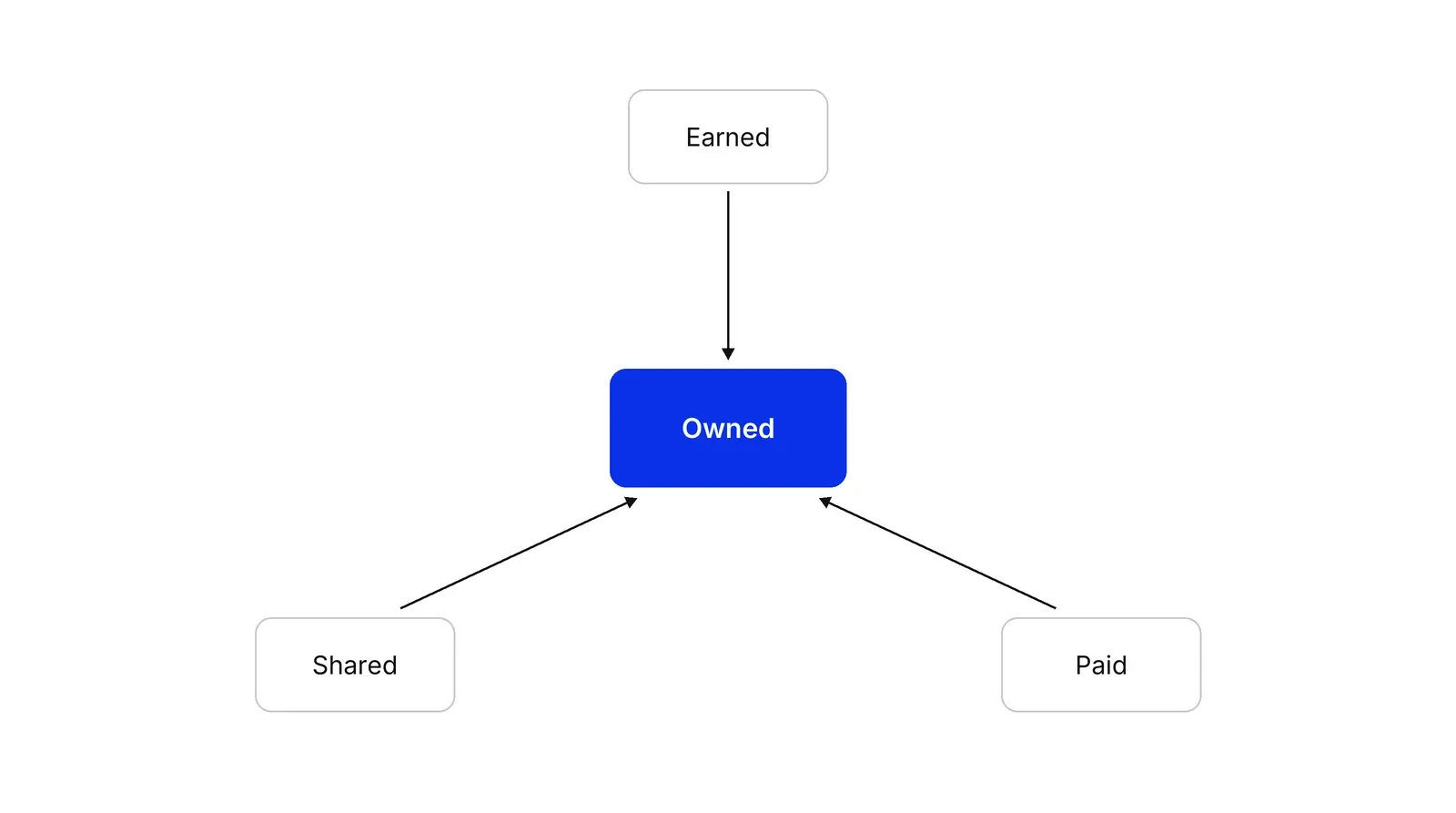
This is why the steps above put the owned asset before the pitch. Coverage with nowhere to land fades in a day.
Grunig’s four models: how you talk to the public
Grunig’s four models of public relations are a classification of how organizations communicate, published by James Grunig and Todd Hunt in Managing Public Relations in 1984. The Sage Encyclopedia of Public Relations separates them by whether the organization listens to feedback.
- Press agentry seeks attention, and the information is “often incomplete, distorted, or consists of half-truths.”
- Public information aims to inform, and telling the complete truth matters most.
- Two-way asymmetric uses research on the audience to make persuasion work better for the company.
- Two-way symmetric uses feedback that can change the company as well as the audience. Sage calls it the only one of the four that is a dialogue.
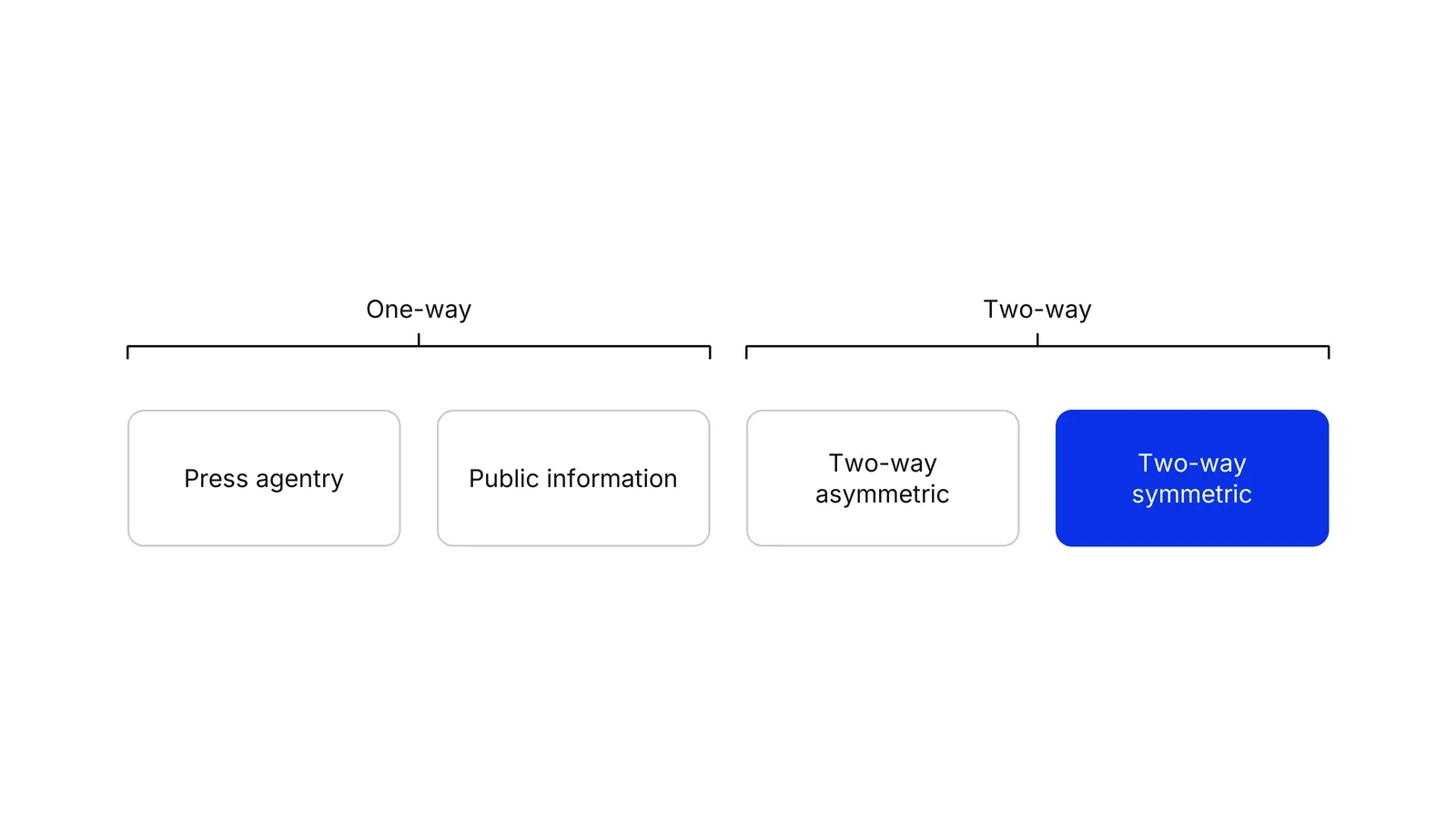
Grunig then led the Excellence study, funded by a $400,000 grant from the IABC Research Foundation, which held up the symmetric model as the most excellent practice. The study’s 1992 book runs to 666 pages.
The model has serious critics. Cancel, Cameron and colleagues argued in 1997 that practice sits on a continuum from pure advocacy to pure accommodation, shaped by 87 variables, and offered that as an alternative to the symmetric ideal. Juliet Roper wrote in 2005 that symmetry is often a compromise used “to deflect criticism and maintain power relations.” For a company planning PR, the useful reading is simple: a strategy that only broadcasts sits in the one-way column, and reporters and customers notice.
Is earned media worth more than paid?
Per exposure, the evidence leans toward earned media; in total, it depends on reach and on how well people know the product. Al and Laura Ries argued the strong version of the case in their 2002 book The Fall of Advertising and the Rise of PR. The research is more conditional. Martin Eisend and Franziska Küster’s meta-analysis in the Journal of the Academy of Marketing Science found that publicity’s credibility effect was about three times as strong as the effect of how people judged the message. The advantage held only for products people knew little about. For familiar products, advertising did better, and campaigns that mixed publicity with advertising weakened publicity’s effect.
Field data points the same way. In the Kiva study, one traditional press mention brought far more loans than one blog post, but frequent social mentions added up to a bigger total effect. Mitchell Lovett and Richard Staelin found that earned media had the most effect per exposure on viewing of a new TV show, while paid media, with its larger reach, dominated in total. Michael Trusov and colleagues reported that word-of-mouth referrals had longer carryover and higher response elasticities than traditional marketing at a social networking site.
Trust surveys agree on direction. In Nielsen’s 2015 global survey of 30,000 online respondents in 60 countries, 83% trusted recommendations from people they know and 66% trusted editorial content, against 63% for TV ads and 42% for online banner ads.
Why earned media is harder to get and matters more
There are fewer reporters to pitch. Pew Research Center counted a 26% fall in US newsroom employment between 2008 and 2020, from about 114,000 to 85,000. The reporters who remain are selective: in Muck Rack’s 2025 survey of more than 1,500 journalists, 86% cited irrelevance as a reason to delete a pitch, and 69% preferred pitches under 200 words.
AI assistants have raised the stakes. Muck Rack’s analysis of more than 25 million links cited by ChatGPT, Claude and Gemini put earned media at about 84% of citations and paid content at 0.3%. Read that figure with care: Muck Rack’s earned category is broad, its numbers have moved between editions, and the company warns that citation behaviour shifts as models change. The direction is still clear. Owned and paid content is rarely what an assistant quotes.
How to measure a PR strategy
Measure outcomes against the goal you set, not the volume of coverage. AMEC’s Barcelona Principles 3.0, released in July 2020, ask for goals before planning and for measurement of outputs, outcomes and impact. One principle, as the Open University summarises it, states that “AVEs are not the value of communication.” Advertising value equivalents price coverage as if it were ad space, which says nothing about whether buyers changed their minds.
Practical outcome metrics include branded search volume, referral traffic and links from coverage, inbound leads that cite an article, and how often AI assistants name you for the queries your buyers ask. Tie each one to the goal in step one. If PR is meant to put you on a shortlist, the positioning statement should be what journalists repeat, and our marketing operational system work puts these metrics on the same dashboard as paid and owned channels.
How to apply PR strategy and earned media, step by step
- Tie PR to one business goal. Write the goal PR serves: be on the shortlist of mid-sized importers, recruit senior engineers, prepare for a funding round. Coverage that does not move that goal is a vanity win. Result: one sentence that every story idea and every outlet on your list has to support.
- Map audiences to outlets. For each audience, list what they read, listen to and trust: two trade titles, a newsletter, a podcast, a regulator's bulletin, an analyst. Then find the specific reporters who cover your topic there. Result: a short media list ranked by how close each outlet sits to buyers.
- Find stories only you can tell. Journalists need news, data or a qualified voice. Look at what you hold that nobody else does: transaction data, survey results, a specialist who explains a new rule clearly, a customer outcome you can document. Result: three to five story angles, each with evidence attached.
- Build the owned asset first. Before pitching, publish the thing coverage will point to: the data report, the expert's profile, a newsroom page with facts and images. The PESO model treats owned media as the destination the other channels send people to. Result: one page that turns a mention into a visit, a link and a lead.
- Pitch few journalists, well. Send short, specific emails to the reporters whose beat matches the story, with the evidence inside. Journalists in Muck Rack's 2025 survey named irrelevance as the top reason they delete pitches, and half said one follow-up, three to seven days later, is acceptable. Result: a pitch log with replies, declines and coverage.
- Amplify and measure outcomes. Share each piece of coverage on your social channels and in sales follow-ups, and put paid budget behind the pieces that perform. Measure what changed: branded search, referral traffic, inbound leads, share of voice in AI answers. Do not report advertising value equivalents. Result: a quarterly review that decides which angles and outlets to keep.
Examples
Kiva and press mentions in microlending
Andrew Stephen and Jeff Galak studied 14 months of daily data from Kiva, a microlending marketplace. A single mention in newspapers, magazines, TV or radio brought, on average, 894 extra loans from new lenders and 403 from repeat lenders. A blog mention brought far fewer, 90 and 63. Because blog and community mentions were so much more frequent, social earned media had the larger total effect, and it also helped generate press coverage. The lesson for a fintech: chase the big press mention, and also keep the community talking, since one feeds the other.
A B2B payments company with its own data
Illustrative, no real company implied. A payments startup serving importers has three years of anonymised data on cross-border fees. It publishes a short report on its site showing how fees differ by corridor and bank, then offers the findings first to two trade reporters who cover trade finance. One runs the story, two newsletters quote it, and the report page collects links. Sales then attach the article to outbound emails. The PR goal, being on importers' shortlists, is checked against the number of inbound demo requests that mention the report.
A dermatology clinic and seasonal expertise
Illustrative, no real clinic implied. Before summer, a clinic's lead dermatologist offers local health reporters a short, sourced briefing on sun damage and skin checks, plus a booking page for skin checks. The clinic does not pay for placement. Two local outlets quote her, and the clinic tracks bookings that arrive through those pages. In health, the expert's credentials and accurate claims carry the story, so every figure in the briefing links to a medical source.
When to use it
Use a PR strategy when buyers need to trust you before they talk to sales: new categories, regulated industries such as fintech and healthcare, high-priced B2B products, or a market where nobody knows your name yet. It also fits before funding rounds, senior hiring pushes and market entries, when third-party validation shortens the path to a yes.
When not to use it
Skip a full PR program when you have nothing new to say and no proof to offer: earned media cannot be bought, and pitching without news wastes reporters' time and your reputation with them. It is also a poor fit when you need predictable leads this month. Paid channels are faster to switch on, and Eisend and Küster found advertising can outperform publicity for products people already know well.
Common mistakes
- Measuring outputs, such as the number of clippings or advertising value equivalents, instead of outcomes such as branded search, inbound leads or changes in how buyers describe you.
- Sending the same press release to hundreds of reporters. Irrelevance is the main reason journalists delete pitches, ahead of promotional tone.
- Winning coverage with nowhere to send readers: no report, no expert page, no clear next step on your own site.
- Treating earned media as free. It costs people, data and time, and it needs a budget line like any other channel.
- Running PR apart from paid, social and content teams, so a good article is never shared, boosted or used by sales.
FAQ
What is a PR strategy?
A PR strategy is a written plan for earning attention from journalists, analysts, creators and customers without paying for placement. It sets the business goal PR serves, the audiences and outlets that matter, the stories and evidence you will offer, and the metrics you will review. It usually sits inside a wider communications strategy.
How do you develop a PR strategy?
Start with one business goal, then map the audiences behind it to the outlets they trust. Find story angles backed by your own data or expertise, publish an owned asset for coverage to point to, pitch a short list of relevant reporters, and review outcomes each quarter. A first draft fits in about two weeks.
What is the PESO model?
The PESO model is a framework by Gini Dietrich of Spin Sucks that groups communication into four media types: paid, earned, shared and owned. It launched with her book Spin Sucks in 2014, according to the company. The idea is to plan the four together, so owned content feeds social posts, coverage and paid promotion.
What are Grunig's four models of public relations?
James Grunig and Todd Hunt described them in Managing Public Relations in 1984: press agentry, public information, two-way asymmetric and two-way symmetric. The first two send messages one way. The two-way models use research and feedback, either to persuade better (asymmetric) or to reach mutual understanding (symmetric).
Is earned media better than paid media?
Per exposure, often yes: a 2011 meta-analysis found publicity's credibility gave it an edge, and a 2016 study found earned media had the most effect per exposure. But paid media reaches more people and can win on total effect, and advertising did better for well-known products. Most companies need both.
Sources
- Spin Sucks, What is the PESO model
- Spin Sucks, The ultimate guide to the PESO Model
- Gini Dietrich, Spin Sucks, Que/Pearson, Open Library record
- James E. Grunig, Todd Hunt, Managing Public Relations, Holt, Rinehart and Winston, 1984, Internet Archive record
- James E. Grunig (ed.), Excellence in Public Relations and Communication Management, Erlbaum, 1992, Internet Archive record
- Sage, Encyclopedia of Public Relations (ed. Robert L. Heath), Two-way and one-way communication
- Sage, Encyclopedia of Public Relations (ed. Robert L. Heath), Excellence theory
- James E. Grunig, Furnishing the Edifice: Ongoing Research on Public Relations as a Strategic Management Function, Journal of Public Relations Research 18(2), 2006
- Public Relations Society of America, About public relations
- Amanda E. Cancel, Glen T. Cameron, Lynne M. Sallot, Michael A. Mitrook, It Depends: A Contingency Theory of Accommodation in Public Relations, Journal of Public Relations Research 9(1), 1997
- Juliet Roper, Symmetrical Communication: Excellent Public Relations or a Strategy for Hegemony?, Journal of Public Relations Research 17(1), 2005
- Alexander V. Laskin, The evolution of models of public relations: an outsider's perspective, Journal of Communication Management 13(1), 2009
- Martin Eisend, Franziska Küster, The effectiveness of publicity versus advertising: a meta-analytic investigation of its moderators, Journal of the Academy of Marketing Science 39(6), 2011
- Springer Professional, abstract of Eisend and Küster (2011)
- Andrew T. Stephen, Jeff Galak, The Effects of Traditional and Social Earned Media on Sales: A Study of a Microlending Marketplace, Journal of Marketing Research 49(5), 2012
- Carnegie Mellon University, news release on Stephen and Galak's Kiva study, November 2012
- Michael Trusov, Randolph E. Bucklin, Koen Pauwels, Effects of Word-of-Mouth versus Traditional Marketing, Journal of Marketing 73(5), 2009
- Mitchell J. Lovett, Richard Staelin, The Role of Paid, Earned, and Owned Media in Building Entertainment Brands, Marketing Science 35(1), 2016
- Duke University Scholars, abstract of Lovett and Staelin (2016)
- Nielsen, Global Trust in Advertising report, September 2015
- Pew Research Center, U.S. newsroom employment has fallen 26% since 2008, July 2021
- PR News, Linda Zebian, The State of Journalism in 2025: insights to optimize your media relations
- Muck Rack, AI citations for PR
- Muck Rack, Experts answer your FAQs on the What is AI Reading? report, August 2025
- AMEC, Barcelona Principles 3.0
- Open University Business School, Barcelona Principles 3.0 and why PR buyers should ask about them
- Al Ries, Laura Ries, The Fall of Advertising and the Rise of PR, HarperBusiness, 2002, Open Library record
Last updated Oct 9, 2026


The compliance layer under fintech marketing operations
A fintech marketing agency can build campaigns. It cannot own the compliance review, the KYC drop-off or the multi-market licensing rules that decide whether a lead ever becomes a customer.
Fractional CMO: what you get, and what has to exist underneath
A fractional CMO brings strategy and judgment. Without reporting, CRM hygiene and a named owner per number, the engagement produces a slide deck instead of a system.

The operations layer behind healthcare patient acquisition
Ads and search bring the request in. What happens between the click and the booked, attended visit decides whether the spend paid off.