Content repurposing
A way to turn one substantial piece of content into several pieces in different formats, and to publish the copies without creating duplicate-content problems in search.
Content repurposing is the practice of taking one substantial piece of content, such as a webinar, interview or research report, and reworking it into other formats: articles, clips, newsletters, posts, slides. Each new piece is rewritten for its channel, not pasted. Where the same text must appear on more than one URL, you mark which copy is the original.
- Origin
- Practitioner practice with no documented originator; the single-source idea is formalised in NPR's 'Create Once, Publish Everywhere', undated
- Level
- 201 · Tool
- Fits
- Startup, Small and mid-size
- Time to apply
- half a day to plan one source into a calendar; two to four weeks to publish and read results
- What you need
- one source with real substance: a recorded talk, an interview, original data or a long article · edit access to page templates, to set canonical tags and noindex · a transcript from YouTube Studio or a similar tool, cleaned by a person · one editor who checks every derivative against the source
Content repurposing is the practice of reworking one substantial piece of content into several others for different formats and channels. A 60-minute webinar becomes an article, three clips and a newsletter issue. No originator is documented. The nearest formal idea is “Create Once, Publish Everywhere”, which NPR used for its content architecture: NPR’s Zach Brand describes content made once in a flexible form and delivered through an API to the NPR iPhone and Android apps, the mobile site, the audio player and partner sites. Marketing teams use the same logic without the engineering: the source is the expensive part, and each copy is rewritten for the place where it will be read.
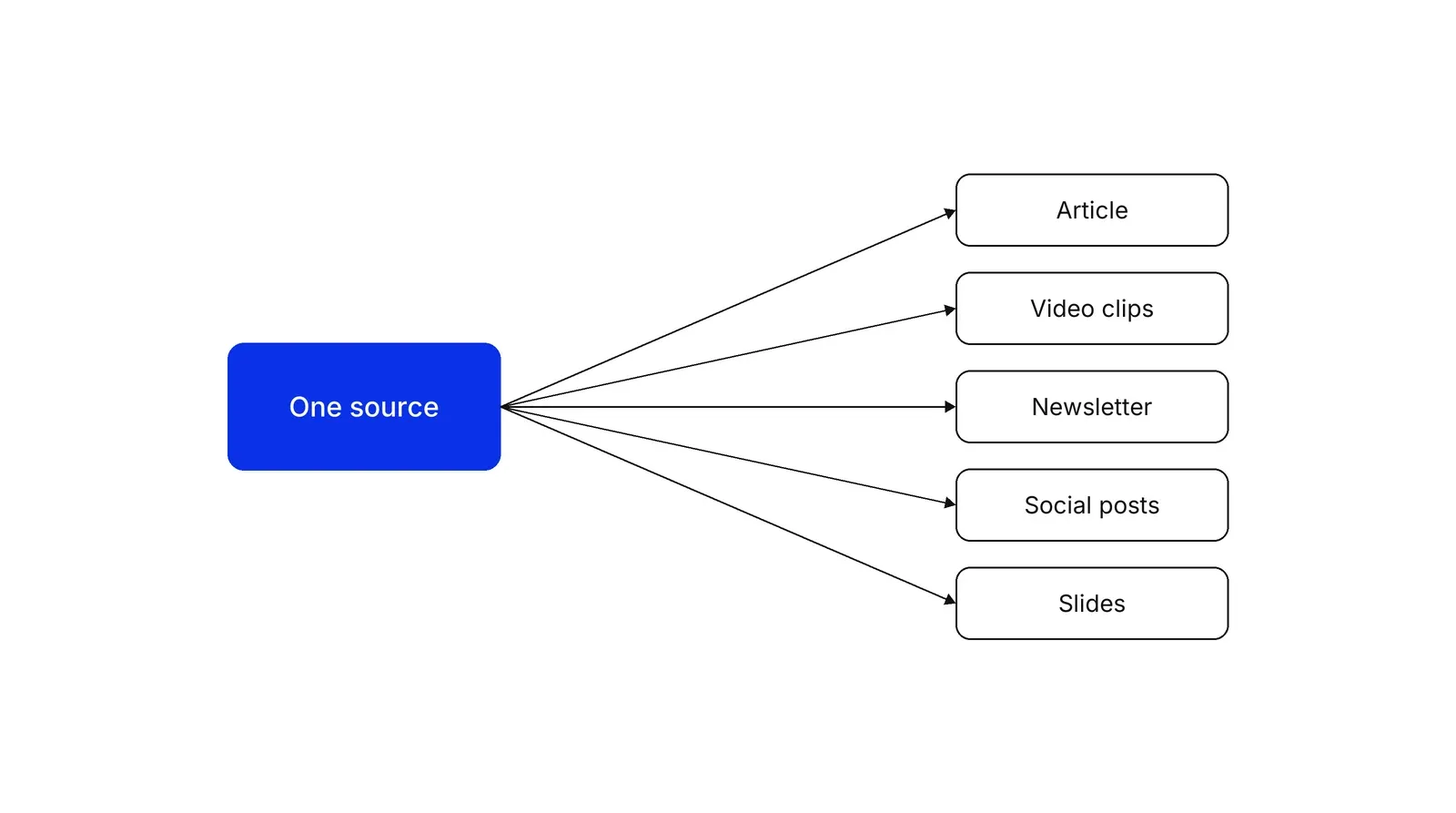
Why does one source feed many pieces?
A good source holds many separate ideas, and people meet content in different ways. In 1997, Jakob Nielsen reported that 79% of test users always scanned new pages and 16% read word by word. In the same article, five versions of one site carried identical information in different wording, and the concise, scannable, objective version scored 124% better on usability than the control. His 2006 eyetracking study of 232 users described an F-shaped reading pattern: readers give most attention to the opening lines. A derivative should lead with the conclusion, not be a cut-down copy of the long text.
Repeating an idea over time also helps people remember it. A 2003 meta-analysis of 97 verbal-learning studies in the Journal of Consumer Research, by Chris Janiszewski, Hayden Noel and Alan Sawyer, explored what spacing does for advertising repetition. Its authors suggest alternating involving media, such as TV commercials, with less involving ones, such as billboards. Nicholas Cepeda, Harold Pashler, Edward Vul, John Wixted and Doug Rohrer pooled 839 assessments from 317 experiments in 184 articles and found that the best gap between exposures grows with the time until the reader needs to recall the idea. These are lab studies on word lists, not content marketing, so read them as a reason to space releases, not a formula.
What makes a derivative worth publishing?
Google Search’s people-first content guidance asks whether a page offers original information, and says credit to other sources does not replace original effort. It also asks whether you change dates to look fresh without substantial change.
Each format has its own documented rules:
| Format | What the platform documents |
|---|---|
| Video on your site | A dedicated watch page with a unique title, description and VideoObject markup |
| YouTube Studio | Caption files or transcript auto-sync, which YouTube does not recommend for videos over 1 hour; automatic captions only in the default language |
| Apple Podcasts Connect | VTT or SRT transcripts in 11 languages on iOS 17.4 or later; automatic transcripts for episodes under 10 hours |
| Images | Descriptive alt text and nearby text that fits the image, for Google Images |
| Translations | Complete pages linked with hreflang, not translated boilerplate around untranslated text |
| AI-drafted copies | Manual fact-check before publishing; mass pages without added value risk the scaled content abuse policy |
Does duplicate content hurt when you republish?
Not as a penalty. Google Search Central’s page on consolidating duplicate URLs treats duplicates as a grouping task: Google Search clusters near-identical pages and shows the one it judges best, and a site will likely do fine without specifying a preference. The risk is that Google Search shows a copy you did not choose.
For copies on your own domain, the same page ranks three signals: a redirect is strong, a rel="canonical" link is strong, and a sitemap entry is weak. Google Search Central calls a canonical a hint, not a rule, so it can choose another URL.
Syndication is different. The troubleshooting guide says the canonical element is not recommended for syndication partners, and the most effective solution is for partners to block indexing. In practice that is a noindex meta tag on the partner’s copy, written into the agreement. Google Search sees it only if it can crawl the page, so a URL blocked in robots.txt hides its noindex. For PDFs, use an X-Robots-Tag header.
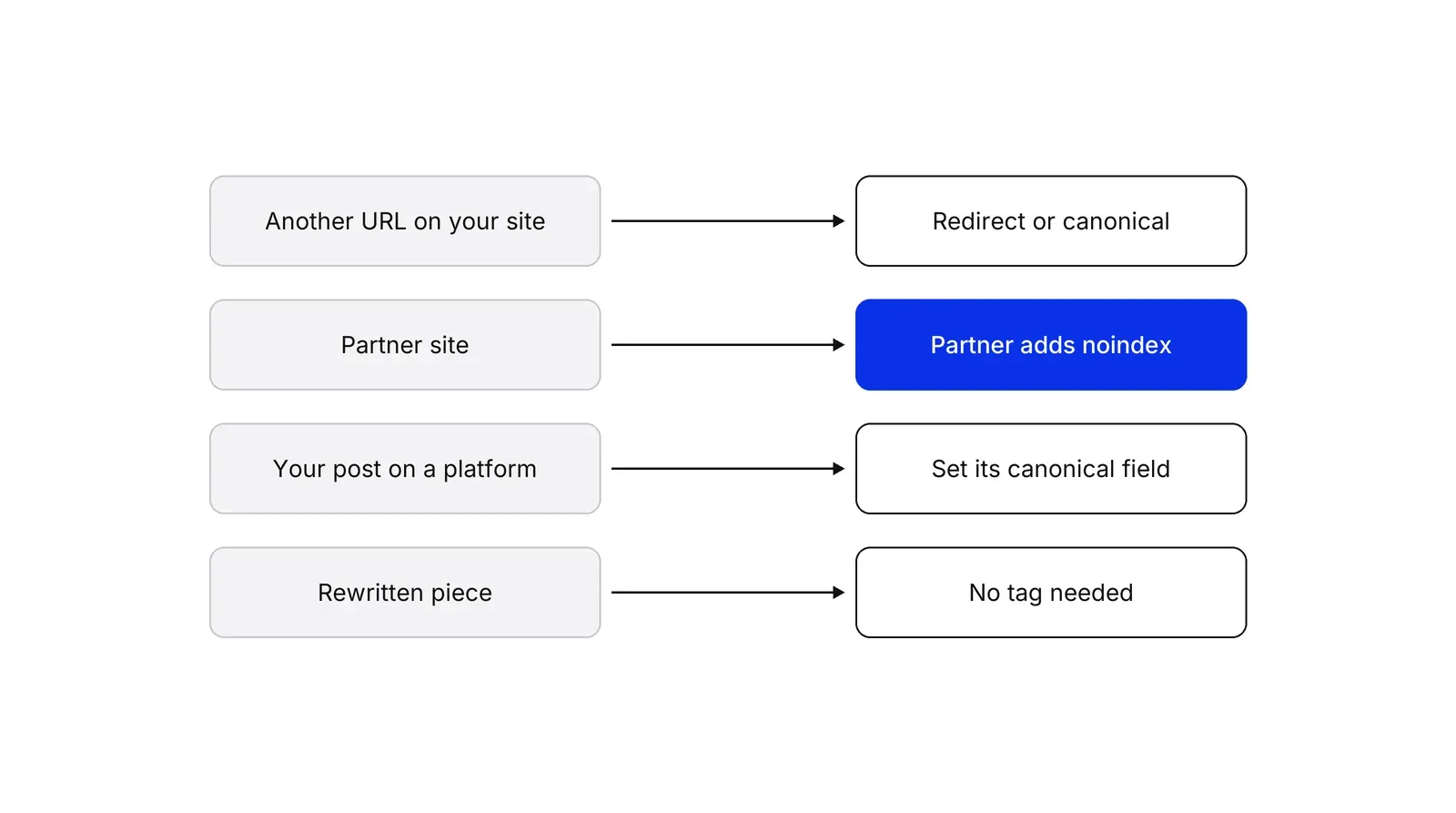
DEV Community lets you point a post at the original with a canonical_url field in its front matter. Treat it as a hint as well.
| Situation | What Google’s documentation points to |
|---|---|
| Same text on two URLs of your site | Redirect, or rel="canonical" on the copy |
| A syndication partner runs your text | Ask the partner to block indexing |
| Your content hosted elsewhere without permission | Contact the host or file a DMCA request |
| A new piece in new words and a new format | Nothing to mark; it is a separate page |
In Google Search Console, the URL Inspection tool shows the user-declared canonical next to the Google-selected one. The Search Console Page indexing report lists URLs under the status “Duplicate, Google chose different canonical than user”.
What does a four-week release look like?
This illustrative calendar uses the 45-minute payments webinar from the first example, with five delay causes as its main list.
| Week | Piece | Channel | Copy handling |
|---|---|---|---|
| 1 | Long article built from the transcript | Company site | Original, self-referencing canonical |
| 1 | Video page with captions | YouTube and company site | Separate watch page, unique title |
| 2 | Three 60-second clips, one per delay cause | LinkedIn and YouTube | New format, no tag |
| 3 | Checklist of the 5 causes | email newsletter | New wording, no tag |
| 4 | Edited article offered to a partner | trade publication | Partner adds noindex |
What about other people’s content?
Google Search’s spam policies name two kinds of scraping: republishing other sites’ content without original value, and copying with only slight changes. Repurposing covers your own material.
Google Search’s byline date guidance asks for a visible date matching datePublished or dateModified in Article, BlogPosting or VideoObject markup.
Link each derivative to the original with an <a href> link and descriptive anchor text (crawlable links), and give every page a unique title (SEO starter guide). See technical SEO; for how the source earns trust, E-E-A-T; for which audience sees which piece, audience temperature. A Growth Lab plan starts from the sources a team already owns and maps them to a release calendar (Growth Lab).
How to apply Content repurposing, step by step
- Choose a source worth repeating. Pick a piece with original material, such as a 45-minute webinar with a practitioner, your own numbers or a long article that already earns visits. Result: one source and the one-sentence claim it makes.
- Pull out the building blocks. List the separate claims, numbers, quotes, stories and steps, each with a timestamp or page reference. Result: 10 to 20 blocks, each usable alone.
- Match blocks to formats and audiences. Give each block a format and a channel: a cold audience gets the problem, a warm one gets proof. Result: a table of block, format, channel and the one action you want.
- Rewrite for each format. Write each piece from its block, leading with the conclusion, with its own title, opening and ending. Do not paste the source. Result: drafts that make sense without the source.
- Decide copy handling before publishing. For every place the same text will live twice, pick one rule: redirect, canonical tag, partner noindex, or no tag because the wording is new. Result: one line per copy, written before launch.
- Space the releases and check indexing. Release over 4 weeks. Then inspect key URLs in Google Search Console and compare the declared canonical with the selected one. Result: a calendar and a list of URLs where Google Search disagrees.
Examples
A cross-border payments company
Illustrative. A finance lead gives a 45-minute webinar on settlement delays for importers. The transcript becomes a long article on the company site, the original. Three clips go to LinkedIn and YouTube, a checklist of five delay causes goes into the newsletter, and a trade publication runs the article with noindex.
A dermatology clinic
Illustrative. A doctor records a 20-minute talk on when a changed mole needs a check. The clinic publishes a video page with captions, a written guide and a short FAQ. The doctor reviews every derivative, and no piece makes a stronger medical claim than the source.
When to use it
Use it when you already have one strong piece, the team has no time for ten new ones, and the same audience uses several channels. It works best for talks, interviews and original data.
When not to use it
Skip it when the source is thin or out of date, because copies spread the weakness. It is also no licence to copy other sites' pages, which Google Search's spam policies treat as scraping.
Common mistakes
- Pasting the same text into LinkedIn, the newsletter and a partner site instead of rewriting it for each.
- Adding a canonical tag to a syndication partner's copy and assuming it settles things, when Google Search Central calls it a hint and does not recommend it for partners.
- Blocking a duplicate URL in robots.txt and adding noindex to it, so Google never sees the noindex.
- Changing the date on a rewritten old article to look fresh when the content has not substantially changed.
- Repurposing only the best-ranking article and never the talks and data sets that have not been written up.
FAQ
Does republishing the same content hurt SEO?
Google Search Central treats duplicate pages as a consolidation question, not a penalty: Google Search groups similar pages and shows one. The risk is that it picks a copy you did not want. Mark your original with a redirect, a canonical tag or a partner noindex, and give each copy something of its own.
Should I use a canonical tag for syndicated content?
The Google Search Central troubleshooting guide says the canonical element is not recommended for avoiding duplication by syndication partners, and that the most effective fix is for partners to block indexing. Within your own site a canonical is a strong signal. For partner copies, ask for noindex in the agreement.
What if a copy outranks my original?
Open the URL Inspection tool in Google Search Console and compare the user-declared canonical with the Google-selected one. If an outside site hosts your content without permission, Google Search Central says to contact the site's host or file a DMCA request. For a licensed partner copy, ask for noindex.
What is the best way to repurpose a webinar?
Start with the transcript and break it into claims, numbers and stories. Publish a video page with captions, an article under its own title, a newsletter issue and three to five clips for LinkedIn and YouTube. Rewrite each for its channel and link back to the original.
How many pieces should one source become?
No study gives a number. Count the separate ideas in the source and make one piece per idea for each channel your audience uses. The 2003 meta-analysis of 97 spacing studies by Janiszewski, Noel and Sawyer points to spacing releases over time, so plan four weeks, not one day.
Sources
- Google Search Central, Consolidate duplicate URLs with canonicalization
- Google Search Central, How Google picks a canonical URL
- Google Search Central, Troubleshoot canonicalization issues
- Google Search Central, Spam policies for Google web search
- Google Search Central, Robots meta tag and X-Robots-Tag specifications (noindex)
- Google Search Central, Creating helpful, reliable, people-first content
- Google Search Central, Influence your byline date in Google Search
- Google Search Central, Video SEO guidance
- Google Search Central, Google Search's guidance on using generative AI content
- Google Search Central, Managing multi-regional and multilingual sites
- Google Search Central, Image SEO guidance
- Google Search Central, SEO starter guide
- Google Search Central, Make your links crawlable
- Google Search Central, Google Search Essentials
- Google Search Console Help, Page indexing report
- Google Search Console Help, URL Inspection tool
- Jakob Nielsen, Nielsen Norman Group, How users read on the web, 30 September 1997
- Jakob Nielsen, Nielsen Norman Group, F-shaped pattern for reading web content, 16 April 2006
- Chris Janiszewski, Hayden Noel, Alan Sawyer, A Meta-analysis of the Spacing Effect in Verbal Learning, Journal of Consumer Research 30(1), 2003 (IDEAS/RePEc)
- Nicholas Cepeda and others, Distributed practice in verbal recall tasks: a review and quantitative synthesis, Psychological Bulletin 132(3), 2006
- Zach Brand, NPR Senior Director of Technology and Strategy, NPR API: Create Once, Publish Everywhere (slides)
- YouTube Help, Add subtitles and captions
- Apple Podcasts for Creators, Transcripts on Apple Podcasts
- DEV Community, Editor guide
Last updated Oct 9, 2026


Marketing agency or growth system: when a company outgrows its agency
An agency is the right call while the founder still runs most of the company. Once the business starts copying itself into new locations or markets, it needs a system that sets goals, tests hypotheses and owns the result.

Why healthcare marketing agencies stall: the short, mid and long wins model we use with clinics
Most agencies own the click and nobody owns the front desk. How we structure clinic work in three horizons, the research behind each one, and one year of results.

The compliance layer under fintech marketing operations
A fintech marketing agency can build campaigns. It cannot own the compliance review, the KYC drop-off or the multi-market licensing rules that decide whether a lead ever becomes a customer.