Content pillars
Content pillars are a short list of recurring themes a brand publishes about, so every post in the editorial or social calendar has a clear job and a clear home.
Content pillars are a small set of recurring themes, usually three to five, that a brand builds its editorial or social calendar around. Each post belongs to one pillar, which keeps the output consistent and shows which themes earn attention. In SEO the word pillar means something else: a hub page that anchors a cluster of related articles.
- Origin
- Practitioner convention with no documented author; related models from Google and YouTube (hero, hub, help) and Coca-Cola (70/20/10), No documented origin year
- Level
- 201 · Tool
- Fits
- Startup, Small and mid-size
- Time to apply
- Half a day to choose pillars, one more day to fill the first month of the calendar
- What you need
- your last 30 to 90 days of posts, with results if you have them · five to ten real questions your customers ask · an honest number for how many posts the team can produce each month
Content pillars are a short list of recurring themes that a brand commits to publishing about. Buffer describes them as the core themes that guide what a brand posts, and Sprout Social as themes or content types shared consistently across profiles, each tied to a purpose, an audience or a format. The pillars decide what the calendar contains before anyone writes a caption. This page covers the editorial and social meaning of the term. For the SEO meaning, a hub page anchoring a cluster of articles, see topic clusters and pillar pages.
Where does the idea come from?
Nobody documents an inventor. The term shows up in the guides of scheduling and social tools such as Buffer, Sprout Social, Mailchimp and Hootsuite, and it has no academic origin we could find. Several older ideas sit next to it. Google and YouTube promote the hero, hub and help model, covered below. Coca-Cola’s Jonathan Mildenhall, then at Coca-Cola, described a 70/20/10 split of content effort in a 2013 keynote at Content Marketing World, and in 2011 explained “liquid” marketing to MediaPost. Joe Pulizzi’s content tilt, explained in a May 2020 Content Marketing Institute article, argues for aiming at a very specific reader. Gary Vaynerchuk’s Jab, Jab, Jab, Right Hook, published by Harper Business on November 26, 2013, holds that patient engagement should come before the sales move.
The research base is the field of content marketing. Linda Hollebeek and Keith Macky define it as sharing useful brand content on digital platforms to build engagement and trust rather than to push an immediate purchase. The Content Marketing Institute’s definition stresses valuable, relevant and consistent content. Pillars are one practical way to make the word “consistent” operational.
What makes a good pillar?
A pillar is a theme broad enough to produce dozens of posts and narrow enough that you can say what does not belong in it. Mailchimp calls pillars stable categories that outlast weekly trends or product drops, and warns against both “lifestyle” (too broad) and a weekday quote series (too narrow). Metricool gives a dentist’s office three pillars: dental education, how-to tutorials and humor.
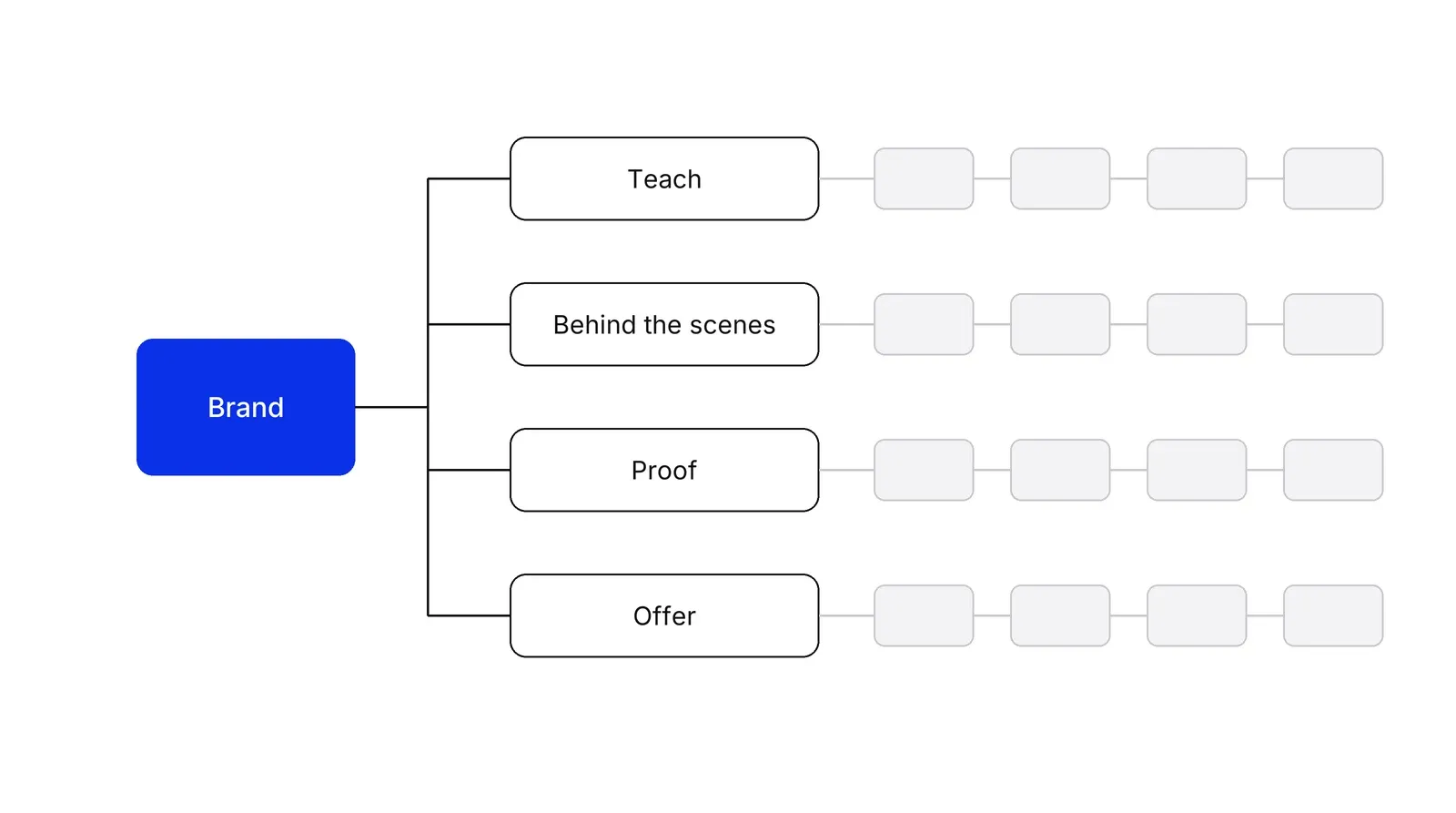
Think in 3 levels: the pillar, the angle inside it and the post. Arithmetic keeps the plan honest: a team that can publish 12 posts a month across 4 pillars has 3 posts per pillar, so each pillar gets about 36 posts a year, and a pillar that cannot support 36 distinct posts is too narrow. Under “Teach” for a clinic, one angle is “what to expect at a first visit”, and the post is a carousel on that. The first level changes rarely, the second changes with the quarter, and the third changes daily.
How many pillars should you have?
3 to 5 is the common answer. Buffer and Sprout Social both say 3 to 5, Kontentino says fewer than 3 gets repetitive and more than 6 loses focus, and Metricool allows up to 7. Hootsuite says most brands use 4: educate, entertain, inspire and promote. We found no study that tests the number, so read it as a rule of thumb about what a team can keep up with.
The sets differ in what they sort by. Hootsuite’s four sort by the effect on the reader, while the dentist example sorts by subject. Either works if two people can put the same post in the same pillar. If they cannot, the definitions are too loose.
How do hero, hub and help content fit in?
Pillars say what you talk about. Hero, hub and help say how big and how frequent each piece is. Newcastle University’s brand guide defines hero as flagship stories that need heavy planning, hub as ongoing content that draws people back, and help as practical information people look for. Practical Ecommerce says hero content is produced once or twice a year, hub content runs on a schedule, and help content answers specific questions, often in under two minutes of video. Its examples: BMW’s short film The Small Escape as hero, the weekly TV show Wild Kingdom (Mutual of Omaha, 1963 to 1988) as hub, and D&B Supply’s short videos on pellet stoves as help. The model is attributed to Google and YouTube, but we could not confirm who first published it or when, and the Google pages we found have moved.
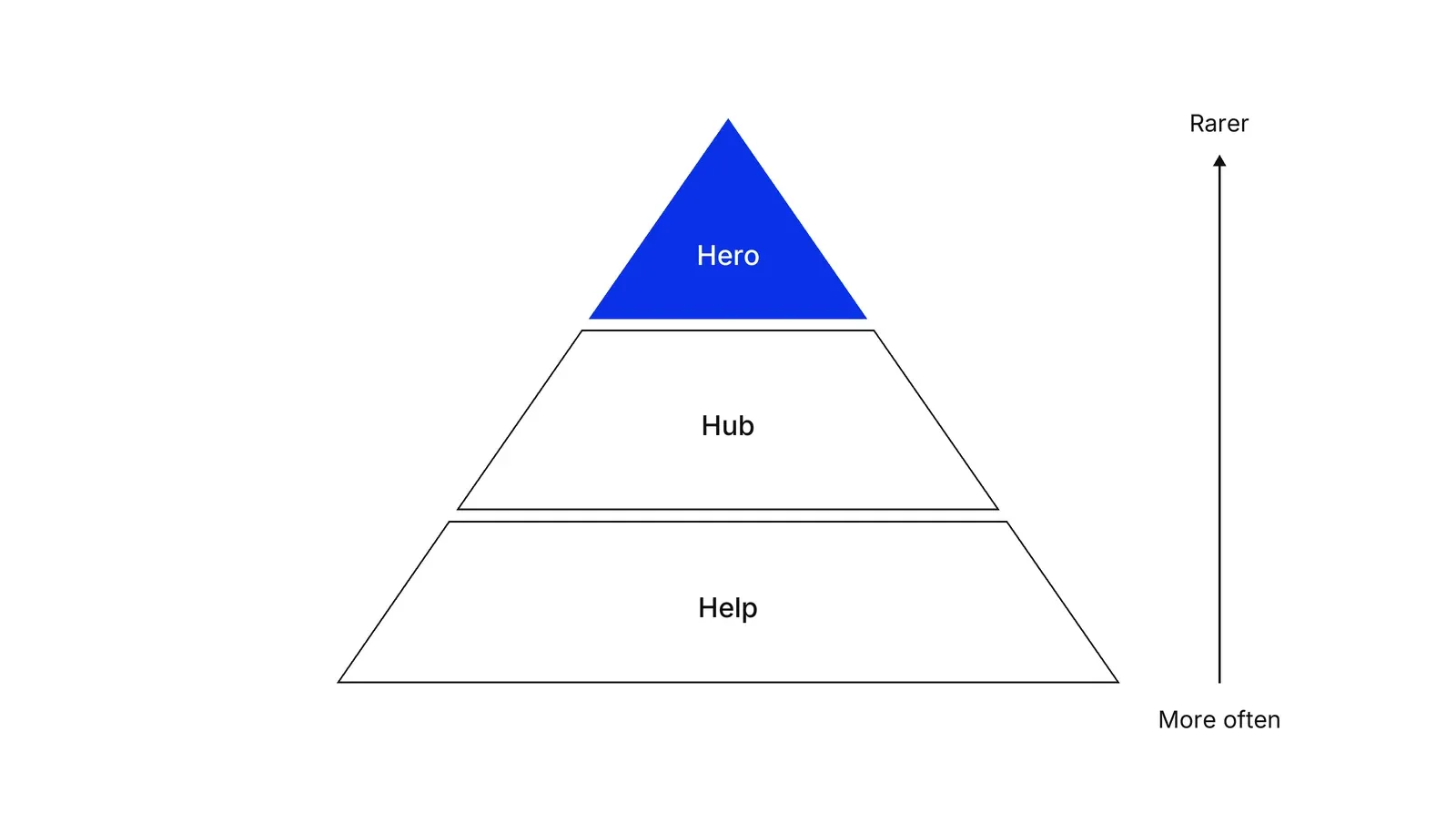
Use it inside each pillar. A “Teach” pillar might have a yearly survey report (hero), a monthly live question session (hub) and a steady flow of short answers (help). Coca-Cola’s 70/20/10 split is a second way to budget effort: safe content gets most of it, and experiments get a fixed small share.
What does research say about the mix?
Studies of brand posts are mostly from Facebook, so they show patterns, not rules. Dokyun Lee, Kartik Hosanagar and Harikesh Nair coded 106,316 messages from 782 companies. Posts with brand personality, such as humor and emotion, were linked to more likes, comments and shares. Purely informative posts, such as prices and deals, were linked to less engagement, but mixing informative content with personality raised engagement. Wafa Tafesse studied 191 posts from five UK car brands and found that post consistency and novelty both raised likes and shares. Sabate, Berbegal-Mirabent, Canabate and Lebherz found, in 164 posts from five Spanish travel agencies, that images and videos earned more likes. Lisette de Vries, Sonja Gensler and Peter Leeflang had already coded 355 posts from 11 brands in 2012 to ask what drives post popularity.
The samples are small, the metric is engagement and not sales, and platforms have changed. The practical reading is modest: do not let one pillar be all promotion, and give each pillar more than one format. Platforms also differ in what they favor. Jan Kietzmann, Kristopher Hermkens, Ian McCarthy and Bruno Silvestre described seven building blocks of social media, among them conversations, sharing and reputation, and each network weights them differently. Sprout Social advises adjusting each pillar to the platform it runs on.
How are content pillars different from other planning terms?
| Content pillar | SEO pillar page | Campaign | |
|---|---|---|---|
| What it is | A recurring theme in a calendar | A long page that anchors a cluster of articles | A time-boxed push for one goal |
| Lives in | Social, email, blog, video | One URL on a website | Several channels at once |
| Lasts | Quarters to years | As long as the topic matters | Weeks to months |
| Checked by | Share of posts and response per pillar | Search visibility for the topic | Result against the goal |
The three work together. A pillar can feed a campaign with its best posts, and a pillar page can be one output of a pillar. Keep the planning layers separate so that a campaign ending does not look like a pillar failing. A messaging hierarchy tells you what to say, a buyer persona tells you to whom, and pillars turn both into a repeating plan. A creative testing framework then tells you which angles inside a pillar to keep. A Growth Lab plan starts from audience questions and team capacity before it names a pillar; see Growth Lab.
How to apply Content pillars, step by step
- Write down who you publish for and what the content must do. Name one audience and one job for the next quarter, such as bookings, trial sign-ups or trust with buyers who are still comparing options. Pillars exist to serve that job. Result: a two-line brief every pillar has to match.
- Audit what you already post. List the last 30 to 90 posts and give each a short theme tag. Mark the five best and the five worst by whatever you measure: saves, shares, replies, clicks. Result: a table showing which themes you already publish and which ones people respond to.
- Collect customer questions. Pull questions from sales calls, support tickets, comments and search suggestions. Group related questions. Each group is a candidate theme. Result: a list of audience-led themes, not a list of what the company wants to say.
- Choose three to five pillars and define each in one sentence. Keep a pillar only if it passes two tests: customers would want it, and you can name what does not belong in it. Write one sentence of scope per pillar. Result: a pillar sheet that two people can read and sort the same post into the same pillar.
- Assign formats and effort. For each pillar, decide the formats (short video, carousel, article, email) and the mix of hero, hub and help pieces. Match volume to real capacity. Result: a plan like 'Teach: two help posts and one weekly series per month'.
- Build the calendar from pillar slots. Give each week a slot per pillar before any caption is written, and tag every post with its pillar in the calendar or scheduling tool. Result: a calendar that fills by rule and a tag you can report on.
- Review every quarter. Compare pillars by the metric tied to the job from step one. Merge pillars that produce the same posts, drop the weakest, and test a new one for about a month before committing. Result: a pillar sheet that changes by evidence, not by mood.
Examples
A private dental clinic (illustrative)
Four pillars and twelve posts a month, so three per pillar. Teach: what happens at a first visit, explained by a dentist. Behind the scenes: how instruments are sterilized, introductions to the team. Proof: patient stories published with written consent. Offer: open check-up slots this month. Because the topic is health, a clinician reviews anything in the Teach pillar before it goes out. The four-pillar split shows quickly if Offer has quietly grown to half of the posts.
A B2B payments startup (illustrative)
Four pillars aimed at finance managers at small exporters. Rules explained: what a change in cross-border rules means for them, with a link to the regulator's text. Product in practice: one workflow shown end to end. Customer operations: how a finance team runs month-end. Company notes: hiring and releases. One hero piece a quarter, such as a survey report, feeds the help and hub posts for the following weeks.
Coca-Cola's 70/20/10 split (documented)
[TopRank Marketing](https://www.toprankmarketing.com/blog/content-2020-coca-colas-content-strategy/) reported that at Content Marketing World in 2013, Coca-Cola's Jonathan Mildenhall described a content plan in which 70% of effort goes to safe, proven content, 20% to building on what works and 10% to high-risk ideas. It is a way to split effort across content, which sits one level above pillars.
When to use it
Use pillars when more than one person posts, when the calendar is filled by whatever came to mind last, or when you cannot say what the brand is known for on social channels or in a newsletter. They pay off most for small teams who need to decide quickly what to make this week.
When not to use it
Skip them for a one-off launch with a fixed end date, where a campaign plan is the right tool. They also add little when a brand has not yet decided who it serves: settle the audience and message first, then choose themes.
Common mistakes
- Naming pillars after content types, like 'video' or 'blog'. A pillar is a theme. Formats are chosen after the theme.
- Using labels so broad that anything fits, such as 'lifestyle'. Mailchimp warns against both too-broad and too-narrow pillars.
- Letting the Offer pillar take over. If most posts ask for a sale, the other pillars have stopped doing their job.
- Treating pillars as permanent. Kontentino recommends a quarterly review, and Hootsuite suggests trying a new pillar for 30 days.
- Copying a competitor's pillars. They fit that company's audience and capacity, not yours.
FAQ
What are content pillars?
Content pillars are the three to five recurring themes a brand publishes about, such as education, behind the scenes, customer proof and offers. Each post is tagged to one pillar, so the calendar has structure and results can be compared by theme. The term comes from social media and editorial planning.
How many content pillars should a brand have?
Most guides say three to five. Buffer, Sprout Social and Kontentino use that range, Hootsuite says most brands use four, and Metricool sets seven as the upper limit. We found no study that tests the number, so treat it as a rule of thumb tied to how much a team can produce.
What is the difference between content pillars and pillar pages?
A content pillar is a recurring theme in an editorial or social calendar. A pillar page is a long page that anchors a cluster of related articles for search. The two can share a topic, but they answer different questions: what to publish regularly, and how to structure a site.
What are examples of content pillars?
Common sets are educate, entertain, inspire and promote (Hootsuite), or education, how-to tutorials and humor for a dentist's office (Metricool). A B2B firm might use rules explained, product in practice, customer operations and company notes. Choose themes your customers ask about, not generic labels.
How often should you change your content pillars?
Review them each quarter and compare pillars by the metric tied to your goal. Kontentino recommends a quarterly review. Hootsuite suggests testing a new pillar for about 30 days and replacing it if it does not perform. Change pillars when the audience or goal changes, not when a week goes badly.
Sources
- Buffer, Content pillars (social media glossary)
- Sprout Social, Social media content pillars
- Mailchimp, Content pillars for social media
- Metricool, The importance of content pillars for a social media strategy
- Kontentino, Content pillars strategy framework
- Hootsuite, Social media content creation guide
- Planable, Social media content pillars
- Newcastle University Brand Hub, Hero, hub, help
- Practical Ecommerce, The Hero-Hub-Help content marketing strategy, July 27, 2020
- TopRank Marketing, Content 20/20: Jonathan Mildenhall on Coca-Cola's content strategy
- MediaPost, Coke's Mildenhall explains 'liquid' marketing, October 4, 2011
- Content Marketing Institute, Joe Pulizzi, Are you guilty of the one thing that kills content marketing?, May 21, 2020
- Content Marketing Institute, What is content marketing?
- Gary Vaynerchuk, Jab, Jab, Jab, Right Hook, Harper Business, 2013 (Apple Books record)
- Dokyun Lee, Kartik Hosanagar, Harikesh Nair, Advertising content and consumer engagement on social media: evidence from Facebook, Management Science, 2018 (Wharton Mack Institute)
- Wafa Tafesse, Content strategies and audience response on Facebook brand pages, Marketing Intelligence & Planning 33(6), 927-943, 2015
- Sabate, Berbegal-Mirabent, Canabate, Lebherz, Factors influencing popularity of branded content in Facebook fan pages, European Management Journal 32(6), 1001-1011, 2014
- Lisette de Vries, Sonja Gensler, Peter Leeflang, Popularity of brand posts on brand fan pages, Journal of Interactive Marketing 26(2), 83-91, 2012
- Linda Hollebeek, Keith Macky, Digital content marketing's role in fostering consumer engagement, trust, and value, Journal of Interactive Marketing 45, 27-41, 2019
- Jan Kietzmann, Kristopher Hermkens, Ian McCarthy, Bruno Silvestre, Social media? Get serious!, Business Horizons 54(3), 241-251, 2011
Last updated Oct 9, 2026


The compliance layer under fintech marketing operations
A fintech marketing agency can build campaigns. It cannot own the compliance review, the KYC drop-off or the multi-market licensing rules that decide whether a lead ever becomes a customer.

Fractional CMO: what you get, and what has to exist underneath
A fractional CMO brings strategy and judgment. Without reporting, CRM hygiene and a named owner per number, the engagement produces a slide deck instead of a system.

The operations layer behind healthcare patient acquisition
Ads and search bring the request in. What happens between the click and the booked, attended visit decides whether the spend paid off.