PAS and AIDA copywriting formulas
PAS, AIDA and 4U are short copywriting formulas that give a page, ad or email a fixed order of moves, so a writer starts from a structure instead of a blank screen.
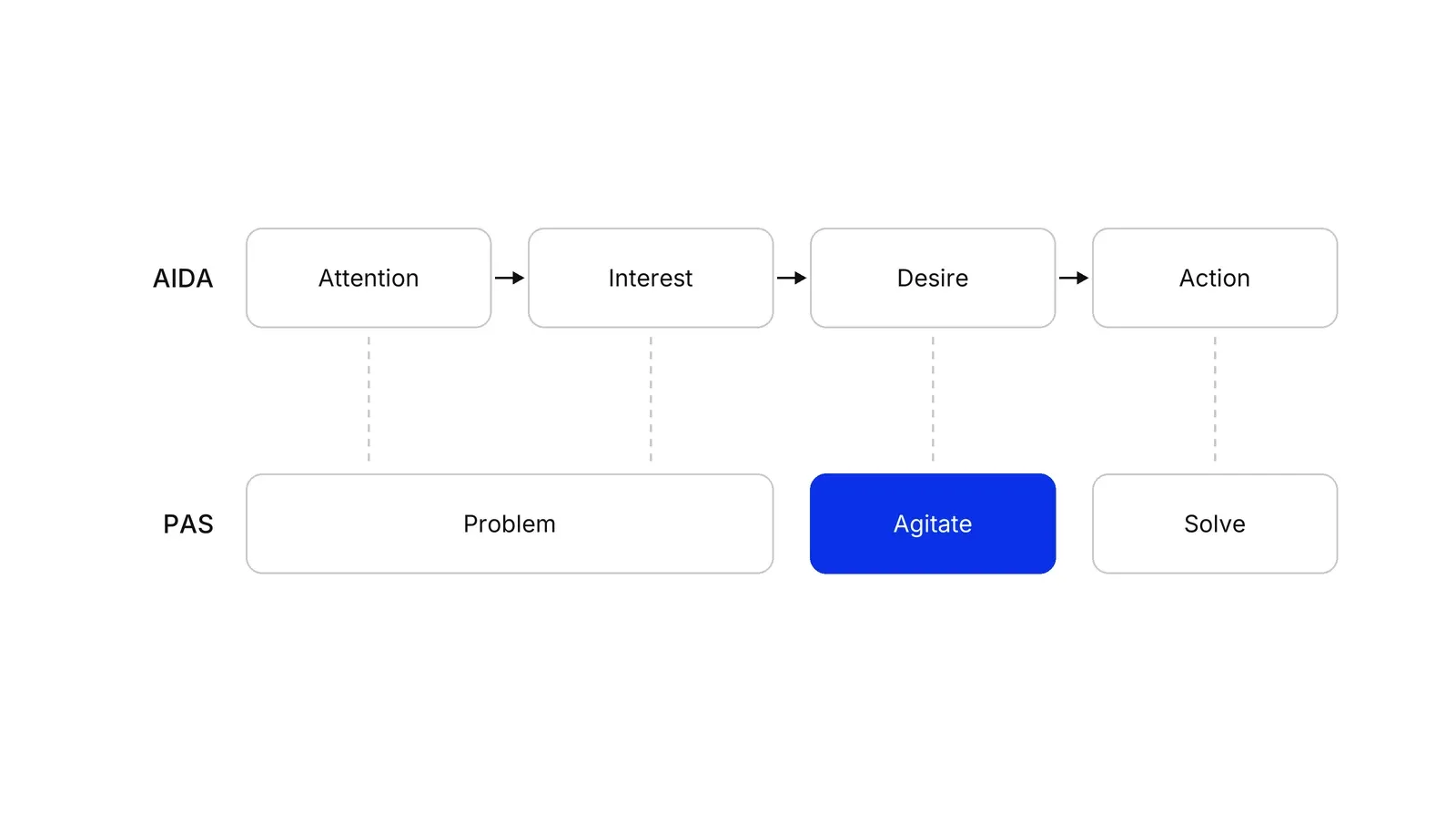
Copywriting formulas are fixed sequences of moves for a piece of selling text. PAS opens with the reader's problem, sharpens it, then offers the solution. AIDA runs attention, interest, desire, action. 4U is a four-question check for headlines and bullets. They speed up drafting, but no study shows one beats the others, so test your version.
- Origin
- AIDA: credited to E. St. Elmo Lewis by Strong (1925), disputed; PAS: no documented inventor; 4U: Michael Masterson and Bill Bonner (per AWAI), AIDA: 1898 (claimed) to 1911 (documented in print); 4U: by 2001
- Level
- 201 · Tool
- Fits
- Startup, Small and mid-size
- Time to apply
- 45 minutes to rewrite one landing page or email
- What you need
- one page, email or ad that has to make one ask · three to five phrases real customers use to describe the problem, from calls, reviews or support tickets · one piece of proof you can show: a number, a name, a guarantee
A copywriting formula is a fixed order of moves for a piece of selling text. The three in common use are PAS (problem, agitate, solve), AIDA (attention, interest, desire, action) and 4U (useful, unique, urgent, ultra-specific). The first two structure a whole page or email. The third checks one headline or bullet. This page covers what each does, how they differ, where their origin stories come from, and what evidence exists behind them.
How do PAS, AIDA and 4U differ?
PAS is for a reader who already feels the problem, AIDA is for a reader who has to be won step by step, and 4U is a test you run on a single line. Pick by the reader’s starting point, not by habit.
| Formula | Steps | Works on | Best when |
|---|---|---|---|
| PAS | Problem, agitate, solve | A whole email, ad or page section | The reader knows the problem exists |
| AIDA | Attention, interest, desire, action | A whole page, ad or sales script | The reader knows little and needs a reason to keep reading |
| 4U | Useful, unique, urgent, ultra-specific | One headline, subject line or bullet | You have a draft line and want to find its weak spot |
For a reader who has never heard of your category, an opening about their problem can miss. Audience temperature covers how to match the opening to what the reader already knows.
Where does AIDA come from?
The usual answer is E. St. Elmo Lewis, in 1898, and the usual answer rests on a single sentence. Edward Strong wrote in a 1925 paper that Lewis “formulated the slogan, ‘Attract attention, maintain interest, create desire,’ in 1898” and later added “get action.” He gave no citation. A 2020 review of response models in health care still traces AIDA to Strong in 1925 and to Lewis.
A 2024 study by Akinori Iwamoto in the Japan Marketing History Review reached a different conclusion. It found no evidence that Lewis produced an AIDA prototype around 1898 and called the dominant hypothesis unsupported or weakly evidenced. It credits Frank Dukesmith and Arthur Sheldon with the formulation and argues Sheldon can be regarded as the originator. Sheldon’s 1911 book The Art of Selling lists favorable attention, interest, desire and action, then adds a fifth step, permanent satisfaction.
So the sources disagree, and the older story is the less documented one. For the longer history and the funnel that grew out of it, see the marketing funnel page.
Who invented PAS?
No source we found documents an inventor or a first printed appearance. Demian Farnworth wrote in Copyblogger in 2014 that he learned it from an unnamed direct-response copywriter’s email newsletter archive. Copyhackers repeats a line that Dan Kennedy called PAS the most reliable formula for sales ever invented, with no citation to a book or date. Treat any named creator as unverified. What can be said is that it comes from direct-response copywriting, where results are counted in orders.
How does PAS work, and where does agitation go wrong?
PAS works by making the cost of the problem concrete before offering the fix, so the solution lands as relief.
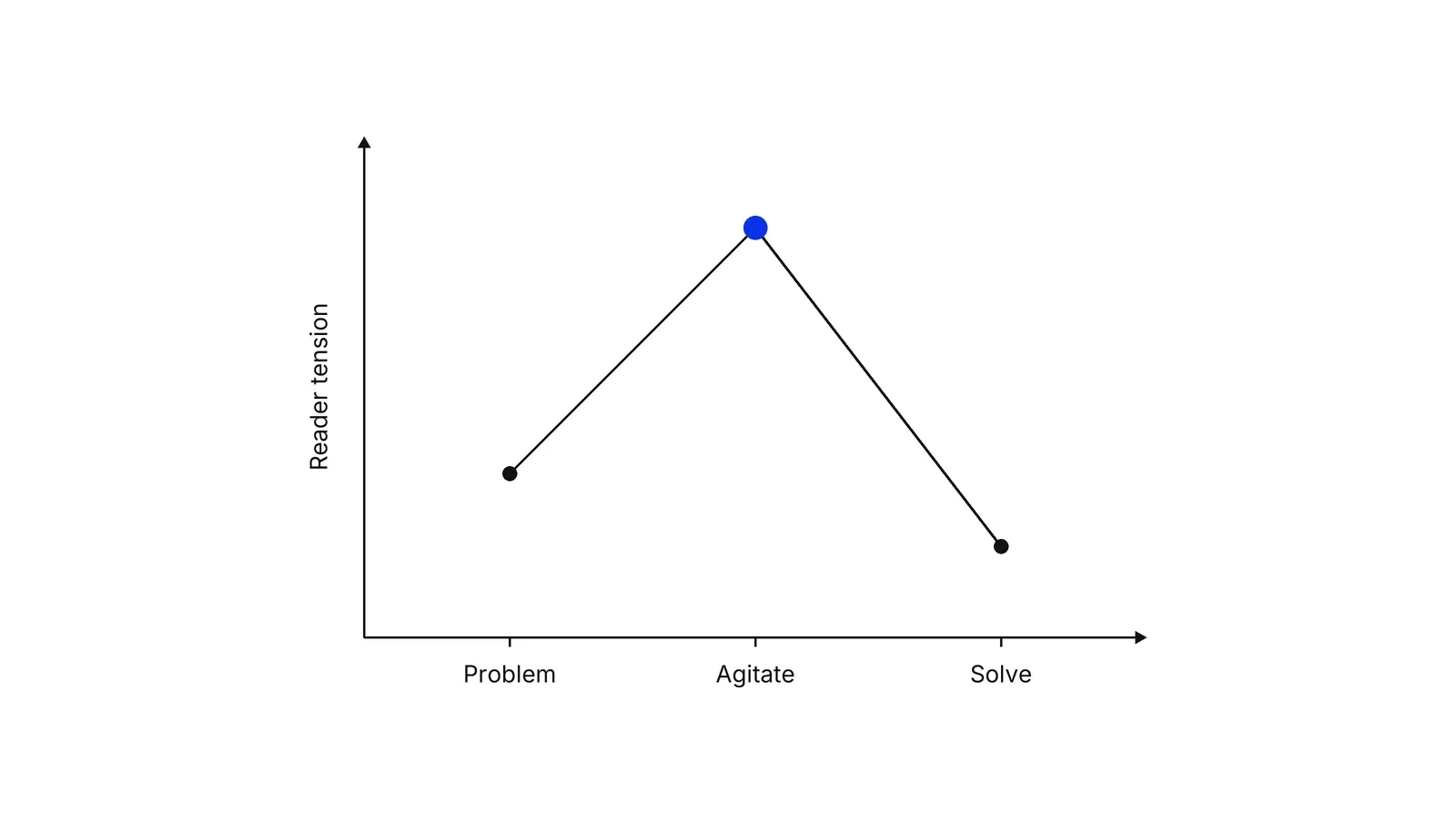
The agitate step borrows from two bodies of research. Tversky and Kahneman showed in 1981 that people weigh losses more heavily than gains, which is the usual argument for describing what a problem costs. Fear-appeal research adds a limit. A 2015 meta-analysis by Melanie Tannenbaum and colleagues covered 127 articles and 248 samples and found a small positive average effect (d = 0.29). Effects grew when messages included statements about how to cope. Witte and Allen’s 2000 meta-analysis found that strong fear paired with low efficacy produced the most defensive responses.
In copy terms: agitate with facts the reader recognizes, once, and move to the solution while they still believe they can act. If the problem is one they cannot change, agitation only annoys them.
What does research say about the “Desire” step?
Specific, plain claims do better than inflated ones. Claude Hopkins wrote in 1923 that platitudes and generalities leave no impression, and that superlatives make readers discount the rest. Morkes and Nielsen tested five versions of the same site in 1997. Objective language scored 27 percent better on usability than promotional language, and a concise, scannable, objective version scored 124 percent better.
Count matters too. Shu and Carlson found that when people know they are being sold to, impressions peaked at three positive claims, and a fourth made them doubt all of them. The messaging hierarchy page uses the same finding to cap a message at three pillars.
Using 4U as an editing check
4U is a quick filter. AWAI’s 2001 note credits Michael Masterson and Bill Bonner and applies it to bullet points. Unbounce’s 2015 version scores a headline with one point per yes and aims for at least three.
| U | Question | Weak line | Stronger line |
|---|---|---|---|
| Useful | Does it offer the reader something of value? | “Our platform” | “Cut month-end close from 8 days to 5” |
| Unique | Could a competitor say the same? | “Quality service” | A method only you use |
| Urgent | Is there a reason to act now? | “Contact us” | “Rates change on 1 November” |
| Ultra-specific | Does it use exact facts? | “Save money” | “Save 34.97 dollars” |
The lines in the right-hand column are illustrations, not results.
What the evidence does not show
No study we found compares PAS or AIDA against other structures. The nearest large test is political: Hewitt and colleagues analyzed 617 ads in 146 experiments and found that common theories of persuasion predict which ads work only weakly, and that it is hard to predict ahead of time which ads persuade. A formula gets a draft started, and an A/B test, as covered in creative testing, says whether it worked.
In finance and health, agitation also meets law. The FTC requires that ads have a reasonable basis before they run, and health or safety claims generally need competent and reliable scientific evidence. A testimonial or a money-back guarantee does not replace that evidence. A Growth Lab plan starts from the customer’s own words and a testing calendar, with the formula chosen last.
How to apply PAS and AIDA copywriting formulas, step by step
- Name the reader and the one action. Write one sentence on who reads this and one sentence on the single action you want. Everything else in the draft serves those two lines. Result: a brief short enough to check every paragraph against.
- Choose the formula by how aware the reader is. Use PAS when the reader already feels a problem and the page must make the case for acting. Use AIDA when the reader knows little and has to be won step by step. Use 4U only to check a headline or a bullet. Result: one formula picked on purpose.
- Draft the first move in the customer's words. For PAS, state the problem in a phrase copied from a customer. For AIDA, open with the fact or promise this audience stops for. Result: an opening line that could not sit on a competitor's page.
- Draft the middle with proof, not adjectives. In PAS, agitate with the real cost of leaving the problem alone, stated once and factually. In AIDA, build desire with a number, a name or a guarantee. Result: a middle section where each claim has something behind it.
- Close with one solution and one action. Present the fix, say what the reader does next, and remove every other link or button near it. Result: one visible next step.
- Score it, then test it. Score the headline and bullets with the four 4U questions, aiming for at least three yes answers. Then run the new version against the old one as an A/B test. Result: a decision based on your audience, not on the formula.
Examples
A dental clinic's implant page
Illustrative. Problem: 'You have avoided a missing tooth for two years because every clinic quotes a different price.' Agitate: say what waiting costs, using only facts the clinic can document and cite on the page. Solve: a fixed-price consultation, the surgeon's name and a booking button. The agitation stays factual and brief, because health claims need evidence behind them.
A payments startup's cross-border transfers page
Illustrative. A founder sends money abroad twice a month. Attention: the exact fee on one sample transfer, compared with the bank's. Interest: how the transfer settles and in how many hours. Desire: a named customer in a similar business and the saving in dollars. Action: open an account with an email address only, and move identity checks after the account exists.
A B2B software cold email
Illustrative. Subject line scored on 4U: useful (names a task the reader does weekly), unique (a method the competitors do not use), urgent (tied to a date the reader already has), ultra-specific (one number). The body then follows PAS in four short sentences: the problem, what it costs the reader's team, the fix, one calendar link.
When to use it
Use a formula when a text has one clear job, such as a landing page, a sales email, a product description or a paid ad, and the writer needs a structure to start from. They also work as an editing checklist: if the draft cannot say which step each paragraph serves, the structure is missing.
When not to use it
Skip them when the reader needs information to decide, such as a pricing page for a complex purchase or a regulated product disclosure. Skip agitation when the audience cannot act on the problem you describe. And never use a formula as a substitute for knowing the customer: a perfect structure around a generic message still reads as generic.
Common mistakes
- Treating a formula as proven. No controlled study we found compares PAS or AIDA against alternatives, and a large archive of political ad tests found common persuasion theories predict results only weakly. Test your own version.
- Agitating until the reader feels hopeless. Fear works best when the text also shows a feasible way out. Without it, strong fear produces defensive reactions.
- Stacking claims in the Desire step. Past three, readers who know they are being sold to start to doubt all of them.
- Repeating the 1898 origin story for AIDA as settled fact. The account traces back to one uncited sentence from 1925.
- Writing marketese: boasts and superlatives instead of facts. In a 1997 test, plain objective text scored better than promotional text on the same site.
FAQ
What is the PAS copywriting formula?
PAS stands for problem, agitate, solve. The text names a problem the reader has, makes its cost felt, then presents the product as the fix. It suits readers who already know the problem exists. Nobody has documented who first wrote it down, so treat origin stories you meet as unverified.
What is the difference between AIDA and PAS?
AIDA has four steps and fits a reader who needs to be won gradually: attention, interest, desire, action. PAS has three and starts from a problem the reader already feels. PAS is the shorter route; AIDA gives more room to build proof. Both end in one action.
Who invented AIDA?
It depends on the source. Edward Strong credited E. St. Elmo Lewis with the slogan in 1898 in a 1925 paper, without citing evidence. A 2024 historical study found that claim weakly supported and credits Arthur Sheldon and Frank Dukesmith with formulating it. Sheldon's 1911 text lists the four words in order.
What is the 4U formula in copywriting?
4U is a four-question check for a headline or bullet: is it useful, unique, urgent and ultra-specific. AWAI credits Michael Masterson and Bill Bonner with the idea. Unbounce suggests giving one point per yes and aiming for at least three. It checks a line; it does not structure a whole page.
Do copywriting formulas actually work?
They give a draft a structure, which speeds up writing, but no controlled study shows that one formula outperforms another. What does have evidence is the content inside: specific facts, concise text and objective wording. Treat a formula as a first draft and measure the result with an A/B test.
Sources
- Akinori Iwamoto, The Origin of AIDA: Who Invented and Formulated the AIDA Model?, Japan Marketing History Review 3(2), 2024
- Edward K. Strong, Theories of Selling, Journal of Applied Psychology 9(1), 1925 (Internet Archive)
- Arthur Frederick Sheldon, The Art of Selling, Sheldon School, 1911 (Internet Archive)
- James K. Elrod, John L. Fortenberry Jr, Response Hierarchy Models and Their Application in Health and Medicine, BMC Health Services Research 20(Suppl 1), 2020
- Demetrios Vakratsas, Tim Ambler, How Advertising Works: What Do We Really Know?, Journal of Marketing 63(1), 1999
- Robert J. Lavidge, Gary A. Steiner, A Model for Predictive Measurements of Advertising Effectiveness, Journal of Marketing 25(6), 1961
- Demian Farnworth, Master This Copywriting Formula to Dominate Any Social Media Platform, Copyblogger, 2014
- Joanna Wiebe, Copywriting Formulas, Copyhackers
- American Writers & Artists Institute, A Review of the 4 U's, 2001
- Marc Aarons, A Classic Formula for Gut Checking Your Landing Page Headlines, Unbounce, 2015
- Claude C. Hopkins, Scientific Advertising, 1923, chapter 7 Being Specific (Internet Archive transcription)
- Jakob Nielsen, How Users Read on the Web, Nielsen Norman Group, 1997
- John Morkes, Jakob Nielsen, Concise, SCANNABLE, and Objective: How to Write for the Web, Nielsen Norman Group, 1997
- Melanie B. Tannenbaum and others, Appealing to Fear: A Meta-Analysis of Fear Appeal Effectiveness and Theories, Psychological Bulletin 141(6), 2015
- Kim Witte, Mike Allen, A Meta-Analysis of Fear Appeals: Implications for Effective Public Health Campaigns, Health Education & Behavior 27(5), 2000
- Amos Tversky, Daniel Kahneman, The Framing of Decisions and the Psychology of Choice, Science 211(4481), 1981
- Suzanne B. Shu, Kurt A. Carlson, When Three Charms but Four Alarms, Journal of Marketing 78(1), 2014
- CBIA, In Marketing, Three's a Charm, 2014 (summary of Shu and Carlson)
- Joshua Hewitt and others, How Experiments Help Campaigns Persuade Voters, American Political Science Review 118(4), 2024
- Yale Institution for Social and Policy Studies, summary of How Experiments Help Campaigns Persuade Voters
- Federal Trade Commission, Advertising FAQ's: A Guide for Small Business
Last updated Oct 9, 2026


The compliance layer under fintech marketing operations
A fintech marketing agency can build campaigns. It cannot own the compliance review, the KYC drop-off or the multi-market licensing rules that decide whether a lead ever becomes a customer.

Fractional CMO: what you get, and what has to exist underneath
A fractional CMO brings strategy and judgment. Without reporting, CRM hygiene and a named owner per number, the engagement produces a slide deck instead of a system.

The operations layer behind healthcare patient acquisition
Ads and search bring the request in. What happens between the click and the booked, attended visit decides whether the spend paid off.