Product-led sales
Product-led sales lets a free or self-serve product do the early selling and sends people only to the accounts where usage, company fit and buying signals point to a bigger deal.
Product-led sales is a go-to-market model in which a free or self-serve product brings in users and a sales team steps in only for accounts where usage, company fit and buying signals point to a larger deal. The product does the early selling. People handle teams, procurement and expansion.
- Origin
- Popularised by OpenView and Kyle Poyar; no single originator found, c. 2021-2022
- Level
- 301 · Advanced
- Fits
- Scale-up
- Time to apply
- Two to four weeks to define the signals; 30 to 60 days to test them
- What you need
- product usage data tied to a company and a user role · a self-serve path that already converts some users without a rep · one named owner for the rules, and one or two people who will do the outreach
Product-led sales (PLS) is a go-to-market model in which the product brings in users and shows them its value, and a sales team joins only where an account looks big enough and ready enough to need a person. The name and the benchmark surveys came from the investor OpenView and its partner Kyle Poyar around 2021 and 2022. OpenView’s own posts on the subject no longer load at their old addresses, so this page works from Poyar’s republished writing, the vendor Pocus that ran the surveys with him, and public filings of companies that sell this way.
How is product-led sales different from product-led growth?
Product-led growth (PLG) is the strategy: the product drives acquisition, conversion and expansion. PLS is the sales layer inside it. Pocus calls it the meeting point where self-serve warms up prospects and sales steps in for teams and enterprises, and notes that self-serve is often not where most revenue comes from. Poyar says the same: product-led does not mean self-service only.
| Sales-led | Product-led growth | Product-led sales | |
|---|---|---|---|
| First contact | A rep or a demo request | The product, free or low cost | The product |
| Who talks to the user | Sales from day one | Nobody, by default | Sales or sales-assist, only for chosen accounts |
| What triggers a conversation | A form or an outbound list | Not applicable | Usage, fit and intent signals |
| Typical deal | Large and complex | Small, paid by card | Small to large, with a path between them |
The model needs a working free tier or trial first. If you are still deciding on one, read about freemium and about activation, since a rep cannot sell to users the product never activated.
What do public filings show about it?
They show a pattern: self-serve first, a sales team added for larger customers. None of the companies below calls it “product-led sales”, so this is our reading of their own statements.
- Dropbox reports over 90 percent of revenue from self-serve channels, and says its sales team works to broaden adoption at organizations that fit the product.
- Slack’s 2019 S-1 says it added a direct sales force and customer success in 2016, focused on larger organizations. It had 500,000 organizations on the free plan, 88,000 paid customers and 575 customers above $100,000 of annual recurring revenue, about 40 percent of fiscal 2019 revenue, and about 8 percent of that year’s revenue came from organizations that had been on the free plan before. Slack believes they converted mainly for search beyond 10,000 messages and single sign-on.
- Atlassian’s 20-F describes online purchase, a customer service team, and a sales team that focuses on expanding the largest customers.
- Zoom’s S-1 says 55 percent of its 344 customers above $100,000 started with at least one free host, and those 344 customers gave 30 percent of revenue.
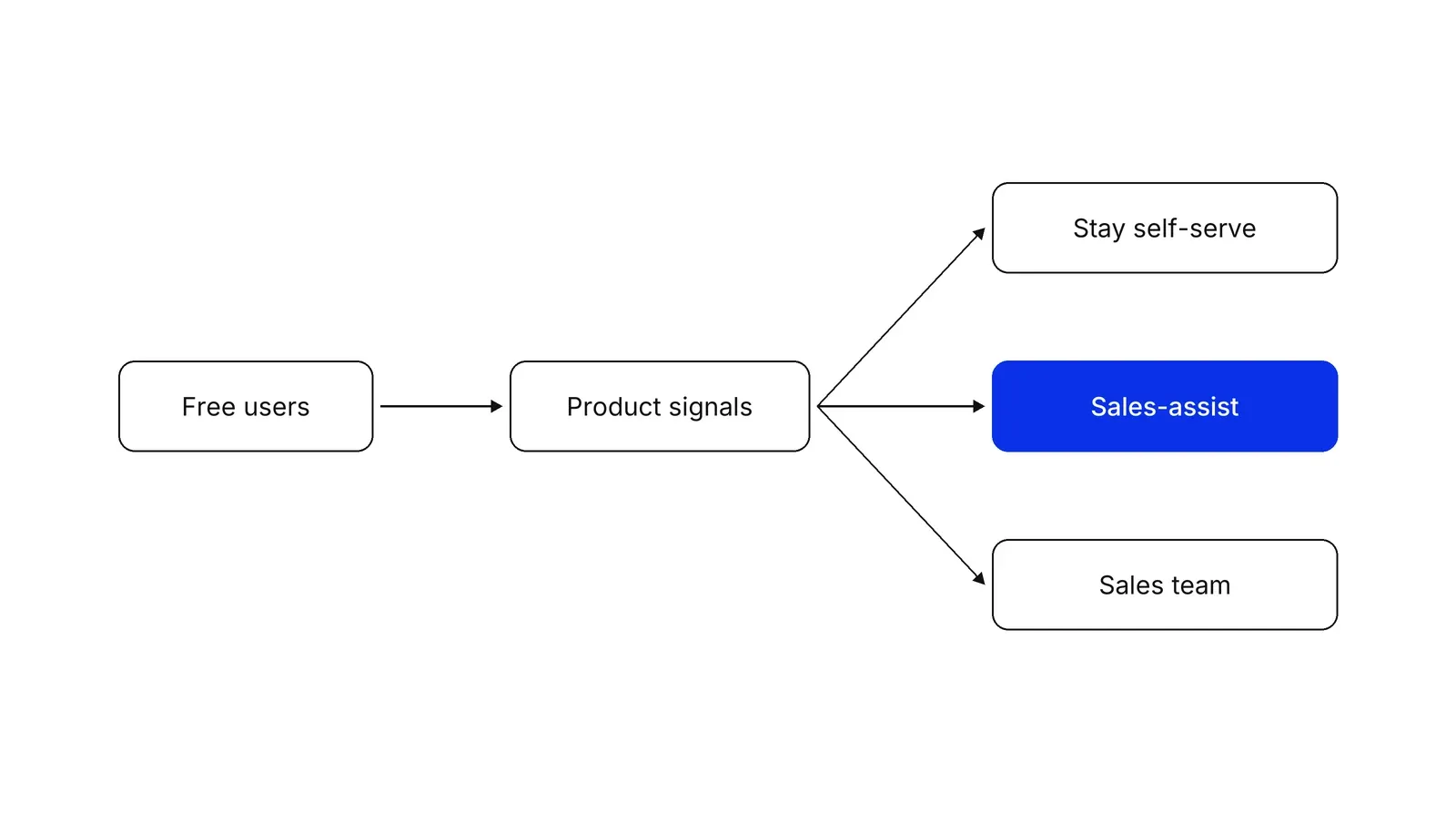
Who should sales call?
Only users or accounts whose behaviour and profile justify the cost of a person. This is what a product-qualified lead (PQL) tries to capture. Pocus defines it through three questions: fit (does the company match your ideal customer), usage (has the user reached core value) and intent (pricing page visits, talk-to-sales clicks, new seats). Poyar’s guide says PQLs often convert at 15 to 30 percent and beat marketing leads, though that is his own figure, and it says only about one in four SaaS companies had a PQL strategy in OpenView’s 2021 benchmarks. In an Amplitude interview he suggests alerting a rep once five users from one account are active. For how it differs from the marketing handoff, see MQL and SQL, and for building a score, lead scoring.
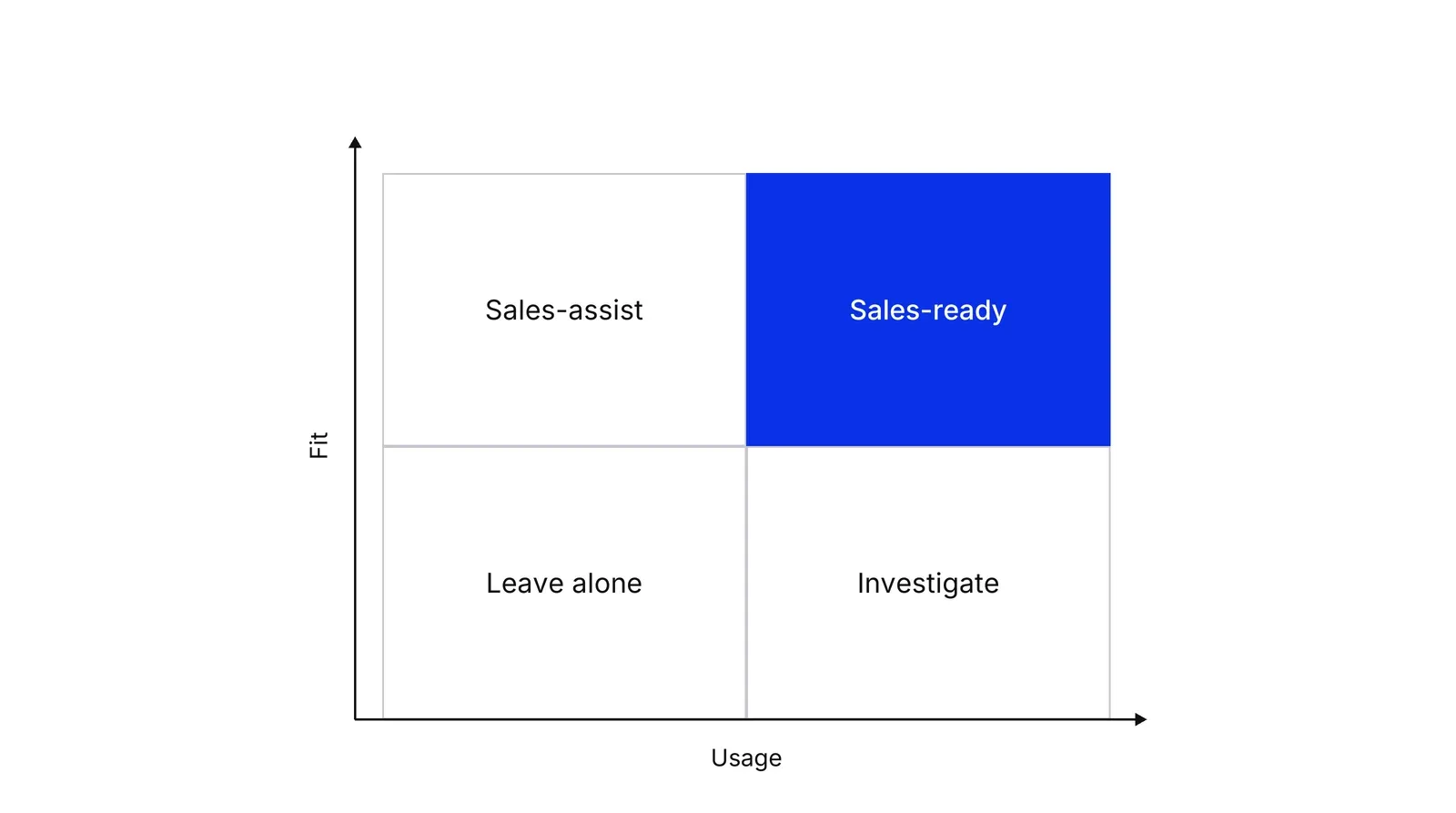
Crossing fit with usage gives four groups, which Pocus describes as sales-ready, sales-assist, unclear and never touch.
The unit also changes with company size. Bhatia argues that in a small team the buyer is usually one of the active users, so a lead is enough. In mid-market and enterprise the buyer is often not a user, so you qualify the account and the rep has to find the budget holder.
What does the human role look like?
Pocus describes three groups: self-serve (product, growth and marketing), an assist team that helps and routes, and sales for enterprise-wide deals. The sales-assist person handles upgrade and pricing questions that are harder than support and simpler than enterprise, and should not talk to every user. In its 2021 survey of 200-plus companies, about 29 percent had a dedicated sales-assist role. It is a vendor survey, so read it as a snapshot.
Calendly shows a mature version. Its CMO and CRO, Jessica Gilmartin, described a support-assist team that closes small deals, a velocity team for the Teams plan and an enterprise team, with scoring that routes leads at once. Before the change, sales had closed some $3,000 deals that belonged in self-serve, and large companies were buying a $192-a-year single-seat plan. She reported website leads up 50 percent while lead-generation spend fell. These are the company’s own figures.
When do you add a sales team?
When the business, not only individual users, starts to ask for more. Andreessen Horowitz names two preconditions: the bottom-up flywheel works, and the company is asking for enterprise features. It cites around $20 to $30 million of ARR as the point where GitHub, Twilio and SendGrid started investing in top-down sales, and says Dropbox saw 3 to 10 percent employee penetration as a tipping point. Bessemer puts it near $25 million for its fastest-scaling portfolio companies. It reports that Twilio hired enterprise sellers only after lead velocity in a segment passed a threshold. A first rep comes much earlier: the Pocus survey found 48 percent hired one between $500,000 and $1 million.
Speed also matters once a signal fires. Oldroyd, McElheran and Elkington reported in HBR that most companies respond to online leads too slowly. We could not read the full article to quote its figures, so we do not repeat them. Set a response target for sales-ready accounts anyway.
For the layer that holds the data and handoffs together, see revenue operations. A Growth Lab plan starts from the self-serve funnel and the accounts it already surfaces (see how we work).
How to apply Product-led sales, step by step
- Write down what self-serve already does. Measure how many sign-ups reach activation and how many pay without talking to anyone. Decide that this path stays the default. Result: a baseline to compare rep-led changes against.
- Define fit. List the company size, industry, region and user roles that make a deal worth a person's time, and work out the smallest deal that pays for a rep. Result: a fit rule that names who is never called.
- Define usage and intent. Pick the product behaviours that mark real value (several active users on one domain, an integration connected, a team invited) and the hand-raisers (pricing page, talk-to-sales click, paywall hit). Result: a short list of signals with thresholds.
- Split accounts into four groups. Cross fit with usage. High on both goes to sales. High fit and low usage goes to sales-assist or nurture. High usage and low fit gets studied for new segments. Low on both is left alone. Result: a routing table.
- Choose the human role for each group. Give small deals to a sales-assist or support role, and complex ones (security review, procurement, many teams) to an account executive. Result: a named owner and a handoff rule for each group.
- Test the rule before you scale it. Send the qualified accounts to reps for a random half and leave the other half self-serve, for 30 to 60 days. Compare conversion and deal size. Result: evidence the human touch adds revenue beyond what self-serve would have produced.
- Review the routing every quarter. Check rep time per account against the revenue it returns, and move accounts that do not pay back to self-serve. Result: a routing table that matches current economics.
Examples
Figma, from its own filing
Documented. Figma's [S-1](https://www.sec.gov/Archives/edgar/data/1579878/000162828025033742/figma-sx1.htm) says it offers an automated self-service option and also a direct sales process to set up new accounts, upgrade customers and expand existing ones. It hired its first sales rep [in 2018](https://www.sec.gov/Archives/edgar/data/1579878/000162828025033742/figma-sx1.htm), the year it launched its Organization plan. In 2024 and the first quarter of 2025, about 70 percent of new Organization and Enterprise customers included at least one user who had been on a Professional plan.
Deputy, as told by Kyle Poyar
Documented, second-hand. In a [Growth.Talent summary](https://www.growthtalent.org/insights/kyle-poyar-on-why-plg-sales-teams-fail-and-how-to-fix-it), Poyar says Deputy put a rep on every free trial because demo requests converted above 50 percent. Businesses of about five employees took as much sales time as mid-market accounts, so a test moved those under ten employees to self-service. Conversion stayed flat, and he reports 70 percent of conversions now happen through self-service.
A payments app, with illustrative numbers
Illustrative, arithmetic only. A fintech app gets 2,000 free business accounts a month. Fit rules (a company email, at least ten staff) keep 300. Of those, 60 have three or more users active in the week and have opened the pricing page. A sales-assist person contacts those 60, and an account executive takes the 12 that ask for invoicing and security documents. Everyone else never hears from a rep.
When to use it
Use it when a self-serve product already converts some users and growing accounts need what a checkout page cannot give: security review, procurement, invoicing, rollout across departments.
When not to use it
Skip it when the product cannot convert anyone without help, since a rep then props up a broken funnel. Skip it for all-small-ticket products where a rep never pays back, or when usage data is not tied to companies.
Common mistakes
- Calling every free user. Poyar names this as one of the two common failures: rep time is spent on accounts whose value cannot repay the cost.
- Selling to the champion instead of the budget holder. The enthusiastic user can show usage but rarely signs the contract, so the rep must find the buyer.
- Treating a PQL as a user when the buyer is not a user. In mid-market and enterprise accounts, the account is the unit to qualify.
- Letting reps keep self-serve revenue out of their quota, or cutting their lead volume overnight. Poyar's advice is to test with data and pay commission on self-serve deals during the transition.
- Hiring the sales team before the self-serve flow works, so the reps carry a funnel the product should have carried.
FAQ
What is product-led sales?
Product-led sales is a hybrid of self-serve and human selling. Free or low-cost use brings users in and shows value, and a sales team steps in for accounts that show strong usage, fit and intent. Pocus describes it as the meeting point between a product-led and a sales-led motion.
What is the difference between product-led sales and product-led growth?
Product-led growth is the strategy of using the product to acquire, convert and expand customers. Product-led sales is the part where people join in, using product signals to decide which accounts get a conversation. Poyar says product-led does not mean self-service only, since self-service is rarely the bulk of revenue at large PLG companies.
What is a product-qualified lead?
A product-qualified lead is a user or account whose product behaviour shows readiness to buy. Pocus defines it as strong usage, a fit with the ideal customer profile and buying intent. Poyar reports PQLs often convert at 15 to 30 percent, which is his own figure, not an audited benchmark.
When should a self-serve company hire its first sales rep?
It varies. In [Pocus's survey](https://www.pocus.com/product-led-sales-benchmark-report) of 200-plus companies, 48 percent made a first sales hire at between $500,000 and $1 million of annual recurring revenue. For a full enterprise sales team, [a16z](https://a16z.com/the-20m-to-500m-question-adding-top-down-sales/) and [Bessemer](https://www.bvp.com/atlas/introducing-enterprise-sales-to-a-product-led-growth-organization) point to around $20 to $30 million, once the bottom-up flywheel works.
Does product-led sales replace the sales team?
No. It changes whom the team calls and when. Dropbox says over 90 percent of its revenue comes from self-serve channels and that a sales team works on wider deployments at fitting organizations. Slack says its direct sales force focuses on larger customers.
Sources
- Kyle Poyar, Growth Unhinged, How Calendly overhauled their product-led sales motion, 2024
- Kyle Poyar, Growth Unhinged, Your guide to PQLs (republished from OpenView)
- Growth.Talent, Kyle Poyar on why PLG sales teams fail and how to fix it
- Pocus, Product-led sales AMA with Kyle Poyar (OpenView) on the PLS benchmarks
- Pocus, What does a PLS team look like
- Pocus, The definitive PQL guide, part 1
- Pocus, Everything you need to know to define, operationalize and convert PQLs
- Pocus, What is the sales-assist role
- Pocus, Product-led sales benchmark report (2021, 200-plus respondents)
- Priya Bhatia, PQLs vs PQAs
- Amplitude, How to benchmark product-led growth with OpenView's Blake Bartlett and Kyle Poyar
- Slack Technologies, Form S-1, 2019 (SEC)
- Dropbox, Form 10-K for fiscal 2024 (SEC)
- Atlassian, Form 20-F for fiscal 2022 (SEC)
- Figma, Form S-1, 2025 (SEC)
- Zoom Video Communications, Form S-1, 2019 (SEC)
- Oldroyd, McElheran and Elkington, The short life of online sales leads, Harvard Business Review, 2011 (BYU record)
- Elena Verna, Why, when and how to add sales to PLG (free preview)
- Andreessen Horowitz, Sarah Wang and David George, Adding top-down sales, 2020
- Bessemer Venture Partners, Introducing enterprise sales to a product-led growth organization
Last updated Oct 9, 2026


Marketing agency or growth system: when a company outgrows its agency
An agency is the right call while the founder still runs most of the company. Once the business starts copying itself into new locations or markets, it needs a system that sets goals, tests hypotheses and owns the result.

Why healthcare marketing agencies stall: the short, mid and long wins model we use with clinics
Most agencies own the click and nobody owns the front desk. How we structure clinic work in three horizons, the research behind each one, and one year of results.

The compliance layer under fintech marketing operations
A fintech marketing agency can build campaigns. It cannot own the compliance review, the KYC drop-off or the multi-market licensing rules that decide whether a lead ever becomes a customer.