Go-to-market strategy
A go-to-market strategy is the plan for how a product reaches paying customers: which segment you sell to first, what you promise them, what you charge, through which channels, and who does the selling.
A go-to-market (GTM) strategy is the plan for bringing a product to paying customers. It fixes five decisions: the first target segment, the value proposition for that segment, the price and packaging, the channels that reach buyers, and the sales motion, which is product-led, sales-led or partner-led. The decisions have to fit each other, because the price of a deal decides which motion you can afford.
- Origin
- Practice-based term with no single inventor; popularised by practitioner books such as Lawrence G. Friedman's Go-to-Market Strategy, No founding date; Friedman's book 2002
- Level
- 301 · Advanced
- Fits
- Startup, Small and mid-size, Scale-up
- Time to apply
- two to three weeks for a first version, then a review after the first 90 days of selling
- What you need
- a market size estimate and a shortlist of two or three candidate segments · 10 to 20 conversations with buyers in those segments, notes in their words · unit economics: expected deal size, cost to acquire a customer, gross margin · one owner who signs off on the plan and on what the team will not do
A go-to-market strategy, usually shortened to GTM, is the plan for how a product reaches paying customers. It answers five questions: who buys first, what you promise them, what you charge, where you reach them, and who does the selling. The term grew out of practice rather than from one author. Lawrence Friedman’s Go-to-Market Strategy, published by Butterworth-Heinemann in 2002, is one of the earliest books under that title, and the phrase is now standard in software, fintech and medical technology companies.
Founders write a GTM plan before a launch. Larger companies write one for each new product, segment or country. In both cases the plan matters because the five decisions constrain each other: a product priced at $50 a year cannot be sold by a salesperson who costs six figures.
What decisions does a GTM strategy make?
A GTM strategy makes five decisions, and they work best in order. Each one narrows the options for the next.
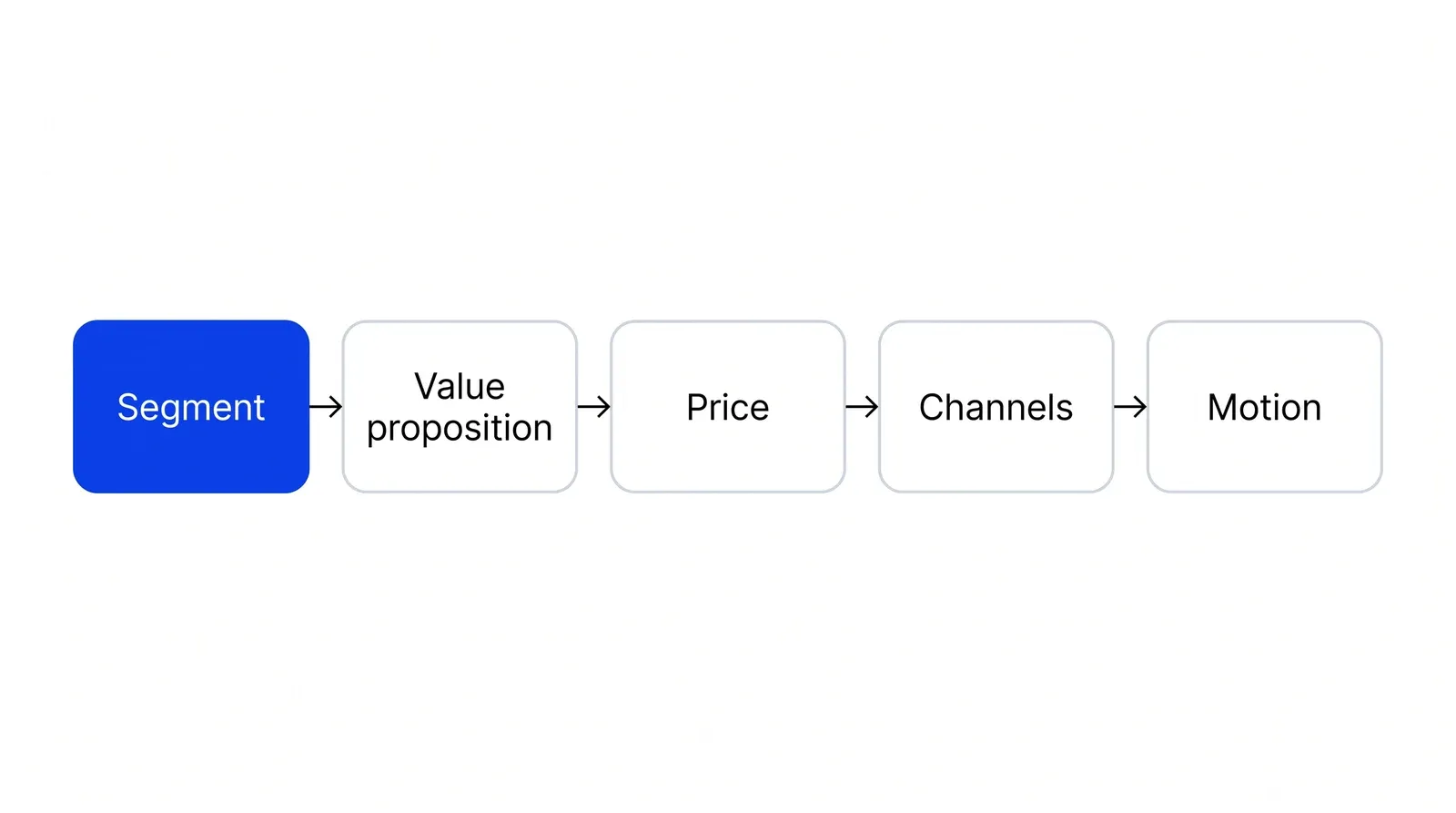
| Decision | Question it answers | Typical output |
|---|---|---|
| Segment | Who buys first? | One named segment with size and buyer role |
| Value proposition | Why would they switch? | Two sentences with a measurable outcome |
| Price and packaging | What do they pay, for what? | Tiers, free plan or trial, average deal size |
| Channels | Where do we reach them? | Two or three channels with targets |
| Motion | Who does the selling? | Product-led, sales-led, partner-led or a mix |
Start with one segment
The first segment should be narrow enough that you can win it. Geoffrey Moore’s Crossing the Chasm tells technology companies to pick a single beachhead segment big enough to matter but small enough to win, and to put all their resources there. Winning one segment produces references that buyers in that segment trust, which makes the next sale cheaper.
A market size estimate such as TAM, SAM and SOM tells you whether a segment is big enough. Buyer interviews tell you whether the problem is urgent and whether a budget exists for it.
Write the value proposition in the buyer’s terms
The value proposition is the reason the segment would switch from what it uses today. James Anderson, James Narus and Wouter van Rossum argued in Harvard Business Review in 2006 that most suppliers claim savings they cannot prove, and that business buyers discount claims without evidence. The fix is a promise with a number attached and proof behind it. A clinic billing service that says “claims paid in 14 days instead of 30” gives the buyer something to check.
A positioning statement turns the value proposition into the sentence your sales team and website repeat.
Price decides the motion
Price is the decision teams most often leave until late, and it should come before the choice of motion. Madhavan Ramanujam and Georg Tacke write in Monetizing Innovation that 72% of innovations fail to meet their financial targets, and they argue for designing the product around what customers will pay. Tiers help here. Rafi Mohammed’s good-better-best approach gives price-sensitive buyers an entry option and gives others a reason to pay more.
The expected deal size then sets a ceiling on the cost of selling. If the salesperson time needed to win a customer costs more than that customer’s gross margin over the first year or two, the motion has to change or the price has to rise.
The three motions: product-led, sales-led, partner-led
The motion is who carries the buyer from first contact to payment. There are three basic options, and most growing companies end up combining two.
| Motion | Who sells | Fits when | Public example |
|---|---|---|---|
| Product-led | The product: free plan or trial, self-service checkout | Deals are small, the product shows value in minutes, one person can decide | Atlassian, early Slack |
| Sales-led | Salespeople who prospect, demo and negotiate | Deals are large, the product is complex, several people approve | Slack and Zoom for large accounts |
| Partner-led | Resellers, agencies, integrators, distributors | Buyers already trust an intermediary, or you need local reach | HubSpot Solutions Partners, Stihl dealers |
Product-led growth is a term that Blake Bartlett of OpenView is credited with coining in 2016, and Wes Bush’s 2019 book Product-Led Growth describes it as users signing up, reaching value and upgrading without talking to a sales rep. Atlassian is the standard case. Its fiscal 2020 annual report says its sales model focuses on customer self-service and that it does not rely primarily on a traditional, commissioned direct sales force. A freemium plan is one common entry point for this motion.
Sales-led selling pays off when deals are complex. In a 1985 study of 159 sales districts at 13 electronics makers, Erin Anderson found firms were more likely to use their own salespeople, instead of outside reps, when performance was hard to measure and product lines were complex and hard to learn.
Partner-led selling borrows someone else’s relationships. HubSpot’s 2025 annual report says Solutions Partners and the customers they referred made up about 25% of its customers and about 49% of its revenue that year. Partners also shape the brand. A Kellogg School case describes how Stihl’s US unit dropped mass merchants and sold only through independent dealers, a move that raised profits and strengthened its premium position.
How deal size sets the mix
Most companies match the motion to the size of each customer. Zoom’s 2019 registration statement describes routes to market that match the size of the customer opportunity, with an online channel for smaller customers and a direct sales force and partners for larger ones. The same Zoom filing reports that 55% of its 344 customers paying more than $100,000 a year had started with at least one free host.
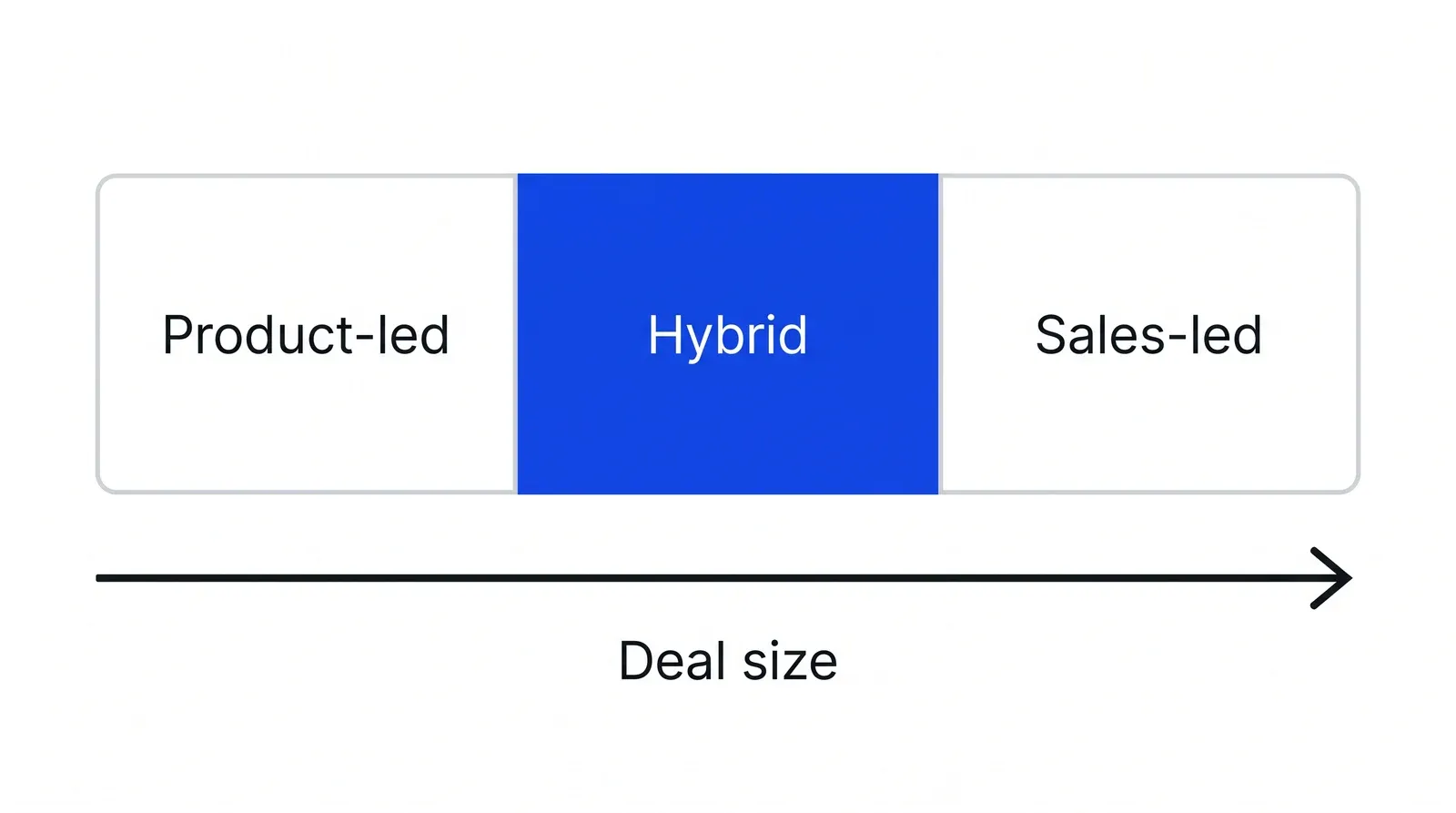
Slack ran the same pattern. Its 2019 filing says a direct sales organization complements the self-service approach and works with champions that free usage has already created inside large companies. For enterprise targets, account-based marketing is the usual way to coordinate marketing and sales around a named list of accounts.
Combining motions is an old idea. Rowland Moriarty and Ursula Moran called such setups hybrid marketing systems in Harvard Business Review in 1990, describing companies that added channels to widen coverage and control costs. A hybrid needs written rules about which leads go to self-service and which go to a salesperson, for example by company size or by number of seats, so the two routes do not chase the same buyer.
Who owns the GTM plan?
The plan needs one owner who can overrule both marketing and sales, because the two functions often disagree on where the problem lies. Kotler, Rackham and Krishnaswamy described that friction in Ending the War Between Sales and Marketing. In a startup the owner is the founder. In a larger company it is usually the head of the business line or a revenue leader. In Pushers’ Growth Lab work, the GTM decisions come before any channel budget, because the channel plan depends on the segment and the motion.
How to apply Go-to-market strategy, step by step
- Pick one first segment. From your candidate segments, choose the one with an urgent problem, a budget already set aside for it, and buyers who talk to each other. Describe it narrowly: company type, size, role of the buyer, region. Result: one segment written in a single sentence, with the others parked for later.
- Write the value proposition for that segment. State the outcome the buyer gets and the one or two points where you beat their current option, in numbers where you can. Test the wording in five buyer conversations. Result: a two-sentence promise that buyers repeat back without help.
- Set price and packaging. Price from the value to the buyer and from what rivals charge, then decide what is in each tier and whether there is a free plan or a trial. Result: a price list and an expected average first-year deal size.
- Choose the motion from the deal size. Compare the expected deal size with the cost of each way of selling. Small deals need self-service sign-up; large, complex deals pay for salespeople; markets where buyers already rely on integrators or resellers suit partners. Result: one primary motion and, if needed, one supporting motion.
- Pick two or three channels and set targets. Choose the channels that reach the segment for the chosen motion: search, communities and product virality for self-service; outbound and events for sales; partner programs for resellers. Result: a channel plan with a 90-day target per channel, such as sign-ups, qualified meetings or partner-sourced deals.
- Run for 90 days and review. Track conversion at each stage, cost per customer and time to close against the plan. Change one decision at a time, starting with the one the numbers point at. Result: a written review that confirms the plan or names the decision to change.
Examples
Slack: product-led first, sales added on top
Slack's 2019 listing document says usage inside organizations is typically driven bottoms-up by end users, and that growth came largely from word of mouth. At the time, free organizations outnumbered paying ones by more than five to one. To win larger accounts, Slack added a direct sales force that, in its own words, complements the self-service approach and works with champions found through self-service adoption. The motion was product-led for entry and sales-led for expansion.
Doximity: free for doctors, paid by pharma and hospitals
Doximity, the US network for physicians, gives membership to doctors for free and charges other parties. Its 2021 registration statement says members include more than 80% of US physicians and that paying customers are primarily pharmaceutical manufacturers and health systems, including all of the top 20 pharmaceutical manufacturers. The GTM separates the user (the doctor) from the buyer (the drug maker or hospital), and the sales team sells access to an audience the free product built.
A payments startup choosing its motion
Illustrative, no real company implied. A startup offers card acceptance for private clinics. A small clinic brings the startup about $1,200 a year in margin. Winning one through a field salesperson costs about $3,000 in salary and travel, so field sales cannot pay back in the first year. The startup sells to small clinics through online sign-up and practice-management software partners, and keeps salespeople for clinic groups with 20 or more sites.
When to use it
Use it before launching a new product, when entering a new segment or country, when growth stalls and nobody can say which channel or segment is working, or when the team is about to hire its first salespeople or sign its first partners. It is also the right exercise when price changes, because a new price can make the current motion unprofitable.
When not to use it
Skip a full GTM plan while you are still looking for a problem worth solving; customer discovery comes first, and a plan built on guesses about the segment will be rewritten anyway. It is also the wrong tool for choosing which business to be in. Questions of industry attractiveness and portfolio belong to strategy frameworks that come before it.
Common mistakes
- Targeting everyone at launch. A plan that names five segments gives the team no reason to say no to any lead, and none of the segments gets enough attention to produce references.
- Choosing a motion that the deal size cannot pay for, such as field sales for a product that earns a few hundred dollars a year per customer.
- Copying a product-led motion because famous software companies use it, when the product needs setup, data migration or approval from several people before anyone sees value.
- Signing partners without giving them a reason to sell: no margin, no training, no leads, so the partner channel exists on paper only.
- Treating the plan as finished. The first 90 days of selling usually prove at least one decision wrong, and the plan should change with the data.
FAQ
What is a go-to-market strategy?
A go-to-market strategy is the plan for how a product reaches paying customers. It sets the first target segment, the value proposition, the price, the channels and the sales motion. The term comes from practice and has no single inventor; Lawrence Friedman's 2002 book Go-to-Market Strategy is one of the earliest books under that title.
What are the main components of a GTM strategy?
Five decisions: the target segment, the value proposition for that segment, price and packaging, the channels that reach buyers, and the motion, meaning who does the selling. Some versions add the launch plan and the metrics. The parts depend on each other, so a change in price or segment usually forces a change in motion.
What is the difference between product-led and sales-led growth?
In a product-led motion, users sign up, see value and pay without talking to a salesperson, often through a free plan or trial. In a sales-led motion, salespeople find, qualify and close deals. Product-led suits small, simple purchases; sales-led suits large, complex ones. Many companies, such as Slack and Zoom, combine both.
What is the difference between a go-to-market strategy and a marketing plan?
A GTM strategy decides who you sell to, what you promise, what you charge and how the sale happens. A marketing plan is one part of executing it: campaigns, content, budget and calendar for the channels the GTM strategy chose. Sales hiring, partner programs and pricing sit in the GTM strategy but outside the marketing plan.
How long does it take to build a go-to-market strategy?
A first version takes two to three weeks if you already have buyer interviews and basic unit economics. Gathering those from scratch adds several weeks. The plan then needs a review after roughly 90 days of selling, because real conversion rates and deal sizes rarely match the first estimates.
Sources
- Lawrence G. Friedman, Go-to-Market Strategy, Butterworth-Heinemann, 2002, Open Library record
- Geoffrey A. Moore, Crossing the Chasm, 3rd edition, HarperBusiness, 2014, Open Library record
- Apple Books, Crossing the Chasm, 3rd edition, publisher description
- Rowland T. Moriarty, Ursula Moran, Managing Hybrid Marketing Systems, Harvard Business Review, November-December 1990
- Philip Kotler, Neil Rackham, Suj Krishnaswamy, Ending the War Between Sales and Marketing, Harvard Business Review, July-August 2006
- James C. Anderson, James A. Narus, Wouter van Rossum, Customer Value Propositions in Business Markets, Harvard Business Review, March 2006
- Eric Almquist, John Senior, Nicolas Bloch, The Elements of Value, Harvard Business Review, September 2016
- Eric Almquist, Jamie Cleghorn, Lori Sherer, The B2B Elements of Value, Harvard Business Review, March-April 2018
- Andris A. Zoltners, Prabhakant Sinha, Sally E. Lorimer, Match Your Sales Force Structure to Your Business Life Cycle, Harvard Business Review, July-August 2006
- Erin Anderson, The Salesperson as Outside Agent or Employee: A Transaction Cost Analysis, Marketing Science 4(3), 1985
- Michael V. Marn, Robert L. Rosiello, Managing Price, Gaining Profit, Harvard Business Review, September-October 1992
- Rafi Mohammed, The Good-Better-Best Approach to Pricing, Harvard Business Review, September-October 2018
- Madhavan Ramanujam, Georg Tacke, Monetizing Innovation, Wiley, 2016
- Wes Bush, Product-Led Growth, ProductLed, 2019; 2nd edition 2026
- TechCrunch, author profile of Blake Bartlett, OpenView
- Slack Technologies, Form S-1 registration statement, 2019
- Zoom Video Communications, Form S-1 registration statement, 2019
- Atlassian Corporation Plc, Form 20-F for fiscal year 2020
- HubSpot, Inc., Form 10-K for fiscal year 2025
- Doximity, Inc., Form S-1 registration statement, 2021
- Richard E. Wilson, Stihl Incorporated: Go-to-Market Strategy for Next-Generation Consumers, Kellogg School of Management Cases, 2017
Last updated Oct 9, 2026


Marketing agency or growth system: when a company outgrows its agency
An agency is the right call while the founder still runs most of the company. Once the business starts copying itself into new locations or markets, it needs a system that sets goals, tests hypotheses and owns the result.

Why healthcare marketing agencies stall: the short, mid and long wins model we use with clinics
Most agencies own the click and nobody owns the front desk. How we structure clinic work in three horizons, the research behind each one, and one year of results.

The compliance layer under fintech marketing operations
A fintech marketing agency can build campaigns. It cannot own the compliance review, the KYC drop-off or the multi-market licensing rules that decide whether a lead ever becomes a customer.