Compensation and motivation systems
A compensation and motivation system sets what people are paid, what the pay is tied to, and which non-cash conditions keep them working well, so that the behavior being rewarded is the behavior the company wants.
A compensation and motivation system is the set of rules that decides what people are paid, what the variable part of their pay depends on, and what the company does beyond money to sustain effort. In sales it usually means a pay mix, a quota, on-target earnings (OTE) and accelerators. It works when pay is tied to results the person controls and measured alongside quality.
- Origin
- Frederick Herzberg (two-factor theory); Edward Deci and Richard Ryan (self-determination theory); Steven Kerr (reward-system critique), 1959; 1971 onward; 1975
- Level
- 301 · Advanced
- Fits
- Startup, Small and mid-size, Scale-up
- Time to apply
- One to two weeks to draft a plan, then a quarter to test it
- What you need
- a clear definition of the result each role is responsible for · twelve months of results per person, to see what is realistic · base salary bands per level · someone from finance to cost the plan at low, expected and high attainment
A compensation and motivation system is the set of rules that decides what people are paid, what part of their pay depends on results, and what else the company does to keep them working well. It draws on three bodies of work: Frederick Herzberg’s 1959 study of job attitudes, the self-determination research that Edward Deci began in 1971, and Steven Kerr’s 1975 paper on why companies reward one behavior while hoping for another. Together they say that pay changes behavior, and not always the behavior the company meant to change.
How much of the pay should be variable?
The pay mix is the split between base salary and variable pay at target. On-target earnings (OTE) is the total cash a person earns when they hit target exactly. In a 60/40 mix, six-tenths of OTE is base pay and four-tenths is variable. The split should follow how much of the result one person controls and how fast it can be measured.
Evidence that variable pay works comes from places where output is easy to count. Edward Lazear’s study of Safelite Glass Corporation found output per worker rose 44 percent, and profits rose, after the firm moved to piece rates. Canice Prendergast’s 1999 review in the Journal of Economic Literature agrees that individuals respond to pay-for-performance, and adds that we still know little about how to pay people whose output is hard to measure. For those roles, put more weight on base pay, set by level in a competency model.
Quotas, accelerators and OTE in a sales plan
A quota is the target of revenue or deals a person must reach in a period for OTE to be paid. An accelerator is a higher commission rate on revenue above quota. Take a rep whose commission rate at quota is 8%. A 1.5 times accelerator lifts the rate to 12% on every dollar above quota. Set quotas from what the team can produce, which is the job of sales capacity planning, not from the revenue the company wishes to book.
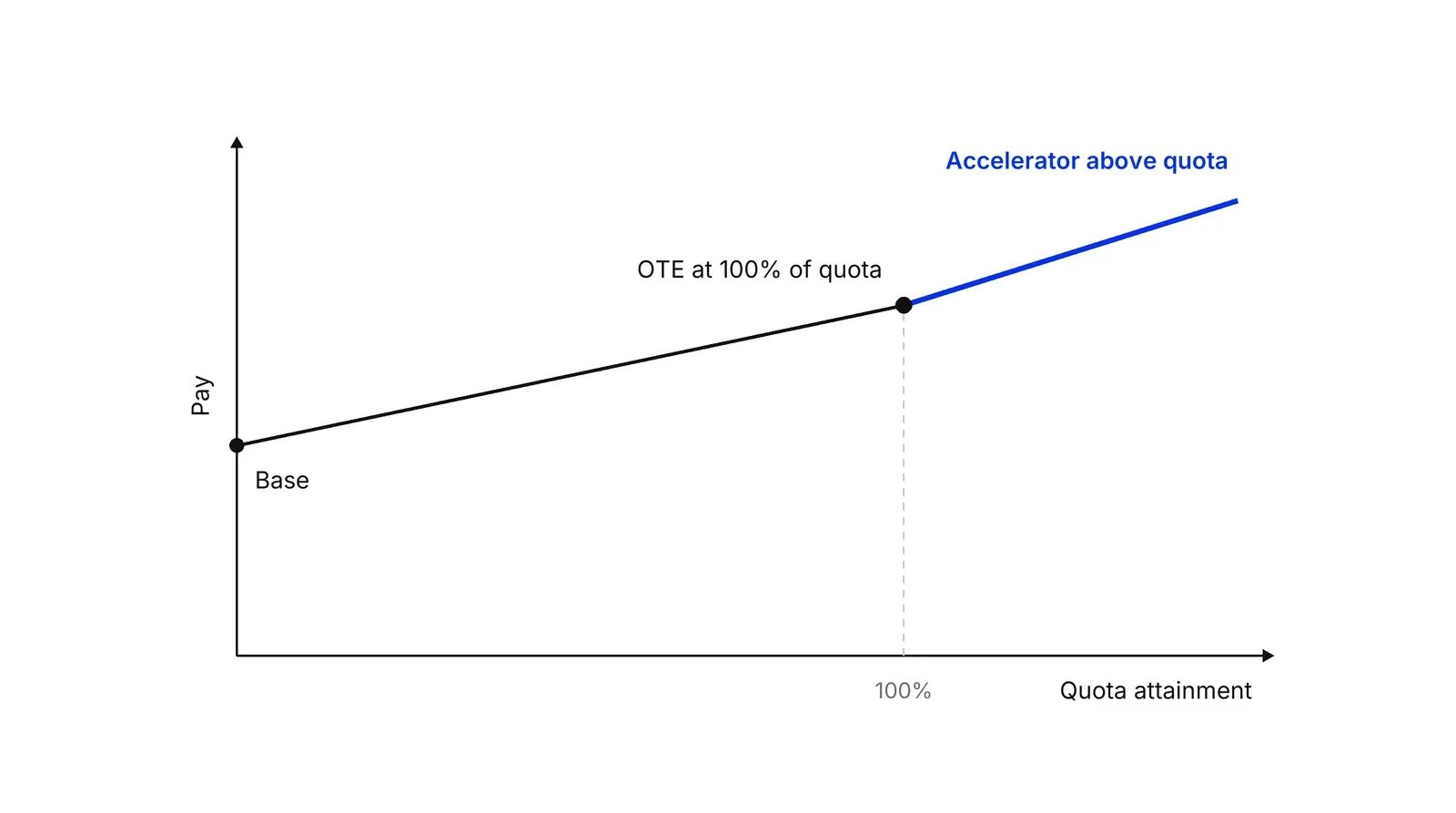
Each part of the plan has research behind it. Chung, Steenburgh and Sudhir (Marketing Science, 2014) found that overachievement commissions kept the best performers selling after they hit quota, and that quarterly bonuses helped weaker performers stay on track for the annual number. Steenburgh and Ahearne’s HBR research found that top performers may stop working once a cap is imposed, and a Darden summary of it reports that moving weak performers from quarterly to annual bonuses cut their revenue by roughly 10%.
Plans can be gamed on the same features. Paul Oyer (Quarterly Journal of Economics, 1998) found manufacturers’ sales run higher near fiscal year-end, consistent with quota-based pay. Ian Larkin studied an enterprise software vendor with an accelerating quarterly commission plan and found reps agreed to lower prices in the quarters where closing paid most, which cost the vendor 6 to 8 percent of revenue.
| Plan feature | What it does, per the research | Where it goes wrong |
|---|---|---|
| Quota | Multi-tiered targets pushed core performers to higher sales (Steenburgh and Ahearne) | Sales bunch near the year-end window (Oyer) |
| Accelerator | Kept the best performers selling past quota (Chung et al.) | Reps accepted lower prices in the accelerated quarter (Larkin) |
| Cap | Limits what the plan can cost | Top performers may stop selling at the cap (Steenburgh and Ahearne) |
| Quarterly bonus | Acts as a pacer for weaker performers (Chung et al.) | Deals get timed to the quarter boundary (Larkin) |
Marketing plans follow the same logic with a harder measurement problem, because a marketer’s output reaches revenue through the sales team. Take a team paid only per lead: volume is easy to raise and quality is easy to lose. A shared target with a quality guardrail, such as the share of leads that become qualified opportunities, is the safer design.
What does motivation research say about paying for results?
Five findings are worth keeping, and each is limited by what it measured.
| Study | What it found |
|---|---|
| Herzberg, Mausner and Snyderman, 1959 | About 200 engineers and accountants in Pittsburgh named achievement, recognition and the work itself as sources of satisfaction. Salary sat among the “hygiene” factors that prevent dissatisfaction without creating motivation |
| Judge et al., 2010 | Across 92 samples pay level correlated .15 with job satisfaction, a weak link |
| Deci, Koestner and Ryan, 1999 | In 128 experiments, engagement-, completion- and performance-contingent rewards lowered free-choice interest in a task (d = -0.40, -0.36, -0.28) |
| Jenkins et al., 1998 | Across 39 studies, financial incentives were unrelated to performance quality and correlated .34 with quantity |
| Kim, Gerhart and Fang, 2022 | The incentive-performance link was positive in both interesting (δ = +.58) and non-interesting (δ = +.52) tasks, and less positive for quality |
Self-determination theory, set out by Ryan and Deci in 2000, holds that three needs, competence, autonomy and relatedness, drive self-motivation when they are met. Deci, Olafsen and Ryan’s 2017 review of the workplace evidence separates autonomous motivation from controlled motivation and links the first to better performance and wellbeing. Deci and colleagues also found that positive feedback raised interest (d = 0.33) while expected tangible rewards lowered it.
The apparent conflict comes from what was measured. Interest in a task after the reward is removed is not the same thing as output while it is paid, and Cerasoli, Nicklin and Ford’s 2014 meta-analysis of 183 samples found intrinsic motivation was the better predictor of quality and incentives the better predictor of quantity. Gerhart and Fang’s 2015 review concludes that support for the claim that pay-for-performance harms workplace motivation is lacking, and Shaw and Gupta (2015) call the erosion claim a myth. Others hold that harm is real in some conditions: Weibel and colleagues’ 2010 meta-analysis found negative effects in interesting tasks, Frey and Jegen (2001) document crowding-out cases, and Gneezy and Rustichini found students paid a small amount performed worse than those paid nothing. Read together, pay moves quantity reliably, quality less so, and the design of the plan decides the rest.
Why do reward systems get gamed?
Because people learn what pays. Kerr’s paper opens on that point and lists cases from politics, war, medicine, universities and sports. In his updated table, companies hope for teamwork and reward individual effort, hope for long-term growth and reward quarterly earnings, and hope for candor while rewarding good news.
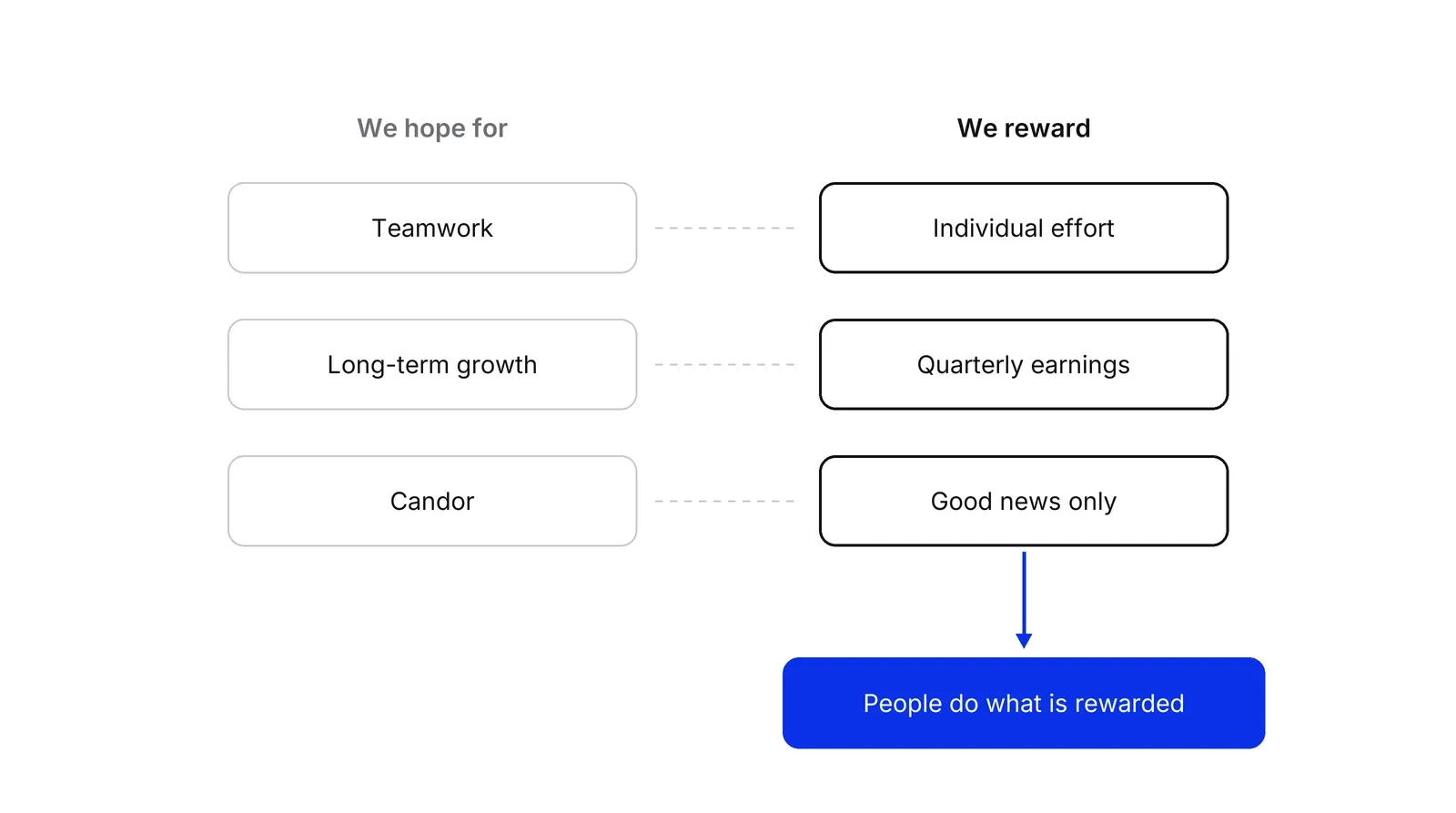
This is Goodhart’s law applied to pay: once a measure sets income, people optimize it. According to the US Consumer Financial Protection Bureau’s 2016 announcement, Wells Fargo was fined $100 million. By the bank’s own analysis, employees had opened more than two million deposit and credit card accounts that may not have been authorized, and the CFPB said the practice was driven by sales targets and compensation incentives.
Money can also change how a choice is framed. In a field study of ten Israeli day-care centers, Gneezy and Rustichini introduced a fine for late-arriving parents in six of them. Late arrivals increased and stayed high for four weeks after the fine was removed. They argue that a penalty can change what people believe about the situation, so a fine can work as a price.
Guardrails work better than rewrites. Pair a volume metric with a quality metric, review the plan for loopholes before launch, and keep targets that sit next to pay, such as OKRs, separate from the bonus formula. Individual ratings feed pay in many firms, so check how noisy they are in performance review frameworks.
A Growth Lab plan starts from the behavior a team has to produce and works back to the pay rule.
How to apply Compensation and motivation systems, step by step
- Name the result and the behavior you want. Write what each role should produce and what good looks like beyond the number: retained customers, clean data, collaboration. Result: a one-page definition that the plan is checked against.
- Set the pay mix from how controllable the result is. Give roles whose output one person drives and you can count a high variable share, and roles that depend on a team or a long cycle a higher base. Result: a base and variable split per role.
- Build the payout curve. Set OTE, a quota sized from capacity, the commission rate at quota, and what happens above it. Decide on caps, and on whether bonuses are paid quarterly or annually. Result: a payout formula costed at low, expected and high attainment.
- Pair every metric with a guardrail. For each paid metric add a second one that moves when the first is gamed, such as retention beside new revenue, or attended appointments beside bookings. Result: a short list of metric pairs with an owner each.
- Run a gaming review before launch. Ask a group of reps or team leads how they would hit the number while hurting the company. Fix the loopholes they name. Result: a revised plan and a list of risks to watch.
- Protect the non-cash conditions. Check that people keep real autonomy over how they work, a path to get better at it, and a team they belong to. Result: a list of working conditions the plan must not damage.
- Review each quarter against what people actually did. Compare behavior, not only attainment, with the definition from step one. Result: a changelog of plan edits with the reason for each.
Examples
An account executive plan (illustrative)
Take the commission rate and accelerator from the quota section above and cost the plan at low, expected and high attainment. The finance check that matters is what the plan costs when half the team lands well above quota, because the accelerator makes the top of the range the most expensive part. Result: a one-line cost per scenario.
A payments company that pays onboarding agents per approved merchant
Illustrative. Paying per approval raises volume and also raises the pressure to approve risky merchants. The fix is a guardrail: part of the bonus depends on the share of approved merchants that are still active and chargeback-free after 90 days, so approval speed cannot be bought at the cost of quality.
A dental clinic front desk
Illustrative. A bonus per booked appointment fills the calendar and can leave more empty chairs if booked patients do not show up. Paying on attended appointments, with a small team bonus for the clinic's monthly total, ties the reward to the visit that earns money and keeps front-desk staff working together.
When to use it
Use it when you hire or promote people into roles with measurable output, when a plan is producing the wrong behavior, or when you add a team such as sales, support or acquisition and have to decide how it is paid. It matters most at the stage when the first variable-pay plan is written, because early plans become habits.
When not to use it
Skip a variable component for work that is hard to measure or that depends on many people, and pay for the role instead. Do not use a pay plan to fix a problem of unclear goals, weak management or a poor product. Where the task is creative or exploratory and quality matters more than volume, keep incentives small and indirect.
Common mistakes
- Setting quotas from the revenue target instead of from what the team can produce. People who cannot reach quota earn base pay only, and the plan stops steering them.
- Capping commissions. Steenburgh and Ahearne report that a cap can make top performers stop selling once they reach it.
- Paying for one metric alone. Larkin found reps at one software vendor accepted lower prices in the quarters where closing paid most, which cost the vendor 6 to 8 percent of revenue.
- Reading the 'rewards kill motivation' studies as an argument against variable pay. Those studies measure interest in a task, and the later meta-analyses find incentives raise output.
- Treating the plan as finished at launch. Oyer and Larkin both found people time their sales to the plan's calendar, so loopholes appear after launch and need a quarterly review.
FAQ
What is a motivation system?
A motivation system is everything a company deliberately sets up to direct and sustain effort: pay and bonuses, goals, recognition, autonomy and growth. Pay is the part that can be written as a formula. The rest shapes whether people want to do the work, and the research says the two parts must not fight each other.
What is OTE in a sales compensation plan?
OTE, on-target earnings, is the total cash a person earns if they hit quota exactly: base salary plus variable pay at target. At a 60/40 mix, six-tenths of OTE is base and four-tenths is variable. OTE is a target, not a guarantee, and most people land above or below it.
What is an accelerator in a commission plan?
An accelerator is a higher commission rate paid on revenue above quota. Chung, Steenburgh and Sudhir (Marketing Science, 2014) found overachievement commissions kept the best performers selling after they reached quota. The risk is gaming: Larkin found reps timing deals to the quarter where an accelerator applied.
Do bonuses reduce intrinsic motivation?
Sometimes. A 1999 meta-analysis of 128 experiments by Deci, Koestner and Ryan found tangible rewards reduced later interest in a task. Later meta-analyses of workplace pay, such as Kim, Gerhart and Fang (2022), find incentives still raise performance, with a weaker effect on quality, especially in interesting work.
How should you split base and variable pay?
Raise the variable share when one person controls the result and it can be measured quickly, as in transactional sales. Raise the base when results depend on a team, take months to show, or are hard to count. Test the plan at low, expected and high attainment before you adopt it.
Sources
- Frederick Herzberg, Bernard Mausner, Barbara Bloch Snyderman, The Motivation to Work, Wiley, 1959 (Routledge reprint, 2017)
- Jamieson, Kirk, Wright, Andrew, Generation Y New Zealand registered nurses' views about nursing work, Nursing Open, 2015 (summary of Herzberg's sample and factor lists)
- Timothy A. Judge, Ronald F. Piccolo, Nathan P. Podsakoff, John C. Shaw, Bruce L. Rich, The relationship between pay and job satisfaction: a meta-analysis, Journal of Vocational Behavior 77(2), 2010
- Richard M. Ryan, Edward L. Deci, Self-determination theory and the facilitation of intrinsic motivation, social development, and well-being, American Psychologist 55(1), 2000
- Edward L. Deci, Effects of externally mediated rewards on intrinsic motivation, Journal of Personality and Social Psychology 18(1), 1971
- Edward L. Deci, Richard Koestner, Richard M. Ryan, A meta-analytic review of experiments examining the effects of extrinsic rewards on intrinsic motivation, Psychological Bulletin 125(6), 1999
- Edward L. Deci, Anja H. Olafsen, Richard M. Ryan, Self-determination theory in work organizations: the state of a science, Annual Review of Organizational Psychology and Organizational Behavior 4, 2017
- G. Douglas Jenkins Jr., Atul Mitra, Nina Gupta, Jason D. Shaw, Are financial incentives related to performance? A meta-analytic review of empirical research, Journal of Applied Psychology 83(5), 1998
- Jason D. Shaw, Nina Gupta, Let the evidence speak again! Financial incentives are more effective than we thought, Human Resource Management Journal 25(3), 2015
- Barry Gerhart, Meiyu Fang, Pay, intrinsic motivation, extrinsic motivation, performance, and creativity in the workplace, Annual Review of Organizational Psychology and Organizational Behavior 2, 2015
- Christopher P. Cerasoli, Jessica M. Nicklin, Michael T. Ford, Intrinsic motivation and extrinsic incentives jointly predict performance: a 40-year meta-analysis, Psychological Bulletin 140(4), 2014
- Jisoo H. Kim, Barry Gerhart, Meiyu Fang, Do financial incentives help or harm performance in interesting tasks?, Journal of Applied Psychology 107(1), 2022
- Antoinette Weibel, Katja Rost, Margit Osterloh, Pay for performance in the public sector: benefits and (hidden) costs, Journal of Public Administration Research and Theory 20(2), 2010
- Bruno S. Frey, Reto Jegen, Motivation crowding theory, Journal of Economic Surveys 15(5), 2001
- Steven Kerr, On the folly of rewarding A, while hoping for B, Academy of Management Journal 18(4), 1975
- Steven Kerr, On the folly of rewarding A, while hoping for B (updated Academy Classic), Academy of Management Executive 9(1), 1995
- Edward P. Lazear, Performance pay and productivity, American Economic Review 90(5), 2000
- Canice Prendergast, The provision of incentives in firms, Journal of Economic Literature 37(1), 1999
- Doug J. Chung, Thomas Steenburgh, K. Sudhir, Do bonuses enhance sales productivity? A dynamic structural analysis of bonus-based compensation plans, Marketing Science 33(2), 2014
- Thomas Steenburgh, Michael Ahearne, Motivating salespeople: what really works, Harvard Business Review, July-August 2012
- UVA Darden School of Business, One size does not fit all when motivating a sales force (summary of the Steenburgh and Ahearne research), 2012
- Ian Larkin, The cost of high-powered incentives: employee gaming in enterprise software sales, Journal of Labor Economics 32(2), 2014
- Paul Oyer, Fiscal year ends and nonlinear incentive contracts: the effect on business seasonality, Quarterly Journal of Economics 113(1), 1998
- Uri Gneezy, Aldo Rustichini, A fine is a price, Journal of Legal Studies 29(1), 2000
- Uri Gneezy, Aldo Rustichini, Pay enough or don't pay at all, Quarterly Journal of Economics 115(3), 2000
- US Consumer Financial Protection Bureau, press release on Wells Fargo's unauthorized accounts, 8 September 2016
Last updated Oct 9, 2026


Fractional COO or embedded operations team? How to choose at Series A
The two models solve different problems: how to tell which one your company needs, and what each costs in time and control.

What operational systems successful fintech startups use: lessons from ten companies
Starling, Monzo, Qonto, bunq, Lunar, Pleo, Tide, Ramp, Mercury and Column scaled on four operating systems. Regulators' findings show what breaks when one of them lags behind growth.

What a revenue operations manager actually owns
Pipeline definitions, CRM hygiene, forecasting and the handoffs between marketing, sales and success. What the role covers, and how it differs from sales ops.