Project portfolio management
Project portfolio management is the practice of choosing, funding, balancing and stopping a company's projects as one set, so that limited people and money go to the work that best serves its strategy.
Project portfolio management is the practice of choosing, funding, balancing and stopping a company's projects as one set, so that limited people and money go to the work that best serves its strategy. Its core decisions are what to start, what to continue and what to kill. Research on product portfolios finds that strategic and scoring methods beat purely financial ones.
- Origin
- No single inventor: Harry Markowitz (portfolio idea, finance); Robert Cooper, Scott Edgett and Elko Kleinschmidt (product portfolios); PMI and ISO (standards), 1952; late 1990s; ISO 21504 revised 2022
- Level
- 301 · Advanced
- Fits
- Scale-up, Enterprise
- Time to apply
- Half a day for the first register and ranking, then 90 minutes each quarter
- What you need
- a list of every initiative running or requested, with an owner · an effort estimate for each, in people-weeks or budget · one decision group that can say stop
Project portfolio management is the practice of treating all of an organization’s projects as one set and deciding which to start, continue or stop. The Project Management Institute’s portfolio standard describes a portfolio as projects, programs and other work grouped to meet strategic objectives. ISO 21504:2022 gives guidance on the same principles for any type of organization. The question behind it is simple: with the people and money we have, which of these projects should exist?
The idea has no single inventor. Harry Markowitz’s 1952 paper on portfolio selection in the Journal of Finance set out the finance version, in which securities are judged as a set and not one by one. Project versions followed, such as Norman Archer and Fereidoun Ghasemzadeh’s 1999 framework in the International Journal of Project Management, which splits selection into phases. The best-known empirical work on product portfolios is by Robert Cooper, Scott Edgett and Elko Kleinschmidt, who studied what high-performing firms did differently.
What a portfolio has to decide
A portfolio has to settle three things: which projects to start, which to keep running, and which to stop. Cooper’s team found in 1997 that leading firms pursued three goals: maximize the value of the portfolio, achieve the right balance of projects, and link the portfolio to the business strategy. Their 1999 study of 205 US companies sorted firms into four groups, named Cowboys, Crossroads, Duds and Benchmark, and scored them on four measures: high-value projects, alignment with strategy, balance, and the right number of projects for the resources available.
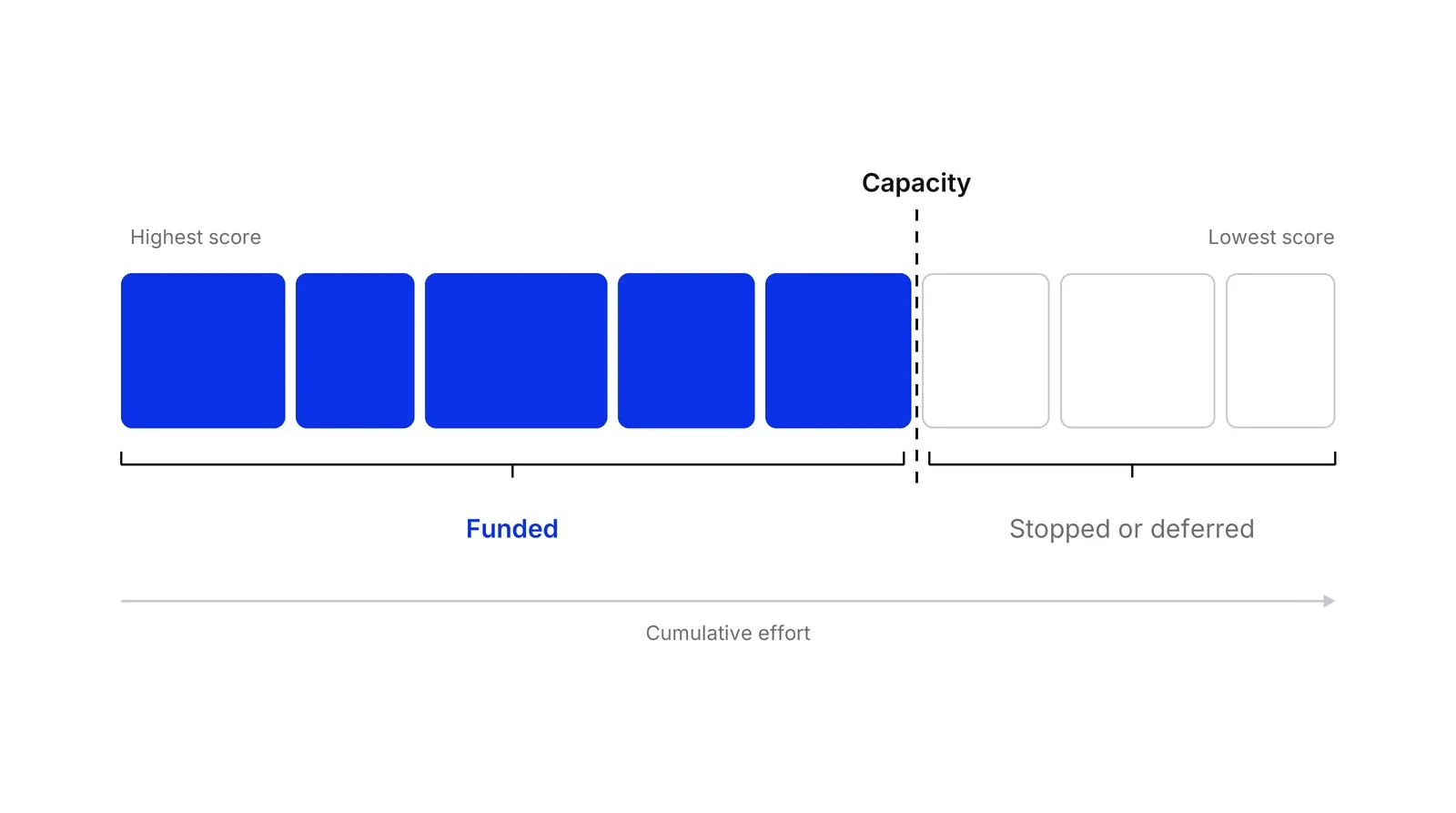
That last measure is where most organizations fail. Projects are cheap to approve and costly to run, so the list grows until everything moves slowly. Rose Hollister and Michael Watkins of Genesis Advisers argue in Harvard Business Review that organizations find it surprisingly hard to kill existing initiatives, even when those no longer fit the strategy. A portfolio gives the limit a visible shape: a list ranked by score, with effort added up until capacity runs out.
How to select projects
Scoring models and strategy-led methods give better portfolios than financial calculations alone. In the 1999 study, the benchmark firms placed less weight on financial methods and more on strategic ones, and used several methods together. A 2001 follow-up in R&D Management found that financial methods were the most popular and rigorous, yet gave the worst overall results, while top performers relied more on strategic and scoring methods. These are firms’ own performance ratings, not audited outcomes.
| Method | How it chooses | Weak spot |
|---|---|---|
| Financial (NPV, payback) | Highest return on estimated cash flows | Forecasts for early projects are guesses |
| Strategic buckets | Fixed budget shares per goal, then rank inside each | Needs clear strategy first |
| Scoring model | Weighted criteria, same for every project | Weights can be gamed |
| Bubble diagram | Plots risk against reward | Hard to compare many items |
For most teams, a scoring model is the practical choice. RICE scoring rates reach, impact, confidence and effort, and ICE scoring does the same with less data. Müller, Martinsuo and Blomquist received 242 survey responses in 2008, filtered 136 high performers for analysis, and found that portfolio selection, reporting and decision-making style were separate control factors, linked to different performance measures. Choosing well is only one part of the job.
Balance and strategy
A good set of projects is balanced as well as individually good. A balanced portfolio splits effort between safe improvements and uncertain bets, and between short and long payoffs. Three horizons of growth gives a ready-made split. Lauren Kester, Erik Jan Hultink and Abbie Griffin tested this in 2014 with 189 pairs of respondents in Dutch firms. Portfolio mindset and agility were associated with all three dimensions of portfolio success, while balance had no direct link to market performance and worked through strategic alignment and portfolio value. Balance helps, but fit with strategy matters more.
Strategy also decides the budget before any project is scored. Capital allocation sets how much goes to each area, and OKRs give the goals that the screening step tests against. Thomas Meskendahl’s 2010 framework links business strategy to how a portfolio is managed and how well it does.
Killing projects
Stopping a project is the hardest decision in the process, because people favour work they have already paid for. Barry Staw’s 1976 study of 240 business students found that people given personal responsibility for a failing investment put more money into it. Hal Arkes and Catherine Blumer (1985) showed that those who had already spent money rated a project’s chance of success higher than those who had not. Dustin Sleesman and colleagues (2012) called the resulting escalation of commitment one of the most persistent and costly decision errors in the organizational sciences, and cite the US government’s support for AIG, which grew from $85 billion to $172 billion as problems surfaced.
The remedy is procedural. Cooper introduced Stage-Gate in Business Horizons in 1990, and later described its gates as Go/Kill or investment decision points. Set stop criteria before a project starts, review it with someone who did not propose it, and decide as if only future costs counted. Overruns follow a long tail, not an average: Bent Flyvbjerg and Alexander Budzier studied 1,471 IT projects, 92% of them in public agencies, and found an average cost overrun of 27%. One in six was a black swan, with a 200% cost overrun and a schedule overrun of almost 70%. Kmart’s $1.4 billion IT modernization, started in 2000, is one of their examples. A portfolio that watches only average performance misses the project that sinks it.
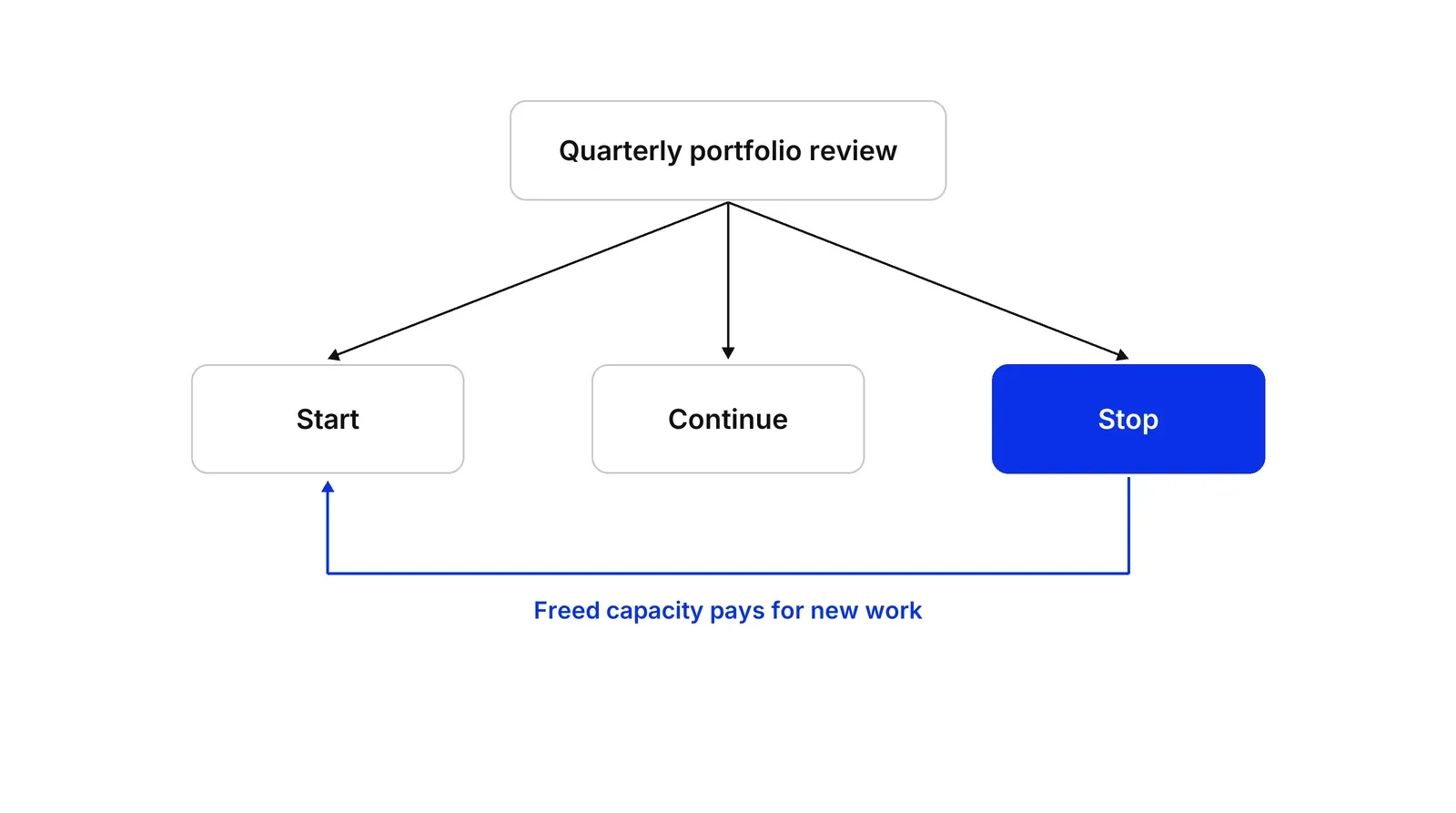
A review rhythm helps, and quarterly planning is the natural place for it. Kester, Griffin, Hultink and Lauche (2011) found that selecting, terminating and continuing at reduced funding behave as one connected system of decisions, so a review should treat them together. A portfolio office often runs the register. Barbara Unger, Hans Georg Gemünden and Monique Aubry (2012) describe three separate roles for it.
Portfolio management versus the BCG matrix
Project portfolio management is often confused with the BCG growth-share matrix, because both use the word portfolio. They answer different questions.
| Project portfolio management | BCG growth-share matrix | |
|---|---|---|
| Unit of analysis | Projects and initiatives | Products or business units |
| Main question | Which work do we fund next quarter? | Where do we invest, harvest or divest? |
| Constraint | People, time and budget | Cash generation and use |
| Typical output | Ranked list with a capacity line | Four quadrants of products |
A company can use both: the matrix to decide which businesses deserve investment, and the portfolio process to pick the projects inside them. A Growth Lab plan starts from this ranking so that the quarter’s experiments fit the capacity the team actually has.
How to apply Project portfolio management, step by step
- Put every initiative in one register. List running and requested work together: name, owner, goal it serves, remaining effort and spend. Include small projects, because they use the same people. Result: one list that shows the true load, usually longer than anyone expected.
- Screen against the current strategy. Ask of each item which goal it serves this year. Mark anything with no answer as a candidate to stop or defer before any scoring. Result: a shorter list in which every item has a stated reason to exist.
- Score what is left on a few shared criteria. Use the same three to five criteria for all items, for example reach, impact, confidence and effort in a RICE or ICE model. Scoring on shared criteria is what makes unlike projects comparable. Result: a ranked list.
- Draw the capacity line. Work out how many people-weeks or how much budget the next quarter really holds, after run-the-business work. Go down the ranked list adding effort until capacity is used. Result: items above the line are funded, items below it are stopped or deferred.
- Check the mix. Look at the funded set as a whole: how much serves the core, how much new bets, how much risk sits in one place, and whether one team carries too much. Swap items if the balance is off. Result: a portfolio that fits the strategy as a set, not only item by item.
- Decide start, continue or stop, and write the kill criteria. For each running project record the evidence that would make you stop it, and the date you will check. Name what the freed capacity will fund. Result: a decision log that the next review can hold the owners to.
- Repeat every quarter. Re-rank with fresh numbers, compare progress with the kill criteria and rebalance. Result: a portfolio that follows the strategy instead of drifting away from it.
Examples
A payments company with more projects than engineers
Illustrative. Eleven initiatives ask for 160 engineer-weeks next quarter, and the team has 90 after support and maintenance. Ranked by score, the top six need 85 weeks. The seventh needs 25 and would break the line. The team funds the top six, defers the rest, and shuts down a partner integration that has missed two checkpoints. The 20 weeks it freed move to a fraud-rules project that was below the line. The point of the exercise is the line itself: eleven yeses were never possible.
A clinic network choosing digital projects
Illustrative. A network of dental clinics has a patient reminder system, online booking, a loyalty programme and a new website all waiting for the same two-person marketing and IT team. Each is scored on patients reached, revenue effect, confidence and effort. Online booking and reminders rank first and second and fill the quarter. The loyalty programme and the website move to next quarter with a written trigger for revisiting them. Nothing is rejected for good, but nothing runs half-staffed.
A pharmaceutical pipeline, documented
Paul and colleagues (Nature Reviews Drug Discovery, 2010) estimated that bringing one new drug to market cost about $1.8 billion, and that a unit of Phase III work costs about ten times a unit of Phase I, so roughly ten early-stage candidates cost the same as one late-stage one. They argued for redirecting resources from candidates likely to fail late towards earlier proof of concept. That is a portfolio decision: stop expensive work that is going nowhere so that cheaper, better-chosen work can start.
When to use it
Use it when demand for projects exceeds the people and money available, when teams run many initiatives in parallel, or when nobody can say which projects were stopped last year. It fits scale-ups and larger organizations, where several teams compete for the same engineers, designers or budget.
When not to use it
Skip a formal portfolio process when the team has three or four projects and one decision-maker; a shared list and a monthly conversation are enough. Do not use it to choose between product lines or business units, where a growth-share or capital allocation view fits better. Do not run it without anyone empowered to stop work.
Common mistakes
- Ranking without a capacity line. A scored list that ends in 'do all of it' has not prioritised anything. Add up the effort and cut where capacity ends.
- Never stopping anything. Staw's 1976 experiment and the meta-analysis by Sleesman and colleagues (2012) show people keep funding failing work, especially work they chose themselves. Write kill criteria before the project starts.
- Counting only big projects. Small requests use the same people and are the usual source of overload. Register everything above a few days of effort.
- Treating the score as the decision. Scores are inputs. Balance, dependencies and strategy still need a person with authority to decide.
- Letting the project owner judge their own project. Research on escalation links personal responsibility to continued funding. Reviews should include someone who did not propose the work.
FAQ
What is project portfolio management?
It is the practice of managing all of an organization's projects as one set, deciding which to start, continue or stop so that scarce people and money serve the strategy. PMI's standard describes portfolios as projects, programs and other work grouped to meet strategic objectives. [ISO 21504:2022](https://committee.iso.org/sites/tc258/home/projects/published/iso-21504.html) gives guidance on its principles.
What is the difference between a portfolio, a program and a project?
A project is one piece of work with a defined result. A program groups related projects managed together for a shared benefit. A portfolio groups projects, programs and other work, related or not, so leaders can decide where limited resources go. PMI's portfolio standard uses this layering.
How do you decide which projects to kill?
Set stop criteria before launch: a metric, a threshold and a date. At each review, compare actual progress with them and ask what you would decide if the project were proposed today with only future costs counted. Sunk costs, the money already spent, should not enter the decision.
How is portfolio management different from the BCG matrix?
Project portfolio management ranks initiatives against capacity and strategy. The BCG growth-share matrix classifies products or business units by market growth and relative share to guide cash allocation. One answers which work to do next quarter; the other answers where to invest in the business.
What methods work best for selecting projects?
In Cooper, Edgett and Kleinschmidt's studies of North American firms, financial methods were the most used but gave the worst reported portfolio results. Top performers leaned on strategic methods and scoring models. A scoring model such as RICE with shared criteria is the simplest place to start.
Sources
- PMI, The Standard for Portfolio Management, Fourth Edition
- ISO/TC 258, ISO 21504:2022 Project, programme and portfolio management, Guidance on portfolio management
- Harry Markowitz, Portfolio Selection, The Journal of Finance 7(1), 1952
- Robert G. Cooper, Scott J. Edgett, Elko J. Kleinschmidt, New Product Portfolio Management: Practices and Performance, Journal of Product Innovation Management 16(4), 1999
- Robert G. Cooper, Scott J. Edgett, Elko J. Kleinschmidt, Portfolio management for new product development: results of an industry practices study, R&D Management 31(4), 2001
- Robert G. Cooper, Scott J. Edgett, Elko J. Kleinschmidt, Portfolio Management in New Product Development: Lessons from the Leaders I, Research-Technology Management 40(5), 1997
- Robert G. Cooper, Scott J. Edgett, Elko J. Kleinschmidt, Portfolio Management in New Product Development: Lessons from the Leaders II, Research-Technology Management 40(6), 1997
- Robert G. Cooper, Stage-gate systems: a new tool for managing new products, Business Horizons 33(3), 1990
- Robert G. Cooper, The Stage-Gate Idea to Launch System, Wiley International Encyclopedia of Marketing, 2010
- Norman P. Archer, Fereidoun Ghasemzadeh, An integrated framework for project portfolio selection, International Journal of Project Management 17(4), 1999
- Thomas Meskendahl, The influence of business strategy on project portfolio management and its success, International Journal of Project Management 28(8), 2010
- Ralf Müller, Miia Martinsuo, Tomas Blomquist, Project portfolio control and portfolio management performance in different contexts, Project Management Journal 39(3), 2008
- Lauren Kester, Erik Jan Hultink, Abbie Griffin, An empirical investigation of the antecedents and outcomes of NPD portfolio success, Journal of Product Innovation Management 31(6), 2014
- Lauren Kester, Abbie Griffin, Erik Jan Hultink, Kristina Lauche, Exploring portfolio decision-making processes, Journal of Product Innovation Management 28(5), 2011
- Barbara Unger, Hans Georg Gemünden, Monique Aubry, The three roles of a project portfolio management office, International Journal of Project Management 30(5), 2012
- Barry M. Staw, Knee-deep in the big muddy, Organizational Behavior and Human Performance 16(1), 1976
- Hal R. Arkes, Catherine Blumer, The psychology of sunk cost, Organizational Behavior and Human Decision Processes 35(1), 1985
- Dustin J. Sleesman, Donald E. Conlon, Gerry McNamara, Jonathan E. Miles, Cleaning up the big muddy, Academy of Management Journal 55(3), 2012
- Bent Flyvbjerg, Alexander Budzier, Why your IT project may be riskier than you think, Harvard Business Review, September 2011
- Steven M. Paul and colleagues, How to improve R&D productivity: the pharmaceutical industry's grand challenge, Nature Reviews Drug Discovery 9, 2010
- Rose Hollister, Michael D. Watkins, Too Many Projects, Harvard Business Review, September-October 2018
Last updated Oct 9, 2026


Fractional COO or embedded operations team? How to choose at Series A
The two models solve different problems: how to tell which one your company needs, and what each costs in time and control.

What operational systems successful fintech startups use: lessons from ten companies
Starling, Monzo, Qonto, bunq, Lunar, Pleo, Tide, Ramp, Mercury and Column scaled on four operating systems. Regulators' findings show what breaks when one of them lags behind growth.

What a revenue operations manager actually owns
Pipeline definitions, CRM hygiene, forecasting and the handoffs between marketing, sales and success. What the role covers, and how it differs from sales ops.