SPIN Selling
SPIN Selling is a question method from Neil Rackham's 1988 book for large B2B sales: ask about the buyer's situation, problems, the consequences of those problems and the payoff of fixing them, so the buyer states the need.
SPIN Selling is a questioning method for large, multi-call B2B sales, developed by Neil Rackham and Huthwaite and set out in his book SPIN Selling. A seller asks four kinds of question in a flexible order: Situation, Problem, Implication and Need-payoff. The aim is to let the buyer, not the seller, say how big the problem is and what solving it is worth.
- Origin
- Neil Rackham, Huthwaite, 1988
- Level
- 201 · Tool
- Fits
- Startup, Small and mid-size, Scale-up
- Time to apply
- 30 minutes to write the questions for one account; a few real calls to feel the difference
- What you need
- one open deal where the buyer has not yet said what the problem costs · a short list of what you already know about the account, from public sources · a call recording or notes, so you can count which question types you actually asked
SPIN Selling is a method for asking questions in large B2B sales, where a deal takes several calls and a buyer has to be convinced that a problem is worth solving. Neil Rackham published it in 1988 through McGraw-Hill, and it rests on research by his firm Huthwaite into what successful sellers did on real calls. The core claim is simple: in a big sale, the buyer should say the need out loud, and your questions are how you get there.
Where SPIN Selling comes from
The publisher’s description is of a study of more than 35,000 sales calls by 10,000 salespeople in 23 countries over 12 years (Routledge). McGraw-Hill calls it a 12-year research effort costing $1 million (McGraw Hill). The book was aimed at major sales, and its publisher says closing techniques that work in small sales tend to fail in larger ones.
Read the number with care. Rackham explained in a 2026 Huthwaite interview that the sample was built through productivity projects at companies such as Xerox, IBM and Motorola, where managers were trained to code calls and then coached their own salespeople. One such project produced 360 calls from 60 salespeople (Huthwaite). He also said the results came from the whole coaching process, not from “four little questions”. The research is Huthwaite’s own, and we found no independent replication, so treat SPIN as a well-documented practitioner method and not as settled science.
Rackham kept writing on major sales: Major Account Sales Strategy (McGraw-Hill, 1989), Rethinking the Sales Force with John DeVincentis (McGraw-Hill, 1998), and a 2006 Harvard Business Review article with Philip Kotler and Suj Krishnaswamy on sales and marketing.
What are the four SPIN question types?
SPIN stands for Situation, Problem, Implication and Need-payoff. Each type has a different job, and together they move a buyer from a fact to a need they state themselves.
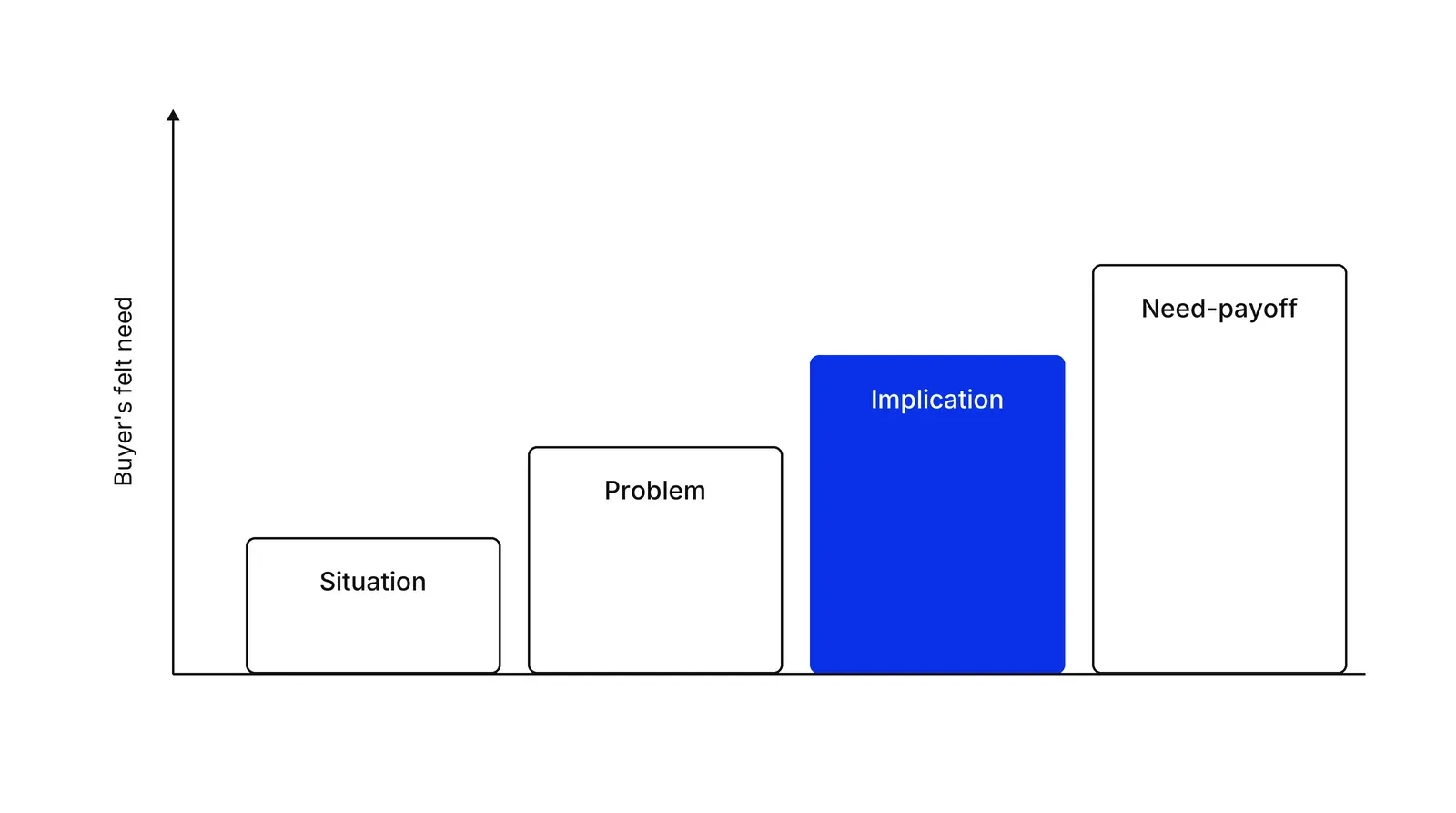
| Type | Job | Example |
|---|---|---|
| Situation | Gather background | “How many people book appointments by phone?” |
| Problem | Find a difficulty or dissatisfaction | “How often do bookings get double-entered?” |
| Implication | Show what the problem causes | “What does a double booking cost you in doctor time?” |
| Need-payoff | Ask what a fix would be worth | “If that stopped, what would you do with the time?” |
Huthwaite’s guidance is to keep Situation questions few: its research reports that successful sellers asked fewer of them, and asked more focused ones (Huthwaite). The weight sits in the middle. Huthwaite says successful sellers looked for the consequences of leaving a problem unresolved, not only for the problem itself.
Implied needs and explicit needs
An implied need is a dissatisfaction the buyer mentions. An explicit need is a stated wish for a solution. Huthwaite’s account of the research is that implied needs had no relationship with success in major sales, while explicit needs were a key indicator of it (Huthwaite).
This is the logic behind the order of the questions. A buyer who says “booking is a bit clunky” has given you an implied need. People live with clunky for years. Implication questions attach a cost to it, and Need-payoff questions ask the buyer to describe the benefit of fixing it. At that point the need is explicit, and an offer lands as an answer, not as a pitch.
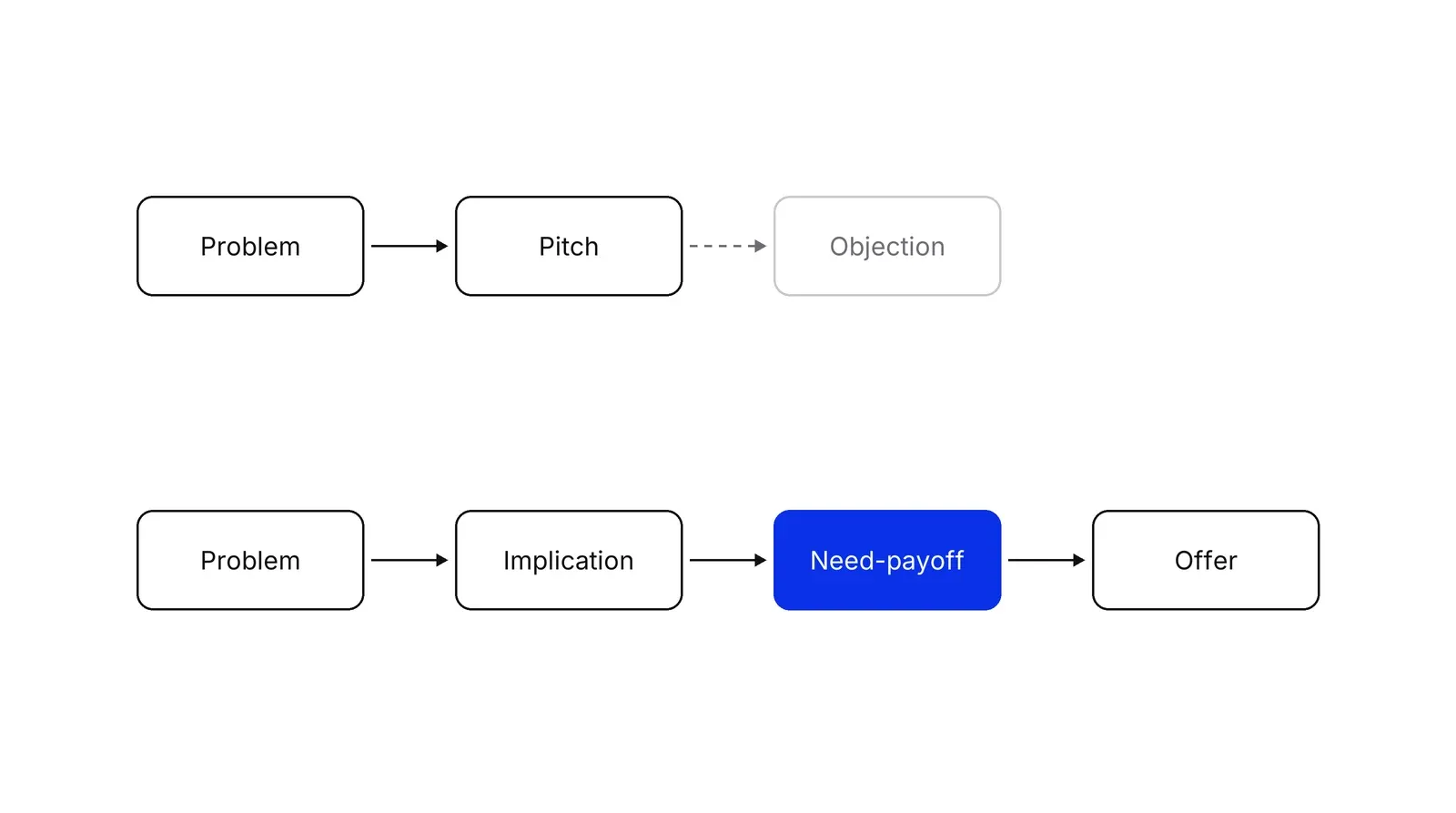
The same source says that continual use of closing techniques sharply reduces the chance of success in large sales, and that top performers propose the highest realistic commitment instead of asking for the order. Treat that as Huthwaite’s reading of its own data.
Why the questions work
Part of the effect is ordinary conversation. In three studies of live conversations, Huang and colleagues found that people who ask more questions, especially follow-up questions, are better liked, and that people do not expect this. That is not sales research, but it fits what a discovery call is.
The rest is ownership. Huthwaite argues that people rarely argue with their own conclusions, which is why a need the buyer has stated is harder to object to than one you have asserted. It is a claim about psychology, and the source offers no data for it.
Sales research also measures the broader habit SPIN trains. The SOCO scale, defined by Saxe and Weitz in 1982, scores how customer-oriented a salesperson is, and Raymond Thomas, Geoffrey Soutar and Maria Ryan tested a ten-item short form on Australian data from 250 salespeople, 157 of their managers and 276 customers (Journal of Personal Selling and Sales Management). That work is about the orientation, not about SPIN’s four question types, and it does not test them.
Question count alone is a weak guide. Gong’s analysis of 519,000 recorded discovery calls found the best outcomes with 11 to 14 targeted questions, and Gong itself warns that correlation is not causation. What the questions do matters more than how many there are.
SPIN Selling compared with similar methods
| SPIN Selling | BANT | Solution selling | The Mom Test | |
|---|---|---|---|---|
| Purpose | Move a buyer to state a need | Decide if a lead is worth time | Diagnose a problem, then fit a solution | Learn the truth before building |
| Used by | A seller in discovery | A seller early on | A seller across the deal | A founder or researcher |
| Core move | Four question types | Four qualifying checks | Pain, vision, value case | Ask about the past, not opinions |
SPIN and the Mom Test both rely on questions about real behaviour, but they have opposite goals: SPIN guides a buyer toward a decision, while the Mom Test avoids steering anyone. For research on why a buyer switched, a switch interview is the better tool.
Where SPIN falls short
Buying has changed. Adamson, Dixon and Toman argued in 2012 that “customers don’t need you the way they used to”, because buyers can define solutions without a seller (Harvard Business Review). Their Challenger approach, set out in the 2011 book The Challenger Sale, answers this by having the seller teach the buyer something new instead of only drawing out needs. Huthwaite’s reply is that buyers who have done their own research still need help thinking through consequences (Huthwaite).
Two practical limits follow. First, a buying group has several people with different problems, so one Implication chain with one contact may miss the finance lead or the security team. Second, the method is trademarked and Huthwaite says it cannot be taught in full from a book, so a team that copies four question names from a blog is using a simplified version.
A Growth Lab plan for a sales team can start from call recordings: tag each question by type and see which one is missing.
How to apply SPIN Selling, step by step
- Research before the call. Collect everything you can learn without asking: company size, tools, recent news, who is on the call. This keeps Situation questions to the few that only the buyer can answer. Result: a one-page fact sheet and a short list of gaps.
- Ask a few Situation questions. Confirm facts and ask only what you could not find. Huthwaite reports that successful sellers asked fewer Situation questions, and more focused ones. Result: enough background to ask a real Problem question, and no interrogation.
- Surface problems. Ask where the current way of working causes difficulty, dissatisfaction or delay. Let the buyer list several. Result: two or three problems in the buyer's own words, not yours.
- Make one problem concrete with Implication questions. Pick the problem the buyer cares about most and ask what follows from it: what it costs, who else it affects, what it delays. Get a number where one exists. Result: a problem the buyer now sees as large enough to act on.
- Ask Need-payoff questions. Ask what the buyer would gain if the problem were solved: time, money, risk avoided. Let the buyer describe it. Result: a stated need in the buyer's own words, which is the signal to talk about your offer.
- Link your offer to the stated need and ask for a next step. Show only the part of your offer that answers what the buyer just said, then propose the biggest realistic next step, such as a pilot or a meeting with finance. Result: a concrete commitment tied to a need the buyer owns.
Examples
A payments provider selling to a mid-size online merchant
Illustrative. Situation: how many card payments a month, and through which provider? Problem: how satisfied is the merchant with the share that fail at checkout? Implication: if 3% of the merchant's monthly checkouts fail, and there are 4,000 of them, that is 120 lost sales. At an average basket of 80, the monthly loss is 9,600, before counting customers who never return. Who in finance sees that number today? Need-payoff: if retries recovered half of those, what would that recovered revenue mean for the quarter? Only now does the seller describe smart retries.
A software vendor selling scheduling to a private clinic
Illustrative. Situation: how are appointments booked today? Problem: how often do patients miss appointments? Implication: with 20 missed slots a week and an average visit worth 60, that is 1,200 in idle doctor time every week, plus a longer wait for patients who could have taken those slots. Need-payoff: if reminders cut missed slots by a quarter, what would the front desk do with the freed time? The clinic manager, not the vendor, says the number out loud.
When to use it
Use it in B2B sales that take several calls, involve real money or change for the buyer, and where the buyer may not feel the problem is big enough yet. It suits discovery calls, account reviews and renewal conversations.
When not to use it
Skip it for quick, low-value purchases where the buyer already knows what they want, and for pure customer research, where the goal is to learn and not to move a deal. Do not run it as a script: Huthwaite itself calls SPIN a logical framework, not a rigid sequence.
Common mistakes
- Asking too many Situation questions. The buyer feels audited and you spend the call on facts a website would have given you.
- Stopping at Problem questions. A dissatisfaction the buyer is willing to live with does not turn into a purchase until its consequences are clear.
- Putting words in the buyer's mouth. An Implication question that contains your own conclusion is a pitch with a question mark.
- Using the questions as a fixed script in the same order every time. Rackham's own company says the order should adapt to the conversation.
- Jumping to the offer the moment a problem appears. Huthwaite says offering a solution the buyer has not asked for is the easiest way to create an objection.
FAQ
What does SPIN stand for in sales?
SPIN stands for Situation, Problem, Implication and Need-payoff. Situation questions gather facts, Problem questions find difficulties, Implication questions explore what those difficulties cause, and Need-payoff questions ask what solving them would be worth. Rackham has said he wanted the last letter to be V for value, but SPIV is British slang.
Who created SPIN Selling?
Neil Rackham created it with his research firm Huthwaite and published it in the McGraw-Hill book SPIN Selling. Major Account Sales Strategy followed a year later. SPIN is a Huthwaite trademark, and the company sells licensed training in the method.
How many sales calls were studied for SPIN Selling?
The publisher describes a 12-year study across 23 countries. Rackham has explained that the sample was assembled through coaching projects at firms such as Xerox, IBM and Motorola, where trained managers coded calls. The data is Huthwaite's own, and I found no independent replication.
Is SPIN Selling still relevant?
For complex B2B deals, mostly yes, because buyers still need to feel a problem is worth solving. Buying also involves more people and more self-research than when the book appeared, so the method needs adapting: ask fewer Situation questions you can look up, and bring the wider group into Implication questions.
What is the difference between SPIN Selling and BANT?
BANT is a checklist that decides whether a lead deserves a salesperson's time: budget, authority, need and timeline. SPIN is a conversation method for what happens once you are talking: how the buyer comes to see and state the need. Many teams use BANT to qualify and SPIN to run discovery.
Sources
- Neil Rackham, SPIN Selling, McGraw-Hill, 1988 (Internet Archive record)
- McGraw Hill, SPIN Selling, product page
- Routledge, Neil Rackham, SPIN Selling (Gower edition)
- Neil Rackham, Major Account Sales Strategy, McGraw-Hill, 1989 (Internet Archive record)
- Neil Rackham, Account strategy for major sales, Gower, 1988 (Internet Archive record)
- Neil Rackham, John DeVincentis, Rethinking the Sales Force, McGraw-Hill, 1998 (Internet Archive record)
- Philip Kotler, Neil Rackham, Suj Krishnaswamy, Ending the War Between Sales and Marketing, Harvard Business Review, July 2006
- Huthwaite International, Neil Rackham on the research behind SPIN
- Huthwaite International, The sales hypothesis that led to SPIN Selling
- Huthwaite International, SPIN Selling applies science to the art of selling
- Huthwaite International, SPIN Selling: complete guide
- Huthwaite International, Exploring the power of SPIN Selling questions
- Huthwaite International, The SPIN methodology
- Huthwaite International, Neil Rackham explains the origins of the SPIN acronym
- Huthwaite International, Why SPIN Selling still works
- Huthwaite International, Rethinking SPIN
- Brent Adamson, Matthew Dixon, Nick Toman, The End of Solution Sales, Harvard Business Review, July-August 2012
- Matthew Dixon, Brent Adamson, The Challenger Sale, Portfolio/Penguin, 2011 (Internet Archive record)
- Karen Huang, Michael Yeomans, Alison Wood Brooks, Julia Minson, Francesca Gino, It doesn't hurt to ask: question-asking increases liking, Journal of Personality and Social Psychology 113(3), 2017
- Alison Wood Brooks, Leslie K. John, The Surprising Power of Questions, Harvard Business Review, May-June 2018
- Gong, data-driven tips for sales discovery calls
- Raymond Thomas, Geoffrey Soutar, Maria Ryan, The selling orientation-customer orientation (S.O.C.O.) scale: a proposed short form, Journal of Personal Selling and Sales Management 21(1), 2001
- Rob Fitzpatrick, The Mom Test, book site
Last updated Oct 9, 2026


Marketing agency or growth system: when a company outgrows its agency
An agency is the right call while the founder still runs most of the company. Once the business starts copying itself into new locations or markets, it needs a system that sets goals, tests hypotheses and owns the result.

Why healthcare marketing agencies stall: the short, mid and long wins model we use with clinics
Most agencies own the click and nobody owns the front desk. How we structure clinic work in three horizons, the research behind each one, and one year of results.

Why channel tests stall after month three
Most paid channel tests do not end with a decision. They end when the budget runs out, the attribution model changes, or everyone quietly stops looking at the dashboard.