Offer architecture
Offer architecture is the deliberate design of everything a buyer gets, risks and gives up in one deal, so that saying yes is easier than saying no.
Offer architecture is the practice of designing a sales offer as a system: the result promised, the parts that deliver it, the guarantee, and any real limits on supply or time. Alex Hormozi popularised it in a 2021 book on offers as the Grand Slam Offer, built on a value equation where value rises with the dream outcome and its perceived likelihood and falls with time delay and effort.
- Origin
- Alex Hormozi (Grand Slam Offer, value equation), 2021
- Level
- 201 · Tool
- Fits
- Startup, Small and mid-size
- Time to apply
- a half-day workshop for a first version, then two to four weeks of testing against the current offer
- What you need
- notes or recordings from at least ten sales calls, in the buyer's own words · your delivery cost for each part of the current offer · one person who can approve a guarantee and the refund budget behind it
Offer architecture is the practice of designing a sales offer as a whole system: the result you promise, the parts that deliver it, the risk the buyer carries, and any real limits on places or time. The term describes a habit good salespeople have always had. Alex Hormozi gave it a popular method in his 2021 book $100M Offers, published through his company Acquisition.com, where he calls the finished result a Grand Slam Offer.
Hormozi’s own store page says his businesses generated more than $120 million across four industries and that the book has sold over 800,000 copies. Those are his figures, not audited ones, and the same page states that his results are not typical. The method is still worth studying, because most of its parts match decades of research on value, bundling, warranties and scarcity.
What is the value equation?
The value equation is Hormozi’s model of how a buyer judges an offer. Value equals the dream outcome multiplied by the perceived likelihood of achieving it, divided by the time delay multiplied by the effort and sacrifice it takes. The Acquisition.com offers course gives it a module of its own, and the book treats it as the base for everything else.
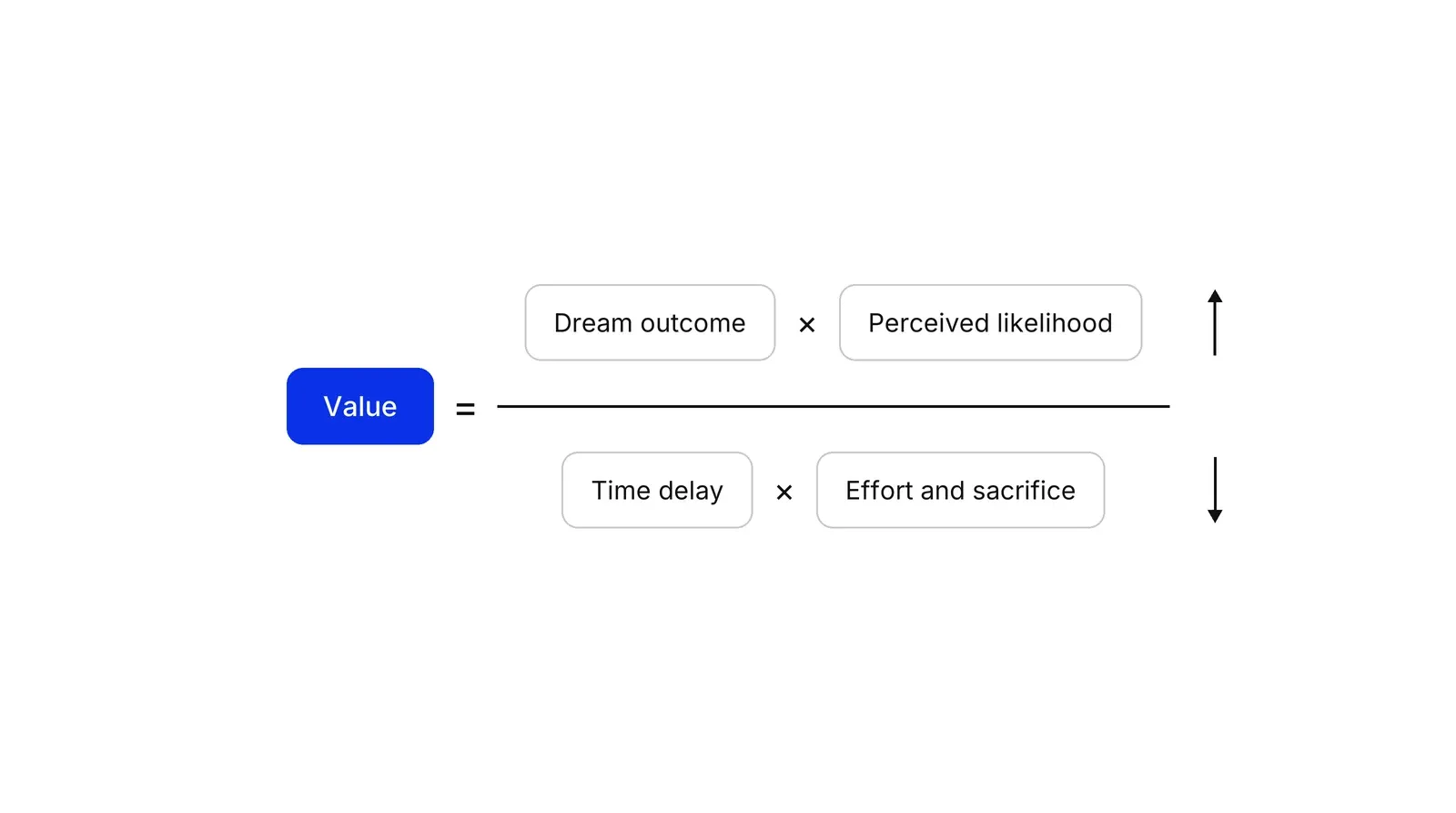
The dream outcome is the result the buyer wants, in their own words: a clinic owner wants a full diary, not “patient acquisition services”. Perceived likelihood is how sure the buyer is that it will work for them, and case studies, a guarantee and a visible process all raise it. Time delay is how long until they see the result or a first sign of it. Effort and sacrifice is what they must do, learn or give up along the way.
The model is older than its name. Valarie Zeithaml’s 1988 study in the Journal of Marketing found that consumers describe value as what they get for what they give, and that the give side covers time and effort as well as money. Piers Steel’s temporal motivation theory, which he calls a hybrid of expectancy theory and hyperbolic discounting, has the same shape: expectancy and value push motivation up, delay pushes it down. The economics of time discounting explains why a result next month is worth less to a buyer than the same result today.
What no study has done is test Hormozi’s formula as a formula. Read it as a checklist of four things to improve, not as a number to compute.
How do you build the offer stack?
You build the stack by listing every obstacle between the buyer and the result, then turning each obstacle into a part of the offer. Hormozi’s method runs in that order: problems first, solutions second, then a trim that removes parts that cost you a lot and add little, then a stack of what remains under one price.
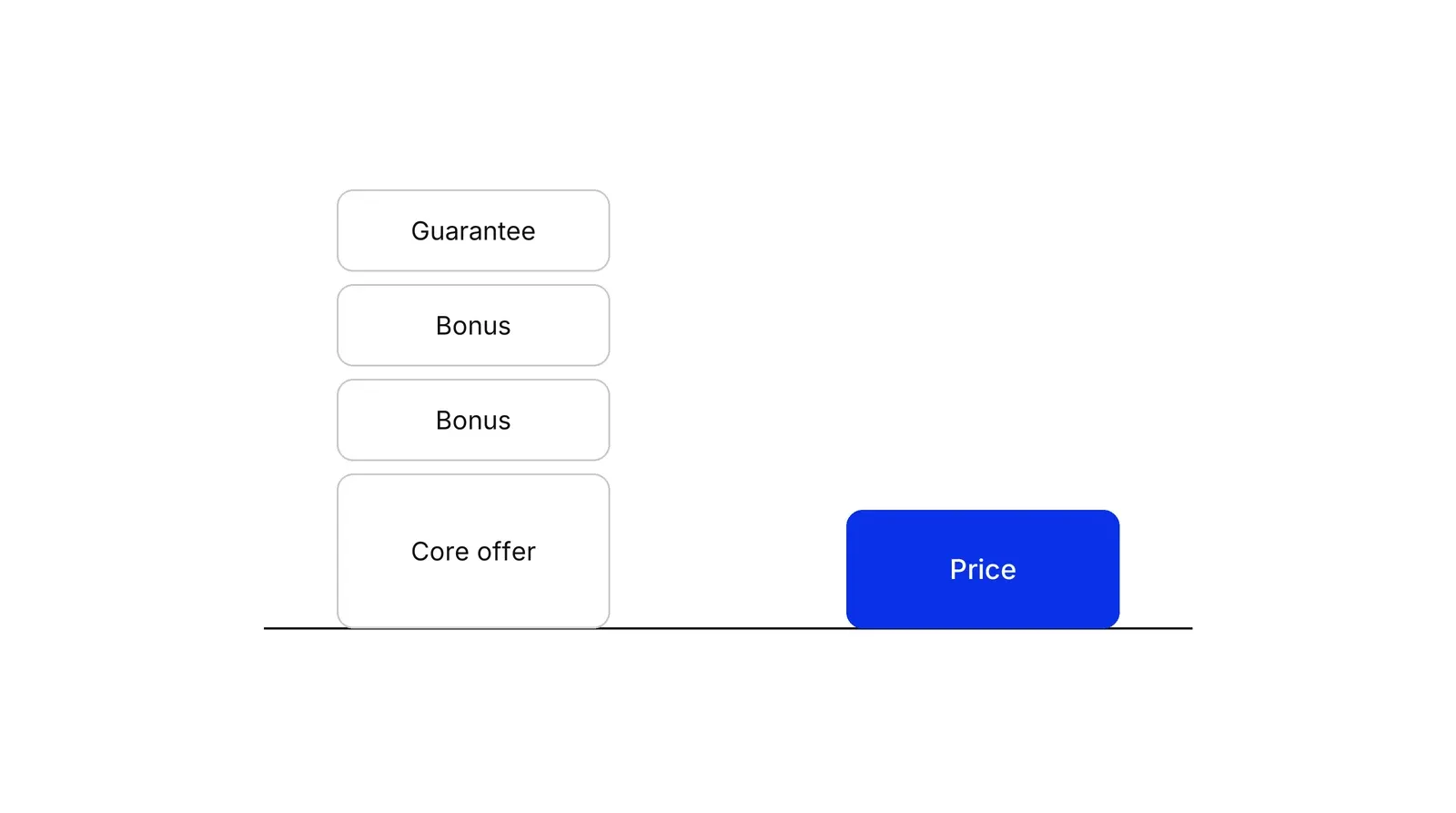
The research on bundling explains why this works and where it breaks. Stremersch and Tellis, in their 2002 synthesis, separate price bundling, a discount on separate products sold together, from product bundling, where parts are integrated into something new. A Grand Slam Offer is product bundling: the parts only make sense together. Adams and Yellen’s 1976 paper is the classic economic analysis of bundling as a way to sell one package to buyers who value its parts differently.
Two findings shape how you present the stack. Richard Thaler’s mental accounting paper set out the rule “segregate gains”: several separate gains feel bigger than one combined gain, which is why each component deserves its own name. Shampanier, Mazar and Ariely found that a zero price makes people see more benefit in an item than a small positive price does, so a free bonus pulls harder than its cost suggests.
The warning comes from Soman and Gourville, who studied how bundled prices change whether people use what they paid for. Gourville and Soman argued in Harvard Business Review that managers rarely think about consumption when they set prices. A bonus nobody opens adds cost and does nothing for the buyer’s result.
Guarantees: moving risk off the buyer
A guarantee raises perceived likelihood by moving the risk of failure from the buyer to the seller. Hormozi gives the topic a full chapter, listed on the audiobook page, and describes several types: unconditional refunds, conditional guarantees that depend on the buyer doing their part, “anti-guarantees” where all sales are final for a stated reason, and implied guarantees such as pay-for-performance fees.
Research supports the mechanism. Christopher Hart argued in a 1988 Harvard Business Review article that guarantees matter most for services, where buyers cannot inspect what they buy in advance. Sanford Grossman’s 1981 paper analysed the informational role of warranties, and Boulding and Kirmani’s 1993 experiments found that consumer responses to warranties match signaling theory: a seller who offers a strong promise is read as one who expects to keep it.
The practical test is money. Model the refund rate, double it, and check the offer still makes a profit.
Scarcity and urgency: only if true
Scarcity means a real limit on supply; urgency means a real limit in time. Both raise the value buyers place on an offer. Michael Lynn’s 1991 meta-analysis of commodity theory found that scarcity increases the value of things people can own. Inman, Peter and Raghubir found in 1997 that purchase limits and time limits make a deal look better, though the effect showed up only among consumers low in need for cognition.
Fake scarcity is common and increasingly illegal. A 2019 crawl of about 11,000 shopping sites found 393 countdown timers, 157 of them deceptive, on 140 sites. The UK Competition and Markets Authority opened cases over countdown timers in 2022 and urgency claims in 2023. Since April 2025, Schedule 20 of the Digital Markets, Competition and Consumers Act lists falsely claiming an offer is available only for a limited time as always unfair. Real limits are fine: a cohort of 12 because two clinicians have 12 slots is a fact.
How offer architecture differs from related tools
| Tool | Question it answers | Output |
|---|---|---|
| Offer architecture | What exactly does the buyer get, risk and give up in this deal? | A priced package with guarantee and terms |
| Value proposition | Why should this customer choose us at all? | A statement of fit between product and customer needs |
| Lead magnet | What free thing earns a first contact? | A small free asset traded for contact details |
| Pricing research | What will buyers pay? | A price point or range |
The value proposition comes first and the offer turns it into a deal. In our Growth Lab work, the offer is one of the first things we test, because a weak offer makes every channel look expensive.
How to apply Offer architecture, step by step
- Name the buyer and the result they want. Write the outcome one buyer group wants, in their words from sales calls, with a time frame. A clinic owner wants a full diary of new patients, not a marketing retainer. Result: one sentence describing the dream outcome for one named group.
- List every obstacle on the way. Walk through what happens before, during and after the purchase and write down each thing that could stop the buyer from getting the result: doubt, waiting, setup work, cost of switching. Result: a list of 15 to 30 problems, each tagged with the value-equation lever it hurts.
- Turn each obstacle into a solution. Rewrite every problem as a fix and choose how to deliver it: done for the buyer, done with them, a template, a call, software. Result: a long list of possible offer components with a delivery method for each.
- Trim, then stack. Score each component on value to the buyer and cost to you. Cut the ones that cost a lot and add little, keep the cheap high-value ones, and present the rest as named parts of one package. Result: a stack of five to eight components and a price that sits well below their combined value.
- Add a guarantee you can afford. Choose the guarantee type, write its conditions in one sentence, and model what happens if refunds or remedies double your expected rate. Result: a guarantee the finance owner has signed off with a budget line.
- Add only true limits. If capacity is genuinely limited, say how many places there are and why. If a bonus really ends on a date, keep that date. Result: a scarcity or urgency statement you could prove to a regulator, or none at all.
- Test against the current offer. Run the new offer beside the old one for the same traffic or the same sales team and compare close rate, refund rate and margin per customer. Result: a decision to adopt, revise or drop the new architecture, backed by numbers.
Examples
A physiotherapy clinic's back pain programme
Illustrative, no real clinic implied. The clinic sold ten sessions for $600 and closed about one in five enquiries. The rebuilt offer keeps the price and changes the parts: an assessment within 48 hours of booking (less delay), a home exercise plan with short videos (less effort), a week-three review with two extra sessions at no charge if the agreed function goals have not moved (a conditional guarantee on the process, never on a clinical cure), and a cap of 12 new programme patients a month, which is the real capacity of two clinicians. Each change targets one lever of the value equation, and the cap is true, so it can be stated plainly.
A payment provider's onboarding offer for online shops
Illustrative. A payments company's sales team kept losing shops that feared a slow, risky migration. The new offer bundles a go-live date of five business days, a migration done by the provider's own engineers, and a fee guarantee: if fees in the first full month exceed the quote, the provider refunds the difference. If a shop is quoted $2,000 and is billed $2,150, it gets $150 back. The guarantee costs little when quotes are accurate and raises the buyer's confidence exactly where the doubt sat.
When to use it
Use it when buyers say the product sounds good but they are not sure it will work for them, when you compete mainly on price, or when a launch or a new segment needs a reason to act now. It suits services, programmes and B2B products where you control delivery and can change what is included.
When not to use it
Skip it for commodity goods sold on price and availability, where adding bonuses only adds cost. Avoid guarantees you cannot fund and any scarcity you cannot prove. In regulated fields such as healthcare and financial services, check what you may promise before you write a guarantee, because outcome promises can breach advertising rules.
Common mistakes
- Stacking bonuses the buyer never uses, which adds delivery cost and does nothing for the result, since unused parts of a bundle do not raise perceived likelihood.
- Inventing deadlines and stock counts. Fake countdown timers are a named target of UK enforcement and are banned outright under the Digital Markets, Competition and Consumers Act 2024.
- Offering an unconditional guarantee without modelling refunds, then quietly making it hard to claim, which destroys the trust it was meant to build.
- Raising the dream outcome in the copy without changing delivery, so the promise grows and the likelihood the buyer believes in stays the same.
- Treating the value equation as arithmetic and scoring offers to two decimal places. It is a checklist of four levers, not a measured formula.
FAQ
What is an offer in simple words?
An offer is the full deal you put in front of a buyer: what they get, what it costs, how fast they get the result, what effort it takes and what happens if it does not work. Price is only one part. Two companies can charge the same and still make very different offers.
What is a Grand Slam Offer?
It is Alex Hormozi's name, from his 2021 book $100M Offers, for an offer so well built that buyers compare it with nothing else on the market. He builds it by listing every obstacle the buyer faces, turning each into a solution, stacking those solutions, and adding a guarantee, scarcity, urgency and a clear name.
What is Hormozi's value equation?
It says value equals the dream outcome times the perceived likelihood of achieving it, divided by the time delay times the effort and sacrifice required. To raise value you make the result bigger or more believable, or make it faster and easier to reach. Hormozi presents it as a guide, not a measured formula.
What makes a good offer?
A good offer answers the buyer's doubts. It promises a result they want, shows why it is likely to work for them, shortens the wait, removes work they would have to do, and carries a guarantee the seller can afford. Any limit on places or time is true and stated plainly.
Is a sales offer the same as a job offer?
No. A job offer is an employer's proposal of a role, salary and terms to a candidate. A sales offer is a company's proposal to a buyer. The logic overlaps, though: candidates also weigh the outcome, how likely it is, how long it takes and what they give up.
Sources
- Acquisition.com, $100M Offers: How To Make Offers So Good People Feel Stupid Saying No, hardcover store page
- Acquisition.com, Offers course module list (The Value Equation, Guarantees, Scarcity & Urgency)
- Acquisition.com, $100M Offers audiobook chapter list
- Stefan Stremersch, Gerard J. Tellis, Strategic Bundling of Products and Prices: A New Synthesis for Marketing, Journal of Marketing 66(1), 2002
- William James Adams, Janet L. Yellen, Commodity Bundling and the Burden of Monopoly, Quarterly Journal of Economics 90(3), 1976, RePEc record
- Dilip Soman, John T. Gourville, Transaction Decoupling: The Effects of Price Bundling on the Decision to Consume, Marketing Science Institute working paper, 1998
- John T. Gourville, Dilip Soman, Pricing and the Psychology of Consumption, Harvard Business Review, September 2002
- Richard H. Thaler, Mental Accounting and Consumer Choice, Marketing Science 4(3), 1985, reprint on Fermat's Library
- Kristina Shampanier, Nina Mazar, Dan Ariely, Zero as a Special Price: The True Value of Free Products, Marketing Science 26(6), 2007
- Valarie A. Zeithaml, Consumer Perceptions of Price, Quality, and Value: A Means-End Model and Synthesis of Evidence, Journal of Marketing 52(3), 1988, Flinders University course copy
- Piers Steel, The Nature of Procrastination, Psychological Bulletin 133(1), 2007, University of Calgary repository
- Shane Frederick, George Loewenstein, Ted O'Donoghue, Time Discounting and Time Preference: A Critical Review, Journal of Economic Literature 40(2), 2002
- Christopher W. Hart, The Power of Unconditional Service Guarantees, Harvard Business Review, July 1988
- William Boulding, Amna Kirmani, A Consumer-Side Experimental Examination of Signaling Theory: Do Consumers Perceive Warranties as Signals of Quality?, Journal of Consumer Research 20(1), 1993
- Sanford J. Grossman, The Informational Role of Warranties and Private Disclosure about Product Quality, Journal of Law and Economics 24(3), 1981, RePEc record
- Michael Lynn, Scarcity Effects on Value: A Quantitative Review of the Commodity Theory Literature, Psychology & Marketing 8(1), 1991, Cornell eCommons
- J. Jeffrey Inman, Anil C. Peter, Priya Raghubir, Framing the Deal: The Role of Restrictions in Accentuating Deal Value, Journal of Consumer Research 24(1), 1997
- Arunesh Mathur et al., Dark Patterns at Scale: Findings from a Crawl of 11K Shopping Websites, Proceedings of the ACM on Human-Computer Interaction 3 (CSCW), 2019
- Competition and Markets Authority, CMA investigates online selling practices based on urgency claims, 30 November 2022
- Competition and Markets Authority, Wowcher investigated over online urgency claims, 31 March 2023
- Competition and Markets Authority, Online choice architecture: how digital design can harm competition and consumers, April 2022
- UK Parliament, Digital Markets, Competition and Consumers Act 2024, Schedule 20 (commercial practices always considered unfair)
Last updated Oct 9, 2026


Marketing agency or growth system: when a company outgrows its agency
An agency is the right call while the founder still runs most of the company. Once the business starts copying itself into new locations or markets, it needs a system that sets goals, tests hypotheses and owns the result.

Why healthcare marketing agencies stall: the short, mid and long wins model we use with clinics
Most agencies own the click and nobody owns the front desk. How we structure clinic work in three horizons, the research behind each one, and one year of results.

Why channel tests stall after month three
Most paid channel tests do not end with a decision. They end when the budget runs out, the attribution model changes, or everyone quietly stops looking at the dashboard.