Dynamic pricing
Dynamic pricing is changing the price of the same offer over time in response to demand, remaining stock and the market, inside limits you set in advance.
Dynamic pricing is changing the price of the same product or service over time, by rule or algorithm, as demand, remaining stock and market conditions change. It grew out of airline revenue management and fits fixed, perishable capacity such as seats, rooms and appointments. It works only inside fairness limits, disclosure rules for personalised prices and competition law.
- Origin
- Airline revenue management: Littlewood's booking rule at BOAC, American Airlines' yield management; theory by Guillermo Gallego and Garrett van Ryzin, 1972; 1992; 1994
- Level
- 401 · Expert
- Fits
- Scale-up, Enterprise
- Time to apply
- two to four weeks to set rules and guardrails, then a test over several full demand cycles
- What you need
- a fixed or perishable supply: seats, rooms, slots, delivery windows or stock with a deadline · sales history by date, price and remaining stock, plus a first estimate of price elasticity · unit cost, so the floor price is above what each sale costs you · a named owner for price rules, and a lawyer who has read the disclosure and competition rules for your markets
Dynamic pricing is the practice of changing the price of the same offer over time, by rule or algorithm, as demand, remaining stock and market conditions change. It has no single inventor. Its roots are in airline revenue management. Jeffrey McGill and Garrett van Ryzin’s research survey traces the field to a 1972 booking rule by Littlewood of BOAC, accept a discount booking only while its revenue beats the expected revenue of a later full-fare one, and dates intensive North American development to American Airlines’ Super Saver fares in April 1977. This page covers when the method pays, why customers push back, and where law sets limits. It is general information, not legal advice.
Where the idea comes from: perishable capacity
Dynamic pricing works best when supply is fixed and expires. An empty seat has no value after departure, so the question is which price to show now, given how many units remain and how much time is left. Gallego and van Ryzin formalised this in 1994 for a seller clearing a fixed stock before a deadline, with examples such as airline seats, hotel rooms and seasonal fashion. Den Boer surveys the later line of work that adds learning demand from sales data. The textbook account is Talluri and van Ryzin’s book, which covers both quantity-based and price-based revenue management.
American Airlines is the best-known case. In 1992 Smith, Leimkuhler and Darrow described its system, and the company estimated a quantifiable benefit of $1.4 billion over three years. That is the company’s own estimate, so read it as a claim, not a measurement.
How the price moves
Price changes come from two engines that can run together: the clock and stock, and live demand signals. The first lowers or raises price as a date approaches or inventory falls. The second reacts to bookings, searches or a rival’s public price.
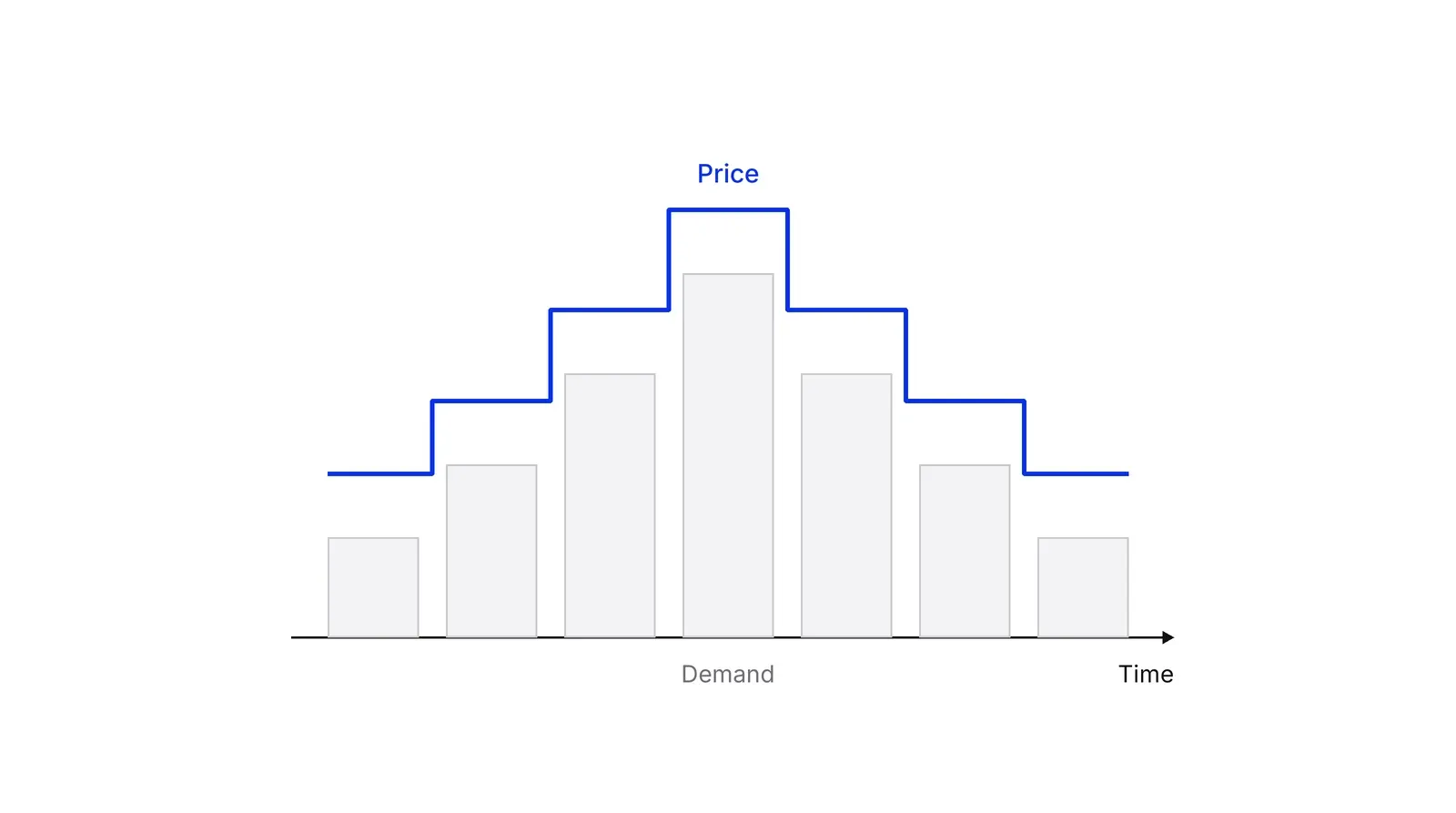
Ride-hailing shows the logic under heavy demand. Castillo, Knoepfle and Weyl showed that when price is too low in busy hours, idle drivers disappear and cars are sent on long pickups, which lowers earnings and removes drivers from the road. A platform with one fixed price would have to set it very high all the time. Surge pricing avoids that. Cohen and colleagues used Uber’s surge algorithm to estimate demand and put consumer surplus from UberX at about $2.9 billion in four US cities in 2015. Two of the authors had ties to Uber.
To see how far a price can move, you need an estimate of price elasticity. The ceiling comes from the value the buyer gets, which value-based pricing describes.
Why customers resist it
Customers judge a price move by its reason, and a price rise that exploits a sudden need reads as unfair. In the 1986 telephone surveys by Kahneman, Knetsch and Thaler in Toronto and Vancouver, 82% of 107 respondents called it unfair for a hardware store to raise a snow shovel from $15 to $20 the morning after a blizzard. Their finding was that people accept price rises that pass on higher costs and reject those that capture a demand shift.
Familiarity softens this. Wirtz and Kimes ran two experiments in 2007 and found that framing and who is advantaged affected fairness judgments when people were less familiar with a practice, and not when familiarity was high. There is a cost to getting it wrong. In a 28-month randomised field experiment with over 50,000 customers, Anderson and Simester found that customers who later saw a retailer sell an item for less bought less afterwards, most of all the best customers.
Dynamic versus personalised pricing
The legal line runs between dynamic pricing, where all shoppers see the same price at the same time, and personalised pricing, where the price depends on data about the individual. The two are often mixed up.
| Question | Dynamic pricing | Personalised pricing |
|---|---|---|
| What moves the price | Time, supply, rivals’ prices | The buyer’s profile |
| Two shoppers at once | Same price | Possibly different prices |
| EU disclosure | Not required by the 2019 Omnibus rule | Required where based on automated decision-making |
The Omnibus Directive added to the consumer rights law an information duty, Article 6(1)(ea) of Directive 2011/83/EU: tell the consumer where the price was personalised on the basis of automated decision-making. Its recital 45 says the duty should not apply to “dynamic” or “real-time” pricing that involves no such personalisation. The Commission’s 2021 guidance repeats the line and adds that the duty covers only the fact of personalisation, not the criteria.
The United States has begun to follow. According to Skadden, New York’s Algorithmic Pricing Disclosure Act took effect on 10 November 2025 and requires a notice that a price was set by an algorithm using personal data, with civil penalties up to $1,000 per violation. Whether personalisation pays is open: Dube and Misra found in a field experiment that it raised profit but cut total consumer surplus, though over 60% of consumers benefited.
Presentation is policed too. The UK CMA opened a case on Ticketmaster in September 2024, looking at whether buyers got clear and timely information about dynamic pricing. It closed on 25 September 2025 with undertakings, including 24 hours’ notice before tiered pricing is used.
Algorithms and collusion
Pricing software is already common: Chen, Mislove and Wilson identified over 500 Amazon Marketplace sellers using algorithmic pricing in 2016. It can also lift prices together without any meeting, and that is why competitive pricing covers the legal limits in detail. Calvano and colleagues found in simulation that Q-learning algorithms learned prices above competitive levels without communicating. In the field, Assad, Clark, Ershov and Xu studied German gasoline stations: adoption raised margins about 9% where there was competition, and in duopolies about 28% when both stations adopted.
Enforcers act on shared data. In November 2025 the US Department of Justice filed a proposed settlement alleging that RealPage’s rent software used landlords’ nonpublic information. Feed your model your own data and public prices only.
Guardrails that make it defensible
A price corridor, a step rule and a stated reason are what separate a revenue tool from a trust problem.
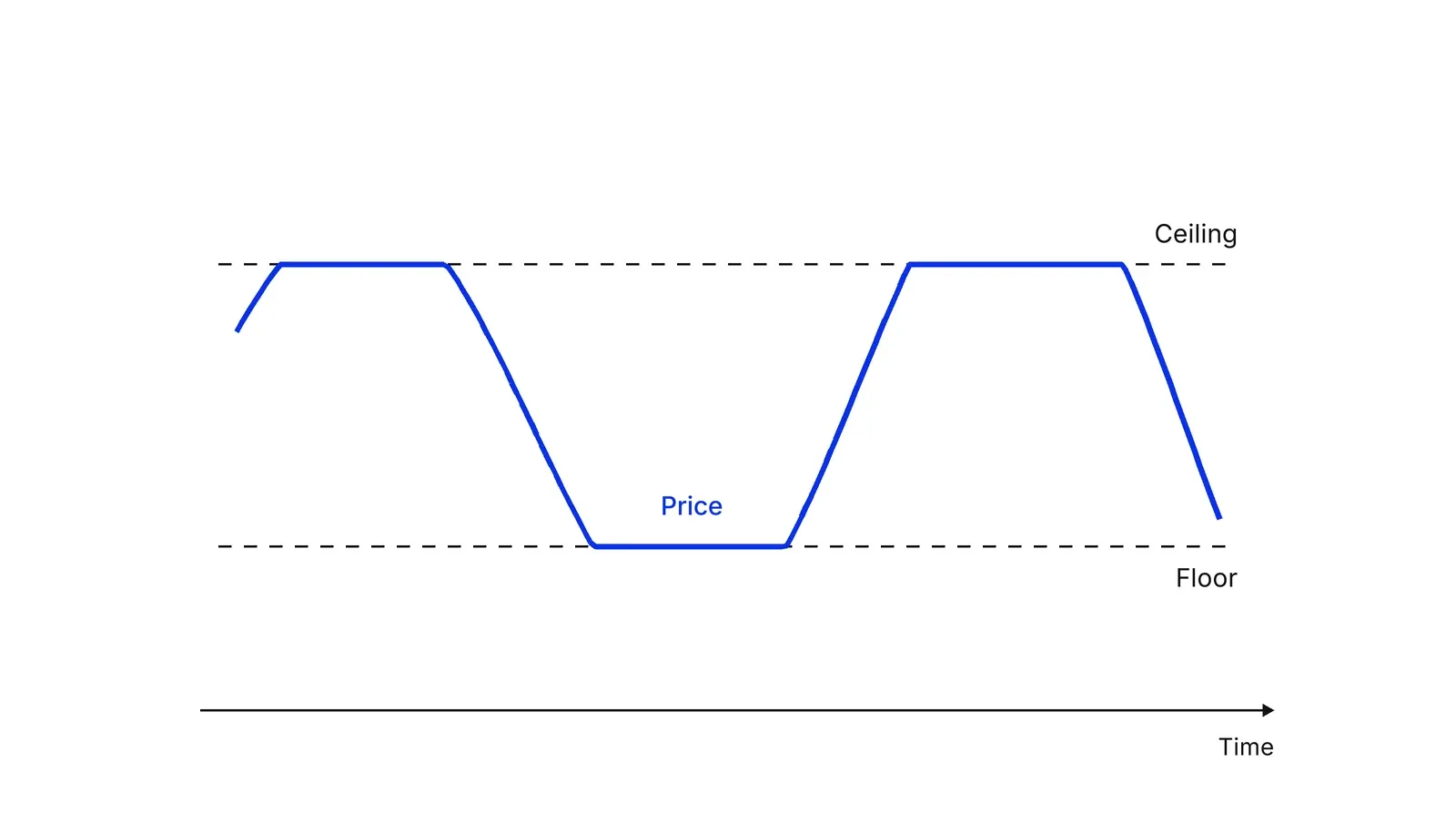
Test the rules on dates or markets before you roll them out, watch repeat purchases next to revenue, and keep a price-anchoring plan, since a visible reference price shapes how a change is read, see price anchoring. A Growth Lab plan starts from the corridor and the rule sheet above, see Growth Lab.
How to apply Dynamic pricing, step by step
- Check that the supply is fixed or perishable. List what cannot be stored or restocked in time: seats on a departure, clinic appointment slots, hotel nights, a delivery window. If extra units are cheap and instant, dynamic pricing has little to gain. Result: a list of offers where an unsold unit is lost and a sold-out date means lost demand.
- Estimate how demand reacts to price. Take past price changes and promotions, or run a small test, and estimate elasticity for each offer and period. Peak dates usually differ from quiet ones. Result: a rough demand response per offer, with a range, not a single number.
- Choose the signals that move the price. Pick a few non-personal signals: days until the date, share of stock left, forecast demand and a public rival price. Leave out data about the individual buyer. Result: a short list of signals, each with a source and an owner.
- Set a floor and a ceiling. The floor is above unit cost and above the price you can defend to current customers. The ceiling is what buyers would still see as fair, anchored in the value of the offer. Result: a price corridor written down before any algorithm runs.
- Write the move rules. Define the step size, how often prices can change and what a customer who bought earlier sees. Many small steps are easier to defend than a jump after a news event. Result: a rule sheet that says, for each state of demand and stock, what price shows.
- Disclose and test fairness. Show why prices differ in plain words on the page, such as a lower price for off-peak slots. Test the rules on dates or markets, and read complaints and repeat purchases next to revenue. Result: a test report that includes customer reaction, not only revenue.
- Review for personalisation and for collusion risk. Confirm that every customer who looks at the same offer at the same time sees the same price, or that you disclose personalisation. Confirm the algorithm learns from your own data and public prices, not rivals' nonpublic data. Result: a signed checklist and a quarterly review date.
Examples
American Airlines and yield management
Smith, Leimkuhler and Darrow described American Airlines' reservations system and gave the company's own estimate of its benefit, which is a company figure and not an independent audit. The system split the problem into overbooking, discount allocation and traffic management, then combined the answers into seat limits for each fare.
Uber surge pricing and the wild goose chase
Castillo, Knoepfle and Weyl argued that when ride prices stay too low in busy hours, idle drivers vanish and cars get sent to distant pickups, which cuts earnings and removes drivers from the road. Their remedy was surge pricing. Cohen and colleagues used Uber's surge algorithm to estimate demand and consumer surplus. Two of the authors had ties to Uber.
A dental clinic with empty Tuesday slots
Illustrative, no real clinic implied. A clinic has 30 cleaning slots on Tuesdays and 12 are usually empty, while Saturday slots sell out. It sets a floor of 70 against a unit cost of 40, shows Saturday at 110, and offers Tuesday at 85 with the reason stated on the page. A filled Tuesday slot adds 45 of contribution; an empty one adds nothing. The test measures whether Saturday bookings fall.
When to use it
Use it when capacity is fixed or perishable, demand swings by date or hour, you can measure how buyers react, and you can explain a price difference in a sentence. It fits airlines, hotels, ride-hailing, ticketing, delivery windows, clinics with unfilled slots and any product with a hard deadline.
When not to use it
Skip it when buyers see you as a trusted relationship partner and compare prices across visits, when supply is easy to add, when the price is negotiated in each deal, or when you cannot yet explain a change in plain words. Also avoid it where the need is urgent and the buyer has no alternative, since that is the case customers judge hardest. Start with fixed tiers instead.
Common mistakes
- Letting the algorithm raise prices at the moment of greatest need, such as after a storm, which Kahneman and colleagues found most respondents judged unfair.
- Treating personal data as a signal without checking whether the price is then personalised and must be disclosed.
- Skipping a floor and a ceiling, so a sudden demand spike or a rival's error sets a price you cannot defend.
- Reading only revenue in the test. Anderson and Simester found that customers who later saw a lower price bought less afterwards.
- Feeding rivals' nonpublic prices or sales into the model, or using a vendor that pools them.
FAQ
What is dynamic pricing?
Dynamic pricing means changing the price of the same offer over time, following rules or an algorithm, in response to demand, remaining stock, timing or market conditions. It differs from personalised pricing, where two customers see different prices for the same offer at the same time because of data about them.
What is the difference between dynamic and personalised pricing?
In dynamic pricing the price depends on variables not tied to the customer, such as time of day, supply or rivals' prices, so shoppers see the same price at the same moment. In personalised pricing it depends on the buyer's profile. The EU Commission's 2021 guidance draws this line and treats only personalisation as needing disclosure.
Is dynamic pricing legal?
Generally yes. EU law does not require disclosure for dynamic pricing that involves no personalisation based on automated decision-making, but it does require it where the price is personalised. New York now requires a notice on algorithmic personalised prices. Competition law and price gouging rules still apply.
Why do customers think dynamic pricing is unfair?
Kahneman, Knetsch and Thaler found that a store raising a snow shovel price from $15 to $20 after a blizzard was judged unfair by 82% of 107 respondents. Wirtz and Kimes later found that framing and fencing sway fairness judgments mainly when people are unfamiliar with the practice.
Can pricing algorithms collude?
Research says they can learn to. Calvano and colleagues found that Q-learning algorithms learned prices above competitive levels without communicating. Assad and colleagues found margins in German duopoly gasoline markets rose when both stations adopted pricing software. The US Department of Justice alleged that RealPage's software used landlords' nonpublic data.
Sources
- Barry C. Smith, John F. Leimkuhler, Ross M. Darrow, Yield Management at American Airlines, Interfaces 22(1), 1992
- Jeffrey I. McGill, Garrett J. van Ryzin, Revenue Management: Research Overview and Prospects, Transportation Science 33(2), 1999
- Kalyan T. Talluri, Garrett J. van Ryzin, The Theory and Practice of Revenue Management, Springer, 2004
- Guillermo Gallego, Garrett van Ryzin, Optimal Dynamic Pricing of Inventories with Stochastic Demand over Finite Horizons, Management Science 40(8), 1994
- Arnoud V. den Boer, Dynamic pricing and learning: Historical origins, current research, and new directions, Surveys in Operations Research and Management Science 20(1), 2015, University of Twente record
- Daniel Kahneman, Jack L. Knetsch, Richard H. Thaler, Fairness as a Constraint on Profit Seeking: Entitlements in the Market, American Economic Review 76(4), 1986
- Jochen Wirtz, Sheryl E. Kimes, The Moderating Role of Familiarity in Fairness Perceptions of Revenue Management Pricing, Journal of Service Research 9(3), 2007, Cornell eCommons record
- Eric T. Anderson, Duncan I. Simester, Price Stickiness and Customer Antagonism, Quarterly Journal of Economics 125(2), 2010
- Juan Camilo Castillo, Dan Knoepfle, E. Glen Weyl, Surge Pricing Solves the Wild Goose Chase, working paper, July 2017
- Peter Cohen, Robert Hahn, Jonathan Hall, Steven Levitt, Robert Metcalfe, Using Big Data to Estimate Consumer Surplus: The Case of Uber, NBER Working Paper 22627, 2016
- Jean-Pierre Dube, Sanjog Misra, Personalized Pricing and Consumer Welfare, Journal of Political Economy 131(1), 2023
- Le Chen, Alan Mislove, Christo Wilson, An Empirical Analysis of Algorithmic Pricing on Amazon Marketplace, WWW 2016, project page
- Directive (EU) 2019/2161 of 27 November 2019 (Omnibus Directive), recital 45 and Article 4
- Directive 2011/83/EU on consumer rights, consolidated text including Article 6(1)(ea)
- European Commission, Notice: Guidance on the interpretation and application of Directive 2011/83/EU, 2021, section 3.3.1 Personalised price
- Skadden, New York Algorithmic Pricing Law Enacted as Other Jurisdictions Weigh Controls on Price-Setting Technologies, January 2026
- UK Competition and Markets Authority, Ticketmaster: consumer protection case
- Emilio Calvano, Giacomo Calzolari, Vincenzo Denicolo, Sergio Pastorello, Artificial Intelligence, Algorithmic Pricing, and Collusion, American Economic Review 110(10), 2020
- Stephanie Assad, Robert Clark, Daniel Ershov, Lei Xu, Algorithmic Pricing and Competition: Empirical Evidence from the German Retail Gasoline Market, CESifo Working Paper 8521, 2020
- U.S. Department of Justice, Justice Department requires RealPage to end sharing of competitively sensitive information, 24 November 2025
Last updated Oct 9, 2026


Marketing agency or growth system: when a company outgrows its agency
An agency is the right call while the founder still runs most of the company. Once the business starts copying itself into new locations or markets, it needs a system that sets goals, tests hypotheses and owns the result.

Why healthcare marketing agencies stall: the short, mid and long wins model we use with clinics
Most agencies own the click and nobody owns the front desk. How we structure clinic work in three horizons, the research behind each one, and one year of results.

Why channel tests stall after month three
Most paid channel tests do not end with a decision. They end when the budget runs out, the attribution model changes, or everyone quietly stops looking at the dashboard.