Category entry points
Category entry points are the buying situations, needs and moments that make people think of a category, and the Ehrenberg-Bass method for finding them, choosing which to link the brand to and measuring progress.
Category entry points (CEPs) are the cues buyers use to pull brands from memory when a buying situation comes up: a motive, a mood, a time, a place, a companion. Jenni Romaniuk of the Ehrenberg-Bass Institute built them into a method: find the cues with the 7Ws, shortlist five to eight with the 3Cs, then link the brand to them in advertising.
- Origin
- Jenni Romaniuk, with Byron Sharp, Ehrenberg-Bass Institute, 2016 (How Brands Grow Part 2); 2023 (Better Brand Health)
- Level
- 401 · Expert
- Fits
- Scale-up, Enterprise
- Time to apply
- three to six weeks for the first elicitation and survey, then a review once a year or every two years
- What you need
- a sample of recent category buyers, including people who have never bought your brand · notes from sales and customer service on what was happening when buyers got in touch · a survey tool that can show a grid of situations against brands and allow several answers per row
Category entry points (CEPs) are the cues people use to pull brands from memory when a buying situation comes up. Romaniuk’s 2022 B2B report says they can be internal, such as a motive or an emotion, or external, such as a location or a time of day. Chocolate is the Institute’s stock example: people buy it to treat themselves, for the children, as a snack or to thank someone. Each of those is a separate entry point, and a brand linked to more of them gets more chances to come to mind.
Brand managers, insight teams and media planners use the method to decide which buying moments their advertising should attach the brand to, and to track whether it worked.
Where the idea came from
The method belongs to Jenni Romaniuk of the Ehrenberg-Bass Institute at the University of South Australia. Her Institute profile calls her the key architect of its approaches to entry point, distinctive asset and mental availability measurement.
The roots are older. In 2004 Romaniuk and Byron Sharp redefined brand salience in Marketing Theory as a brand’s “propensity to be noticed or come to mind in buying situations.” Sharp built this into the idea of mental availability in How Brands Grow (2010). The 2016 follow-up by Romaniuk and Sharp (some summaries date it 2015) has a chapter on building mental availability, according to a Strathclyde review, and Brand Genetics summarises its entry points as the why, when, where, with whom and with what of buying. The fullest treatment is Romaniuk’s Better Brand Health, which the Institute’s books page dates to 2023.
Dates in summaries differ. Some give 2018, the year of Romaniuk’s Building Distinctive Brand Assets, a book about the other half of mental availability: colours, logos and other cues that identify the brand. Others give 2022, the year of the B2B report.
Why buying situations decide which brands get considered
Most purchases start from memory, and memory works through cues. Psychologists Collins and Loftus described memory in 1975 as a network in which activation spreads from one concept to linked ones. A buying situation is the starting node. Brands linked to it get activated, and the rest stay silent.
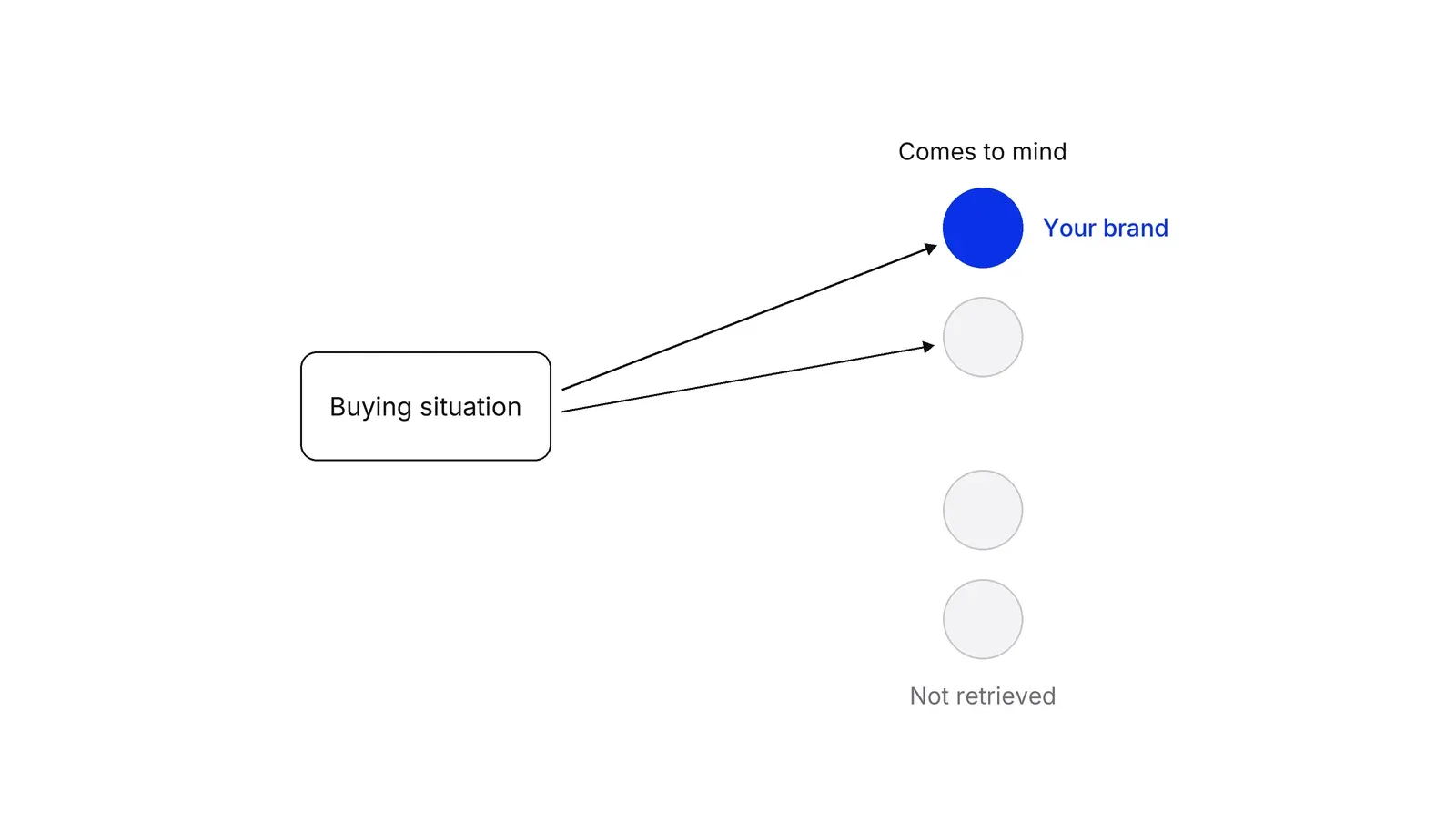
Consumer research shows what follows. Prakash Nedungadi found in two experiments that a brand gets chosen only if the buyer recalls it and fails to recall others they might have preferred, without any change in how they rate the brands. Hoyer and Brown found brand awareness was a dominant choice heuristic in a repeat-purchase product. Desai and Hoyer showed that the situation itself shapes the shortlist: across 32 usage situations, familiar occasions produced larger, less stable sets of recalled products.
Timing matters too. John Dawes of the Institute estimates that up to 95% of business buyers are out of the market at any moment, so advertising mostly builds links that pay off later, when the situation arises.
How do you find category entry points?
Romaniuk’s tool is the 7Ws, a set of prompts that her B2B report applies to business buying:
- When: time of day, season, urgency (“to get a quick resolution”).
- Where: office, remote, a customer’s site (“for international reach”).
- While: what else is happening (“during a digital transformation”).
- With what: products already in use (“to integrate with our reporting software”).
- Why: the motive (“to increase productivity”).
- How feeling: the emotion around the purchase (“to give confidence to someone feeling a bit anxious”).
- With or for whom: senior management, peers, junior staff, the buyer’s own customers.
Answers come from an elicitation survey of buyers or from a brainstorm with sales and marketing, as the LinkedIn B2B Institute guide describes. Romaniuk told Marketing Week that entry points “are not about the brand, they’re about the buyer.” On the Bigeye podcast she added that they reflect everyday reasons for buying, not rare ones.
What counts as an entry point, and what does not
An entry point is a situation that can bring brands to mind on its own. The VIA taskforce series written with Romaniuk gives the test: if a phrase cannot make a buyer think of brands, it is an attribute, not an entry point. “Trustworthy” fails. “For a barbecue at home” passes.
| Category entry point | Brand attribute | Unique selling proposition | |
|---|---|---|---|
| Describes | the buyer’s situation | a quality of the brand | what only this brand offers |
| Example | “paying a supplier abroad today” | “reliable” | “settles in one hour” |
| Job in memory | brings brands to mind | judges brands already in mind | gives a reason to pick this one |
| Shared with rivals? | almost always | often | by definition, no |
The same series names three more traps: treating the list as a complete inventory, assuming more entry points always mean more growth, and trying to claim one exclusively, since buyers rarely link a situation to just one brand.
How do you choose which entry points to pursue?
Romaniuk prioritises by elimination with three filters, the 3Cs: credibility, competitiveness and commonality. The output is a long-short list of five to eight entry points.
Credibility starts with expected values. Bigger brands have more users, and users link a brand to more things, a pattern Sharp and Romaniuk built into a 2000 method for reading image data. Each cell’s expected score is row total times column total divided by grand total. A gap of more than 5 points either way marks a mental advantage or disadvantage.
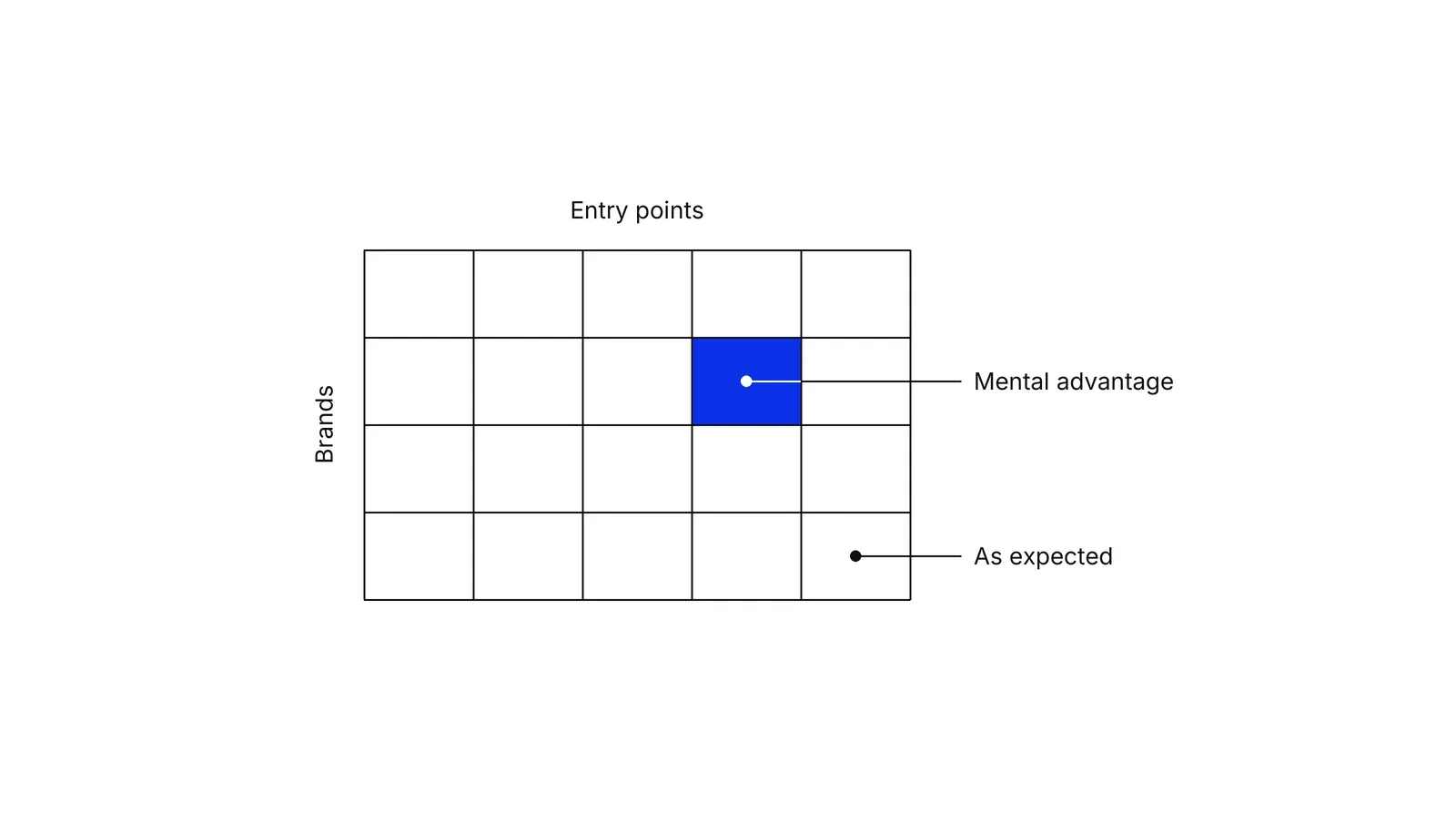
In the report’s US online advertising study, 93% of 99 brand and entry point pairs came out as expected. Competitiveness asks how many rivals already hold an advantage on an entry point. Commonality asks how often the situation occurs and, where order sizes differ, what it is worth. Marketing Week reports that this review can run once a year, or every two years when above-the-line spend is modest.
How progress is measured
Progress shows in the brand by entry point survey, repeated with the same list. The core metrics are mental market share, mental penetration and network size, covered on the mental and physical availability page. Romaniuk adds a fourth, share of mind, which on the Bigeye podcast she ties to erosion among a big brand’s users. Mental market share follows a predictable pattern across brands: Romaniuk modelled it with the NBD-Dirichlet in the Journal of Business Research and reported an excellent fit.
Expect slow movement. According to Dawes, well-established brands often reach 20% to 30% of category buyers on mental penetration, and market leaders about 50%.
Turning entry points into advertising
The B2B report’s rule is co-presentation: show the entry point and the brand together, in ads, on the website and in sales conversations. Each execution should carry one entry point, with a portfolio of executions covering the shortlist over time. The business banking study applies the same logic to financial services. For teams in Growth Lab work, the shortlist doubles as a creative brief: one situation, the brand’s name and assets, and a buyer who will remember both when that situation next comes up. The How Brands Grow page covers the penetration argument behind reaching all category buyers.
How to apply Category entry points, step by step
- Collect buying situations with the 7Ws. Ask recent category buyers, and separately your sales team, about the last time they bought: when, where, while doing what, with what, why, how they felt, and with or for whom. Keep their words. Result: a long list of 20 to 40 raw situations.
- Clean the list. Remove brand attributes such as 'trustworthy' or 'good value', which judge a brand but do not bring one to mind. Merge near-duplicates, and drop details that do not change which brands people think of. Result: 12 to 20 candidate entry points written from the buyer's side.
- Survey category buyers. Show each entry point and ask which brands, if any, buyers link to it, with free choice across your brand and the main rivals. Ask how often each situation happens to them. Result: a brand by entry point table of links, plus how common each situation is.
- Compare actual links with expected links. For each cell, expected = row total x column total / grand total. Mark cells more than 5 points above expected as mental advantages and more than 5 points below as disadvantages, the threshold Romaniuk uses. Result: a map of where each brand is stronger or weaker than its size predicts.
- Shortlist with the 3Cs. Keep entry points where the brand is credible, where few rivals already have an advantage, and which come up often or carry high order values. Result: a long-short list of five to eight entry points for messaging over the next few years.
- Brief advertising and re-measure. Give each piece of creative one entry point and show it together with the brand's name and distinctive assets. Build a set of executions that covers the shortlist over time. Result: a campaign plan, and the same survey repeated in one or two years.
Examples
LinkedIn in US online advertising
In her 2022 B2B report, Jenni Romaniuk surveyed 311 US decision makers on online advertising, asking them to link nine brands to 11 entry points. Of the 99 brand and entry point pairs, 93% scored as expected for the brand's size. Six were mental advantages, including LinkedIn on the entry point about getting approval from the board, at 9 points above expected. One brand was more than 6 points below expected on cutting through the advertising clutter. A small number of real advantages is the normal result, and it is where a brand can start.
A cross-border payments app for freelancers
Illustrative, no real company implied. A payments app surveys 500 freelancers. Its row of scores across ten entry points sums to 120, the column for 'getting paid by a client abroad' sums to 80, and the whole table sums to 800. Expected score: 120 x 80 / 800 = 12%. The app scores 19%, a 7-point mental advantage on a situation that happens every month. 'Paying taxes at year end' shows 3% against an expected 9%, a 6-point disadvantage. The team keeps the first in its ads and asks whether the product can credibly serve the second before spending on it.
A telemedicine clinic listing its Ws
Illustrative. A telemedicine clinic runs the 7Ws with 30 patients. When: at night, when the local clinic is closed. Where: away from home on a trip. While: looking after a sick child. With what: an insurance plan that covers remote visits. Why: to get a prescription renewed. How feeling: worried and in a hurry. For whom: an elderly parent. 'Fast doctors' is dropped from the list, because it is an attribute, not a situation. The survey then shows which of the seven situations already bring the clinic to mind.
When to use it
Use it when a brand in a market with many buyers wants to grow by being thought of in more situations, when a brand tracker reports awareness and liking but says nothing about when people think of the brand, or when creative briefs keep restating the brand's benefits without a buying moment attached. It works in B2B as well as consumer markets.
When not to use it
It adds little before launch, when the brand has too few buyers to show stable links, or in deals with a handful of named accounts, where account work matters more than broad memory. It does not replace positioning: the entry points say when the brand should come to mind, not what it should promise. Skip it if nobody will act on the shortlist.
Common mistakes
- Listing brand attributes as entry points. 'Trustworthy' judges a brand once it is in mind; it does not bring it there. The Ehrenberg-Bass test: could this phrase on its own make a buyer think of brands?
- Treating the list as a complete inventory of every moment. A list of 60 situations has no priorities, and more entry points do not automatically mean more growth.
- Trying to own an entry point. Buyers rarely link a situation to just one brand, so the aim is to be linked to it by more buyers than rivals, not to hold it alone.
- Reading raw scores. Big brands score higher on almost everything because they have more users; compare each score with its expected value first.
- Surveying only your own customers. Growth comes from people who do not yet link the brand to anything, so the sample must include non-buyers.
FAQ
What are category entry points?
Category entry points are the cues buyers use to retrieve brands from memory when they face a buying situation. They can be internal, such as a motive or a feeling, or external, such as a place or a time of day. Each entry point linked to a brand is one more route by which the brand can come to mind.
What are the 7Ws of category entry points?
The 7Ws are prompts for finding entry points: when, where, while doing what, with what, why, how feeling, and with or for whom. Romaniuk's 2022 B2B report uses them as survey questions or brainstorming prompts, asked from both the buyer's personal and business points of view, to collect the situations that start a purchase.
How many category entry points should a brand focus on?
Ehrenberg-Bass guidance ends the prioritisation with a long-short list of five to eight entry points, chosen for credibility, low competition and how often they occur. Each piece of advertising carries one of them, and the set of executions covers the list over time. The full survey list is usually longer, often 10 to 20 situations.
What is the difference between category entry points and positioning?
Positioning decides what a brand claims and for whom. Category entry points describe the situations in which buyers think of a category, and the method measures which brands they retrieve in each. A brand needs both: entry points tell it when to show up in memory, positioning tells it what to say when it does.
Can a brand own a category entry point?
Rarely. In Ehrenberg-Bass survey data buyers seldom link a situation to only one brand, and most brand and entry point scores sit close to what brand size predicts. A realistic goal is a mental advantage: being linked to the situation by noticeably more buyers than expected for a brand of that size.
Sources
- Jenni Romaniuk, Ehrenberg-Bass Institute, Category Entry Points in a business-to-business (B2B) world, B2B report, July 2022
- LinkedIn B2B Institute and Ehrenberg-Bass Institute, Category Entry Points in a B2B world
- LinkedIn B2B Institute and Ehrenberg-Bass Institute, Category Entry Points in business banking
- Youri Harmsen, Adformatie, Category Entry Points ontleed (with Jenni Romaniuk and the VIA Consumer Insights Taskforce), February 2025
- Ehrenberg-Bass Institute, Category Entry Points dissected: how they really contribute to growth
- Byron Sharp, Ehrenberg-Bass Institute, Category Entry Points: the last two strategic pitfalls unraveled
- Ehrenberg-Bass Institute, Identifying and prioritising Category Entry Points, research service description
- Ehrenberg-Bass Institute (from Marketing Facts), How do you measure How Brands Grow?
- Ehrenberg-Bass Institute, Professor Jenni Romaniuk, staff profile
- Ehrenberg-Bass Institute, Books by the Institute's researchers
- John Dawes, Ehrenberg-Bass Institute, Advertising effectiveness and the 95-5 rule, B2B report, May 2021
- Charlotte Rogers, Marketing Week, Ehrenberg-Bass: link brand messages to buying situations, June 2022
- Bigeye, Better Brand Health with Jenni Romaniuk, part 2 (podcast), May 2023
- John Fanning, Marketing.ie, Romaniuk's new book merits attention (review of Better Brand Health), August 2023
- Alan Wilson, review of How Brands Grow Part 2 by Jenni Romaniuk and Byron Sharp, University of Strathclyde, 2016
- Brand Genetics, How Brands Grow Part 2 (2016): speed summary
- Byron Sharp, How Brands Grow: What Marketers Don't Know, Oxford University Press, 2010 (library record)
- Jenni Romaniuk and Byron Sharp, Conceptualizing and measuring brand salience, Marketing Theory 4(4), 2004
- Jenni Romaniuk, Modeling mental market share, Journal of Business Research 66(2), 2013
- Byron Sharp and Jenni Romaniuk, Using known patterns in image data to determine brand positioning, International Journal of Market Research, 2000 (WARC)
- Prakash Nedungadi, Recall and consumer consideration sets, Journal of Consumer Research 17(3), 1990
- Wayne D. Hoyer and Steven P. Brown, Effects of brand awareness on choice for a common, repeat-purchase product, Journal of Consumer Research 17(2), 1990
- Kalpesh Kaushik Desai and Wayne D. Hoyer, Descriptive characteristics of memory-based consideration sets, Journal of Consumer Research 27(3), 2000
- Allan M. Collins and Elizabeth F. Loftus, A spreading-activation theory of semantic processing, Psychological Review 82(6), 1975
Last updated Oct 9, 2026


Marketing agency or growth system: when a company outgrows its agency
An agency is the right call while the founder still runs most of the company. Once the business starts copying itself into new locations or markets, it needs a system that sets goals, tests hypotheses and owns the result.

Why healthcare marketing agencies stall: the short, mid and long wins model we use with clinics
Most agencies own the click and nobody owns the front desk. How we structure clinic work in three horizons, the research behind each one, and one year of results.

Why channel tests stall after month three
Most paid channel tests do not end with a decision. They end when the budget runs out, the attribution model changes, or everyone quietly stops looking at the dashboard.