Pricing waterfall
The pricing waterfall charts every deduction between list price and the cash a seller keeps, so you can see which discounts, rebates and costs of terms leak the most.
A pricing waterfall is a chart that starts at list price and subtracts every discount, rebate, allowance and cost of terms until it reaches the pocket price, the money the seller actually keeps. Michael Marn and Robert Rosiello of McKinsey described it in Harvard Business Review in 1992. It shows where price leaks between the price list and the bank account.
- Origin
- Michael V. Marn and Robert L. Rosiello (McKinsey & Company), 1992
- Level
- 401 · Expert
- Fits
- Scale-up, Enterprise
- Time to apply
- a few days to pull the data for one product, longer if off-invoice items sit in several systems
- What you need
- twelve months of transaction-level sales for one product line, with list price, invoice price and customer · the contract terms of every discount, rebate, allowance and bonus program you run · finance access to the ledgers where off-invoice items are booked, such as marketing, freight and interest · one owner who can speak for sales, marketing and finance
A pricing waterfall is a chart that starts at the list price and subtracts, one bar at a time, every discount, rebate, allowance and cost of terms a seller gives up before the money arrives. The last bar is the pocket price. Michael Marn and Robert Rosiello of McKinsey introduced the pocket price waterfall in Harvard Business Review in 1992. Marn, Eric Roegner and Craig Zawada revisited it in a 2003 McKinsey Quarterly article, which says the tool still helps companies find transaction-pricing opportunities.
It sits at the third of three levels of price management that the 1992 article names: industry supply and demand, product-market strategy, and individual transactions. Value-based pricing and competitive pricing work at the second level. The waterfall works at the third, order by order.
Why does it matter?
Because a small gain in realized price moves profit far more than the same gain in volume. In the 1992 article, a company with average economics (taken from 2,463 Compustat companies) gained 11.1 percent in operating profit from a 1 percent price rise with no lost volume, against 3.3 percent from 1 percent more volume. The 2003 update used a typical S&P 1500 company and got 8 percent for the same price move. Hinterhuber’s 2004 paper cites a 22 percent profit gain from a 5 percent price rise. The samples differ, the direction does not. The effect also runs backward: a 1 percent price cut costs the same share of profit.
What does a pocket price waterfall look like?
It shows three prices in a row. List price is what the catalogue says. Invoice price is list price minus the discounts printed on the invoice. Pocket price is invoice price minus everything else the deal gives away. The 1992 authors argue that pocket price, not invoice price, is the right measure of how attractive a transaction is.
Their own example is a linoleum flooring maker selling to a retailer. From a $6.00 dealer list price per square yard, an order-size discount of 10 cents and a competitive discount of 12 cents give an invoice price of $5.78. Five items that never appear on the invoice follow: a 2 percent payment terms discount, an annual volume bonus, off-invoice promotions, co-op advertising allowances and freight. They bring the pocket price to $4.47.
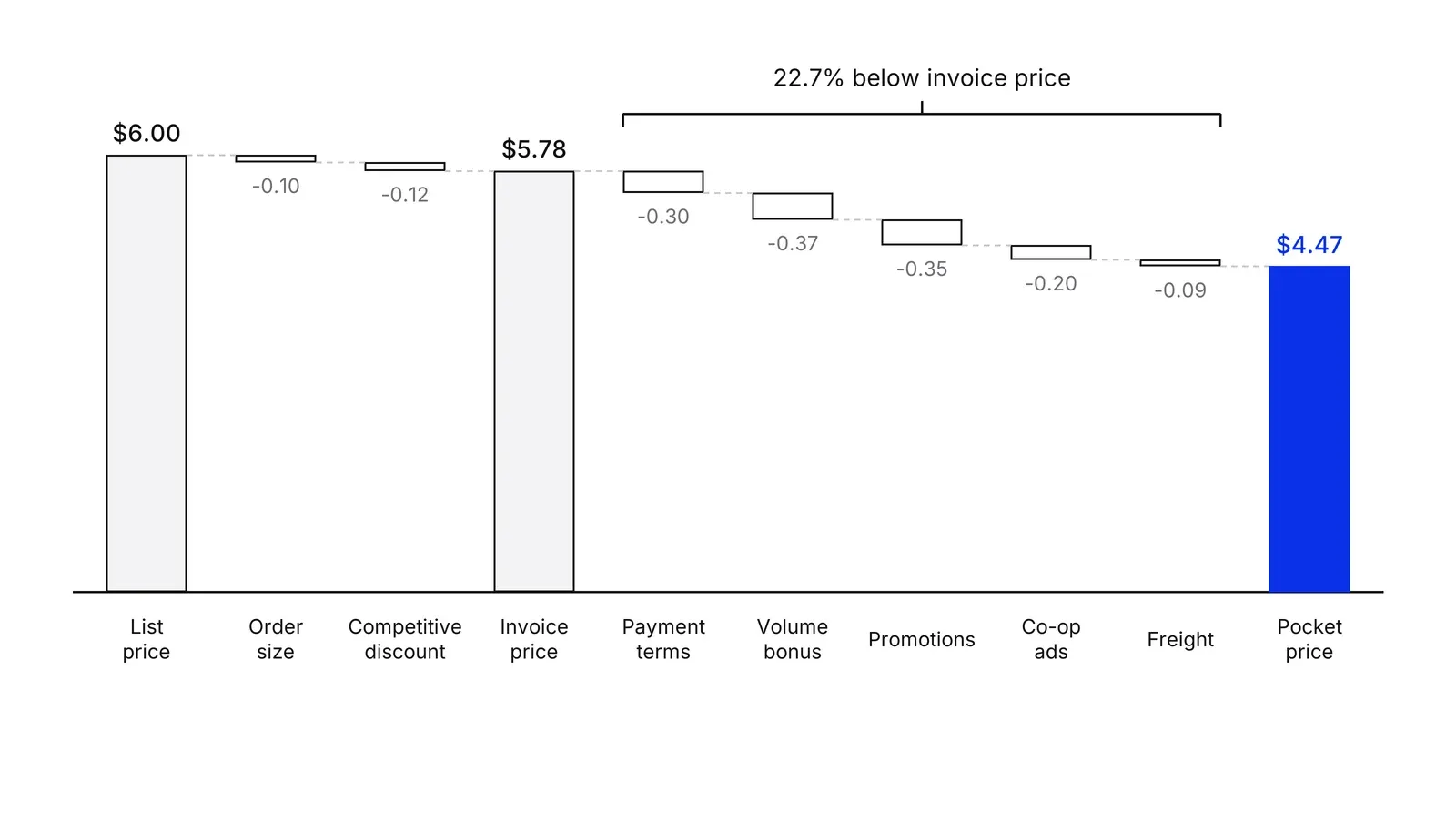
The authors say none of these items hurt much alone, and together they made a 22.7 percent gap. They also say such a gap is common, and list averages from the work they had seen:
| Company type | Average drop from invoice to pocket price |
|---|---|
| Consumer packaged goods | 16.7% |
| Commodity chemicals | 17.7% |
| Computers | 18.6% |
| Footwear | 20.3% |
| Automobiles | 21.9% |
| Lighting products | 28.9% |
These are disguised examples from one firm’s consulting work, so use them as a sense of scale, not a benchmark.
Why do managers miss the leaks?
Because most of them are not on the invoice or in the sales system. Marn and Rosiello note that payment terms discounts get buried in interest expense, co-op advertising is included in company-wide advertising lines, and freight is lumped in with other transport. Management reports tend to show average prices, not transaction prices.
Modern billing tools can hide leaks in a similar way. Stripe’s documentation says a coupon set to apply once is removed from the subscription’s discount list after the invoice is finalized, so a subscription can look undiscounted even though a discount was applied. Revenue accounting handles variable amounts in aggregate: IFRS 15 requires a company to estimate the variable part of the consideration it expects to receive. That gives a total for the period, which is a different thing from a view per customer.
Each leak item also has its own logic, and some have their own research. Petersen and Rajan found some evidence that trade credit is used to price discriminate. Dolan’s 1987 review opens by saying our understanding of the role and design of quantity discounts is limited. The FTC’s 2003 study of slotting allowances found that in some grocery categories they exceeded first-year new product revenue, and in others were under 5 percent of it.
What is the pocket price band?
The pocket price band is the range of pocket prices at which one product sells in a given period, shown as a share of volume at each price. The 1992 article says no item sells at one pocket price to all customers, and that the flooring maker’s single product had a 35 percent gap between its highest and lowest transactions. Bands the authors had examined ranged up to 60 percent for a lighting fixtures maker, 200 percent for a specialty chemicals company and 500 percent for a fastener supplier. The article’s footnotes show the band idea has older roots in earlier Harvard Business Review pieces by Walker (1967) and Ross (1984).
The Castle Battery case shows what a band can reveal. Castle’s policy was to reward big accounts with lower prices, and its battery sold at pocket prices from about $14 to $25 around a $20 average. When managers plotted pocket price against account size for 50 accounts, they found no correlation. Some small accounts bought very cheaply, because long-standing customers knew whom to call for an extra discount, more co-op money or 30 more days to pay.
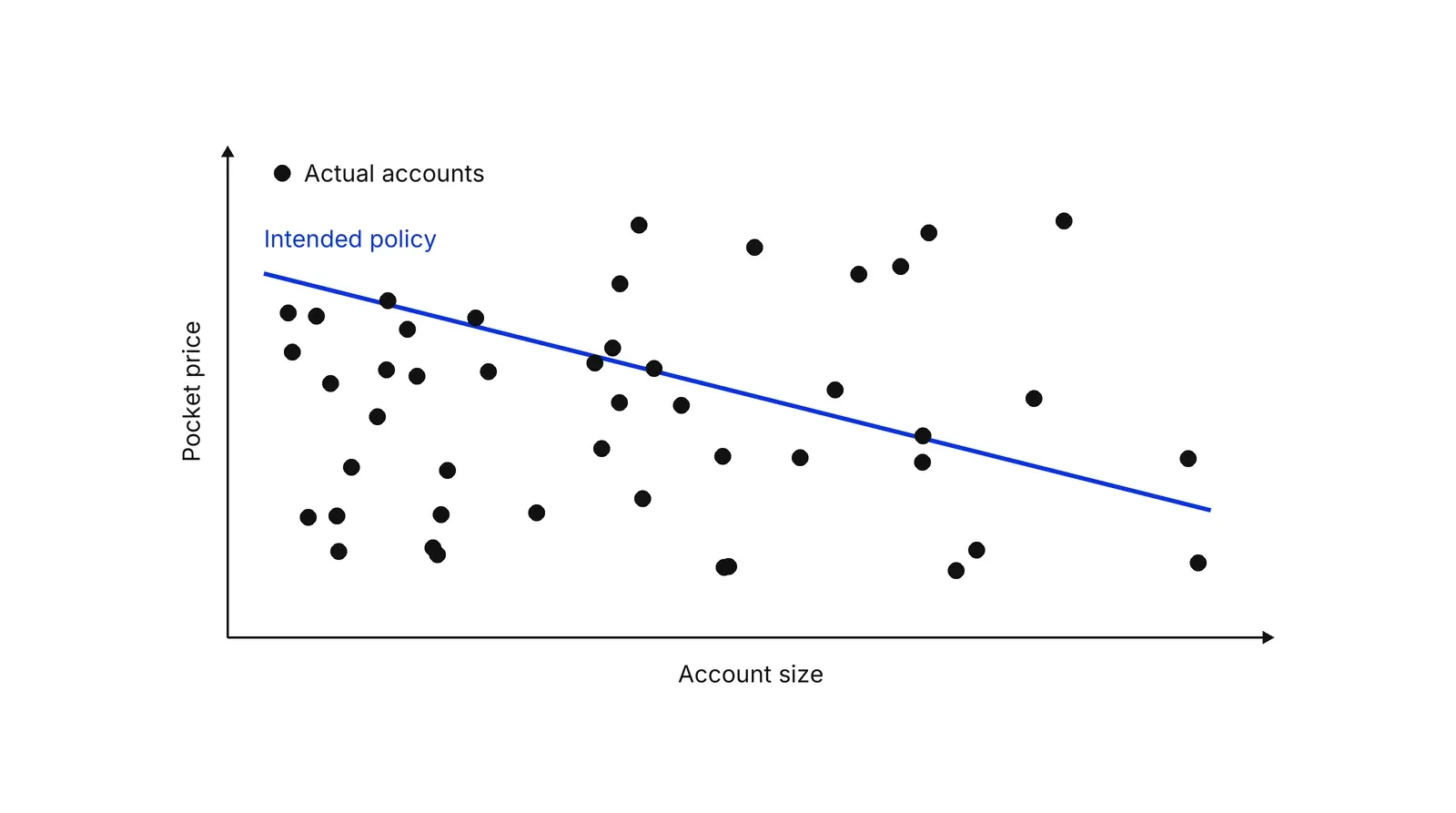
A wide band is not automatically bad. The 2003 article says it shows that customers and competitive situations differ, and that a wide band gives room to lift the average by a point or more through small changes in its shape. The 1992 authors recommend direct action on the best and worst 10 to 20 percent of transactions.
What is waterfall engineering?
Waterfall engineering is adjusting the elements of the waterfall to match what buyers respond to. Tech-Craft found its retailers judged price on invoice price minus cash discount. Moving the annual volume bonus onto the invoice lifted same-store volume by 11 percent. It also found retailers reacted more to a dollar of national promotion discount than to a dollar of order-size discount, though both cost the same. The authors’ rule: when you want to lower price to win volume, move the elements buyers notice most, and when you want to raise it, move the ones they notice least.
This is where price elasticity meets the waterfall. Elasticity is usually measured on one price. The waterfall asks which price in the stack the buyer reacts to. Design choices have theory behind them too: Bergen and John’s models of co-op advertising say participation rates should be higher when media are less targetable or brands more differentiated.
What is pocket margin?
Pocket margin is pocket price minus direct product cost and the cost of serving one account. The 2003 article recommends it when companies sell customized products or bundle services, because cost to serve then differs by order. A glass manufacturer found it needed a pocket margin of at least 12 percent to break even, and that more than a quarter of its sales fell below that line. It reported a 4 percent gain in average pocket margin and a 60 percent rise in operating profit within a year. For the cost side, see contribution margin.
In payments, part of the waterfall is set by law. Regulation (EU) 2015/751 caps interchange at 0.2 percent of the transaction for consumer debit cards and 0.3 percent for consumer credit cards, so for a card business that cost layer has a legal ceiling in the EU, while the discounts and credits above it stay a choice.
Who should own it?
Someone with authority across sales, marketing and finance. In a 2012 survey study of 338 B2B suppliers, Homburg and Hahn found that spreading strategic pricing authority across the three functions raised profitability and sales growth, and that medium levels of delegation to salespeople were best. Sources disagree on the rest: Frenzen and colleagues found delegation helps most when markets are uncertain, while Mishra and Prasad show in theory that centralized pricing can match it. Either way, Marn and Rosiello say pocket price realization should sit in the pay of salespeople and product managers. A Growth Lab plan starts from the pocket price of the offer, not its list price.
How to apply Pricing waterfall, step by step
- Pick one product and one customer type. Start narrow. A single product line sold to one channel gives a waterfall you can check by hand. Result: a scope of one product, one channel and twelve months of transactions.
- List every deduction from list price to cash. Walk the order from price list to payment and write down each item that lowers what you keep, on or off the invoice: standard and special discounts, volume bonuses, promotions, payment terms, co-op money, freight, rebates. McKinsey's 2003 article lists more than a dozen. Result: a complete list of leak items with their contract terms.
- Trace each item to a customer or an order. Many items are booked company-wide, so the data will not arrive in one table. Ask finance where each one lives and how it can be assigned to an account. Result: a transaction table with a column for every item, with gaps marked, not dropped.
- Draw the average waterfall. Average each item as a share of list or invoice price and chart the steps from list price to pocket price. Result: one waterfall chart and one number, the gap between invoice and pocket price.
- Plot the pocket price band and read the tails. Chart pocket price for every transaction against account size and look at the best and worst 10 to 20 percent. Check who sits at the low end and whether the reason is written down. Result: a list of accounts that need a price action and a list that deserve more volume.
- Set a rule and an owner for each element. Give every discretionary item a goal, a cap and an approver, and review the waterfall every quarter. Pay sales and product managers on pocket price, not revenue. Result: written decision rules and a recurring waterfall report.
Examples
Castle Battery, a disguised case from the 1992 article
Castle sold a battery with a base price of $28.40 and an invoice price of $21.16. Off-invoice items took another $2.98, leaving a pocket price of $18.18 and a pocket discount of $10.22, or 36 percent of base. Unit prices ran from about $14 to $25. Management gave the sales force nine months to fix or drop the low-priced accounts, capped exception discounts at 5 percent and tied pay to pocket price. Per the authors, average pocket price rose 3 percent in year one and operating profit rose 42 percent on flat volume.
Tech-Craft moves a bonus onto the invoice
Tech-Craft, a disguised microwave-oven maker, found that retailers compared brands on invoice price minus cash discount and ignored most off-invoice items. It moved its largest off-invoice discount, an annual volume bonus, onto the invoice for one product line, paying on estimated purchases and adjusting at year end. Same-store volume rose 11 percent without deeper discounting. Over the year, the authors report an 11 percent volume gain, a 3.5 percent pocket price gain and a 60 percent operating profit improvement.
A fintech platform contract, illustrative
Illustrative arithmetic, no real company implied. A payments platform lists an annual merchant contract at a list price of USD 120k. Sales agrees a 10 percent discount, so the invoice says 108,000. Then onboarding is waived (6,000), implementation hours are given free (9,000), a service credit is paid (2,000) and a partner earns a 5 percent referral fee (5,400). The pocket price is 85,600, or 71.3 percent of list and 20.7 percent below invoice. The deal looks like a 10 percent discount in the CRM and a 28.7 percent one in the waterfall.
When to use it
Use it when sales run through many discount programs, distributors or negotiated deals, when invoice price is the only price anyone reports, or when two accounts of similar size pay very different amounts. It pays off most where margins are thin and volume is high, because small leaks repeat on every order.
When not to use it
Skip a full waterfall when you sell one product at one public price with no deals, rebates or channel partners. There the list price is the pocket price and the work belongs in value-based pricing or price testing instead. Also skip it as a one-off slide: without a recurring owner it shows leaks and fixes none.
Common mistakes
- Stopping at invoice price. The 1992 authors found that off-invoice items, which accounting often buries in interest, advertising and transport lines, are where many leaks sit.
- Leaving out hard-to-collect items. The authors warn against omitting waterfall elements because they are inconvenient to calculate, since incomplete numbers excuse inaction.
- Treating a wide pocket price band as proof of waste. McKinsey's 2003 article says a wide band shows that customers and situations differ, and that it gives room to move the average.
- Assuming the discount follows account size. In Castle's case, a sample of 50 accounts showed no correlation, and long-standing customers knew whom to call.
- Paying sales on revenue. Marn and Rosiello note that a 5 percent price cut costs a salesperson 5 percent of pay and, for an average company, about 60 percent of operating profit on that transaction.
FAQ
What is the difference between invoice price and pocket price?
Invoice price is list price minus the discounts printed on the invoice. Pocket price is what remains after off-invoice items too, such as payment terms discounts, volume bonuses, co-op advertising and freight. Marn and Rosiello argue pocket price is the right measure of how attractive a transaction is.
How big is the gap between invoice and pocket price?
In the 1992 article the average decline from invoice to pocket price was 16.7 percent for a consumer packaged goods company and 28.9 percent for a lighting supplier, with 22.7 percent in the flooring example. Those are examples from one consultancy's clients, so measure your own business before using any of them.
What is a pocket price band?
It is the range of pocket prices at which one product sells in a given period, shown as a share of volume at each price. Marn and Rosiello reported bands of 35 percent for flooring and up to 500 percent for a fastener supplier. The tails show which customers need action.
What is pocket margin?
Pocket margin is pocket price minus direct product cost and the cost of serving that account. McKinsey's 2003 article recommends it for companies selling customized products or bundled services, where cost to serve differs by order. A glass maker used it to find that over a quarter of its sales fell below break-even.
How do you build a pricing waterfall in a spreadsheet?
List every deduction from list price, pull each as a column per transaction, then chart the average of each column as a step from list price to pocket price. The hard part is data, because items such as co-op money and freight are often booked outside the sales system.
Sources
- Michael V. Marn and Robert L. Rosiello, Managing Price, Gaining Profit, Harvard Business Review, September-October 1992 (publisher record)
- Michael V. Marn and Robert L. Rosiello, Managing Price, Gaining Profit, Harvard Business Review, September-October 1992
- Michael V. Marn, Eric V. Roegner and Craig C. Zawada, The power of pricing, McKinsey Quarterly 2003 Number 1
- Walter L. Baker, Michael V. Marn and Craig C. Zawada, The Price Advantage, 2nd edition, Wiley, 2010 (publisher page)
- Walter Baker, Mike Marn and Craig Zawada, Price Smarter on the Net, Harvard Business Review, February 2001
- Andreas Hinterhuber, Towards value-based pricing: an integrative framework for decision making, Industrial Marketing Management 33(8), 2004
- Christian Homburg, Ove Jensen and Alexander Hahn, How to Organize Pricing? Vertical Delegation and Horizontal Dispersion of Pricing Authority, Journal of Marketing 76(5), 2012 (record)
- Christian Homburg and Alexander Hahn, The Performance Impact of the Organization of Pricing in B2B Firms, IMU Research Insights 008, University of Mannheim, 2012
- Heiko Frenzen and others, Delegation of Pricing Authority to the Sales Force, International Journal of Research in Marketing 27(1), 2010 (Aston University record)
- Birendra K. Mishra and Ashutosh Prasad, Delegating Pricing Decisions in Competitive Markets with Symmetric and Asymmetric Information, Marketing Science 24(3), 2005
- Pradeep Bhardwaj, Delegating Pricing Decisions, Marketing Science 20(2), 2001
- Robert J. Dolan, Quantity Discounts: Managerial Issues and Research Opportunities, Marketing Science 6(1), 1987
- Mark Bergen and George John, Understanding Cooperative Advertising Participation Rates in Conventional Channels, Journal of Marketing Research 34(3), 1997
- Mitchell A. Petersen and Raghuram G. Rajan, Trade Credit: Theories and Evidence, NBER Working Paper 5602, 1996 (Review of Financial Studies 10(3), 1997)
- US Federal Trade Commission, Slotting Allowances in the Retail Grocery Industry: Selected Case Studies in Five Product Categories, 2003
- EUR-Lex, Fees for card-based payments (summary of Regulation (EU) 2015/751)
- Regulation (EU) 2015/751 on interchange fees for card-based payment transactions, Chapter II, as adopted (UK legislation.gov.uk copy)
- IFRS Foundation, IFRS 15 Revenue from Contracts with Customers
- Mario Kienzler and Christian Kowalkowski, Pricing strategy: A review of 22 years of marketing research, Journal of Business Research 78, 2017
- Stripe documentation, Coupons and promotion codes for subscriptions
Last updated Oct 9, 2026


Marketing agency or growth system: when a company outgrows its agency
An agency is the right call while the founder still runs most of the company. Once the business starts copying itself into new locations or markets, it needs a system that sets goals, tests hypotheses and owns the result.

Why healthcare marketing agencies stall: the short, mid and long wins model we use with clinics
Most agencies own the click and nobody owns the front desk. How we structure clinic work in three horizons, the research behind each one, and one year of results.

Why channel tests stall after month three
Most paid channel tests do not end with a decision. They end when the budget runs out, the attribution model changes, or everyone quietly stops looking at the dashboard.