Sales enablement
Sales enablement is the work of giving sellers what they need to sell well and keep selling that way: onboarding, training, coaching, content and tools, tied to a revenue goal.
Sales enablement is the practice of giving a sales team what it needs to sell well and keep doing so: onboarding, training, coaching, content and tools, all tied to a revenue goal. CSO Insights calls it a strategic, collaborative discipline designed to increase predictable sales results. Its aim is to make good selling repeatable across the whole team, not just for a few top reps.
- Origin
- Practitioner-led; no single inventor. The job title appeared in technology companies in the mid-2000s, mid-2000s
- Level
- 201 · Tool
- Fits
- Small and mid-size, Scale-up
- Time to apply
- 4 to 6 weeks for a first working kit, then a monthly review
- What you need
- one revenue problem to fix, with a current number (ramp time, win rate, discounting) · a written ideal customer profile and a short messaging document · a sales manager who will listen to real calls · someone from marketing who owns the content
Sales enablement is the work of giving sellers what they need to sell well and keep selling that way: onboarding, training, coaching, content and tools, tied to a revenue goal. The research firm CSO Insights describes it as “a strategic, collaborative discipline designed to increase predictable sales results”, in its 2017 redefinition reported by Training Industry. Salesforce uses a plainer line: it is how you give sellers what they need to do their job.
The size of the company changes the formality, not the job. A four-person team does it with a one-page pitch and a manager who listens to calls. A larger team gives it an owner, a charter and a budget.
Where the term came from, and why nobody agrees on it
Sales enablement grew out of practice, not out of one author’s framework. A 2017 Selling Power article says the job title appeared in technology companies in the mid-2000s, and that IDC, Forrester and SiriusDecisions began covering it around 2008. The Sales Enablement Society began in February 2016 with 16 members and reported more than 2,500 members in 13 countries by 2018, according to Training Industry.
Academic work came late. In 2021 Peterson, Malshe, Friend and Dover wrote in the Journal of the Academy of Marketing Science that empirical research on the subject did not exist, and they interviewed 41 enablement professionals to build a definition and a model of how firms develop enablement as a lasting capability. The same Selling Power article says the role looks different at every company. So when someone says “we need enablement”, ask which part they mean.
The five parts of enablement
Most definitions list the same parts. Salesforce names onboarding, training and coaching, content, and analytics with technology. Jeff Seeley in Training Industry lists content, training, coaching, technology and a strategy that aligns sales and marketing.
| Part | What it covers | The question it answers |
|---|---|---|
| Onboarding | Getting a new rep productive | How soon can a new rep run a real call alone? |
| Training | Skills, product knowledge, the message | Do reps know what to say, and how? |
| Coaching | Manager feedback on real calls and deals | Does it show up on live deals? |
| Content | One-pagers, case studies, battlecards, matched to a deal stage | What do I send in this situation? |
| Tools and analytics | CRM, content library, call review, usage data | Can reps find it, and can we see what works? |
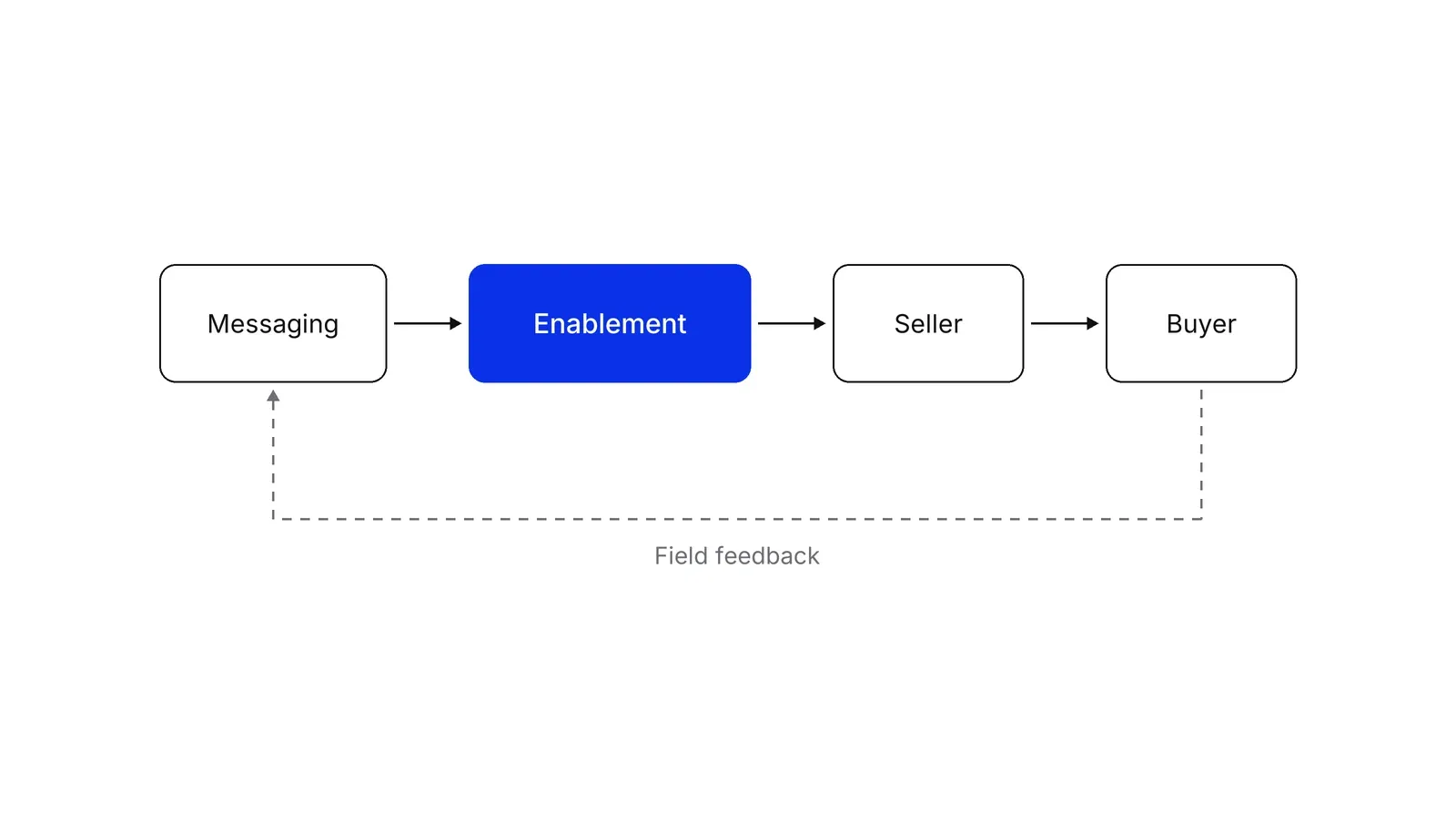
The strategy above these five is made elsewhere. Who to sell to comes from the ideal customer profile and the buyer persona. What to say comes from the positioning statement and the messaging hierarchy. Enablement carries those decisions to the seller and carries what the field learns back. If the upstream documents are vague, enablement polishes the confusion: reps get slick decks that tell different stories.
Does it work? What the numbers show and do not show
The evidence is thinner than vendor marketing suggests. The most quoted data come from the fourth annual CSO Insights enablement study, 500 participants, as summarised in a 2018 report hosted by the vendor Seismic. We could not read the original report. In that summary 61% of organizations had a dedicated enablement person, program or function. Of those, 57% reached their annual quota and won 52.1% of deals. Only 34.4% of organizations with dedicated enablement said it met or exceeded internal expectations.
Read that last figure first. Having a function is not the same as having results, and the summary shows no comparison with teams that have no enablement, so it cannot say the function caused the outcome.
Sellers’ own reports point to what enablement could fix. Salesforce’s fifth State of Sales survey, a vendor study of 7,775 sales professionals in 38 countries fielded in August and September 2022, found reps spend 28% of the week selling. Only 26% got one-to-one coaching at least weekly, and teams use about 10 tools on average, with 66% of reps feeling overwhelmed by the number, the same Salesforce report says.
Research on sales training itself is mixed. Singh, Manrai and Manrai reviewed 56 articles from 1985 to 2014 and found most studies reported positive effects on performance, but no clear cost-benefit link and few strong designs. One study they cite, of 150 US retail organizations, found significant neglect of training evaluation, with little use of all four Kirkpatrick levels. The lesson for a small team is to measure behaviour and results, not attendance.
Why one training session fades
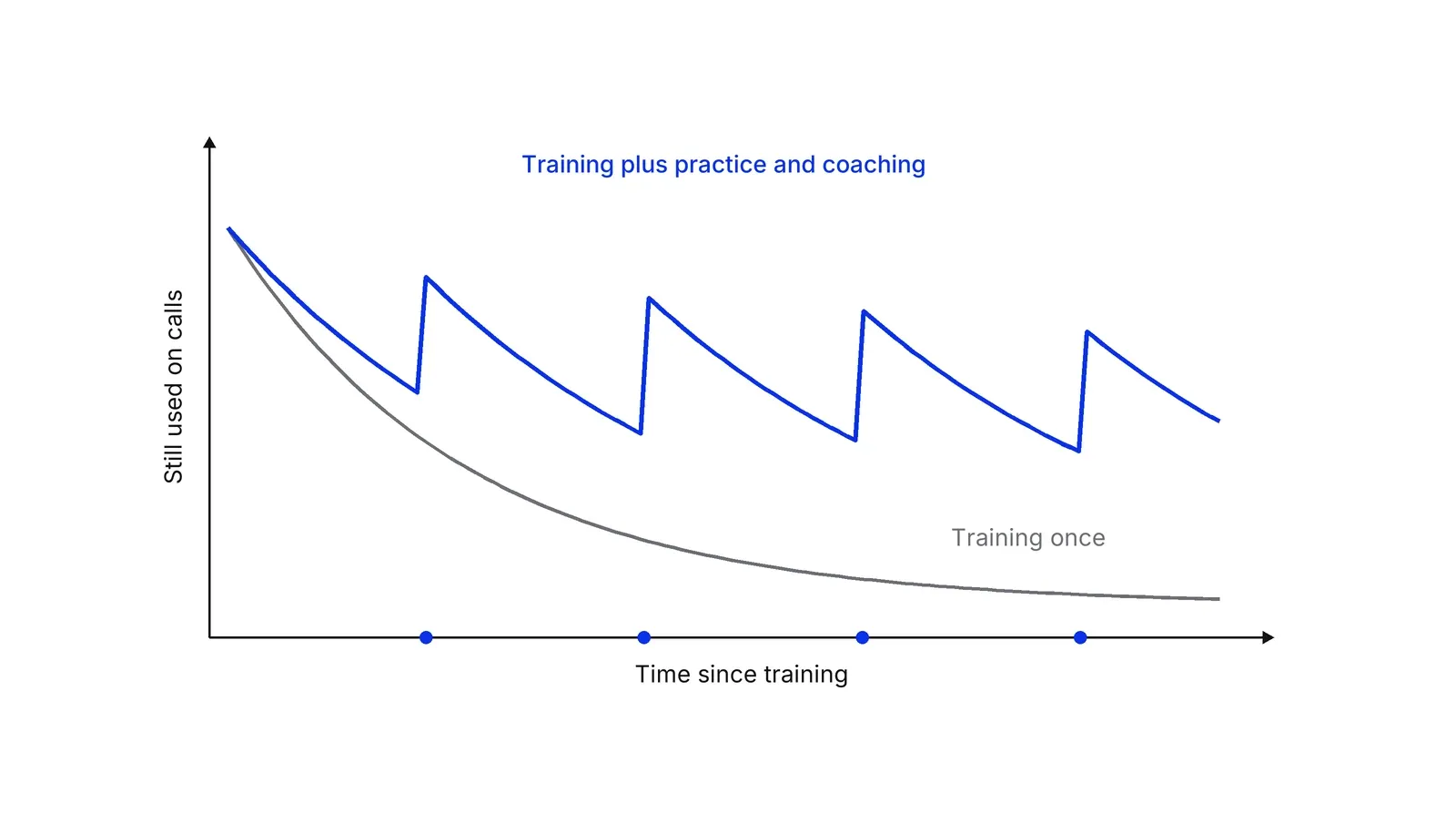
A training session loses most of its effect unless it is followed by practice. Murre and Dros replicated Ebbinghaus’s forgetting curve in 2015 with a single participant and found the same shape: steep loss early, a slower tail later. A workplace study by Kauffeld and Lehmann-Willenbrock followed 64 bank employees. Spaced practice gave better transfer quality, higher self-rated sales competence and better key figures than massed practice, though not more transfer quantity.
Roediger and Karpicke added a second clue in 2006. Students who took recall tests on a passage remembered more a week later than students who re-read it, even though re-reading made them feel surer. For sales teams the practical reading is that role-plays and manager questions on real scenarios do more than another slide deck.
Sales and marketing have to build it together
Kotler, Rackham and Krishnaswamy wrote in the Harvard Business Review in 2006 that each of the two groups often undervalues the other’s contribution. Sabnis and colleagues put a number on one symptom. Their paper cites earlier estimates that reps never contact roughly 70% of the leads marketing generates, and it studies 461 reps at four firms. Follow-up depended on how well leads were prequalified, how closely managers tracked follow-up, lead volume and rep experience. Shared qualification rules such as BANT are one way to make that agreement visible.
Le Meunier-FitzHugh and Piercy studied three large UK organizations in 2007 and found that closer sales and marketing collaboration went with better business performance, with senior management playing a pivotal role. It is a small qualitative study, so treat it as a pointer.
What buyers changed
Buyers now bring a group and a lot of information. Toman, Adamson and Gomez argued in the Harvard Business Review in 2017 that buyers are often more paralysed than empowered by it, so the seller’s job is to make buying easy. Adamson, Dixon and Toman had argued in 2012 that diagnosing needs is worth less now that customers define their own solutions. Forrester’s 2026 State of Business Buying says the typical decision includes 13 internal stakeholders and nine external influencers, though its press release does not give the sample.
The enablement kit follows. Less of it explains the product, and more of it helps a champion bring a group to agreement: comparison sheets, business-case templates and answers for finance and legal.
How to run it with a small team
Write a short charter. The Sales Enablement Collective describes one as a vision, a mission and a few priorities, each with an objective, key metrics, risks and the support needed. Then measure with the four Kirkpatrick levels: reaction, learning, behaviour and results. A Growth Lab plan starts from the one revenue problem enablement should fix and builds the smallest kit around it.
How to apply Sales enablement, step by step
- Pick the revenue problem. Choose one problem enablement will address: new reps take too long to run calls alone, win rate against one competitor is low, or deals end in heavy discounts. Write the current number next to it. Result: a one-line goal with a baseline that a short charter can be built on.
- Fix the story before the materials. Agree who you sell to and what you say to them, using the ideal customer profile, the buyer persona, the positioning statement and the messaging hierarchy. Result: one page every seller and every marketer would describe the same way.
- Map what a seller needs at each deal stage. List the stages of your sales process. For each, write the questions buyers ask, the proof they want and the asset a rep reaches for today. Mark the gaps. Result: a stage-by-stage gap list, so you build only what is missing.
- Build the smallest useful kit. Make an onboarding path for new reps, a handful of core assets per stage (one-pager, case study, objection sheet, comparison) and a place where reps can find them in under a minute. Result: a kit small enough that every rep has seen all of it.
- Train, then reinforce. Run the first session, then schedule short practice rounds on real call scenarios and have managers coach on live calls over the following weeks. Result: a calendar of follow-ups, each with an owner, instead of a one-off workshop.
- Measure at four levels and prune. Track reaction, learning, behaviour on calls and business results, as in the Kirkpatrick model. Once a month, retire assets that nobody opened or attached to a deal. Result: a one-page scorecard and a kit that stays short.
Examples
A B2B payments provider with six reps
Illustrative. Buyers are compliance-minded finance teams, so a new rep must explain licensing, settlement times and pricing on the first call. Enablement ordered the onboarding path by what the rep must say on call one, added two recorded model calls, and had the manager join each new rep's first five live calls. The goal was set as a number: first solo call in 3 weeks instead of 6. The team reviewed the gap monthly.
A clinic group selling corporate health plans
Illustrative. Three reps sell employee check-up programmes to HR directors. The kit: one one-pager per company size, an objection sheet for the three most common HR worries, and a shared rule with marketing for when a lead counts as ready for a call. Marketing and sales review the rule together every month. Content is written to answer HR questions rather than to describe the clinics.
A SaaS team with a content graveyard
Illustrative. A 15-person team has 40 sales assets in a shared drive. A review against the last quarter's deals shows reps attached only 10 of them. The team keeps those, rewrites 5 that were close, and archives the other 25. Reps now search a list of 15 and find what they need.
When to use it
Use it when the product sells through conversations, several reps run them, and results differ widely from rep to rep. It pays off most when new hires are frequent, when the offer changes often, or when marketing and sales describe the product differently. Start when selling is repeatable enough to teach.
When not to use it
Skip a formal program while the founder still does most of the selling and the pitch is changing weekly; a one-page call guide is enough. Leslie and Holloway's sales learning curve argues that building a large sales force before you know how customers buy burns cash, and the same logic applies to building heavy enablement on a motion you have not yet found.
Common mistakes
- Building a content library before agreeing what to say. Reps get polished assets that tell different stories.
- Running one workshop and calling it enablement. Spaced practice beat massed training on transfer quality in a study of 64 bank employees, so schedule follow-ups at the start.
- Measuring attendance and satisfaction only. A review of 56 sales training articles found evaluation was the main research theme but strong designs were rare.
- Leaving coaching to chance. In Salesforce's 2022 survey, only 26% of reps got one-to-one coaching at least weekly.
- Treating tools as the program. The same survey found teams use about 10 tools on average, and 66% of reps feel overwhelmed by the number.
FAQ
What is sales enablement in simple terms?
It is everything a company does so its sellers can sell well: getting new reps up to speed, training them, coaching them on real deals, and giving them the right content and tools at each stage. Salesforce puts it as how you give sellers what they need to do their job.
What is the difference between sales enablement and sales training?
Training teaches a skill or a body of knowledge, usually in sessions. Enablement is wider: it includes training but also onboarding, coaching on live deals, content and tools, and it is judged on revenue outcomes. Training is one of the parts of enablement, not a substitute for it.
Who owns sales enablement?
There is no standard answer. Enablement teams sit in sales, in marketing or in revenue operations, and the Selling Power author describes the role as different at each company. Le Meunier-FitzHugh and Piercy's case studies found senior management pivotal to sales and marketing collaboration, so put the owner high enough to cross both teams.
How do you measure sales enablement?
Use the Kirkpatrick levels: did reps find it useful, did they learn it, do they behave differently on calls, and did results move. Pair them with sales numbers such as time to first solo call, win rate and content use. Attendance counts alone tell you little.
Does a small company need sales enablement?
A small team needs the habits more than a department: a written ideal customer profile, a one-page pitch, a few shared assets and a manager who reviews calls. One person can run this part-time. A dedicated function makes sense once several reps are hired and results vary a lot between them.
Sources
- Robert M. Peterson, Avinash Malshe, Scott B. Friend, Howard Dover, Sales enablement: conceptualizing and developing a dynamic capability, Journal of the Academy of Marketing Science 49(3), 2021
- Seismic (vendor), Sales Enablement Grows Up, summary of the CSO Insights fourth annual Sales Enablement Study, 500 participants, 2018
- Training Industry, Building a sales enablement function, on the CSO Insights 2017 Sales Enablement Optimization Study, November 2017
- Jeff Seeley, Training Industry, Sales enablement: the convergence of development, technology and strategy, August 2018
- Selling Power, Welcome to sales enablement in the digital age, October 2017
- Salesforce (vendor), State of Sales, fifth edition, 7,775 sales professionals in 38 countries, fielded August to September 2022
- Salesforce (vendor), What is sales enablement?
- Forrester, The State of Business Buying, 2026, press release, January 2026
- Nick Toman, Brent Adamson, Cristina Gomez, The New Sales Imperative, Harvard Business Review, March-April 2017
- Brent Adamson, Matthew Dixon, Nick Toman, The End of Solution Sales, Harvard Business Review, July-August 2012
- Philip Kotler, Neil Rackham, Suj Krishnaswamy, Ending the War Between Sales and Marketing, Harvard Business Review, July-August 2006
- Gaurav Sabnis, Sharmila C. Chatterjee, Rajdeep Grewal, Gary L. Lilien, The Sales Lead Black Hole: On Sales Reps' Follow-Up of Marketing Leads, Journal of Marketing 77(1), 2013 (working paper version, 2012)
- Kaj Le Meunier-FitzHugh, Nigel F. Piercy, Exploring collaboration between sales and marketing, European Journal of Marketing 41(7/8), 2007, Warwick repository
- Mark Leslie, Charles A. Holloway, The Sales Learning Curve, Harvard Business Review, July-August 2006
- Jaap M. J. Murre, Joeri Dros, Replication and analysis of Ebbinghaus' forgetting curve, PLOS ONE 10(7), 2015
- Henry L. Roediger III, Jeffrey D. Karpicke, Test-enhanced learning: taking memory tests improves long-term retention, Psychological Science 17(3), 2006
- Simone Kauffeld, Nale Lehmann-Willenbrock, Sales training: effects of spaced practice on training transfer, Journal of European Industrial Training 34(1), 2010, University of Amsterdam repository
- Jagdip Singh, Lalita A. Manrai, Ajay K. Manrai, Sales training: a state of the art and contemporary review, Journal of Economics, Finance and Administrative Science 20, 2015
- Kirkpatrick Partners, The Kirkpatrick Model
- Daniel O'Dowd, Sales Enablement Collective, What is a sales enablement charter?, April 2023
Last updated Oct 9, 2026


Marketing agency or growth system: when a company outgrows its agency
An agency is the right call while the founder still runs most of the company. Once the business starts copying itself into new locations or markets, it needs a system that sets goals, tests hypotheses and owns the result.

Why healthcare marketing agencies stall: the short, mid and long wins model we use with clinics
Most agencies own the click and nobody owns the front desk. How we structure clinic work in three horizons, the research behind each one, and one year of results.

The compliance layer under fintech marketing operations
A fintech marketing agency can build campaigns. It cannot own the compliance review, the KYC drop-off or the multi-market licensing rules that decide whether a lead ever becomes a customer.