Content-led growth
Content-led growth is a go-to-market model in which published content is the main way buyers find, trust and choose a company, so it works only when the content is better than what rivals publish and the product behind it is already wanted.
Content-led growth is a go-to-market model in which a company's published content, such as articles, free tools, original data and video, is the main way buyers find it, trust it and choose it, so most new customers arrive without ads or outbound sales. It compounds over time, but it needs months of steady publishing and depends on search engines that now send fewer clicks.
- Origin
- No single author; practice from B2B software, grown out of inbound marketing, 2000s onward; the name has no documented first use
- Level
- 301 · Advanced
- Fits
- Startup, Scale-up
- Time to apply
- two weeks to plan, then at least two quarters of steady publishing before the first honest review
- What you need
- a product with a known buyer and a clear reason to buy it · a subject expert who can write or review every piece · access to search data and to signups or pipeline by landing page · a budget that does not expect content to pay back within one quarter
Content-led growth is a go-to-market model in which published content is the main way a company is found, trusted and chosen. Customers arrive through articles, free tools, original data and video, not mainly through ads or outbound sales calls. Nobody owns the term, and no source documents who first used it. It grew out of inbound marketing, which HubSpot describes as a methodology that attracts customers with helpful content, and out of content marketing, which the Content Marketing Institute defines as a strategic approach built on valuable, relevant and consistent content.
The difference is weight. In content marketing, content is one channel. In content-led growth it is the engine the whole motion runs on. Sources also disagree on scope: some count only new customers, others include retention and expansion. This page uses the narrower sense, acquisition.
How does the content-led loop work?
The loop has five steps: publish something a buyer needs, get found, earn trust before any sales conversation, convert, and put part of the revenue back into the next round of content. It is a specific case of a growth loop, where the output of one round feeds the next, and it resembles the marketing flywheel.
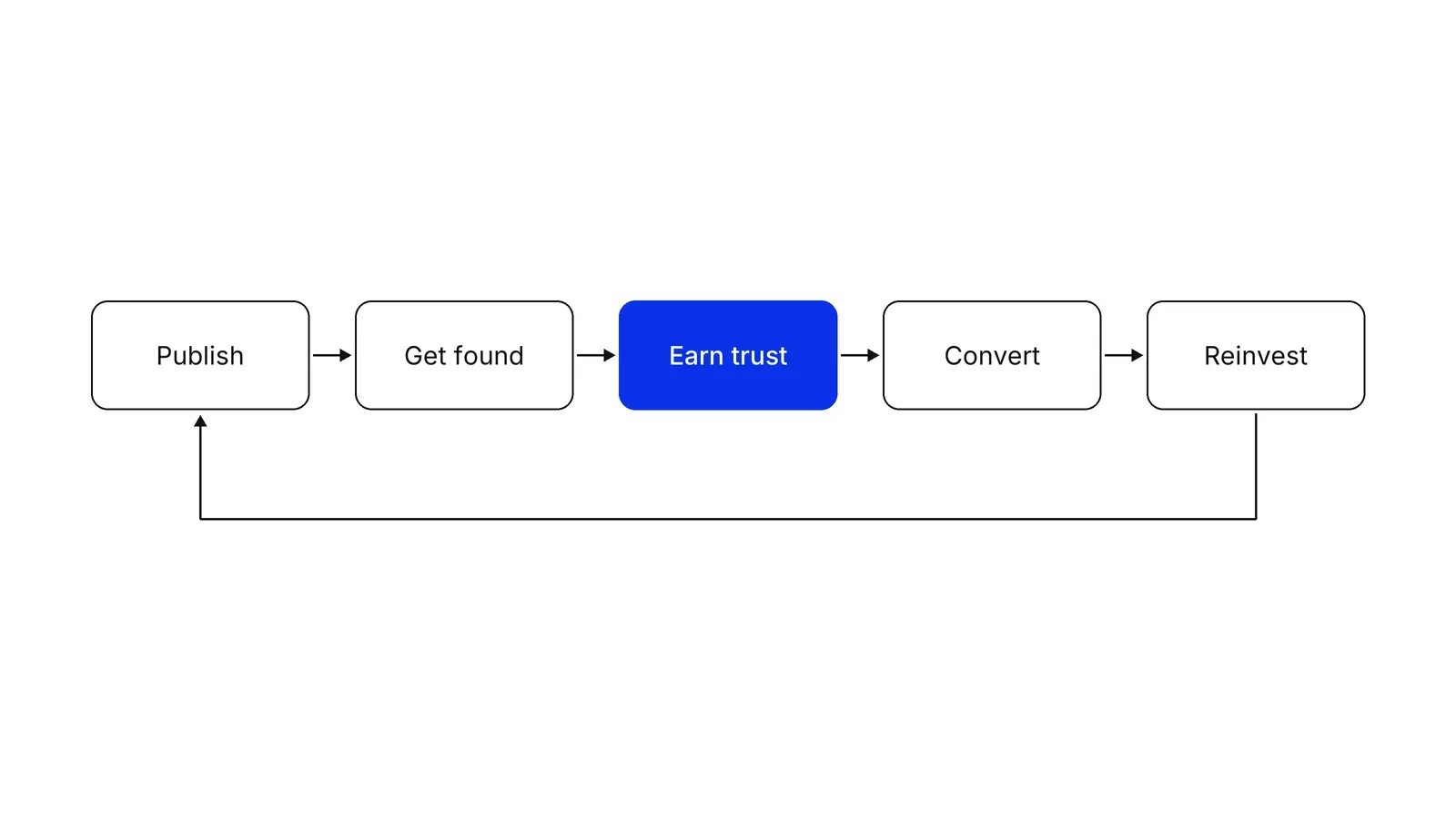
The trust step matters because most buyers are not buying today. John Dawes of the Ehrenberg-Bass Institute argued in 2021 that up to 95% of business buyers are out of the market for a given product at any moment. His arithmetic: firms change a main provider, such as a bank or law firm, about once every five years, so roughly 20% are in the market in a year and 5% in a quarter. He calls the 95% a heuristic, not a precise rule. The same logic favours content: it reaches the people who are not ready yet, and it is already in their memory when they are.
Content-led growth also assumes the product works. If you cannot yet say who buys and why, settle that first with product-market fit, or the content will amplify the wrong message.
How is it different from product-led and sales-led growth?
The models differ in what brings the customer in and what the model depends on. Companies mix them, so the rows describe a lead engine, not a pure type.
| Model | What brings the customer in | What it depends on |
|---|---|---|
| Content-led | Content found through search, tools or reputation | Subject expertise, search visibility, patience |
| Product-led | The product itself, through a free tier or trial | A product that is easy to adopt and spreads by use |
| Sales-led | Outbound contact and sales calls | Salespeople, lead lists, deal size that pays for them |
| Paid-led | Advertising | Budget that must keep running |
Real filings show the mix. Semrush’s S-1/A describes a self-service product, a large free tier (over 548,000 active free customers against over 79,000 paying ones at 30 September 2021) and unpaid content marketing such as blogs and webinars. Atlassian’s F-1/A says it relies on word of mouth and low-touch demand generation in place of a costly traditional sales setup, which is product-led more than content-led. HubSpot’s 2014 S-1 says its blog attracts about 1.5 million visits a month, and also that agency partners and referred customers made up about 42% of its customers. Content was a large part of the engine, not all of it.
What do content-led companies publish?
They publish assets that answer a buying question better than anything else on the internet. Four kinds recur.
- Search guides built around the questions buyers type, organised as topic clusters and pillar pages.
- Free tools and calculators, which double as a lead magnet.
- Original data from your own product or customers, which earns links and citations. Ahrefs’ own study of 14 billion pages is a data asset of this kind.
- Templated pages built from a database, such as the app pages Zapier’s own post cites as an example of programmatic SEO. The method has its own rules; see the programmatic SEO page.
Authority matters as much as format. Google’s guidance asks content to be made for people, with a clear Who, How and Why, which ties to E-E-A-T. Founder and expert voices help here, as in thought leadership.
How long does it take, and why does most content fail?
It takes months, and most pages never earn traffic. Ahrefs’ 2023 study found that 96.55% of pages in its sample get no traffic from Google. Its 2025 study found that 1.74% of new pages reached the top 10 within a year, and that 72.9% of top-10 pages were more than three years old. Orbit Media’s 2026 survey of 1,042 bloggers found 13.9% reporting strong results.
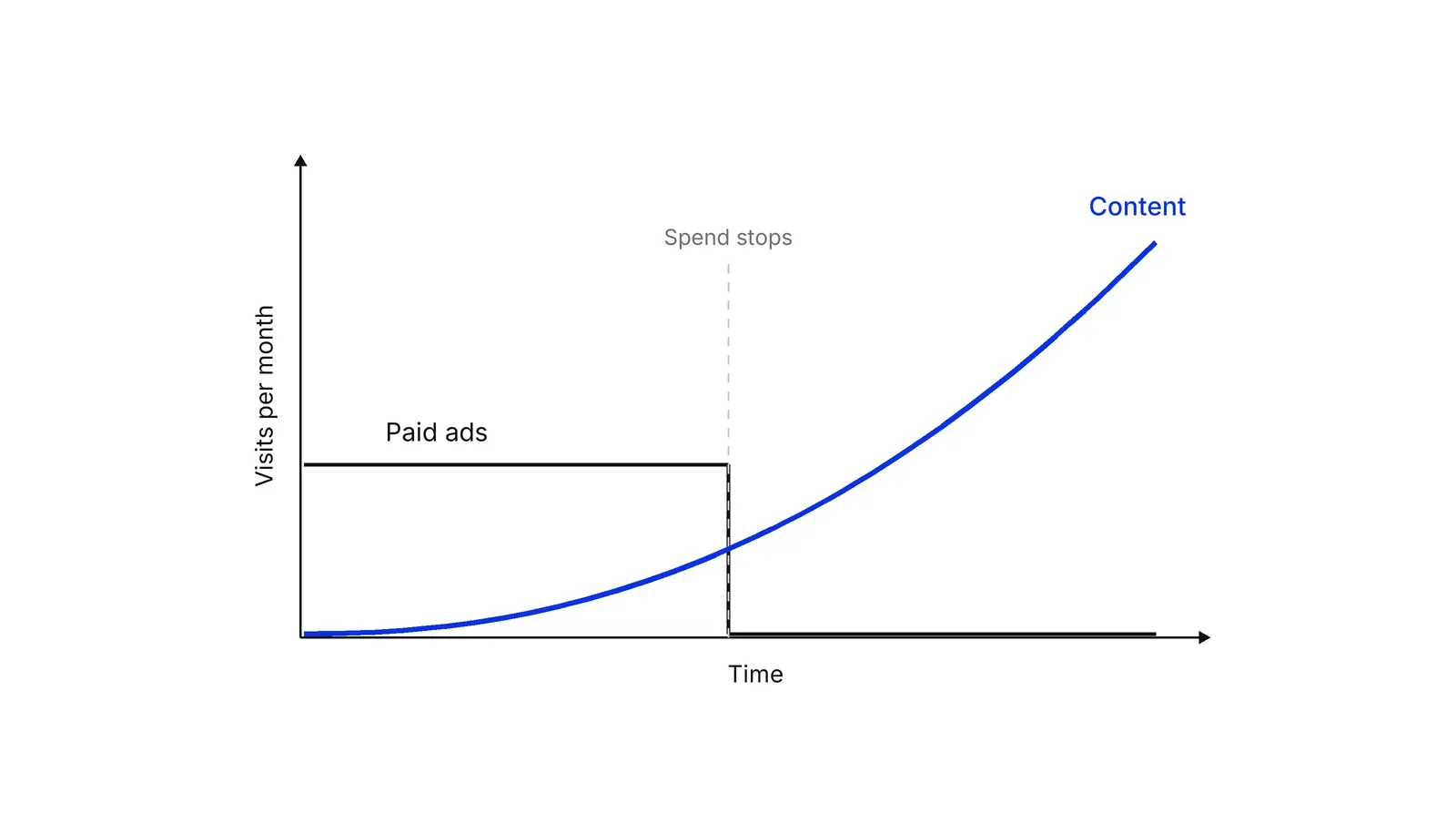
The picture shows why the model is patient money. Paid traffic starts at once and stops when the budget stops. Content starts near zero, and the pages that work keep paying. Volume does not rescue weak pages: Google’s spam policy treats large amounts of unoriginal content made mainly to rank as scaled content abuse, and Google said its March 2024 update would cut low-quality, unoriginal results, later reporting a 45% reduction.
Does AI search break content-led growth?
It lowers the return on traffic, so the model has to be judged on signups and pipeline, not visits. Pew Research found people clicked a result link in 8% of visits with an AI summary, against 15% without one. Ahrefs measured 58% lower click rates for position-one pages when an AI Overview appears. SparkToro’s 2024 study found 58.5% of US Google searches ended without a click to the open web.
Google says there are no additional requirements to appear in AI Overviews or AI Mode, beyond being indexed and eligible for Search. NerdWallet’s annual report names the dependency openly and describes moving visitors to registration to cut reliance on search. An email list, an account or a community gives you a way back to the reader that no algorithm controls.
How do you know it is working?
Watch three numbers: non-branded search visits, signups or bookings from content pages, and the share of pipeline where a content page was an early touch. Visits alone mislead. A Growth Lab plan starts from one buyer question, one asset and one measured next step, as described in Pushers’ Growth Lab practice.
How to apply Content-led growth, step by step
- List the questions buyers ask before they buy. Collect 30 to 50 real questions from sales calls, support tickets and search suggestions, in the buyer's words. Result: a question list ranked by how close each question sits to a purchase.
- Check that people search for them. Look up search demand for each question and read the pages that rank today. Drop topics nobody searches for and topics where every result is stronger than anything you can write. Result: a shortlist of 10 to 15 topics you can win.
- Choose the asset only you can make. Pick one format where you hold an edge, such as original data from your own product, a free calculator, or a guide written by someone who does the work daily. Result: one named asset type per topic, not a general blog.
- Build the next step into every page. Give each page one clear next move that fits the reader's stage: a template, a trial, a booking, a newsletter. Result: every published page points to a defined action and a way to count it.
- Publish on a fixed rhythm and update what ranks. Commit to a cadence you can hold for two quarters, and refresh pages that slip instead of only adding new ones. Result: a calendar with named owners and a review date for each page.
- Review on leading and lagging numbers. After two quarters, compare non-branded search visits, signups from content pages and pipeline where a content page was an early touch. Result: a decision to continue, change the topics or stop.
Examples
Semrush: free tools and unpaid content
Semrush, the SEO software company, told investors in its 2021 filing that it relies on unpaid content marketing, including blogs, webinars and thought leadership, alongside paid advertising. It describes a large free tier and self-service onboarding that lets it acquire customers with relatively low sales investment. The filing gives no split by source, so it shows the model but not how much content contributed.
NerdWallet: a content-led fintech that depends on Google
NerdWallet's 2024 annual report says its articles, calculators and reviews are the base of its organic reach. The same report says the company depends on search engines, particularly Google, that a 2017 Google action temporarily lowered its rankings and traffic, and that AI-assisted search could affect it further. Its response is to move visitors toward registration to cut reliance on search. It is a documented case of both sides of the model.
Cleveland Clinic: review as the price of entry in health content
Cleveland Clinic's editorial policy says Health Essentials articles are written by professional writers and that a Cleveland Clinic medical expert reviews each article for medical accuracy. AI tools may help with brainstorming but do not replace writers or medical reviewers. Health is a field where readers and Google both look for evidence that the author knows the subject, so the review step is part of the content model, not an extra.
When to use it
Use it when you have a product people already want, subject experts who can explain the work better than rivals, a sales cycle where buyers research alone before they talk to you, and a budget that can wait two or more quarters for results. It fits B2B software, fintech and professional services with a considered purchase.
When not to use it
Skip it before product-market fit, when no one can say who buys and why, because content will amplify the wrong message. Skip it when the market has almost no search demand and no other place to publish, when you need pipeline this quarter, or when you cannot give writers access to real expertise.
Common mistakes
- Publishing for traffic instead of for buyers, so visits rise while signups stay flat.
- Running the blog as a side task with no owner, no cadence and no review date, then judging it after six weeks.
- Producing many thin pages with a template or an AI tool. Google's spam policy treats large amounts of unoriginal content made mainly to rank as scaled content abuse.
- Ignoring the next step, so a good article ends without a signup, a template or a booking link.
- Putting all growth on one search engine with no email list, community or registered users to fall back on.
FAQ
What is content-led growth?
Content-led growth is a go-to-market model where published content is the main engine for finding, trusting and choosing a company. It grew out of inbound marketing and content marketing, and the term has no documented author. Sources split on scope: some count only new customers, others include retention and expansion.
How is content-led growth different from content marketing?
Content marketing is a method: the Content Marketing Institute defines it as creating valuable, relevant, consistent content for a defined audience. Content-led growth is a company-level choice to make that content the main route to customers. A firm can do content marketing while still growing mostly through sales or ads.
How long does content-led growth take?
Plan for months, not weeks. Ahrefs found that only a small share of newly published pages reached Google's top 10 within a year, and most top-10 pages were over three years old. Review after two quarters, and expect payback to take longer than for paid ads.
Is content-led growth dead because of AI search?
It is under pressure, not dead. Pew Research and Ahrefs both found fewer clicks on results when an AI summary appears. Google says no special steps are needed to appear in its AI features.
What is the difference between content-led and product-led growth?
Product-led growth brings customers in through the product itself, such as a free tier or trial. Content-led growth brings them in through content before they touch the product. Many companies combine both: Semrush's filing describes free tools plus unpaid content, and Atlassian's describes word of mouth and low-touch demand generation.
Sources
- Content Marketing Institute, What Is Content Marketing?
- HubSpot, What is inbound marketing?
- HubSpot, Form S-1 registration statement, 25 August 2014
- Semrush Holdings, Form S-1/A, November 2021
- Atlassian Corporation Plc, Form F-1/A, 7 December 2015
- NerdWallet, Form 10-K for fiscal year 2024
- Zapier, Programmatic SEO: How to do it and if you should
- Cleveland Clinic, Editorial policy
- Hanna Holliman, Jennifer Rowley, Business to business digital content marketing: marketers' perceptions of best practice, Journal of Research in Interactive Marketing 8(4), 2014
- John Dawes, Ehrenberg-Bass Institute, Advertising effectiveness and the 95-5 rule: most B2B buyers are not in the market right now, 2021
- Tim Soulo, Ahrefs, 96.55% of content gets no traffic from Google, 2023
- Patrick Stox, Ahrefs, How long does it take to rank in Google?, 2025
- Andy Crestodina, Orbit Media, Blogging statistics, 2026 survey
- Google Search Central, Creating helpful, reliable, people-first content
- Google Search Central, Spam policies for Google web search
- Google, March 2024 core update and new spam policies
- Google Search Central, AI features and your website
- Pew Research Center, Google users are less likely to click on links when an AI summary appears, July 2025
- Ryan Law, Ahrefs, AI Overviews reduce clicks, update, February 2026
- Rand Fishkin, SparkToro, 2024 zero-click search study
Last updated Oct 9, 2026


Marketing agency or growth system: when a company outgrows its agency
An agency is the right call while the founder still runs most of the company. Once the business starts copying itself into new locations or markets, it needs a system that sets goals, tests hypotheses and owns the result.

Why healthcare marketing agencies stall: the short, mid and long wins model we use with clinics
Most agencies own the click and nobody owns the front desk. How we structure clinic work in three horizons, the research behind each one, and one year of results.

The compliance layer under fintech marketing operations
A fintech marketing agency can build campaigns. It cannot own the compliance review, the KYC drop-off or the multi-market licensing rules that decide whether a lead ever becomes a customer.