Lean Canvas
Lean Canvas is a one-page template, adapted by Ash Maurya from the Business Model Canvas, that breaks a startup idea into nine boxes of assumptions so a founder can find the riskiest one and test it first.
Lean Canvas is a one-page business model template created by Ash Maurya in 2010 as an adaptation of Alexander Osterwalder's Business Model Canvas. Its nine boxes put the customer's problem, the solution, key metrics and unfair advantage on a single page. Founders use it to write down their idea as a set of assumptions, rank them by risk and test the riskiest one first.
- Origin
- Ash Maurya, adapting Alexander Osterwalder's Business Model Canvas, 2010
- Level
- 201 · Tool
- Fits
- Startup
- Time to apply
- 20 minutes for a first draft, then a few weeks of customer interviews to test it
- What you need
- one idea and one customer segment to describe · a printed or online canvas and a 20-minute timer · access to 10 or more people in the target segment for interviews
Lean Canvas is a one-page template that breaks a startup idea into nine boxes, each holding an assumption about customers, the problem, the product or the money. Ash Maurya published the first version on his blog in August 2010, as an adaptation of the Business Model Canvas from Alexander Osterwalder and Yves Pigneur’s Business Model Generation. The point is speed. A founder can write the whole idea down in an afternoon, see which part is a guess, and go test that part before spending money on it.
Maurya built the canvas into his book Running Lean. He first self-published it as a PDF, then O’Reilly released a second edition in 2012 as the first title in The Lean Series presented by Eric Ries. The third edition came out in March 2022, a near-complete rewrite. The canvas is now taught in startup courses such as one at Tallinn University of Technology, and Maurya’s company LEANSTACK still offers it.
What are the nine boxes of a Lean Canvas?
Each box answers one question about the idea. Maurya’s current description, in What is a Lean Canvas?, adds three sub-boxes that most templates now show.
| Box | The question it answers |
|---|---|
| Problem | What are the top one to three problems, and how do people solve them today (existing alternatives)? |
| Customer Segments | Who has the problem, who pays, and which early adopters feel it most? |
| Unique Value Proposition | Why is this different and worth attention, in one message? A short high-level concept, such as “Flickr for video”, sits under it. |
| Solution | What is the simplest fix for each problem? Kept small on purpose. |
| Channels | How do you reach customers, first by hand and later at scale? |
| Revenue Streams | How do you make money, and at what price? |
| Cost Structure | What does it cost to build and launch a first version, and what is the monthly burn? |
| Key Metrics | Which three to five numbers show customers getting value? |
| Unfair Advantage | What can competitors not easily copy or buy? |
The layout matters less than the order you think in. Maurya’s 2019 post on a “leaner” canvas says that at the earliest stage only two boxes count: Customer Segments and Problem. If those two are wrong, every box built on them is wrong too.
How is it different from the Business Model Canvas?
Lean Canvas keeps the Business Model Canvas grid and replaces four of its nine boxes. Maurya explained the swap in a February 2012 post. He kept the layout so his version could be credited back to Osterwalder, whose canvas was shared under a Creative Commons license that allowed remixing. Maurya’s own template carries the same kind of license, Creative Commons Attribution-Share Alike 3.0.
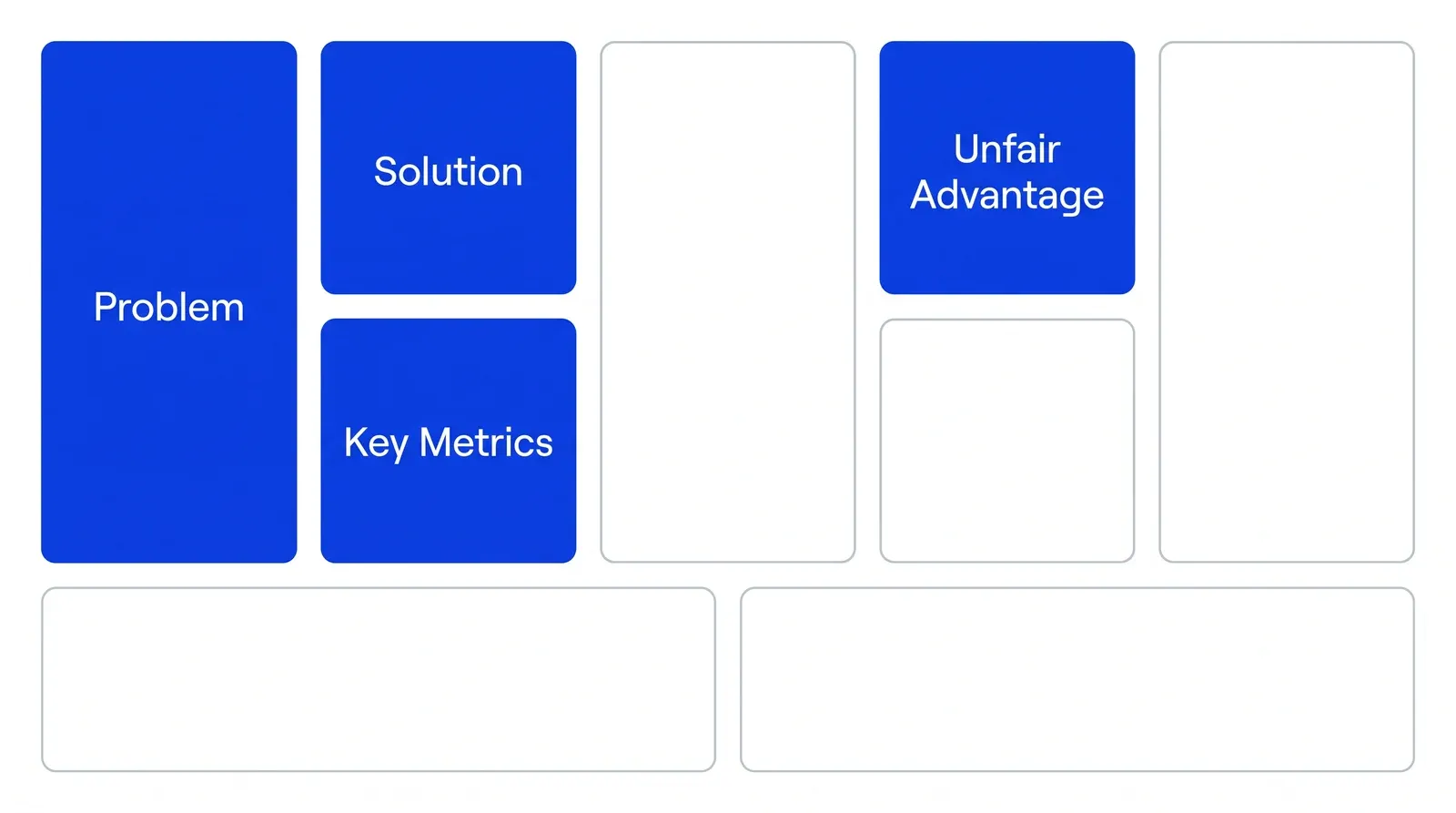
| Box | Change | Maurya’s reason |
|---|---|---|
| Problem | Added | Most startups fail by building the wrong product, so the problem gets its own box |
| Solution | Added | A small box stops founders falling in love with their first idea |
| Key Metrics | Added | Only a few numbers matter at any stage, and picking the wrong one is a risk |
| Unfair Advantage | Added | It pushes founders to plan a defence against fast followers |
| Key Partners | Removed | Partnerships are often wasteful for an unknown startup with an untested product |
| Key Activities | Removed | Activities follow from the solution once it is tested |
| Key Resources | Removed | Modern tools cut resource needs; what is left belongs under Unfair Advantage |
| Customer Relationships | Removed | The path to customers is covered by Channels |
The canvas changed after 2010. Maurya’s original post and slides still had a Key Activity box; Key Metrics had taken its place by the 2012 explanation.
The choice between the two canvases is mostly about stage. In a 2025 study of student founders in Algeria, N. Gahlam found they preferred Lean Canvas while working on ideas and customer problems, and moved to the Business Model Canvas later for a fuller picture of the business. Some evidence points to a cost of the swap. Ted Ladd’s study of 271 cleantech teams found that teams working on key activities and key partnerships, two of the boxes Maurya dropped, did significantly better in a pitch competition.
How do you fill in a Lean Canvas?
Fill it fast and expect it to be wrong. In his post on fill order, Maurya tells founders to set a 20-minute timer, fill as many boxes as they can and leave the rest blank. He says there is no single right order: start from whatever triggered the idea, then check the chain. For founders who are unsure, his 2024 guide still shows a suggested sequence. Customer Segments comes first, then Problem, the value proposition and Solution, then Channels, Revenue Streams, Cost Structure and Key Metrics, with Unfair Advantage last.
The check is the useful part. Look at the first boxes you filled and mark each belief as a leap of faith, an anecdote or a fact. Then reorder so the early links, usually who the customer is and what hurts, rest on evidence.
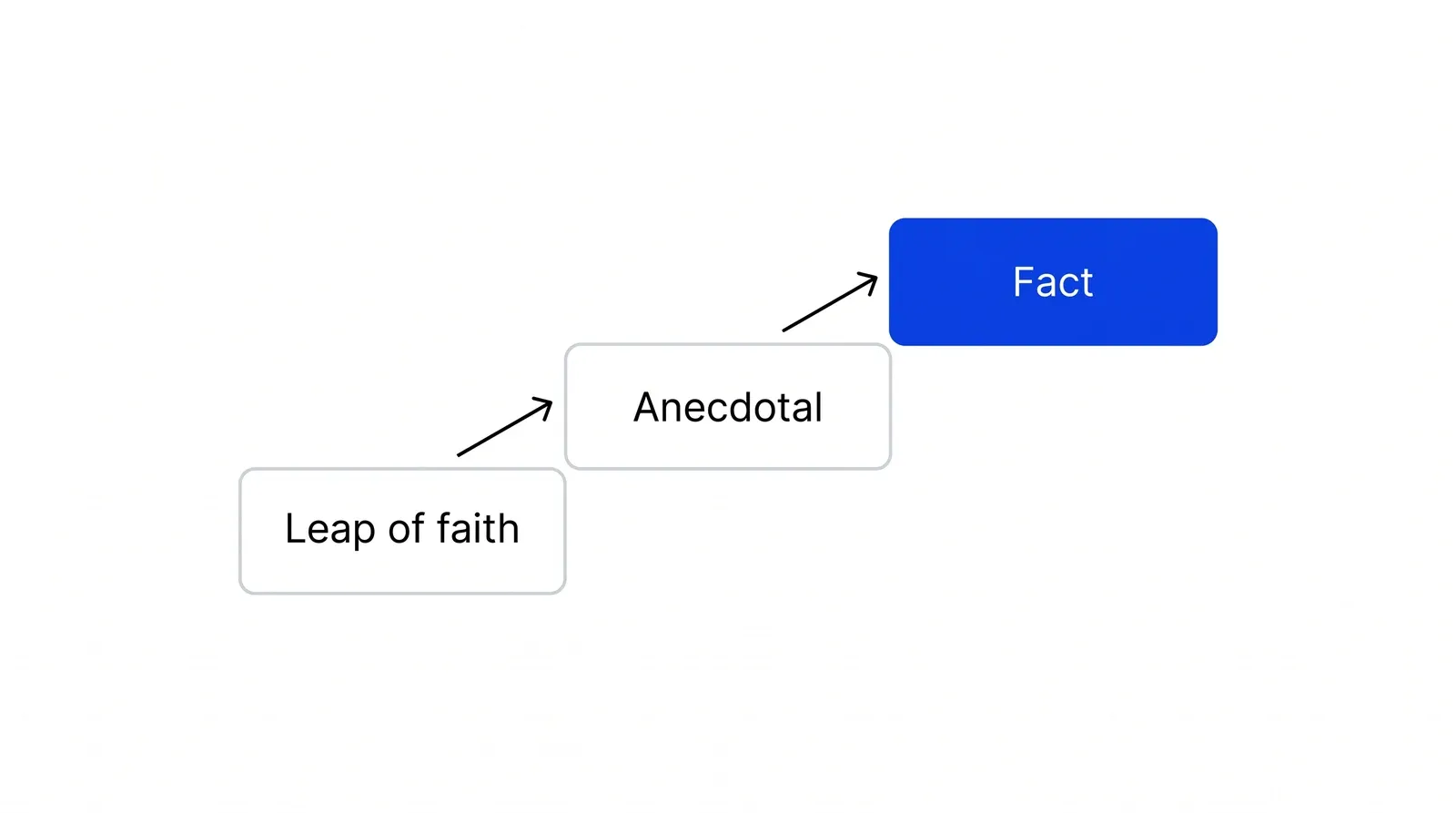
Take a payments idea for freelancers. “Freelancers wait 60 days to get paid” might be a fact from public invoice data. “They would pay a 2% fee to get paid now” is a leap of faith. That second belief is the one to test, through interviews or a manual pilot, before anyone writes code.
What counts as an unfair advantage?
An unfair advantage is something competitors cannot easily copy or buy. Maurya took the definition from Jason Cohen’s 2010 essay Real Unfair Advantages, which lists insider industry knowledge, a hard-to-assemble team, personal authority and existing customers as examples. Features, copy and prices fail the test, because anyone can copy what they can see.
In a 2024 post, Maurya maps the box onto Hamilton Helmer’s seven powers, including network effects, switching costs, scale economies and cornered resources. He also separates it from the value proposition. The value proposition tells customers why to buy. The unfair advantage tells competitors why copying will not pay. Good design is hard to create but easy to copy, so it belongs in the first box, not the second.
Most new startups have nothing to write here, and that is fine. Students in an Indonesian study by E. Harianto found it the hardest box to fill. A blank is better than “first mover”, and it reminds the team to plan how they will build an advantage over time.
Does using a Lean Canvas improve results?
The gains come from testing what the canvas says. The best evidence comes from a randomized trial by Arnaldo Camuffo and colleagues, published in Management Science, with 116 Italian startups. Both groups learned the Business Model Canvas. Only the treated group was taught to read it as a set of hypotheses and test them like scientists. Those founders performed better and pivoted more often, and Bocconi University reported that they earned more revenue.
A study of 152 NSF I-Corps teams by Michael Leatherbee and Riitta Katila found the same chain at work: writing hypotheses on a canvas, probing them with customers and converging on an idea. Both studies used Osterwalder’s canvas, not Lean Canvas, but the mechanism is the one Maurya designed his canvas for. Steve Blank describes the same loop of hypotheses and customer tests in Harvard Business Review, and Eric Ries calls it validated learning.
Maurya is candid about the limits. He advised founders not to pitch investors with the canvas in 2011, because most had never seen one. In 2018 he wrote that it does not replace a business plan alone, and added a traction model to show the idea is big enough to be worth solving.
In our Growth Lab work we run changes through HADI loops, and a Lean Canvas feeds them directly: each leap-of-faith box becomes a hypothesis with an action, an expected result and a date to check it.
How to apply Lean Canvas, step by step
- Pick one customer segment. Write a separate canvas for each segment, because different customers have different problems and pay through different channels. A clinic app for patients and the same app sold to clinic owners are two canvases. Result: one segment named at the top of the page.
- Draft the canvas in 20 minutes. Set a timer and fill as many boxes as you can, starting with Customer Segments and Problem, the way Maurya advises. Leave blanks where you have nothing honest to write. Result: a rough snapshot of the idea, not a plan.
- Add the sub-boxes that keep you honest. Under Problem, list how people solve it today (existing alternatives). Under Customer Segments, name the early adopters who feel the problem most. Under the value proposition, write a short high-level concept such as 'Flickr for video'. Result: a canvas grounded in what customers already do.
- Put rough numbers on the bottom row. Estimate price, the cost to build and launch a first version, and the monthly burn. Pick three to five key metrics that show customers getting value, not page views. Result: a first check on whether the idea can pay for itself.
- Label each belief and find the riskiest. Mark every entry as a leap of faith, an anecdote or a fact. Reorder so the first links in your chain, usually who the customer is and what hurts, rest on evidence. Result: one riskiest assumption to test next.
- Test, then update the canvas. Run problem interviews or a small experiment against the riskiest assumption, then rewrite the boxes it touches. Date each version so the team can see what it learned. Result: a canvas that changes with evidence instead of staying a poster.
Examples
A home-physiotherapy app
Illustrative. Customer segment: knee-surgery patients in their first eight weeks after discharge; early adopters are patients whose clinic is more than 30 minutes away. Problem: they skip exercises because they do not know if they are doing them right. Existing alternatives: printed sheets and YouTube. Unique value proposition: video feedback from your own physiotherapist twice a week. Key metric: share of prescribed sessions completed. Unfair advantage: blank for now. The riskiest belief is that patients will pay. If 40 interviews show only 2 would pay and 25 say their surgeon's clinic should pay, the team rewrites the canvas with clinics as the customer and patients as users.
Invoice financing for freelancers
Illustrative. Customer segment: freelance designers who invoice agencies on 60-day terms. Problem: rent is due before clients pay. Existing alternatives: credit cards and overdrafts. Revenue: a 2% fee per advanced invoice. At an average invoice of 2,000 euros that is 40 euros each, so covering 8,000 euros of monthly costs needs 200 invoices a month. Key metric: invoices advanced per active user per month. The riskiest assumption is default risk, so the first test is a manual pilot with 20 invoices before writing any code.
A bank's internal venture team
Illustrative. A team inside a bank wants to sell payroll software to small firms. Its canvas lists the bank's existing small-business clients as an unfair advantage, because a startup cannot buy that customer base. Key metrics: trial accounts that run a first payroll within 14 days. The canvas shows that the problem box rests on two internal opinions and no customer evidence, so the team runs 15 interviews before asking for a build budget.
When to use it
Use it at the very start of a new product or startup, before writing code or a business plan, when the main risk is building something nobody wants. It also works inside larger companies for a new venture or product line, and as a short way to explain an idea to advisors or a steering committee.
When not to use it
Skip it for an established business whose customers and problem are already proven. There the Business Model Canvas, with its partner, resource and activity boxes, describes the operation better. Do not use it as a pitch deck for investors who have never seen one, and do not treat a filled canvas as proof of anything until its assumptions are tested.
Common mistakes
- Starting with the solution box and writing problems to fit it. Maurya keeps the Solution box small on purpose; fill Customer Segments and Problem first.
- Covering several customer segments on one canvas. Problems, channels and prices differ by segment, so the boxes turn into vague averages.
- Writing 'great design' or 'first mover' as the unfair advantage. Both can be copied or bought. An empty box is more honest.
- Choosing vanity numbers such as page views or sign-ups as key metrics. Pick three to five that show customers getting value.
- Treating the canvas as a finished plan. Camuffo and colleagues' 2020 trial found results came from testing the hypotheses, not from filling in a canvas.
FAQ
What is the difference between Lean Canvas and Business Model Canvas?
Lean Canvas keeps the Business Model Canvas layout but swaps four boxes. Key Partners, Key Activities, Key Resources and Customer Relationships are replaced by Problem, Solution, Key Metrics and Unfair Advantage. Business Model Canvas describes how an existing business works; Lean Canvas is built for an untested idea, where the main question is whether the problem is real.
How do you fill in a Lean Canvas?
Set a 20-minute timer and fill what you can, leaving blanks. Start with Customer Segments and Problem, then the unique value proposition, solution, channels, revenue, costs, key metrics and unfair advantage. Maurya now says there is no single correct order. What matters is labelling each entry as fact or guess and testing the riskiest guess first.
What is an unfair advantage in a Lean Canvas?
It is something competitors cannot easily copy or buy. Maurya borrows the definition from Jason Cohen's 2010 essay. Examples are network effects, insider knowledge of an industry, exclusive access to customers or data, and switching costs. Good design, low prices and hard work do not count. Most new startups leave this box blank at first.
Where can I get a Lean Canvas template?
LEANSTACK, Ash Maurya's company, offers the canvas online, and most whiteboard tools include a copy. You can also draw it: five columns on top with Problem, Solution and Key Metrics, Unique Value Proposition, Unfair Advantage and Channels, Customer Segments, and two boxes underneath for Cost Structure and Revenue Streams.
Can a Lean Canvas replace a business plan?
Partly. Maurya argues it replaces the business model story in a plan but not the numbers stakeholders want. In a 2018 post he adds a traction model and a traction roadmap to cover that gap. A filled canvas also proves nothing on its own; it lists the assumptions a business plan would otherwise hide.
Sources
- Ash Maurya, How I Document My Business Model On 1 Page, August 2010
- Ash Maurya, Running Lean Canvas: How to Document Your Business Model Hypotheses, SlideShare, 2010
- Ash Maurya, Why Lean Canvas vs Business Model Canvas?, February 2012
- Ash Maurya, What is a Lean Canvas?, 2024
- Ash Maurya, What is the Right Fill Order for a Lean Canvas?, January 2019
- Ash Maurya, Reorder your Chain of Beliefs with a leaner Lean Canvas, January 2019
- Ash Maurya, How to Formulate Your Unfair Advantage Strategy with a Lean Canvas, 2024
- Ash Maurya, A Lean Canvas is NOT Enough to Replace a Business Plan, 2018
- Ash Maurya, Delivering Effective Investor Pitches With Lean Canvas, Part 1, July 2011
- Ash Maurya, The New and Updated Running Lean Book, January 2012
- Ash Maurya, Running Lean, 10th Anniversary Edition, February 2022
- O'Reilly Media, press release on Running Lean, second edition, first title in The Lean Series, February 2012
- LEANSTACK, Lean Canvas
- Strategyzer, Business Model Generation (Alexander Osterwalder and Yves Pigneur)
- Strategyzer, The Business Model Canvas
- Jason Cohen, Real Unfair Advantages, A Smart Bear, July 2010
- Arnaldo Camuffo, Alessandro Cordova, Alfonso Gambardella, Chiara Spina, A Scientific Approach to Entrepreneurial Decision Making: Evidence from a Randomized Control Trial, Management Science 66(2), 2020
- Bocconi University, Entrepreneurs who think like scientists get better results
- Michael Leatherbee, Riitta Katila, The lean startup method: Early-stage teams and hypothesis-based probing of business ideas, Strategic Entrepreneurship Journal 14(4), 2020
- Ted Ladd, Does the business model canvas drive venture success?, Journal of Research in Marketing and Entrepreneurship 20(1), 2018
- N. Gahlam, Entrepreneurial modeling in Algerian universities: a comparative exploration of Lean Canvas and BMC, Economic and Regional Studies 18(4), 2025
- E. Harianto, Implementasi Lean Canvas Pada Entrepreneurial Project Startup Bisnis, BIP's Jurnal Bisnis Perspektif 10(1), 2018
- A. Mewengkang, J. R. Batmetan, Techno-entrepreneurship learning model in higher education, Elinvo 6(1), 2021
- Tallinn University of Technology, ITI8740 Software Development Team Project, The Lean Canvas (course slides)
- Steve Blank, Why the Lean Start-Up Changes Everything, Harvard Business Review, May 2013
- Tom Eisenmann, Why Start-ups Fail, Harvard Business Review, May-June 2021
- Eric Ries, The Lean Startup: Principles
Last updated Oct 9, 2026


Marketing agency or growth system: when a company outgrows its agency
An agency is the right call while the founder still runs most of the company. Once the business starts copying itself into new locations or markets, it needs a system that sets goals, tests hypotheses and owns the result.

Why healthcare marketing agencies stall: the short, mid and long wins model we use with clinics
Most agencies own the click and nobody owns the front desk. How we structure clinic work in three horizons, the research behind each one, and one year of results.

Why channel tests stall after month three
Most paid channel tests do not end with a decision. They end when the budget runs out, the attribution model changes, or everyone quietly stops looking at the dashboard.