Subscription model
A subscription model charges customers a recurring fee for continued access to a product or service, so revenue is measured as monthly recurring revenue, churn and customer lifetime value instead of one-off sales.
A subscription model is a pricing model in which customers pay a recurring fee for continued access to a product or service instead of buying it once. Its economics are tracked through monthly recurring revenue (MRR), churn and customer lifetime value (LTV). In the US, EU and UK, regulators also govern how sign-up, renewal and cancellation must work.
- Origin
- Business practice with no single originator, No single date
- Level
- 201 · Tool
- Fits
- Startup, Small and mid-size, Scale-up
- Time to apply
- A day to build the MRR and churn view; a quarter of cohort data to trust the LTV figure
- What you need
- a billing export with one row per customer per month · your acquisition cost for the same period · whoever owns the sign-up and cancellation screens
A subscription model is a pricing model in which a customer pays a recurring fee, monthly or yearly, for continued access to a product or service. The seller trades a large one-off sale for a smaller payment that repeats for as long as the customer stays. No single inventor is documented: newspapers, magazines and clubs sold this way long before software did, and SaaS made it the default way to sell digital products. This page covers the economics, what pricing research has found, and the cancellation rules that now shape the design.
Which numbers run a subscription business?
Four numbers run it: MRR, churn, LTV and CAC. David Skok’s SaaS metrics guide defines MRR as monthly recurring revenue, for businesses that mostly sign monthly contracts, and uses annual recurring revenue (ARR) where annual contracts dominate. Skok’s guide splits the monthly change into new, churned and expansion MRR. Contraction, where a customer stays but downgrades, is a fourth movement.
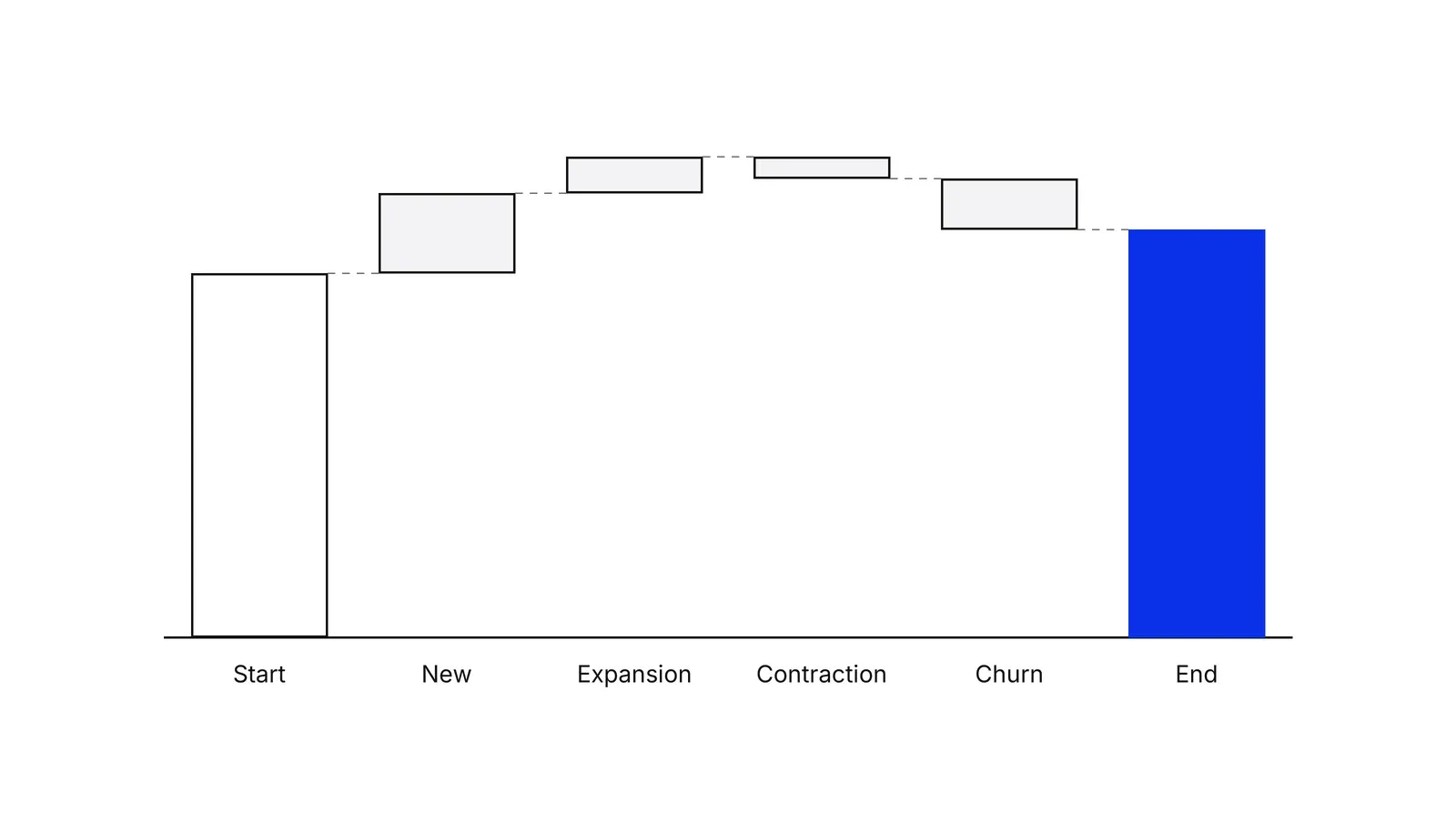
Churn is revenue or customers lost to cancellation. Skok separates customer churn, which counts accounts, from revenue churn, which counts dollars, because the two can differ sharply. He treats net revenue churn above 2% a month, about 22% of revenue over a year, as a serious problem. Net churn turns negative when expansion from remaining customers exceeds what cancellations remove. That is why net revenue retention is the companion metric for any subscription with upsells or seats.
Lifetime value (LTV) is what a typical customer is worth over the whole relationship, and CAC is what it costs to win one. Skok says the best SaaS businesses have an LTV to CAC ratio above 3 and recover CAC within roughly 12 months, and he presents both as guidelines.
Why does churn matter more than price?
Churn sets how long revenue lasts, so a small change compounds. With monthly churn c, a customer stays 1 ÷ c months on average, which is 20 months at 5% and 50 months at 2%. A common shortcut multiplies monthly gross margin by that lifetime. The fuller formula in Gupta, Lehmann and Stuart’s Journal of Marketing Research paper adds a discount rate: margin times retention divided by (1 plus the discount rate minus retention). In their calculation, a $100 annual margin, 80% retention and a 12% discount rate give a lifetime value of $250. They estimate that a 1% improvement in retention raises customer and firm value by 3% to 7%, against about 1% for margin and 0.02% to 0.3% for acquisition cost.
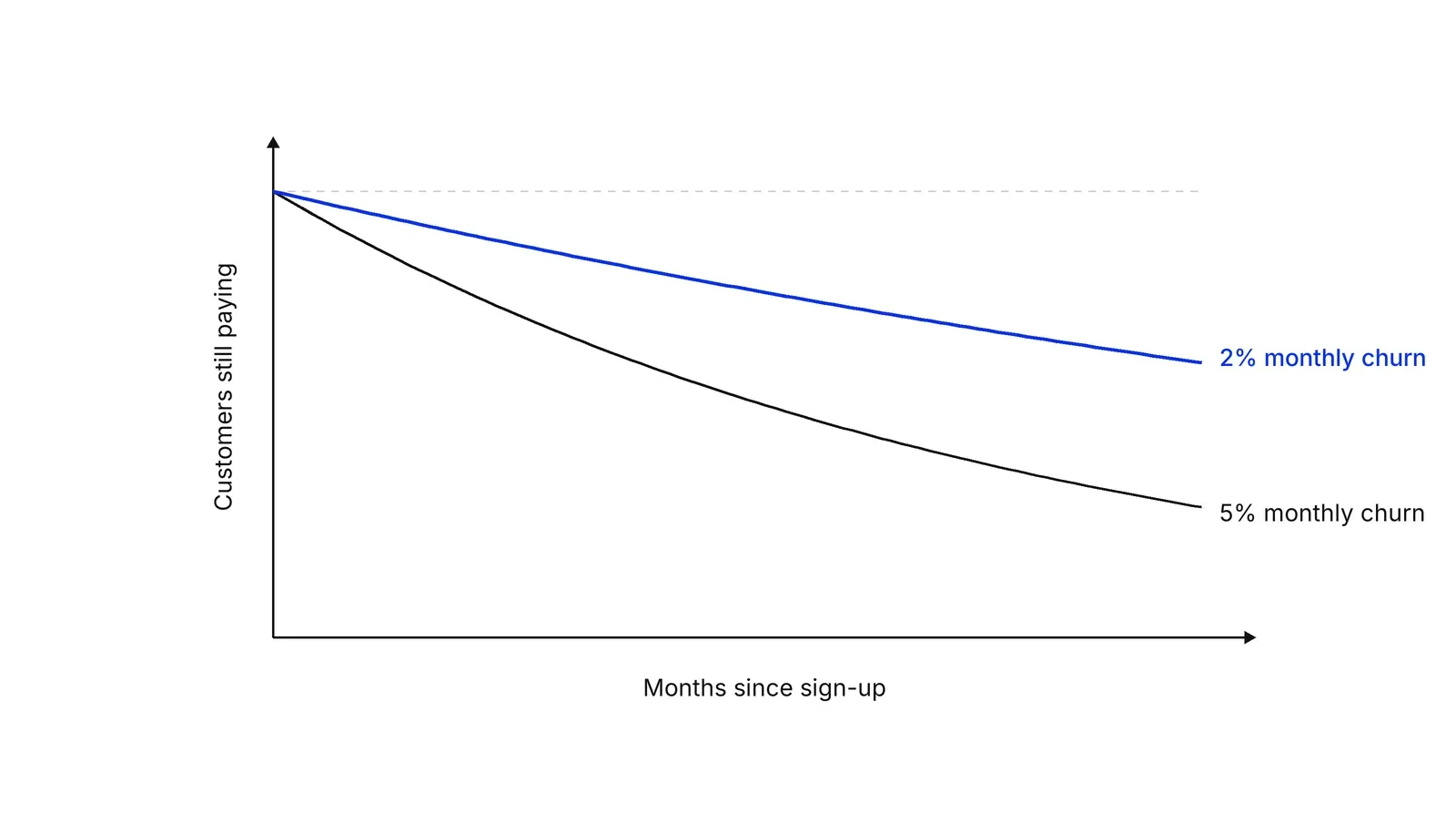
One caution applies to every shortcut here. Fader and Hardie show that textbook LTV uses a single retention rate, while cohort retention usually rises over time because the customers most likely to leave go first. Ignoring this understates the value of the customers who remain. Read churn by cohort, as in cohort analysis, and compare the shape of the curves, as described under retention curves and the smile curve.
What does academic research say about subscription pricing?
Four findings matter for a pricing decision.
- Access price drives retention. Peter Danaher’s field experiment with a cellular service found that access price affects retention much more than usage price, and that ignoring attrition understated price sensitivity by about 45% in his case, because customers who stay are less price sensitive.
- Customers over-choose flat rates. Lambrecht and Skiera found a flat-rate bias in internet-access data: many users pick a flat fee although pay-per-use would cost less. The bias did not significantly raise churn and raised profit. The opposite bias, choosing pay-per-use when a flat rate is cheaper, largely increased churn.
- Auto-renewal profits from overconfidence. DellaVigna and Malmendier studied 7,752 health-club members. Those on flat fees above $70 attended about 4.3 times a month and forwent about $600 on average by not buying a 10-visit pass. Monthly-contract members were 17% more likely than annual members to remain enrolled beyond a year. The authors attribute this to members overestimating their future attendance and the chance they will cancel.
- Shorter trials can win. In a field experiment by Yoganarasimhan, Barzegary and Pani, a software firm that gave a standard 30-day trial found that shorter trial lengths maximized acquisition, retention and profitability. Skilled users gained from longer trials, beginners from shorter ones. See freemium for the free-tier alternative to a trial.
The third finding explains why regulators care. A model that earns money from customers who forget to cancel is the model the rules below target.
How do failed payments and lapsed customers fit in?
Some churn is accidental. Stripe’s documentation says many failed subscription payments are recoverable and recommends retrying them automatically, with a default of 8 tries within 2 weeks. Hard declines, such as a stolen card, cannot be retried without a new payment method, so the fix there is a message asking the customer to update the card. Customers who left on purpose are a different group, addressed by win-back campaigns. Consumer media shows how common leaving is: Deloitte’s March 2026 data has 41% of US consumers cancelling a paid video service in the previous six months.
What do the cancellation rules require?
Subscription rules differ by market and are moving, so treat this as a map and not as legal advice.
| Jurisdiction | Status when we checked (October 2026) | What it requires |
|---|---|---|
| United States | The FTC’s 2024 click-to-cancel rule was vacated; a new rulemaking began in March 2026 | ROSCA: clear disclosure of terms, express consent, easy cancellation |
| EU | Consumer Rights Directive in force; withdrawal function from 19 June 2026; Digital Fairness Act announced, not proposed | 14-day withdrawal for distance contracts; an in-interface withdrawal function |
| Germany | Section 312k BGB in force | A cancellation button and confirmation page on sites selling continuing contracts |
| United Kingdom | DMCC Act Part 4 passed, not yet in force; government says January 2027 | Pre-contract information, reminders, cooling-off periods, easy exit |
United States. The Eighth Circuit vacated the FTC’s amended Negative Option Rule in Custom Communications v. FTC, which the FTC’s own notice cites. The FTC’s March 2026 notice asks whether to amend the rule or revive parts of the vacated one, and we found no proposed or final replacement. ROSCA still bars online negative option charges unless the seller discloses key terms before taking billing details, gets express informed consent and offers simple cancellation. In September 2025 the FTC announced a $2.5 billion settlement with Amazon over Prime enrollment and cancellation: a $1 billion civil penalty and $1.5 billion in refunds.
EU. The Consumer Rights Directive gives 14 days to withdraw from a distance contract, extended by up to 12 months when the trader fails to give withdrawal information. Directive 2023/2673 adds a “withdraw from contract here” function for online contracts, applying from 19 June 2026. The Digital Fairness Act had not been proposed as of the Parliament tracker’s 20 September 2026 update, with an indicative date of Q4 2026. In Germany, section 312k BGB already requires a cancellation button, and a business that omits it lets consumers terminate at any time without notice.
United Kingdom. Part 4 of the DMCC Act requires pre-contract information, reminder notices, cooling-off rights and easy exit. A 14-day cooling-off period applies at sign-up and again after a trial or a contract of 12 months or more renews, according to the government’s consultation response. The 9 August 2026 announcement says the rules start in January 2027.
A Growth Lab plan for a subscription starts from the MRR bridge and cohort curves, then tests price, trial and cancellation flow one at a time.
How to apply Subscription model, step by step
- Decide what the recurring fee buys. Write one sentence on the value a customer receives every month: access, a replenished product or a curated selection. If you cannot name something the customer would miss after cancelling, the model will not hold. Result: a clear reason to keep paying that the price page can state.
- Set the price and the billing period. Pick a flat fee or tiers, and offer monthly and annual options. Danaher's field experiment found that the access fee moves retention far more than usage charges do, so test the access price first. Result: a price list with a monthly and an annual rate.
- Build the MRR and churn view. From the billing export, split each month's change into new, expansion, contraction and churned MRR, and track customer churn and revenue churn separately. Result: a one-page monthly bridge from start to end MRR.
- Calculate LTV and payback. Divide monthly gross margin per customer by monthly churn, then compare it with acquisition cost. Check months to recover that cost against the 12-month guideline. Result: an LTV to CAC ratio and a payback period per channel.
- Design trial, sign-up and cancellation together. Show the price, billing period and renewal terms before taking card details, get a clear agreement to recurring charges, and make cancelling as easy as signing up. Result: a flow your legal reviewer can check against the US, EU and UK rules.
- Recover failed payments and lapsed customers. Retry failed card payments on a schedule and message customers whose cards fail. Then run a win-back sequence for people who cancel. Result: a lower share of churn that no customer chose.
Examples
A dental clinic membership
Illustrative. A clinic sells a plan at $40 a month covering two cleanings a year and 10% off treatment, with an 80% gross margin on the plan, so $32 of margin a month per member. At 5% monthly churn the average member stays 20 months, an LTV of $640. If joining costs $400 in marketing, the ratio is 1.6 and payback takes 12.5 months. Cutting churn to 2% with reminders and easy rebooking lifts expected stay to 50 months and LTV to $1,600, a ratio of 4.
A B2B payments tool
Illustrative. A startup sells reconciliation software at $300 a month per company. Its MRR bridge shows new customers adding revenue while churn removes it, so it adds seat-based pricing. Expansion MRR from larger teams then offsets part of the churned revenue, which is the route to negative net churn that David Skok describes. Billing for finance teams also needs payment retries, because expired company cards cause cancellations nobody chose.
When to use it
Use it when customers get value repeatedly or continuously, such as software, memberships, replenishment, media and care plans, and when you can measure usage and retention by cohort. It fits businesses that want predictable revenue and have the retention to repay acquisition cost.
When not to use it
Skip it when the need is rare or one-off, such as a wedding dress or a house move, or when customers see no value between uses. Also reconsider it if you cannot cancel as easily as you sign up, because that design now draws regulatory action in several jurisdictions.
Common mistakes
- Using one blended churn number. New customers leave faster than long-standing ones, so Fader and Hardie show that a single retention rate misleads. Read churn by cohort.
- Treating annual prepayment as retention. An annual plan hides churn until renewal day, and the UK regime adds a 14-day cooling-off period after a long contract renews.
- Counting the free trial as a pricing detail. Trial design changes who subscribes and who stays, and a trial that rolls into a paid plan on its own triggers reminder and cooling-off duties under the UK regime.
- Making cancellation a maze. The FTC's Amazon settlement shows what regulators do with hard cancellation.
- Ignoring failed payments. Cards expire and banks decline, and those lost customers are in your churn figure.
FAQ
How does a subscription business model make money?
It earns a recurring fee, usually monthly or annual, and profits only if the customer stays long enough to repay acquisition cost. The test is LTV against CAC: the best SaaS businesses, David Skok writes, have a ratio above 3 and recover acquisition cost within about 12 months.
What is the difference between MRR and ARR?
MRR is monthly recurring revenue, used by businesses that mostly sign monthly contracts. ARR is annual recurring revenue, used where annual contracts dominate. Skok's SaaS metrics article makes that split. Both count only recurring fees, not one-off setup charges or usage that varies without commitment.
What is a good churn rate for a subscription?
It depends on the segment, so we found no universal benchmark. Skok treats net revenue churn above 2% a month as a serious problem for SaaS. Consumer media churns faster, as the Deloitte data in the body shows.
Is the FTC click-to-cancel rule in force?
No. The Eighth Circuit vacated the 2024 rule on 8 July 2025 on procedural grounds, and the FTC opened a new rulemaking in March 2026. ROSCA still requires clear disclosure, express consent and easy cancellation for online negative option sales, and the FTC enforces it.
What are the UK subscription rules under the DMCC Act?
Part 4 of the DMCC Act 2024 requires pre-contract information, reminder notices, 14-day cooling-off periods and easy online exit. The government's August 2026 announcement puts commencement in January 2027, after earlier statements pointed to spring 2027. Secondary legislation was still outstanding when we checked.
Sources
- Federal Trade Commission, FTC Seeks Public Comment in Response to Advance Notice of Proposed Rulemaking Regarding Negative Option Marketing Practices, 2026
- Federal Trade Commission, Negative Option Rule: Advance Notice of Proposed Rulemaking (16 CFR Part 425), 2026
- Federal Trade Commission, Negative Option Rule (rule page and rulemaking history)
- Federal Trade Commission, Announces Final Click-to-Cancel Rule, October 2024
- Federal Trade Commission, FTC Secures Historic $2.5 Billion Settlement Against Amazon, September 2025
- Restore Online Shoppers' Confidence Act, 15 U.S.C. 8403, Cornell Legal Information Institute
- UK Department for Business and Trade, Government response to consultation on the implementation of the new subscription contracts regime, April 2026
- GOV.UK, PM starts roll out of everyday fixes on the cost of living, ending rip-off discounts and subscription traps, 9 August 2026
- Digital Markets, Competition and Consumers Act 2024, Part 4, legislation.gov.uk
- Directive (EU) 2023/2673 amending Directive 2011/83/EU as regards financial services contracts concluded at a distance and repealing Directive 2002/65/EC, EUR-Lex
- Directive 2011/83/EU on consumer rights, EUR-Lex
- Bürgerliches Gesetzbuch, section 312k (Kündigung von Verbraucherverträgen im elektronischen Geschäftsverkehr), Federal Ministry of Justice
- European Parliament Legislative Train, Digital Fairness Act
- European Commission, Review of EU consumer law (Digital Fairness Fitness Check and the Digital Fairness Act)
- Peter J. Danaher, Optimal Pricing of New Subscription Services: Analysis of a Market Experiment, Marketing Science 21(2), 2002
- Anja Lambrecht, Bernd Skiera, Paying Too Much and Being Happy About It, Journal of Marketing Research 43(2), 2006
- Stefano DellaVigna, Ulrike Malmendier, Paying Not to Go to the Gym, American Economic Review 96(3), 2006
- Peter S. Fader, Bruce G. S. Hardie, Customer-Base Valuation in a Contractual Setting: The Perils of Ignoring Heterogeneity, Marketing Science 29(1), 2010
- Sunil Gupta, Donald R. Lehmann, Jennifer Ames Stuart, Valuing Customers, Journal of Marketing Research 41(1), 2004 (author manuscript)
- Hema Yoganarasimhan, Ebrahim Barzegary, Abhishek Pani, Design and Evaluation of Optimal Free Trials, Management Science 69(6), 2023
- David Skok, SaaS Metrics 2.0, For Entrepreneurs
- Deloitte Insights, Digital Media Monitor dashboard (Digital Media Trends), March 2026 data
- Stripe, Automate payment retries (Billing documentation)
Last updated Oct 9, 2026


Marketing agency or growth system: when a company outgrows its agency
An agency is the right call while the founder still runs most of the company. Once the business starts copying itself into new locations or markets, it needs a system that sets goals, tests hypotheses and owns the result.

Why healthcare marketing agencies stall: the short, mid and long wins model we use with clinics
Most agencies own the click and nobody owns the front desk. How we structure clinic work in three horizons, the research behind each one, and one year of results.

How to calculate channel payback and unit economics
A CAC number that only marketing believes will not survive a finance review. This guide calculates channel payback so both teams work from the same model.