Entrepreneurial Operating System (EOS)
The Entrepreneurial Operating System (EOS) is a set of management tools from Gino Wickman's book Traction that gives a leadership team one vision, a weekly scorecard, 90-day priorities and a fixed weekly meeting.
The Entrepreneurial Operating System (EOS) is a management system for the leadership team of a privately held company, described in Gino Wickman's book Traction. It has six components: vision, people, data, issues, process and traction. Its main tools are the Vision/Traction Organizer, 90-day Rocks, a weekly Scorecard, the 90-minute Level 10 meeting and the Accountability Chart.
- Origin
- Gino Wickman, 2007 (Traction); expanded edition later
- Level
- 301 · Advanced
- Fits
- Small and mid-size, Scale-up
- Time to apply
- one full day to set the first Rocks and meeting, about a quarter to make the weekly rhythm stick
- What you need
- a leadership team of three to eight people who will meet every week · one person who runs the business day to day and one who sets direction (often the same person in a small company) · a Scorecard of five to 15 weekly numbers
The Entrepreneurial Operating System, or EOS, is a package of management tools for the leadership team of a privately held company. Gino Wickman set it out in the book Traction, first published in 2007, and it is now supported by a company, EOS Worldwide, that trains and certifies outside coaches called implementers. Most of the claims about how well it works come from that same company, so this page marks them as vendor claims.
The six key components
EOS says every business is made of six parts: vision, people, data, issues, process and traction. EOS Worldwide’s description is short. Vision means the leadership team agrees where the company is going. People means the right people in the right seats. Data means running on a handful of objective numbers. Issues means problems are solved at the root. Process means core processes are written down and followed. Traction means the vision is executed every 90 days.
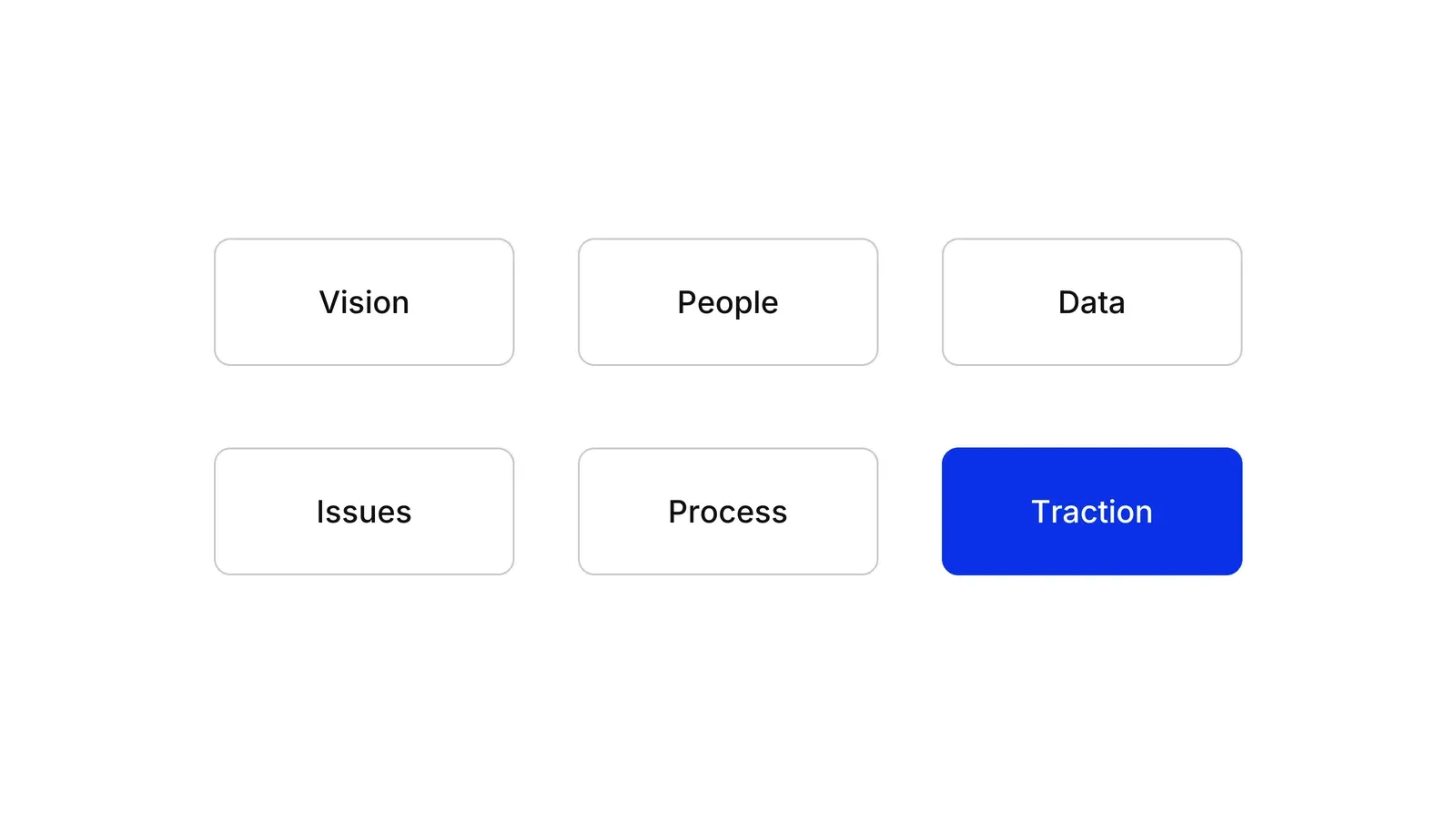
The idea is old: a business with a clear plan, owners, numbers and a routine does better than one without. What EOS adds is a named tool for each component, so a leadership team can start on Monday without designing a method first.
The Vision/Traction Organizer
The Vision/Traction Organizer, or V/TO, is a two-page plan that answers eight questions. The glossary and Ninety’s explainer list them: core values, core focus, 10-year target, marketing strategy, 3-year picture, 1-year plan, quarterly Rocks and issues. The first five form the vision page. The last three form the traction page.
Several of these echo earlier work. EOS Worldwide equates the 10-year target with the “big hairy audacious goal” that Jim Collins describes, and core values and purpose recall Collins and Porras’s 1996 article on vision. The V/TO packs those ideas into a form a leadership team can fill in during one or two sessions.
Rocks, the Scorecard and the 90-day rhythm
A Rock is one of the three to seven most important priorities that a company, team or person must finish in the next 90 days, with a single owner and a due date, as EOS Worldwide defines it. Leadership members carry three to seven, department managers three to five and individual staff one to three. The company’s Rocks come first; individual Rocks follow from them.
The Scorecard is a weekly sheet of five to 15 numbers. EOS calls them measurables and prefers that word to KPIs because they should predict the future of the business, not only record it. Kaplan and Norton made the same argument for the balanced scorecard in 1992: financial results arrive too late to steer by. A KPI tree is one way to pick the numbers that belong on it.
The 90-day cycle matches the problem that Sull, Homkes and Sull describe: two-thirds to three-quarters of large organizations struggle to execute a strategy they already have. A single quarterly list of priorities is the EOS answer. It is close to the focus on one goal in the 4 Disciplines of Execution, though EOS runs a whole company list rather than one goal per team.
The Level 10 meeting
The Level 10 meeting, or L10, is the weekly 90-minute leadership meeting. It uses one fixed agenda: a 5-minute segue, Scorecard, Rock review, customer and employee headlines, and to-do review, then 60 minutes of issue solving and a 5-minute conclusion. Each person rates the meeting from 1 to 10, with 8 as the goal.
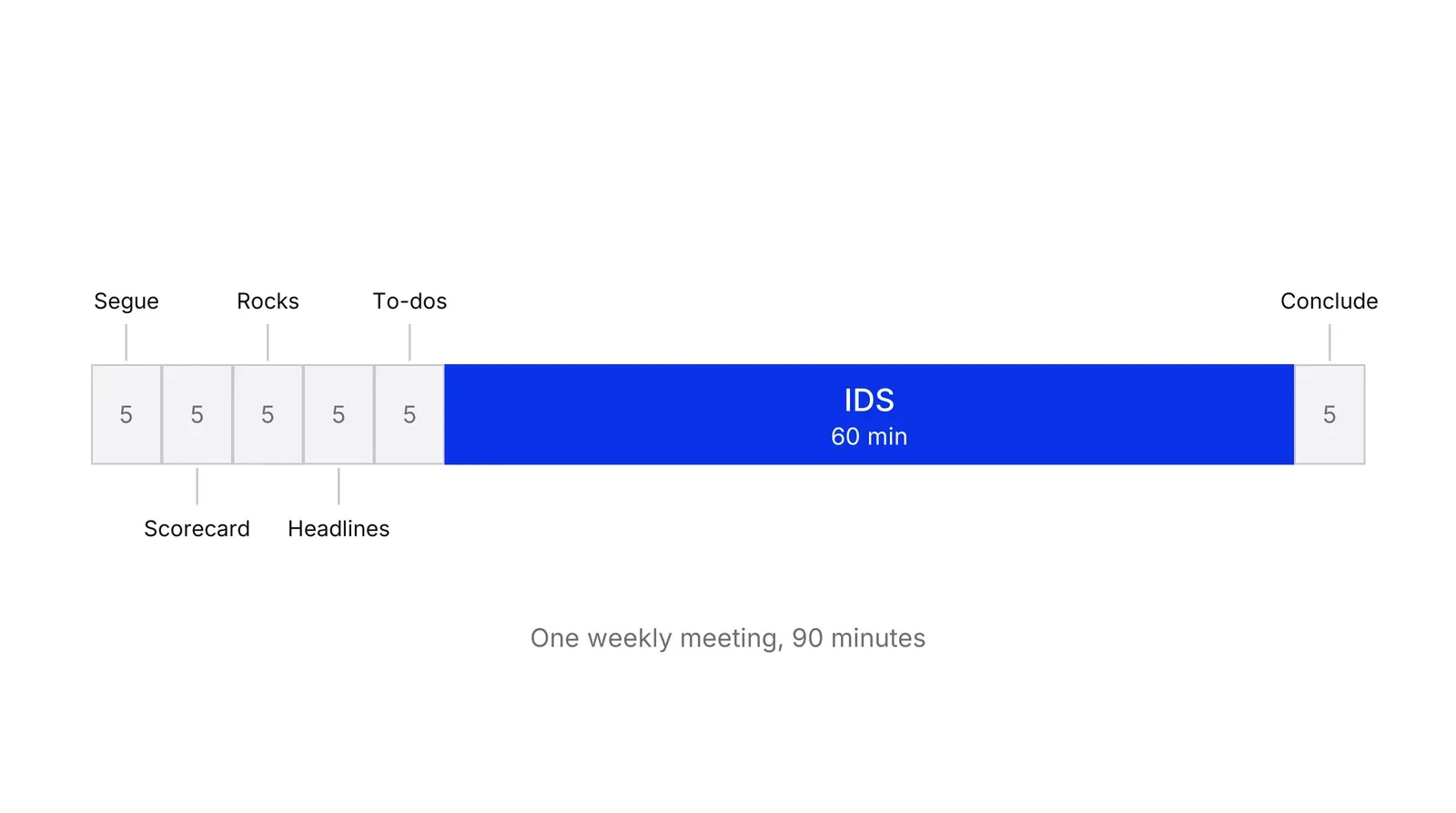
IDS stands for identify, discuss, solve. The point is to spend the longest block on the problems that matter instead of on reports. The design suits what meeting research finds. Perlow, Hadley and Eun report that executives average nearly 23 hours a week in meetings, up from under 10 in the 1960s, and Rogelberg finds that leaders rate their own meetings far higher than attendees do. A rating at the end of every meeting is a cheap check on that gap. Lencioni’s earlier book Death by Meeting makes a similar case for matching each type of meeting to its purpose. Our page on operating rhythm shows how the weekly meeting sits alongside daily, monthly and quarterly ones.
The Accountability Chart
The Accountability Chart is a one-page structure of seats, each with five to seven outcomes and one owner. EOS Worldwide says to design the structure first and add names after. The top has two seats: the Visionary, who sets direction, and the Integrator, who runs the business day to day. Wickman and Mark Winters wrote Rocket Fuel about that pairing.
A person fits a seat if they pass GWC: they Get it, Want it and have the Capacity to do it. It differs from a RACI matrix, which maps who is responsible, accountable, consulted and informed for each task. The chart fixes ownership of a whole seat. Neilson, Martin and Powers found that redrawing the org chart is often the first reflex when strategy fails to land, which is why EOS puts clarity of ownership ahead of reporting lines.
What the evidence says
We found no independent, peer-reviewed study of EOS itself. EOS Worldwide says that hundreds of thousands of companies run on it and that full implementation with a coach takes about two years. Those are vendor statements, and the company’s own pages do not offer a study behind them. Figures that circulate online, such as 88 percent of users reporting better performance, name no sample or method in the places we looked, so we do not repeat them.
Indirect evidence is better. A randomized field experiment by Bloom and co-authors gave management consulting to a random set of Indian textile plants and reported an 11 percent rise in productivity in the working-paper version, later published in the Quarterly Journal of Economics. It tested practices in factories, not EOS, and it does not show that EOS works. It does show that plain management habits can matter. Bruch and Ghoshal’s study of managers, Beware the Busy Manager, points to the problem EOS aims at: busy people who react instead of following a plan.
EOS has a close relative. Verne Harnish’s Scaling Up (book page) is built on four decisions: people, strategy, execution and cash. The two systems overlap on priorities and rhythm, and a company picks one by the fit of its tools and culture rather than by results.
A Growth Lab plan starts from the numbers and owners before choosing any system like this; see Growth Lab.
How to apply Entrepreneurial Operating System (EOS), step by step
- Draw the Accountability Chart. List the functions the business needs, such as sales and marketing, operations, and finance, and write five to seven outcomes under each seat. Put names in only after the structure is agreed. The result is a one-page chart with one owner per seat.
- Fill in the Vision/Traction Organizer. Answer its eight questions together, from core values to the 1-year plan, on two pages. Write down what the leadership team disagrees on and settle it. The result is a shared plan the whole team can state in the same words.
- Choose a Scorecard. Pick five to 15 weekly numbers that predict how the business will do, with an owner and a goal for each. The result is a single sheet that shows in a minute whether the week is on track.
- Set this quarter's Rocks. Agree on the three to seven most important priorities for the next 90 days at company level, then let each leader set their own. Every Rock gets one owner and a due date. The result is a short list people can recite.
- Run the weekly Level 10 meeting. Hold the same agenda at the same time every week: good news, Scorecard, Rocks, headlines, to-dos, then an hour of solving issues. Rate the meeting from 1 to 10 at the end. The result is a decision rhythm that does not depend on anyone's calendar mood.
- Repeat every 90 days. At the end of the quarter, score the Rocks, refresh the Vision/Traction Organizer, and set the next set. Once a year, plan the year. The result is a loop that keeps the plan alive.
Examples
A 60-person clinic group
Illustrative. A clinic group with six sites has a founder who also approves every schedule change. The leadership team draws an Accountability Chart and finds that two seats, patient intake and finance, have no owner. They name owners, set three company Rocks for the quarter, such as a single booking process across all sites, and start a weekly meeting. Scorecard numbers include new bookings and no-show rate. The arithmetic of the change is simple: three open seats become filled, and every quarter ends with a score of how many Rocks were done.
A 40-person payments company
Illustrative. A payments business runs onboarding, compliance review and support as three separate queues. Its leadership team puts the average time to approve a new account on the Scorecard, turns the backlog into one Rock, and uses the issues list in the weekly meeting to track every stuck file to a named owner. After a quarter the team checks the Rock against its due date and decides whether the next quarter's Rock is the same problem or a new one.
When to use it
Use it when a privately held company has grown past what the founder can hold in their head, and the leadership team lacks one agreed plan, clear owners and a steady meeting rhythm. EOS Worldwide describes its target as companies of roughly 10 to 250 people.
When not to use it
Skip it when the real problem is product-market fit or cash, since EOS organizes a business that already works. It also fits poorly in a very large company with many divisions, or where the leader is unwilling to share decisions with a team.
Common mistakes
- Treating the Accountability Chart as an org chart of names, and so building seats around the people already in the building.
- Setting 15 Rocks, which brings back the lack of focus the 90-day list was meant to remove.
- Letting the Level 10 meeting turn into a status round, so the hour for solving issues shrinks to ten minutes.
- Choosing Scorecard numbers that are easy to count rather than numbers that predict results.
- Skipping the quarterly session after the first quarter, which ends the cycle that makes the rest work.
FAQ
What is EOS in business?
EOS, the Entrepreneurial Operating System, is a set of management tools for the leadership team of a privately held company. Gino Wickman described it in the book Traction. It covers vision, people, data, issues, process and traction, and it runs on 90-day priorities and a weekly leadership meeting.
What are the six key components of EOS?
The six key components are vision, people, data, issues, process and traction. Vision is a shared plan, people means the right person in the right seat, data is a handful of weekly numbers, issues are solved at the root, process means documenting core processes, and traction means executing the vision every 90 days.
What is a Level 10 meeting?
A Level 10 meeting is the weekly 90-minute leadership meeting in EOS. It follows one fixed agenda: segue, Scorecard, Rock review, headlines, to-dos, issue solving (about 60 minutes) and a conclusion with a rating from 1 to 10. It starts and ends on time, on the same day each week.
Is EOS the same as Scaling Up?
No. Both give a growing company a plan, priorities and a meeting rhythm, but they come from different authors. Verne Harnish's Scaling Up is built on four decisions: people, strategy, execution and cash. EOS is built on six components and a set of named tools.
Is there evidence that EOS works?
We found no independent, peer-reviewed study of EOS itself. The results quoted for it come from EOS Worldwide and from implementers. Indirect support exists for structured management practices in general, such as a randomized field experiment on Indian textile plants, but it did not test EOS.
Sources
- EOS Worldwide, What is EOS
- EOS Worldwide, EOS glossary
- EOS Worldwide, The Accountability Chart
- EOS Worldwide, Rocks
- EOS Worldwide, Traction by Gino Wickman
- EOS Worldwide, Rocket Fuel by Gino Wickman and Mark C. Winters
- EOS Worldwide Implementer blog, 4 secrets to a smoother EOS meeting
- Ninety, the 8 EOS vision questions (software vendor for EOS teams)
- Scaling Up, Verne Harnish book page
- Robert Kaplan, David Norton, The Balanced Scorecard, Harvard Business Review, 1992
- Donald Sull, Rebecca Homkes, Charles Sull, Why Strategy Execution Unravels, Harvard Business Review, 2015
- Gary Neilson, Karla Martin, Elizabeth Powers, The Secrets to Successful Strategy Execution, Harvard Business Review, 2008
- James Collins, Jerry Porras, Building Your Company's Vision, Harvard Business Review, 1996
- Jim Collins, BHAG (Big Hairy Audacious Goal)
- Heike Bruch, Sumantra Ghoshal, Beware the Busy Manager, Harvard Business Review, 2002
- Leslie Perlow, Constance Hadley, Eunice Eun, Stop the Meeting Madness, Harvard Business Review, 2017
- Steven Rogelberg, Why Your Meetings Stink, and What to Do About It, Harvard Business Review, 2019
- Patrick Lencioni, Death by Meeting, Jossey-Bass (Wiley), 2004
- Nicholas Bloom and co-authors, Does Management Matter? Evidence from India, NBER Working Paper 16658
- Nicholas Bloom and co-authors, Does Management Matter? Evidence from India, Quarterly Journal of Economics, 2013
Last updated Oct 9, 2026


Fractional COO or embedded operations team? How to choose at Series A
The two models solve different problems: how to tell which one your company needs, and what each costs in time and control.

What operational systems successful fintech startups use: lessons from ten companies
Starling, Monzo, Qonto, bunq, Lunar, Pleo, Tide, Ramp, Mercury and Column scaled on four operating systems. Regulators' findings show what breaks when one of them lags behind growth.

What a revenue operations manager actually owns
Pipeline definitions, CRM hygiene, forecasting and the handoffs between marketing, sales and success. What the role covers, and how it differs from sales ops.