Cash flow
Cash flow is the record of cash moving into and out of a business, split into operating, investing and financing activities, and it tells you whether the company can pay its bills even when the profit line looks healthy.
Cash flow is the movement of cash into and out of a business over a period, reported in a statement of cash flows under three headings: operating, investing and financing activities. It differs from profit because it records when money actually moves, not when revenue is earned or a cost is incurred. A business can show a profit and still run out of cash.
- Origin
- IASB (IAS 7) and FASB (ASC 230); cash conversion cycle by Verlyn Richards and Eugene Laughlin, 1980 for the cash conversion cycle
- Level
- 201 · Tool
- Fits
- Startup, Small and mid-size, Scale-up
- Time to apply
- half a day to classify three months of bank movements, then 30 minutes a week to keep a 13-week forecast current
- What you need
- bank statements for the last three months, with the opening balance · an aged list of unpaid customer invoices and unpaid supplier bills · the payroll, rent, tax and loan calendar for the next quarter
Cash flow is the movement of cash into and out of a business over a period. Accountants report it in a statement of cash flows, which sits next to the profit and loss statement and the balance sheet. The international standard that governs it is IAS 7, issued by the IFRS Foundation’s accounting board, and the US equivalent is ASC 230 from the Financial Accounting Standards Board. Under IAS 7, “cash” means cash on hand and demand deposits, plus short-term, highly liquid investments that convert to known amounts of cash.
Founders and operators use it for a simpler reason: it shows whether the company can pay what it owes this month.
Why can a profitable business run out of cash?
Because profit and cash follow different clocks. Profit records revenue when it is earned and a cost when it is incurred. Cash records the day money moves. Whenever costs are paid before customers pay, the business funds the difference from its own balance.
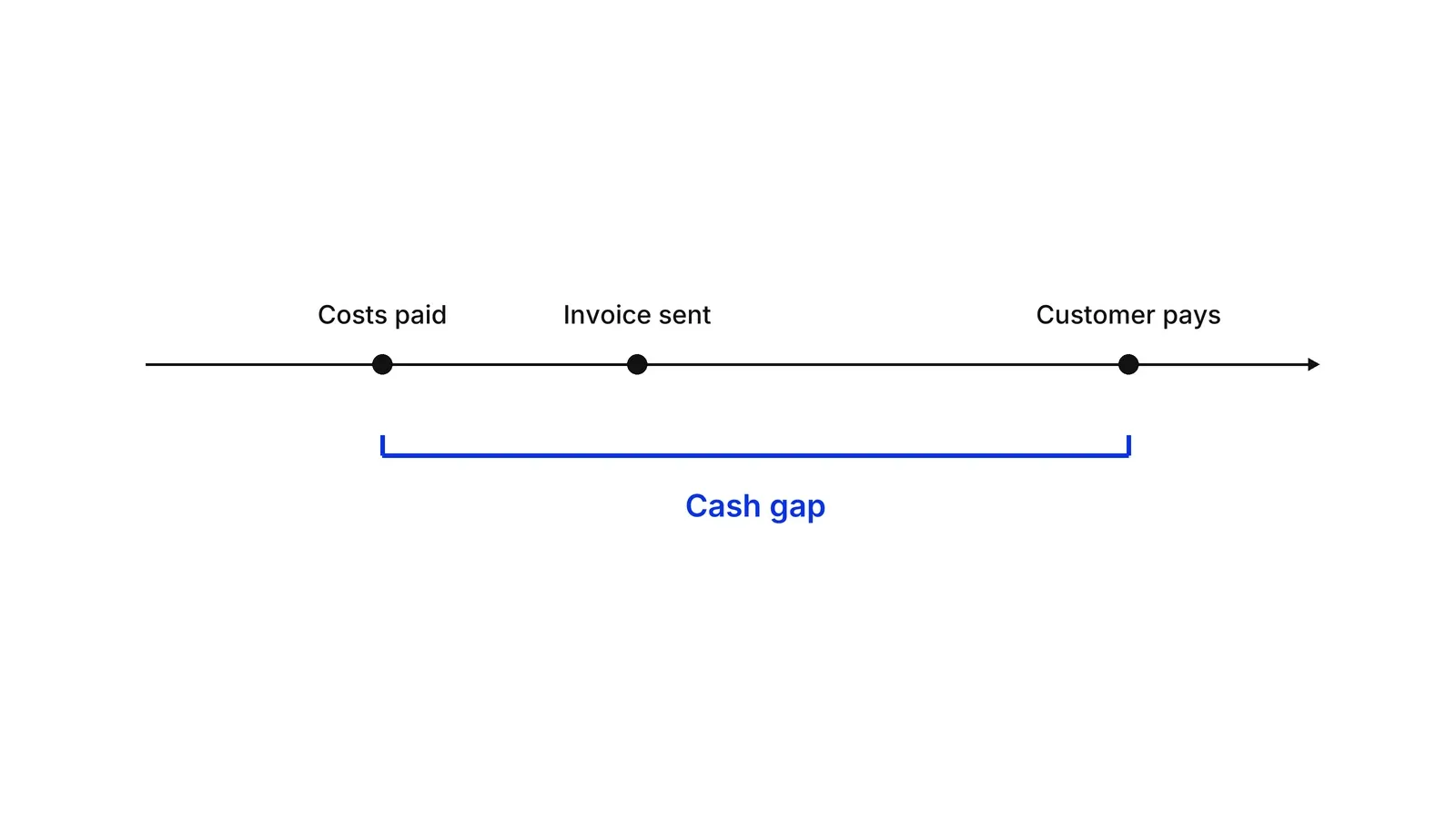
The research on failure points at the same place. CB Insights analysed 431 venture-backed companies that shut down since 2023 and could identify reasons for 385 of them. “Ran out of capital” topped the list at 70%, which CB Insights treats as the last cause, not the root one. The JPMorgan Chase Institute studied 597,000 small businesses from February to October 2015 and found a median cash buffer of 27 days, with the 25th percentile at 13 days and the 75th at 62. In the Federal Reserve’s 2024 Small Business Credit Survey, 51% of 7,653 responding employer firms named uneven cash flow as a financial challenge.
The oldest well-documented case is W. T. Grant. Largay and Stickney showed in 1980 that the retailer’s operations used more cash than they produced through 1973, even though “cash flow” in the narrow sense of net income plus depreciation stayed steady, and that investors still valued the stock at nearly 20 times earnings. The Journal of Accountancy later summarised it as positive earnings and current ratios with severely negative cash flows before bankruptcy.
The three buckets of a cash flow statement
A statement of cash flows sorts every movement into operating, investing or financing activities. Operating means the principal revenue-producing activities and anything that does not fit the other two. Investing means acquiring and disposing of long-term assets and investments. Financing means changes in equity and borrowings.
| Bucket | Typical receipts | Typical payments |
|---|---|---|
| Operating | Customer payments | Suppliers, salaries, taxes, rent |
| Investing | Sale of equipment or investments | Equipment, software capitalised as an asset, acquisitions |
| Financing | New loans, share issues | Loan repayments, dividends |
IFRS and US GAAP agree on the three buckets and disagree on details. Under ASC 230, interest paid is an operating cash flow, per PwC’s guide. Until IFRS 18 takes effect for periods beginning on or after 1 January 2027, IAS 7 lets many companies choose where to show interest and dividends, and IFRS 18 removes most of that choice, according to KPMG. Bank overdrafts can count as cash under IFRS when they are an integral part of cash management and cannot under US GAAP, while US GAAP includes restricted cash in the cash totals, according to Deloitte’s comparison. For a payments or banking business holding customer money, those differences change the headline cash number.
Direct or indirect method?
The direct method lists gross cash receipts and payments. The indirect method starts from profit and adjusts for non-cash items and for changes in receivables, payables and stock. IAS 7 encourages the direct method because it provides information useful in estimating future cash flows that the indirect method does not. Deloitte notes that US GAAP requires a reconciliation of net income to operating cash flow under both methods. From 2027, IFRS 18 moves the starting point of the indirect method from profit after tax to operating profit.
Operators need both. The indirect view explains why cash and profit disagree. The direct view, laid out by week, tells you whether Friday’s payroll will clear.
The cash conversion cycle
The cash conversion cycle is the number of days between paying for inputs and collecting from customers. Verlyn Richards and Eugene Laughlin introduced it in 1980, according to the Journal of Accountancy. It equals days of inventory plus days of receivables minus days of payables.
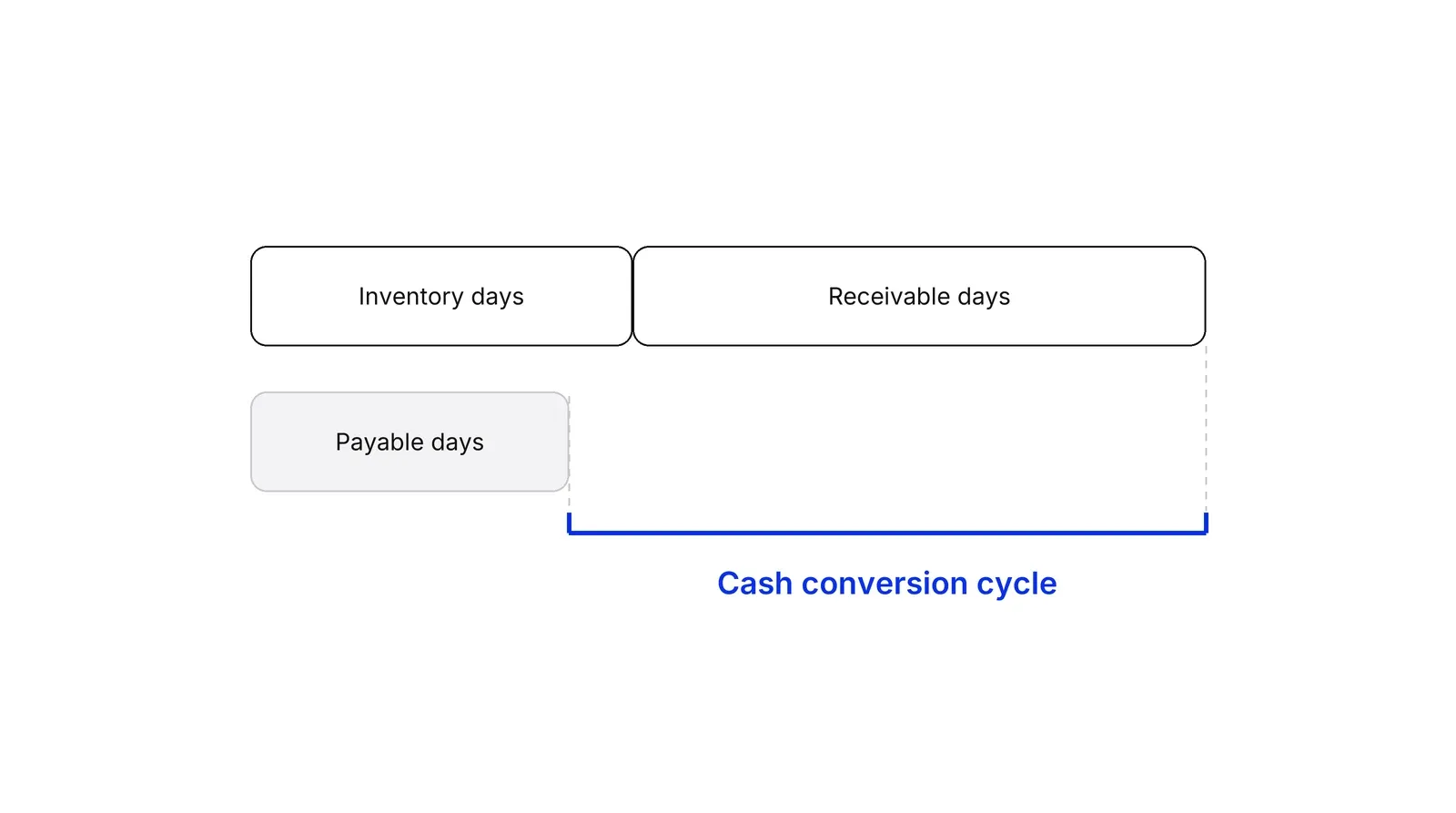
With 30 days of stock, 45 days to collect and 25 days to pay suppliers, the cycle is 50 days. Shortening any of the three shortens the gap. The cycle can also be negative: a 2013 Journal of Accountancy article put Amazon’s at minus 38 days, meaning customers paid before suppliers did. Supplier finance arrangements can stretch payable days without showing in plain sight, which is why the IASB added disclosure requirements in May 2023, effective for periods beginning on or after 1 January 2024.
Cash flow is not profit, and it is not enough on its own
| Profit and loss | Cash flow | |
|---|---|---|
| Records | Revenue earned, costs incurred | Money received and paid |
| Answers | Is each sale worth making? | Can we pay on Friday? |
| Distorted by | Accrual timing, depreciation | Prepayments, late payers, one-off purchases |
Sloan’s 1996 study in The Accounting Review found that how long an earnings figure lasts depends on the relative size of its cash and accrual parts. Reading both together is better than reading either. The margin on each sale is a separate question, and our page on contribution margin covers it. For subscription businesses, billing terms decide the timing, as the subscription model page explains.
The 13-week forecast
A 13-week cash flow forecast is a rolling, weekly projection of receipts and payments for the next quarter. KPMG’s 2020 guidance explains the horizon: 13 weeks is one fiscal quarter, long enough to inform decisions and short enough to stay accurate. KPMG also says to update it weekly or even daily, and recommended stretching it to 17 weeks when uncertainty was exceptional. Build it from the direct method, using invoice due dates and the payroll calendar.
Paul Graham’s “default alive” test is the startup version of the same idea. If expenses stay flat and revenue keeps growing at its recent rate, does the company reach profitability before the money runs out? His 2009 essay on ramen profitability makes the related point that a company earning enough to cover its founders’ living costs no longer has to raise money to survive.
A Growth Lab plan should start from the cash the business can spend, not from the profit it reports.
How to apply Cash flow, step by step
- Fix what counts as cash. Write down which accounts are cash: bank balances and short-term, easily convertible deposits. Money held for customers or locked as a guarantee is tracked separately. Result: one opening cash number everyone agrees on.
- Sort three months of bank movements into three buckets. Tag every receipt and payment as operating (customers, suppliers, staff, tax), investing (equipment, long-term assets) or financing (loans, equity, dividends). Result: a table showing where cash came from and where it went.
- Reconcile profit to operating cash flow. Start from profit and adjust for non-cash items and for changes in receivables, payables and stock. Result: a short list of the reasons your profit and your operating cash flow differ.
- Build a weekly 13-week forecast. Lay out expected receipts and payments week by week from invoice due dates, the payroll calendar and bills. Result: a closing cash balance for each of the next 13 weeks, with the lowest week marked.
- Measure the cash conversion cycle. Add days of stock and days of unpaid customer invoices, then subtract days of unpaid supplier bills. Result: one number of days you finance out of your own cash, and a target to shorten it.
- Set a cash floor and name the trigger. Choose the minimum balance the company can hold and the actions you will take when the forecast dips below it, such as chasing invoices or delaying a hire. Result: a rule the team follows without a meeting.
- Roll it forward every week. Replace last week's forecast with actuals, add a new week at the end and note the three biggest misses. Result: a forecast that gets more accurate and a habit of looking ahead.
Examples
A clinic that bills insurers
Illustrative, no real clinic implied. A clinic earns $40,000 a month and spends $36,000 a month on staff, rent and supplies, so it books a profit every month. Insurers pay 60 days after treatment. Over the first two months $72,000 leaves the bank and nothing arrives, and the first insurer payments land at the start of month three. The clinic is profitable and still needs about that much cash to get through the wait.
A software company that bills annually
Illustrative arithmetic. A SaaS company signs 100 customers in January at $1,200 a year each, paid upfront, so January brings $120,000 of cash. Under [IFRS 15](https://www.ifrs.org/issued-standards/list-of-standards/ifrs-15-revenue-from-contracts-with-customers/) the company recognises revenue as the service is delivered, one twelfth of that sum each month. The cash arrives early, which is why annual billing helps cash flow, and why that money has to be held back for the service still owed.
Amazon, 2025
[Amazon reported](https://ir.aboutamazon.com/news-release/news-release-details/2026/Amazon-com-Announces-Fourth-Quarter-Results/) 2025 net income of $77.7 billion, operating cash flow of $139.5 billion and free cash flow of $11.2 billion for the trailing twelve months. Three different numbers describe the same year. Free cash flow is the figure left after capital spending, the kind of outflow the investing section of a cash flow statement exists to show, and here it is a small fraction of operating cash flow.
When to use it
Use it when the company is growing, when customers pay slowly, when payroll is large next to the bank balance, or before a fundraising round, a hiring plan or a big purchase. It answers a question profit cannot: can we pay what we owe over the next three months?
When not to use it
Do not use the statement alone to judge whether a product or customer segment is worth having. A cash flow can look strong because customers paid in advance or because a supplier was paid late. Profit per unit and unit economics answer that question.
Common mistakes
- Treating profit as a proxy for cash and checking the bank balance only when a payment is due.
- Forecasting from the profit and loss statement instead of from invoice due dates, so late-paying customers never show up.
- Counting prepaid annual contracts as money to spend, when the service for that money is still owed.
- Building a forecast once a quarter. Cash plans go stale in weeks, which is why practitioners update them weekly.
- Stretching supplier payment terms to fix the numbers without noticing that it damages supplier relationships and hides the real cycle.
FAQ
What are the three types of cash flow?
Operating, investing and financing. Operating covers the principal revenue-producing activities, such as customer receipts and payments to suppliers and staff. Investing covers buying and selling long-term assets. Financing covers raising or repaying equity and borrowings, according to the definitions in IAS 7.
What is the difference between the direct and indirect method?
The direct method reports gross cash receipts and payments. The indirect method starts from profit and adjusts it for non-cash items and changes in working capital. IAS 7 encourages the direct method. Under US GAAP both methods need a reconciliation from net income.
Why can a profitable company have negative cash flow?
Profit counts revenue when it is earned, while cash counts money when it moves. If a company pays staff and suppliers before customers pay, or spends cash on stock and equipment, operating or total cash flow can be negative while profit is positive. W. T. Grant showed this pattern before its bankruptcy.
What is a 13-week cash flow forecast?
It is a rolling, weekly forecast of cash receipts and payments for the next quarter. KPMG describes 13 weeks as one fiscal quarter, long enough to inform decisions and short enough to stay accurate. Each week you replace the forecast with actuals and add a new week.
What items appear in a cash flow statement?
Operating items include receipts from customers and payments to suppliers, employees and tax authorities. Investing items include purchases and sales of equipment and other long-term assets. Financing items include loans taken and repaid, equity raised and dividends paid. Interest and dividends sit in different sections depending on the accounting standard.
Sources
- IFRS Foundation, IAS 7 Statement of Cash Flows
- IFRS Foundation, International Accounting Standard 7 Statement of Cash Flows, standard text
- IFRS Foundation, IFRS 18 Presentation and Disclosure in Financial Statements
- IFRS Foundation, IFRS 15 Revenue from Contracts with Customers
- IFRS Foundation, IASB increases transparency of companies' supplier finance, May 2023
- KPMG, IFRS 18 changes the statement of cash flows
- Deloitte, Roadmap: IFRS and US GAAP comparison, statement of cash flows
- PwC, Financial statement presentation guide, classification of cash flows (ASC 230)
- PwC, FASB ASU 2016-18, Statement of Cash Flows (Topic 230): Restricted Cash
- Journal of Accountancy, The cash conversion cycle and liquidity analysis, May 2013
- James A. Largay, Clyde P. Stickney, Cash Flows, Ratio Analysis and the W. T. Grant Company Bankruptcy, Financial Analysts Journal 36(4), 1980
- Journal of Accountancy, Cash flow ratios, October 1998
- Richard G. Sloan, Do Stock Prices Fully Reflect Information in Accruals and Cash Flows about Future Earnings?, The Accounting Review 71(3), 1996
- CB Insights, The top 9 reasons startups fail, March 2026
- JPMorgan Chase Institute, Cash Is King: Flows, Balances, and Buffer Days, 2016
- Federal Reserve Banks, 2025 Report on Employer Firms: Findings from the 2024 Small Business Credit Survey
- KPMG, COVID-19 webinar summary, Liquidity and cash management, March 2020
- Paul Graham, Default Alive or Default Dead?, October 2015
- Paul Graham, Ramen Profitable, July 2009
- Amazon.com, Amazon.com Announces Fourth Quarter Results, 2026
Last updated Oct 9, 2026


How to calculate channel payback and unit economics
A CAC number that only marketing believes will not survive a finance review. This guide calculates channel payback so both teams work from the same model.

Fractional CFO vs finance operations: which gap do you actually have
A fractional CFO is a person. Finance operations is a system. Companies searching for one are often missing the other, or both.