Price increase playbook
A price increase playbook is a sequence for raising prices on an existing customer base: segment it, decide who keeps the old price, give notice that the law and your customers can accept, and measure churn against a holdout.
A price increase playbook is a repeatable way to raise prices on existing customers without losing more profit than the rise earns. It has four parts: segment the base, decide who is grandfathered, give notice that satisfies consumer law and customer expectations, and measure churn against a holdout group kept on the old price.
- Origin
- Practice; no single originator. Profit leverage of price: Michael Marn and Robert Rosiello (McKinsey), 1992 (profit leverage)
- Level
- 301 · Advanced
- Fits
- Small and mid-size, Scale-up
- Time to apply
- two to four weeks of preparation, then one to three months of monitored rollout
- What you need
- revenue, margin and churn by plan, tenure and contract type · the contract or terms of service, with the clause that lets you change price · a billing system that can charge two prices to two groups · a way to pick customers at random for a holdout
A price increase playbook is a set of decisions made in order before you tell customers anything: how much churn the rise can absorb, who is affected, who is protected, how much notice the law and the customer need, and how you will know whether it worked. No single author owns it. It is accumulated practice, and the pieces below each rest on a source.
The legal parts are general information, not legal advice. Contract terms and consumer rules differ by country and by customer type.
Why does a price rise pay for itself so quickly?
Because price falls straight through to profit while volume does not. In their 1992 Harvard Business Review article, Michael Marn and Robert Rosiello of McKinsey compared profit levers for an average company. In the full text, a 1% price improvement, assuming no loss of volume, raises operating profit by 11.1%, against 3.3% for a 1% volume gain. According to its Exhibit 1, the exhibit is based on the average economics of 2,463 companies in Compustat.
The condition is the whole point. The figure assumes nobody leaves. Your own version is the break-even volume loss: the share of customers you can lose before profit drops below today’s. It equals the price rise divided by the new contribution margin, where both are shares of today’s price. At a 10% rise and a 50% margin that is 16.7%.
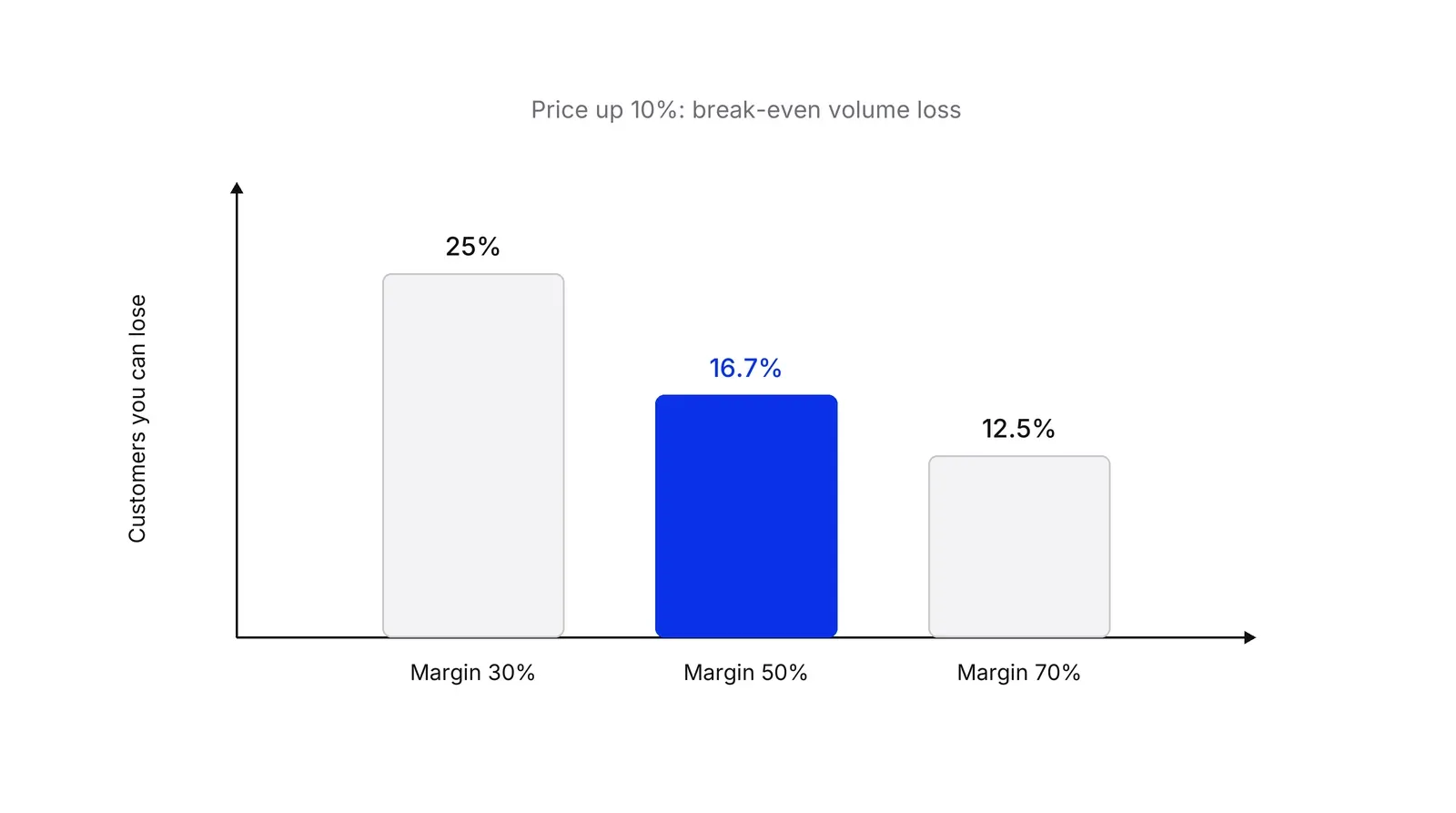
These are arithmetic on illustrative margins. Compare the result with your measured price elasticity and with the value customers get, as in value-based pricing.
How do you segment the base?
Segment by the things that change both churn risk and legal route: plan, tenure, usage, contract type, and consumer or business. A single rise for everyone is the common mistake. Ascarza’s field experiments on retention found that customers at the highest risk of churning are not necessarily the best targets for a retention programme. She recommends targeting on sensitivity to the intervention. For a price rise that means finding who reacts, not only who looks unhappy, and the holdout below is how you find out.
Separate fixed-term from open-ended contracts first. The rules in the next section depend on it. Then separate customers on legacy plans, who often pay far less than the current list, from those on current plans.
Who gets grandfathered?
Grandfathering means existing customers keep the old price while new customers pay the new one. It trades revenue now for trust and lower churn at the moment of the rise. Set an end date or you create a permanent discount.
Netflix shows both versions. In May 2014 it charged new US members 8.99 dollars while existing members kept 7.99 for two years. When the protection ended, about 17 million customers, roughly a third of its base, moved to 9.99. In 2011 it had instead split a bundle into two 7.99 plans, and its shareholder letter acknowledged that this upset many subscribers; Home Media Magazine reported a loss of 810,000 net US subscribers that quarter. These are public cases, and the sources do not isolate the price effect from the plan change.
How much notice is required?
No source we read sets a number of days. The tests are reasonable notice, a stated reason and a genuine right to leave. Rules differ by region:
| Region | What the source says | Source |
|---|---|---|
| EU | Terms letting a seller change terms unilaterally, or raise a price without a right to cancel, are listed as potentially unfair | Directive 93/13/EEC, Annex |
| EU | The contract must set out the reason and method of a price variation, and the right to terminate must be usable in practice | CJEU, RWE Vertrieb |
| UK | Open-ended contracts may change terms with reasonable notice and a free right to leave | Consumer Rights Act 2015, Schedule 2 |
| UK | A fair price clause gives advance notice early enough to act and exit | CMA guidance CMA37 |
| Russia | Unilateral change is allowed only where a code, law or other legal act permits it; between a business and a non-business party the contract can give that right only to the non-business side | Civil Code, Article 310 |
The EU digital content directive sets conditions for modifying a digital service, such as a valid reason in the contract and advance notice, but its Article 19 does not mention price, so price rises fall back on the unfair terms rules above. CMA37 adds that raising a price for an unchanged product, unrelated to costs, is more likely to be unfair. Business-to-business contracts follow their own terms, so read the renewal and price clauses before you plan the date.
How do you tell customers?
Say the new price, the date, the reason and what the customer gets, in plain words from a named person. Fairness research explains why the reason matters. Homburg, Hoyer and Koschate report that repurchase intention after a rise depends mainly on its size and on whether customers see the motive as fair, and that higher satisfaction softens the damage. Campbell found that an increase attributed to a negative motive was judged significantly less fair than the same increase attributed to a positive one. Kahneman, Knetsch and Thaler found respondents accepted price rises that protect profits against rising costs and judged rises that exploit a shift in demand unfair. See Xia, Monroe and Cox for the wider framework.
Do not hide the change in a footer. Amazon’s 2000 random DVD price test, which varied prices on 68 titles, shows what hidden price differences cost: it ended in refunds to 6,896 customers and a policy of giving buyers the lowest test price.
How do you measure churn impact with a holdout?
Keep a random share of one segment on the old price, apply the new price to the rest, and compare churn, downgrades and revenue per customer between the groups. The gap is the effect of the rise. A before and after comparison mixes in seasonality, campaigns and product changes. In Gordon and colleagues’ Facebook study, observational methods often failed to recover the effects that randomised experiments produced, in advertising rather than pricing.
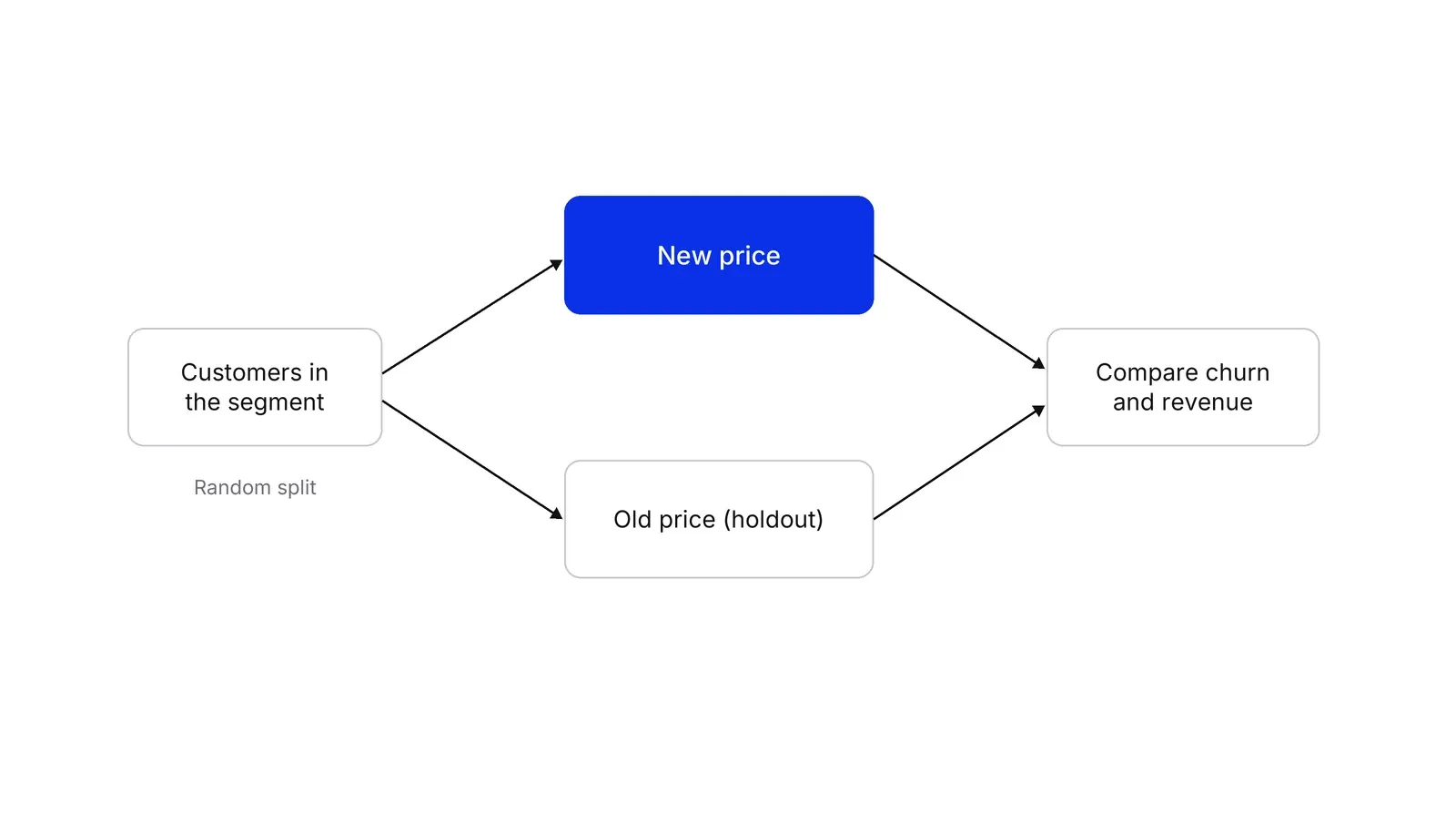
Size the holdout before you start, using minimum detectable effect and sample size and the design in incrementality testing, because churn effects are small and need many customers. Stripe’s guidance is to change one variable and to track perceived unfairness alongside the numbers. Plan the holdout with legal review: charging two prices to similar existing customers can itself draw complaints, so many teams test on new customers or one region first, as Stripe suggests. Kohavi, Tang and Xu cover pitfalls such as carryover. Churned customers are a source for win-back campaigns, and the price move sits inside your subscription model economics.
A Growth Lab plan starts from the segment table and the break-even number, then sets the holdout before any customer is told.
How to apply Price increase playbook, step by step
- Work out the break-even volume loss. For each product, divide the price rise by the new contribution margin as a share of today's price. A 10 percent rise at a 50 percent margin breaks even at a 16.7 percent customer loss. Result: a single number per product that says how much churn the rise can absorb.
- Segment the base. Split customers by plan, tenure, usage, contract type and whether they are consumers or businesses. Mark the segments where the law limits unilateral change. Result: a table of segments with the planned rise, the legal route and the owner of each.
- Decide who is grandfathered, and for how long. Choose between no protection, a fixed grace period and permanent protection for each segment. Put an end date in writing if the protection is temporary. Result: a grandfathering rule per segment that finance can model.
- Check the notice route with a lawyer. Find the clause that allows the change, confirm the reason is stated in the contract, and set a notice period long enough for customers to leave before the new price applies. Result: an approved notice period and a cancellation path with no penalty.
- Write the message. State the new price, the date, the reason and what the customer gets for it, in one short email sent by the account owner or product lead. Result: a template tested on a small group of staff or friendly customers.
- Run the rise with a holdout. Pick one segment, assign a random share of its customers to stay on the old price for the test period, and apply the new price to the rest. Result: two groups whose churn and revenue can be compared directly.
- Read the result and decide the rollout. Compare churn, downgrades and revenue per customer between the groups, then extend, adjust or stop for that segment. Result: a rollout decision with the measured churn gap in it.
Examples
A dental clinic membership
Illustrative numbers, no real clinic implied. A clinic sells a membership at 40 dollars a month to 600 patients and plans a rise to 44 dollars, which is 10 percent. Contribution margin is 60 percent of the old price. Break-even loss is 0.10 divided by 0.70, about 14.3 percent, or 86 patients. If 30 patients leave, profit rises. The clinic keeps patients who have been members for five years on 40 dollars for another year, because they are the most likely to be told in person.
Netflix, 2011: bundle split
In September 2011 Netflix split one plan into two plans at 7.99 dollars each, so customers wanting both paid 15.98. In its Q3 letter the company said it had upset many subscribers, and according to Home Media Magazine it lost 810,000 net US subscribers in the quarter. The case shows what a large rise with little warning can cost.
Netflix, 2014 to 2016: grandfathering with an end date
According to iPhone in Canada, Netflix raised the price for new US members to 8.99 dollars in May 2014 and held existing members at 7.99 for two years. CBS Miami reported that when the protection ended, about 17 million customers, roughly a third of the base, moved to 9.99. A time-limited rule gives you a date to plan the second rise around.
When to use it
Use it when costs have risen, when the product has gained value customers can name, when you are far below competitors with a similar offer, or when you have not raised prices in years. It fits subscriptions and memberships most, because every customer is billed again and has a natural moment to react.
When not to use it
Hold the rise when the product has recently got worse, when the customer is in a service failure or a dispute, when your contract gives you no valid route to change price, or when you cannot measure churn because billing data is incomplete. Fix the cause first.
Common mistakes
- Using one price rise for the whole base, including segments where the contract does not allow a unilateral change.
- Quoting the 11 percent profit gain from a 1 percent price rise without its condition that volume does not fall.
- Giving notice shorter than the time a customer needs to compare alternatives and leave.
- Judging churn by comparing this month with last month, when seasonality and other changes moved at the same time.
- Grandfathering with no end date, so the old price becomes a permanent discount you cannot remove.
FAQ
How much notice do you have to give before raising prices?
No fixed number of days appears in the EU directive or the UK Act. The test is reasonable or effective advance notice, with a real right to leave before the new price applies. The UK CMA says notice must let consumers act to avoid the rise and exit. Check the exact rule for your contract and country.
What does 1% price increase equal in profit?
Marn and Rosiello's 1992 HBR article put it at 11.1 percent more operating profit for an average company, assuming no loss of volume. According to the article's Exhibit 1, the figure rests on average economics of 2,463 companies in Compustat. Your number depends on your margin, so calculate it from your own cost structure.
What is grandfathering in pricing?
Grandfathering means existing customers keep their old price while new customers pay the new one. It protects trust with loyal customers and lowers churn at the moment of the rise. According to iPhone in Canada, Netflix did it in 2014 for two years. The cost is that part of your base pays less for as long as the protection lasts.
How do you measure churn after a price increase?
Keep a random share of comparable customers on the old price and compare churn, downgrades and revenue per customer with the group that got the new price. Before and after comparisons mix in seasonality and other changes. A randomised holdout isolates the effect of the price.
Can you raise prices on existing customers in Russia?
Article 310 of the Civil Code says unilateral change of an obligation is not allowed unless a code, law or other legal act permits it. Where only one side is a business, a contract can grant the right to change terms only to the non-business party. Get legal advice before changing a consumer contract.
Sources
- Harvard Business Review, Michael V. Marn and Robert L. Rosiello, Managing Price, Gaining Profit, September-October 1992
- Marn and Rosiello, Managing Price, Gaining Profit, full text as hosted by the University of North Carolina at Charlotte
- European Union, Council Directive 93/13/EEC on unfair terms in consumer contracts (EUR-Lex)
- European Union, Directive (EU) 2019/770 on contracts for the supply of digital content and digital services (EUR-Lex)
- Court of Justice of the EU, Case C-92/11 RWE Vertrieb AG v Verbraucherzentrale Nordrhein-Westfalen, 21 March 2013 (EUR-Lex)
- UK Parliament, Consumer Rights Act 2015, Schedule 2 (legislation.gov.uk)
- UK Competition and Markets Authority, Unfair contract terms guidance (CMA37), 22 July 2026
- Civil Code of the Russian Federation, Part One, Article 310 (ConsultantPlus)
- Christian Homburg, Wayne D. Hoyer, Nicole Koschate, Customers' Reactions to Price Increases, Journal of the Academy of Marketing Science 33(1), 2005
- Margaret C. Campbell, Perceptions of Price Unfairness: Antecedents and Consequences, Journal of Marketing Research 36(2), 1999
- Lan Xia, Kent B. Monroe, Jennifer L. Cox, The Price Is Unfair! A Conceptual Framework of Price Fairness Perceptions, Journal of Marketing 68(4), 2004
- Daniel Kahneman, Jack L. Knetsch, Richard Thaler, Fairness as a Constraint on Profit Seeking, American Economic Review 76(4), 1986
- Eva Ascarza, Retention Futility: Targeting High-Risk Customers Might Be Ineffective, Journal of Marketing Research 55(1), 2018
- Brett R. Gordon, Florian Zettelmeyer, Neha Bhargava, Dan Chapsky, A Comparison of Approaches to Advertising Measurement, Marketing Science 38(2), 2019
- Ron Kohavi, Diane Tang, Ya Xu, Trustworthy Online Controlled Experiments, Cambridge University Press, 2020
- Stripe, Price testing: how to find the right price to grow revenue and customer trust
- Netflix, shareholder letter, Q3 2011 (SEC Form 8-K exhibit 99.1)
- Home Media Magazine, Netflix posts 810K sub loss in Q3, October 2011
- iPhone in Canada, Netflix increases to 8.99 for new members, existing users stay at 7.99 for 2 years, May 2014
- CBS Miami, Netflix raising prices next month, April 2016
- Amazon.com, statement regarding random price testing, September 2000
Last updated Oct 9, 2026


Marketing agency or growth system: when a company outgrows its agency
An agency is the right call while the founder still runs most of the company. Once the business starts copying itself into new locations or markets, it needs a system that sets goals, tests hypotheses and owns the result.

Why healthcare marketing agencies stall: the short, mid and long wins model we use with clinics
Most agencies own the click and nobody owns the front desk. How we structure clinic work in three horizons, the research behind each one, and one year of results.

Why channel tests stall after month three
Most paid channel tests do not end with a decision. They end when the budget runs out, the attribution model changes, or everyone quietly stops looking at the dashboard.