Paid social account structure
Paid social account structure is how you arrange campaigns, ad sets and ads so the platform's delivery system gets enough conversions per unit to learn, and so reports stay readable.
Paid social account structure is the way campaigns, ad sets and ads are organised in an ad account such as Meta Ads Manager or VK Ads. The campaign holds the objective, the ad set holds audience, placements and often budget, and the ad holds the creative. A good structure uses few ad sets, so each one collects about 50 optimisation events a week and exits Meta's learning phase.
- Origin
- No single author; documented in Meta's Business Help Centre and practised by performance marketers, current guidance as published by Meta, VK, TikTok and Google in 2026
- Level
- 301 · Advanced
- Fits
- Small and mid-size, Scale-up
- Time to apply
- half a day to audit and rebuild one account; two weeks for new ad sets to settle
- What you need
- admin access to the ad account and its last 90 days of results · one conversion event that fires reliably through the pixel or a server-side connection · your average cost per result, to work out how many ad sets the budget can feed · a naming template agreed with whoever reads the reports
Paid social account structure is the way you arrange campaigns, ad sets and ads inside an ad account so the platform’s delivery system gets enough data to optimise and people can still read the reports. Nobody invented it. The rules come from the platforms’ own documentation, mostly Meta’s Business Help Centre, and from media buyers who learned that a tidy-looking account with dozens of narrow ad sets often performs worse than a plain one with three.
The question the structure answers is practical: how do you set up campaigns so the algorithm can learn?
What lives at each level?
Every major social platform uses the same three levels, and each level holds one kind of decision. Meta’s help page puts the objective at the campaign, targeting, budget, schedule and placements at the ad set, and the creative at the ad. VK Ads uses the same three steps, calling the middle level an ad group.
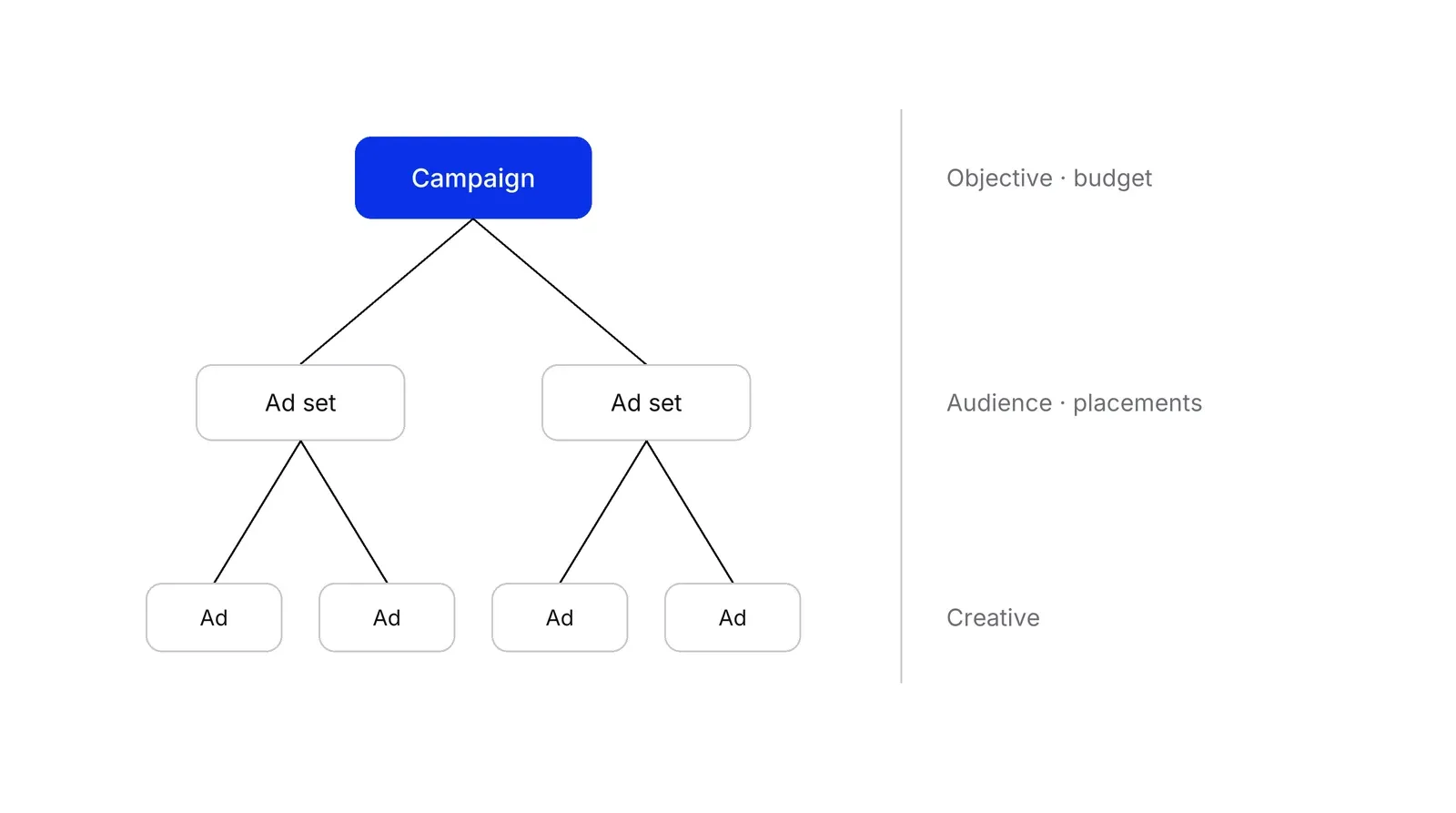
| Level | Meta Ads Manager | VK Ads | What you decide |
|---|---|---|---|
| Campaign | Objective; budget if Advantage+ campaign budget is on | Promoted object, target action, bid strategy, budget | What result to buy |
| Ad set / ad group | Audience, placements, schedule, bid; budget if campaign budget is off | Audience, placements, schedule | Who sees it, and where |
| Ad | Images, video, text, call to action | Text, images, video | What they see |
Two VK details change how you plan. The target action cannot be changed after launch, and budget optimisation, at campaign or ad group level, cannot be switched on, off or moved once ads run, per VK’s budget optimisation page. Decide both before you press publish. Google Ads, for comparison, describes account, campaign and ad group layers, with budget at the campaign.
Why the learning phase sets the number of ad sets
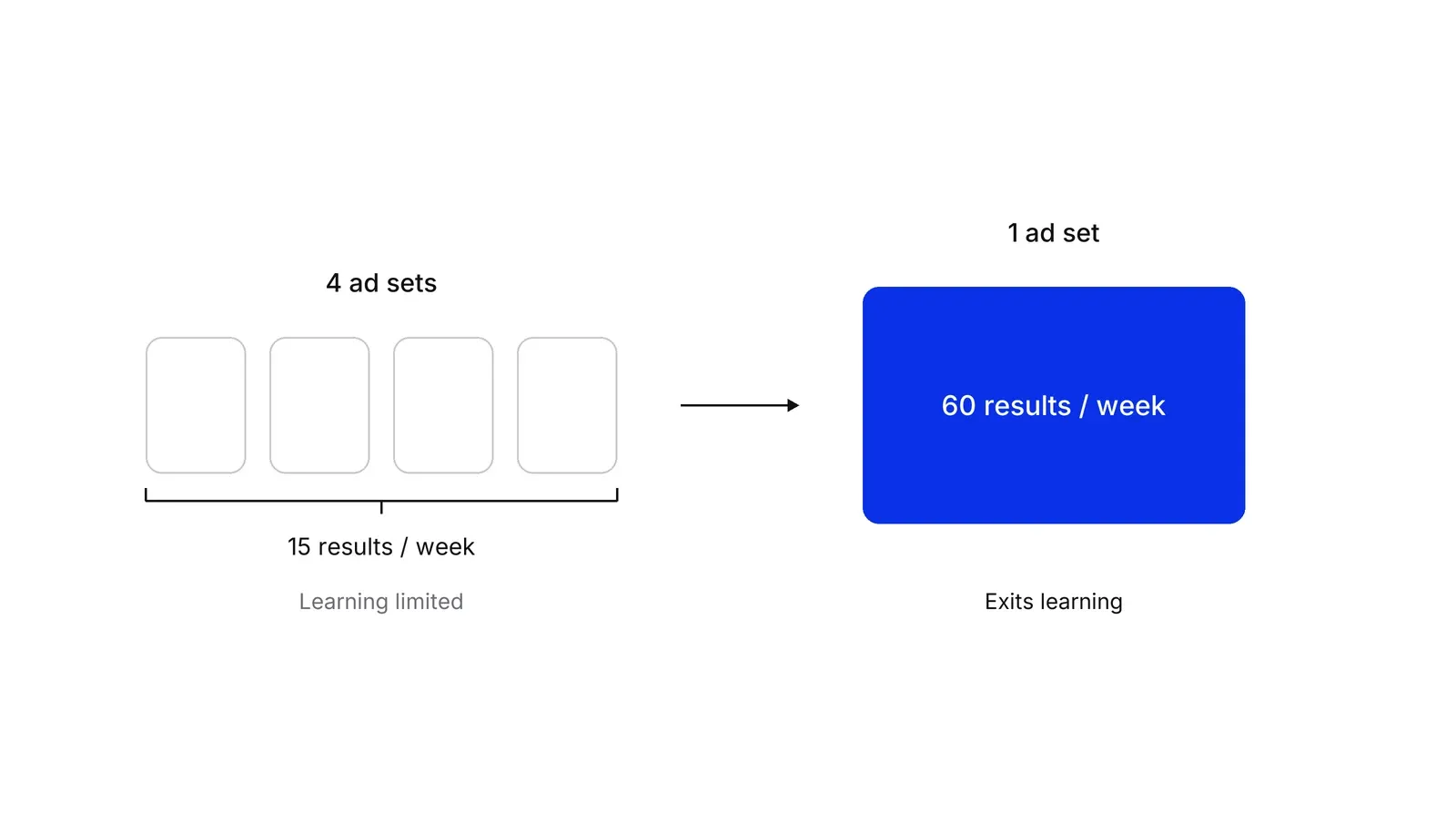
The learning phase is the period when the delivery system is still working out how to deliver a new or heavily edited ad set. Meta says an ad set usually exits it after about 50 results in the week after its last significant edit. If it is unlikely to get there, its status turns to Learning limited, which Meta lists as caused by small audiences, low budgets, low bids, auction overlap, rare optimisation events or too many ads.
Plan the number of ad sets from this threshold. An account buys a fixed number of results per week, and every extra ad set divides them. An account buying 60 leads a week can bring one ad set out of learning. Split across four, each gets 15, and none does.
Other platforms publish different numbers, so do not carry Meta’s 50 everywhere. TikTok says volatility starts to fall after about 25 campaign results or 7 days. Google Ads gives no count and says calibration typically takes one or two conversion cycles. VK Ads help does not publish a learning threshold at all; figures quoted for it come from practitioners, not from VK.
Consolidation: what to merge and what to keep apart
Consolidation means fewer campaigns and ad sets, each with more budget and more results. Meta’s ad volume guidance is specific: combine ad sets split by audience and use breakdowns for reporting, merge small regions into larger ones, use Advantage+ placements instead of one ad set per placement, and put several languages in one ad set. Its fragmentation page gives the example of three ad sets for dogs, dog toys and dog collars that should be one.
There is a second reason to merge. When ad sets overlap, Meta lets only the highest-value ad from the same advertiser enter a given auction, so the rest sit out. Meta adds that separate ad accounts may not avoid this.
Keep things apart when they truly differ: a different optimisation event, a different offer for existing customers, a market with its own legal rules or a budget someone else owns. Meta itself recommends Advantage+ audience for almost every campaign type except retargeting, which is a fair line between cold and warm traffic (see audience temperature).
What Advantage+ campaigns change
Advantage+ campaigns hand three ad set decisions to Meta: audience, placements and budget. For the sales, app promotion and leads objectives, Ads Manager now opens in an Advantage+ setup, though manual settings remain available. Meta reports that Advantage+ sales campaigns improved cost per conversion by 9% on average. That is Meta’s own figure with no published method, so treat it as a claim to test, not a forecast.
With broad targeting, the advertiser still shapes who sees the ads, mainly through the creative: Muhammad Ali and colleagues found that ad content and budget alone skewed who saw ads even when targeting was neutral. Meta’s Andromeda engineering post describes a system built for far more ads per advertiser. Distinct concepts matter more than distinct ad sets, which is why the creative testing framework sits next to this one.
Read results where the budget is optimised
The breakdown effect is Meta’s term for a common misreading: thinking the system moved spend into a worse ad set, placement or ad. Its help page says to judge results at campaign level with Advantage+ campaign budget, and at ad set level for placements or several ads in one ad set. VK says the same about its campaign budget optimisation.
The same logic limits what an account can tell you about ads. Michael Braun and Eric Schwartz show in the Journal of Marketing that platforms deliver each ad to a different, optimised mix of people. Two ad sets side by side are not an experiment; use the platform’s A/B tool.
Edits, budgets and naming
On Meta, significant edits restart learning: any change to targeting, creative or optimisation event, adding an ad, changing bid strategy, or pausing for seven days or more. Budget changes depend on size; Meta’s example is that USD 100 to 101 is unlikely to reset an ad set, while USD 100 to 1,000 may. VK’s bid strategy page suggests raising budgets by about 15 to 20% a day.
Names are part of the structure. Meta allows one name template per level per ad account, built from campaign fields, free text and drop-downs. Copy the same pattern into UTM tags: Google Analytics treats values as case sensitive and recommends lowercase, while VK Ads adds campaign and ad IDs to UTMs automatically by default. In Pushers’ Growth Lab work, the naming template is agreed before the first campaign goes live, because renaming later breaks report history.
How to apply Paid social account structure, step by step
- Count what the budget can feed. Divide weekly spend by cost per result. That is the number of optimisation events the account produces per week. Divide by 50 to get the most ad sets Meta can bring out of learning at once. Result: a hard ceiling, for example 60 results a week supports one learning ad set, not four.
- Group by objective and conversion event. Make one campaign per business goal and optimisation event: purchases, leads, app installs. Keep prospecting and retargeting apart only when they need different events or offers. Result: a short list of campaigns, each with one clear objective.
- Merge ad sets that differ only in targeting detail. Combine ad sets split by interest, small region, placement or language. Use Advantage+ audience or broad targeting with Advantage+ placements, and read age, region and placement through breakdowns. Result: one to three ad sets per campaign, each forecast to reach about 50 results a week.
- Put variety into the creative, not the ad sets. Load each ad set with a few distinct concepts. On Meta one ad can hold up to ten creative assets. Test new concepts in a proper A/B test rather than by adding ad sets. Result: fewer, richer ads that give the system real choices.
- Name everything with one template. Set a name template per level in Ads Manager and mirror it in UTM tags: market, objective, audience type, concept, launch date. Result: a report anyone can filter without asking the media buyer what an ad set means.
- Change slowly and log every edit. Batch edits, avoid pausing for a week or more, and raise budgets in steps. VK Ads recommends increases of about 15 to 20% a day for cost-capped campaigns. Result: ad sets that stay out of learning and a log that explains every reset.
Examples
Meta's two-placement breakdown example
Meta's help page on the breakdown effect describes a campaign with a USD 500 budget across Facebook Stories and Instagram Stories. Facebook started cheaper, at USD 0.35 per result against 0.72, so the system tested both and then moved spend. Final numbers: Instagram Stories got USD 450 at USD 1.46 per result, Facebook Stories USD 50 at USD 1.10. Facebook looks cheaper on paper, but Meta's table shows its cost rising to USD 5.30 by day 10. Judged at the ad set level, where the budget was optimised, the split was right.
A dental clinic with four interest ad sets
Illustrative, no real clinic implied. A clinic spends USD 1,500 a week on Meta at about USD 25 per lead, so roughly 60 leads a week. Its media buyer runs four ad sets: implants, braces, whitening and a lookalike, each with a quarter of the budget. Each gets about 15 leads a week, so all four show Learning limited. Merging them into one ad set with broad targeting and four creative concepts gives about 60 leads a week in one place, above the 50 Meta looks for. Breakdowns still show which age groups book.
A fintech app on VK Ads
Illustrative. A payments app runs VK Ads with campaign budget optimisation on and three ad groups: Moscow, Saint Petersburg and other regions. VK's help says that with campaign optimisation results must be judged at campaign level, and that optimisation cannot be switched on or off after launch. So the team decides the budget mode before launch, compares regions through statistics rather than by turning ad groups off, and leaves the target action alone, because VK does not allow changing it once ads run.
When to use it
Use it when you set up a new ad account, when most ad sets show Learning or Learning limited, when cost per result swings week to week without an obvious cause, or when nobody can read the account without the person who built it. It matters most for accounts spending enough for one to ten ad sets to collect about 50 results a week.
When not to use it
Do not consolidate when ad sets really need different objectives, conversion events, legal disclaimers or budgets owned by different teams; merge those and you lose control you need. Very small accounts that cannot reach 50 results a week in any setup gain little from restructuring; switch to a more frequent event first. Structure also cannot answer whether ads cause sales; that takes a lift test.
Common mistakes
- Splitting ad sets by interest, region or placement to get cleaner reports. Meta's own guidance is to combine them and use breakdowns, because splitting divides the learning.
- Comparing ad sets inside one campaign and calling it a test. Delivery is optimised, not random, so the comparison mixes creative with who the system chose to show it to.
- Judging a campaign with Advantage+ campaign budget ad set by ad set, then switching off the ad set with the higher cost per result. Meta calls this misreading the breakdown effect.
- Editing every day. Changes to targeting, creative, optimisation event or bid strategy, and adding ads, all send an ad set back into learning on Meta.
- Naming campaigns ad hoc. Mixed cases and missing UTM fields split one campaign into several rows in Google Analytics, which treats Facebook and facebook as different values.
FAQ
How many ad sets should a Facebook campaign have?
As many as the budget can feed with about 50 results a week each, and usually no more than a few. Divide weekly results by 50 to get the ceiling. Meta says Advantage+ campaign budget is best suited to campaigns with at least two ad sets, so one to three is a common range for most small and mid-size accounts.
What is the learning phase in Facebook ads?
It is the period after you create an ad set or make a significant edit, when Meta's delivery system is still exploring how to deliver it. Results are less stable and cost per result is usually higher. Ad sets normally exit after about 50 results in the week after the last significant edit; otherwise they show Learning limited.
Should I use campaign budget or ad set budgets?
Use campaign budget, which Meta calls Advantage+ campaign budget, when ad sets share a goal and you are happy for spend to flow to the best opportunities. Use ad set budgets when each ad set must get a fixed amount, for example a country with a contractual spend. With campaign budget, read results at campaign level.
How is a VK Ads campaign structured?
VK Ads uses three levels. The campaign sets the promoted object, target action, bid strategy and budget. The ad group sets audience, placements and schedule. The ad holds text, images or video. Budget optimisation can run at campaign or ad group level and, like the target action, cannot be changed after launch.
How should I name ad campaigns?
Use the same fields in the same order at every level, separated by one character, for example market_objective_audience_concept_date. Meta's name templates can build names from campaign fields and drop-down lists, one template per level per ad account. Use lowercase and copy the campaign name into utm_campaign so analytics matches the ad account.
Sources
- Meta Business Help Centre, About the learning phase
- Meta Business Help Centre, Significant edits and learning phase
- Meta Business Help Centre, About learning limited
- Meta Business Help Centre, About managing ad volume
- Meta Business Help Centre, Combine ad sets and campaigns in Meta Ads Manager to reduce audience fragmentation
- Meta Business Help Centre, Understand auction overlap
- Meta Business Help Centre, What are campaigns, ad sets and ads in Meta Ads Manager?
- Meta Business Help Centre, About Advantage+ campaign budget
- Meta Business Help Centre, About the breakdown effect when advertising on our system
- Meta Business Help Centre, About Advantage+ sales campaigns
- Meta Business Help Centre, About the Advantage+ campaign experience
- Meta Business Help Centre, About Advantage+ audience
- Meta Business Help Centre, Choose ad placements in Meta Ads Manager
- Meta Business Help Centre, Create a name template in Meta Ads Manager
- Meta Business Help Centre, Apply a name template in Meta Ads Manager
- Engineering at Meta, Meta Andromeda: Supercharging Advantage+ automation with the next-gen personalized ads retrieval engine, December 2024
- VK Ads Help, Как создать рекламу (How to create an ad)
- VK Ads Help, Оптимизация бюджета (Budget optimisation)
- VK Ads Help, Стратегии ставок (Bid strategies)
- VK Ads Help, UTM-метки (UTM tags)
- TikTok Ads Manager Help, About Learning Phase
- Google Ads Help, Duration of the learning period for campaigns and what affects it
- Google Ads Help, About your account organization
- Google Analytics Help, URL builders: Collect campaign data with custom URLs
- Michael Braun, Eric M. Schwartz, Where A/B Testing Goes Wrong: How Divergent Delivery Affects What Online Experiments Cannot (and Can) Tell You About How Customers Respond to Advertising, Journal of Marketing 89(2), 2025
- Muhammad Ali et al., Discrimination through optimization: How Facebook's ad delivery can lead to skewed outcomes, Proceedings of the ACM on Human-Computer Interaction (CSCW), 2019
Last updated Oct 9, 2026


Marketing agency or growth system: when a company outgrows its agency
An agency is the right call while the founder still runs most of the company. Once the business starts copying itself into new locations or markets, it needs a system that sets goals, tests hypotheses and owns the result.

Why healthcare marketing agencies stall: the short, mid and long wins model we use with clinics
Most agencies own the click and nobody owns the front desk. How we structure clinic work in three horizons, the research behind each one, and one year of results.

Why channel tests stall after month three
Most paid channel tests do not end with a decision. They end when the budget runs out, the attribution model changes, or everyone quietly stops looking at the dashboard.