Strategy execution office
A strategy execution office is a small corporate unit that owns the routines that carry a strategy out, from translating it into targets to reviewing it every month, without setting the strategy itself.
A strategy execution office, which Robert Kaplan and David Norton named the Office of Strategy Management in Harvard Business Review in 2005, is a small corporate unit that owns the process of carrying a strategy out. It works like the executive team's chief of staff: it designs, runs and joins up planning, budgeting and review routines, but does not set the strategy.
- Origin
- Robert S. Kaplan and David P. Norton, 2005; The Execution Premium 2008
- Level
- 401 · Expert
- Fits
- Enterprise
- Time to apply
- Two to four weeks to design the mandate and name the team; one to two quarters to run a full cycle
- What you need
- an executive sponsor, usually the CEO, who will chair the strategy review · a list of the strategy routines you already run: planning, budgeting, scorecards, reviews · three to eight people with strategy, finance or operations experience
A strategy execution office is a small unit at the centre of a company that owns the routines which carry a strategy out. Robert Kaplan and David Norton proposed it in a 2005 Harvard Business Review article under the name Office of Strategy Management, and developed it in their 2008 book The Execution Premium. The idea answers one question: who in this company is responsible for making the strategy happen, week after week, when the executives are busy with everything else?
Why plans stall
Plans fail in the handover between planning and operations, and nobody owns the handover. The 2005 article opens with the claim that most companies have ambitious growth plans and few realize them. It cites Chris Zook and James Allen’s study of 1,854 large corporations, in which seven of eight failed to achieve profitable growth although about 90% had detailed strategic plans. Bain’s own book page gives a different share for the same research, 11% of companies meeting the growth test, so treat the exact ratio as approximate.
Other sources point the same way. Michael Mankins and Richard Steele wrote in Harvard Business Review that most strategies deliver only 63% of their promised financial value. Lawrence Hrebiniak, a Wharton professor, said in 2005 that in a Wharton-Gartner survey of 223 managers the top problem was managing change and overcoming internal resistance. The widely quoted claim that 50% to 90% of strategies fail is disputed: a 2015 review in the Journal of Management & Organization found that the estimates rest on outdated, fragmentary or absent evidence and that the true rate remains to be determined. The gap is real. Its size is not settled.
The six-stage loop
The office exists to run a six-stage loop. In a 2010 working paper Kaplan lists the stages as develop the strategy, translate it, align the organization, plan operations, monitor and learn, and test and adapt. The publisher’s description of The Execution Premium groups the same ground into four parts: develop strategy, plan execution, implement, and test and update. The two descriptions differ in how many boxes they draw, not in what they cover.
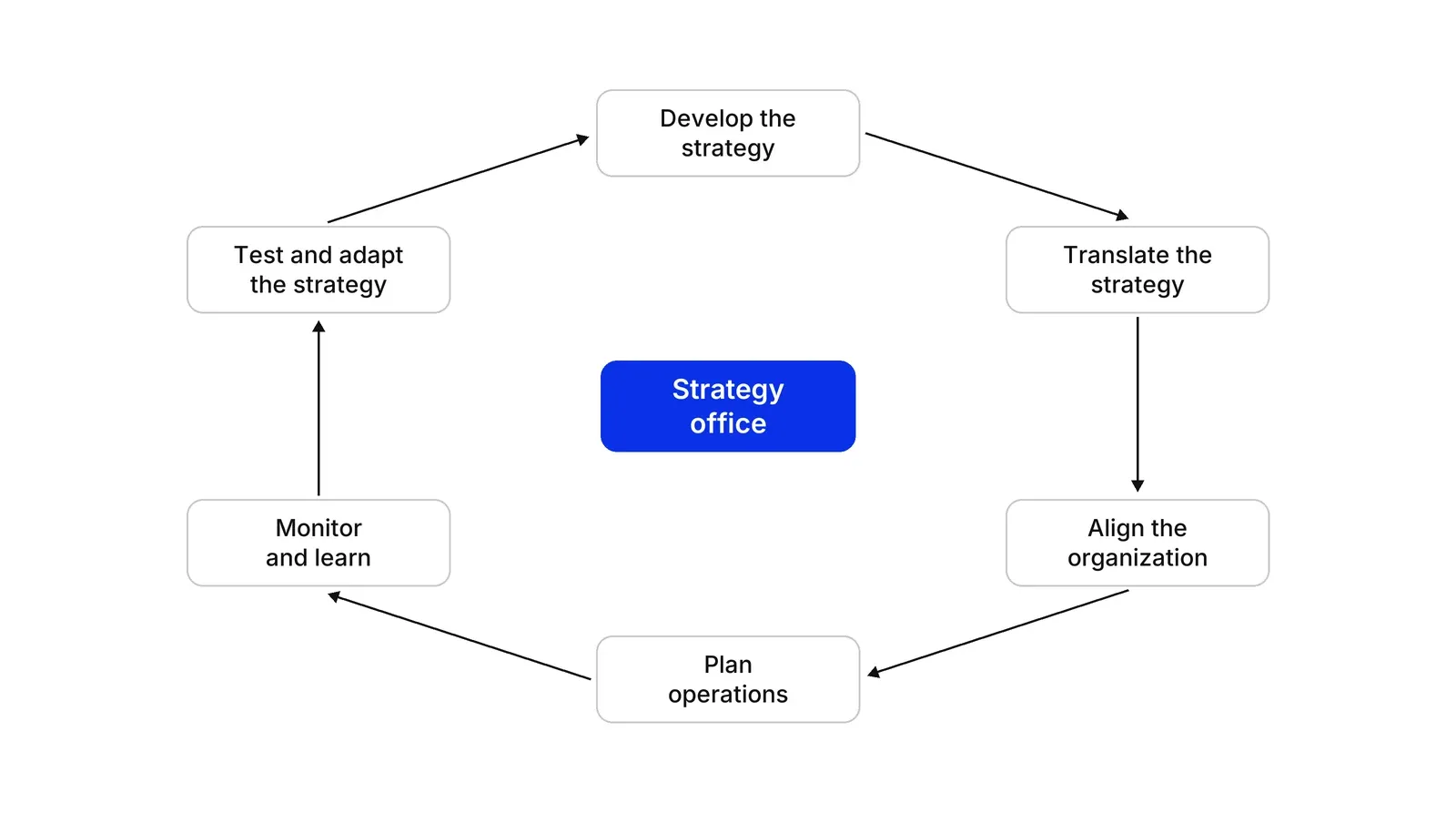
The loop is the end point of about fifteen years of scorecard work. The 1992 article argued that financial measures alone send misleading signals, and the 2007 reprint of the scorecard paper adds customer, internal process and learning perspectives. The 2000 map article turned objectives into a picture, and the 2004 readiness article added a check on people, systems and culture. The book Alignment argued that headquarters should coordinate business and support units, which is the job the office later took on.
Most of these stages already exist somewhere. Finance runs budgeting, HR runs goals, operations runs process improvement. Kaplan notes that other pieces, such as strategy maps and scorecards, are new processes with no natural home in the existing structure. A strategy map draws objectives as a cause-and-effect chain, and a scorecard attaches measures and targets to them. Goals written as OKRs or deployed through hoshin kanri fill the same slot in the loop.
What the office does: architect, owner, integrator
The office has three roles. Kaplan and Norton describe it as the architect of the missing processes, the owner of the processes that cross departments, and the integrator of the activities that already exist. In the Execution Premium interview at Harvard Business School, the owner role covers strategy development, translation and the senior strategy review meetings, and the integrator role covers budgeting, communications, HR and IT planning and initiative management, working with their current owners.
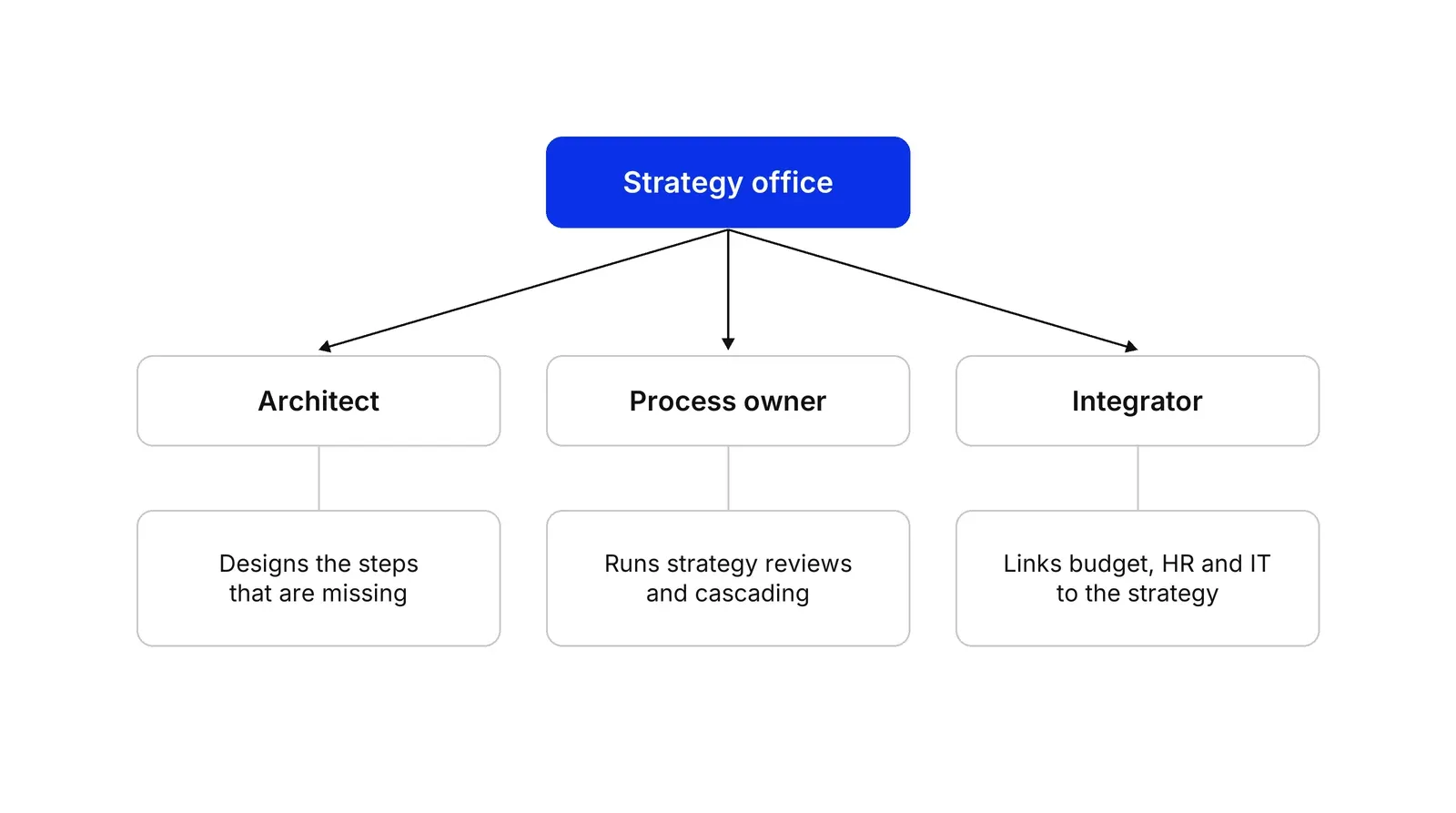
The limits matter as much as the roles. In a separate Kaplan and Pateman interview the office owns scorecard management and cascading, coordinates budgeting, operational planning and performance management, and does not dictate strategy or take over work done by finance, IT or HR. It runs the cadence that an operating rhythm sets for a whole company, but for the strategy only.
Size, place and how it is staffed
The authors put the typical size at three to five people in smaller offices and six to eight in large, complex companies. Staff usually come from the scorecard team, strategic planning or finance. The office reports close to the CEO, and the CEO matters more than the office: Kaplan and Norton say in the Execution Premium interview that the CEO led the effort in every Balanced Scorecard Hall of Fame case they cite, and Kaplan’s 2010 paper says that failed scorecard programs usually traced back to a lack of executive leadership.
How it differs from nearby roles
| Strategy execution office | Strategic planning unit | Project or portfolio office | Chief strategy officer | |
|---|---|---|---|---|
| Main job | Owns the loop from strategy to review | Produces the strategic plan | Tracks projects and their delivery | Senior executive for strategy |
| Covers execution | Yes | Little or no influence, per Kaplan and Pateman | Yes, for projects | Varies |
| Typical output | Scorecard, review pack, aligned budget | Plan document | Project register, portfolio ranking | Strategy and deals |
Henry Mintzberg wrote in 1994 that planning had split conceptual work from execution, which is the split the office is meant to close. Kaplan and Pateman say an enhanced planning unit is a natural home for the office. Research on related roles is thin and does not settle the question. Menz and Scheef studied S&P 500 firms over five years and found that a chief strategy officer was more likely to sit in the top team where diversification, acquisition activity and role interdependence were higher, and that having one did not significantly affect financial performance. Angwin, Paroutis and Mitson interviewed senior strategy directors and describe their role as shaping, connecting and executing strategy. Unger, Gemünden and Aubry describe three roles for a portfolio management office.
What the evidence does and does not show
The case for the office comes from the authors’ client work, and we found no independent study that measures whether an office improves results. Kaplan and Pateman name the U.S. Army, Chrysler Group and Canadian Blood Services as early adopters without outcome figures. The scorecard idea behind it has critics: Nørreklit’s 2000 paper challenged some of its assumptions. Mintzberg and Waters argued in 1985 that strategies take shape in more ways than formal plans, which is a reason to keep the last stage, testing and adapting, in the loop. A review cycle run quarterly, as in quarterly planning, gives it a natural slot. A Growth Lab plan starts from the same idea: one named owner for every stage between a goal and its results.
How to apply Strategy execution office, step by step
- List the strategy routines and their owners. Write down every process that touches strategy: annual planning, budgeting, objectives, initiative tracking, review meetings, incentives. Note who runs each one today. Result: a map that shows which routines have no owner and which have three.
- Set the mandate and the reporting line. Decide that the office facilitates and coordinates, and that strategy choices stay with the CEO and business-unit heads. Place it close to the CEO, as a chief of staff would sit. Result: a one-page charter that says what the office owns, what it coordinates and what it never decides.
- Staff it from people you already have. Kaplan and Pateman describe three to five people in smaller offices and six to eight in large, complex companies, usually drawn from planning, finance or an existing scorecard team. Result: a named team with strategic thinking, people skills, project management and operating experience.
- Draw the closed loop and assign each stage. Take the six stages (develop, translate, align, plan operations, monitor and learn, test and adapt) and mark each as owned, coordinated or supported by the office. Result: a loop with one accountable name on every stage.
- Run a strategy review that is separate from the operating review. Hold a regular meeting, monthly or quarterly, with one agenda: are the strategic objectives and initiatives on track, and what must change. Keep firefighting out of it. Result: a dated calendar of reviews with a standard pack and a list of decisions taken.
- Connect budget, initiatives and incentives to the strategy. Work with the CFO and HR so that funding, initiative selection and personal goals refer to the same objectives. Result: a budget that shows which strategic objective each large line serves.
- Test the strategy once a year. Use results and outside data to challenge the strategy itself, and feed the answer into the next planning round. Result: a short note that keeps, changes or drops each strategic assumption.
Examples
A payments company with a plan nobody tracks
Illustrative. A 600-person payments firm sets four goals each January. Finance budgets by department, product runs its own roadmap, and nobody checks the goals until the next January. The CEO appoints a four-person office from finance and strategy. It builds a scorecard, ties the budget to the four goals, and runs a monthly strategy review chaired by the CEO. In month three the review shows that a goal on cross-border volume has no funded initiative. The point is the gap the routine exposes, not a result we claim.
A clinic network with several owners of the same goal
Illustrative. A network of 12 clinics wants more repeat visits. Marketing owns reminders, operations owns scheduling and the medical director owns recall policy. Each reports its own numbers. A small office does not take over any of these jobs. It maps them to one objective, sets one shared measure and puts the three owners in one monthly review. Coordination is the product.
Canadian Blood Services and others, documented
Kaplan and Pateman name the U.S. Army, Chrysler Group and Canadian Blood Services as early adopters of the office and say the effects are felt most keenly there. The Harvard Business School interview gives no outcome figures for them, so we cannot say how much the office contributed.
When to use it
Use it when the company has a written strategy, several units and support functions that each run their own planning, and results that keep falling short of plans. It suits larger organizations where strategy, budget, HR and IT calendars do not meet, and where a scorecard or objectives system already exists but has no owner.
When not to use it
Skip a dedicated office in a team of a few dozen people, where the CEO and one chief of staff can run the cycle. Do not create one to write the strategy for the executives, to police other departments or to duplicate finance, HR or IT work. Do not create one without a sponsor who chairs the review.
Common mistakes
- Letting the office set the strategy. Kaplan and Pateman say it should not dictate strategy or take over work that finance, IT or HR already do. It facilitates, coaches and coordinates.
- Starting without the CEO. Kaplan reports that failed scorecard programs usually traced back to a lack of executive leadership, often when staff groups introduced the tool without the CEO's commitment.
- Reorganizing instead of fixing routines. Neilson, Martin and Powers wrote in [Harvard Business Review](https://hbr.org/2008/06/the-secrets-to-successful-strategy-execution) that leaders reach first for the organization chart when strategy stalls. Redrawing boxes does not add a review, a measure or an owner.
- Mixing the strategy review with the operating review. Urgent problems crowd out long-term questions when both share one agenda.
- Building a reporting bureaucracy. A pack that nobody reads is a cost. Keep the review to the objectives, measures and initiatives that carry the strategy.
FAQ
What is a strategy execution office?
It is a corporate unit that owns and joins up the processes that carry a strategy out. Kaplan and Norton called it the Office of Strategy Management in 2005 and compared it to a general's chief of staff. It does not create strategy and does not hold line authority.
Who is responsible for strategy execution in a company?
The CEO and line leaders. In Kaplan and Norton's account, the CEO led strategy development and implementation in every Balanced Scorecard Hall of Fame case they cite. The office supports them by running the routines, such as translation, cascading and review meetings, so that execution does not depend on memory or goodwill.
How is it different from a project management office?
A project management office tracks projects and their delivery. A strategy execution office owns the wider loop: translating strategy into objectives, aligning budgets and incentives, running strategy reviews and testing the strategy. It can use a portfolio office as one input, but its scope is the strategy, not the project list.
How many people does a strategy execution office need?
Kaplan and Pateman say large, complex companies typically need about six to eight full-time staff and smaller offices three to five. Most staff come from the scorecard team, strategic planning or finance, not new hires. These figures are the authors' observation from client work, not a measured optimum.
Do you need a balanced scorecard to have one?
No. Kaplan and Pateman say a scorecard is important but not necessary, and that an office can be built by asking the same questions about measuring strategy, allocating resources and making strategy understood. Most offices they describe grew out of a scorecard program.
Sources
- Robert S. Kaplan, David P. Norton, The Office of Strategy Management, Harvard Business Review, October 2005
- Harvard Business School Working Knowledge, The Office of Strategy Management (Kaplan and Pateman interview)
- Harvard Business School Working Knowledge, Strategy Execution and the Balanced Scorecard
- Harvard Business Review Press, Robert S. Kaplan, David P. Norton, The Execution Premium, 2008
- Robert S. Kaplan, Conceptual Foundations of the Balanced Scorecard, Harvard Business School Working Paper 10-074, 2010
- Harvard Business Review Press, Robert S. Kaplan, David P. Norton, Alignment, 2006
- Robert S. Kaplan, David P. Norton, The Balanced Scorecard: Measures that Drive Performance, Harvard Business Review, January-February 1992
- Robert S. Kaplan, David P. Norton, Using the Balanced Scorecard as a Strategic Management System, Harvard Business Review, July-August 2007 reprint
- Robert S. Kaplan, David P. Norton, Having Trouble with Your Strategy? Then Map It, Harvard Business Review, September-October 2000
- Robert S. Kaplan, David P. Norton, Measuring the Strategic Readiness of Intangible Assets, Harvard Business Review, February 2004
- Michael C. Mankins, Richard Steele, Turning Great Strategy into Great Performance, Harvard Business Review, July-August 2005 (Bain & Company reprint page)
- Chris Zook, James Allen, Profit from the Core, Bain & Company
- Carlos J. F. Cândido, Sérgio P. Santos, Strategy implementation: What is the failure rate?, Journal of Management & Organization 21(2), 2015
- Gary L. Neilson, Karla L. Martin, Elizabeth Powers, The Secrets to Successful Strategy Execution, Harvard Business Review, June 2008
- Knowledge at Wharton, Lawrence Hrebiniak, Got a Good Strategy? Now Try to Implement It, 2005
- Henry Mintzberg, The Fall and Rise of Strategic Planning, Harvard Business Review, January-February 1994
- Henry Mintzberg, James A. Waters, Of strategies, deliberate and emergent, Strategic Management Journal 6(3), 1985
- Markus Menz, Christine Scheef, Chief strategy officers: Contingency analysis of their presence in top management teams, Strategic Management Journal 35(3), 2014
- Duncan Angwin, Sotirios Paroutis, Sarah Mitson, Connecting up Strategy: Are Senior Strategy Directors a Missing Link?, California Management Review 51(3), 2009
- Barbara Unger, Hans Georg Gemünden, Monique Aubry, The three roles of a project portfolio management office, International Journal of Project Management 30(5), 2012
- Hanne Nørreklit, The balance on the balanced scorecard: a critical analysis of some of its assumptions, Management Accounting Research 11(1), 2000
Last updated Oct 9, 2026


Fractional COO or embedded operations team? How to choose at Series A
The two models solve different problems: how to tell which one your company needs, and what each costs in time and control.

What operational systems successful fintech startups use: lessons from ten companies
Starling, Monzo, Qonto, bunq, Lunar, Pleo, Tide, Ramp, Mercury and Column scaled on four operating systems. Regulators' findings show what breaks when one of them lags behind growth.

What a revenue operations manager actually owns
Pipeline definitions, CRM hygiene, forecasting and the handoffs between marketing, sales and success. What the role covers, and how it differs from sales ops.