Zero-click search strategy
A zero-click search strategy accepts that many searches now end on the results page, sorts your queries by how likely they are to send a visit, and builds growth on being quoted, remembered and findable instead of on clicks alone.
A zero-click search strategy is a plan for growing when a large share of Google searches ends without a visit to any website. You sort queries by how likely they are to send a click, write answers that can be quoted on the results page with your name attached, move conversions onto Google's own surfaces, and measure impressions, branded search and calls instead of sessions.
- Origin
- SparkToro (Rand Fishkin), using clickstream panels from Jumpshot, Similarweb and Datos, 2019 to 2026
- Level
- 401 · Expert
- Fits
- Small and mid-size, Scale-up
- Time to apply
- one afternoon to sort your queries; a quarter before the trend lines mean anything
- What you need
- Search Console access with at least three months of query data · a Google Business Profile, if you serve customers in a place · one person who owns the weekly numbers
A zero-click search strategy is a way of growing when search sends fewer visits than it used to. A zero-click search is one that ends on the results page, with no visit to any website. SparkToro, the audience-research company led by Rand Fishkin, has published estimates of the share of such searches since 2019, each from a different clickstream panel (a group of volunteers whose browsing is recorded). The strategy that follows from the numbers is to stop treating the click as the only proof that content worked.
How many Google searches end without a click?
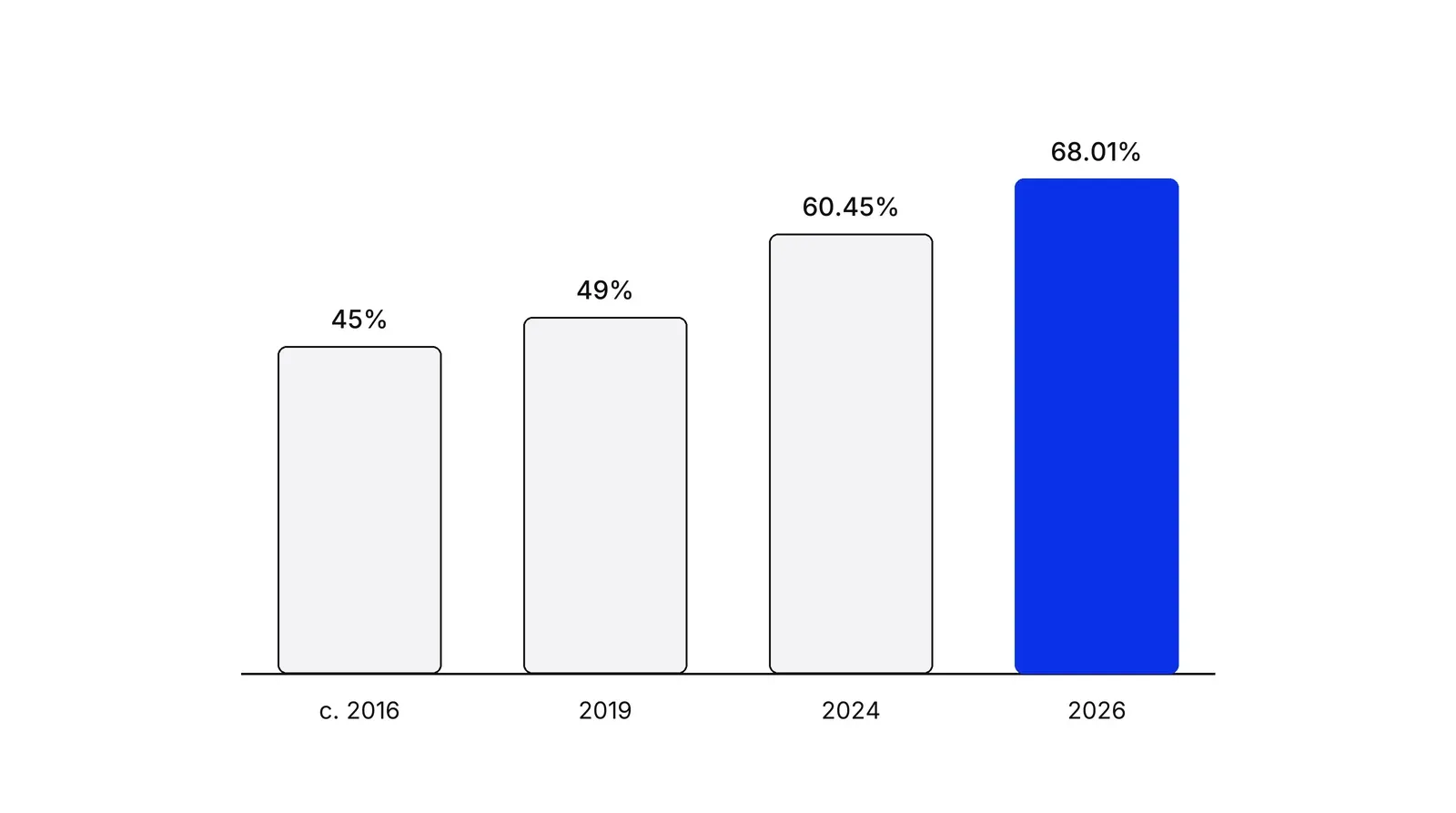
Between 58% and 68% of US Google searches ended without a click in the latest SparkToro studies, depending on year, panel and definition. The table shows what each study measured, because the numbers are not interchangeable.
| Study | Panel and region | Period | Headline |
|---|---|---|---|
| SparkToro, 2024 | Datos, US and EU, desktop and Android | Sep 2022 to May 2024 | 58.5% zero-click in the US, 59.7% in the EU; 374 clicks to the open web per 1,000 US searches, 360 in the EU |
| SparkToro, 2026 | Similarweb, US, desktop and mobile web | Jan to Apr 2026 | 68.01% zero-click |
The authors state their own limits. Datos, the 2024 panel provider, now publishes a quarterly State of Search report from its clickstream. The 2024 panel did not include iPhones and may have counted too many ad-blocker users, so paid clicks were probably understated. The 2026 post calls the comparison across years “a bit of apples and oranges”, covers mobile browsers but not the Google app, and estimates mobile paid clicks. It also restates the 2024 figure as 60.45%, not 58.5%, which is why you should compare only within one study’s series. For 2019, SparkToro’s own pages differ: the 2021 post calls it 50.33%, and the 2026 post lists 49%.
Why are clicks falling?
Part of the answer is Google answering questions itself, and part is AI summaries on the results page. Pew Research Center tracked 900 US adults in March 2025. Visits to a page with an AI summary led to a click on a traditional result 8% of the time, against 15% without one. Pew notes this is an association, not proof of cause, and the panel is opt-in.
Ahrefs compared 300,000 keywords and found the top result’s click-through rate about 58% lower with an AI Overview present, December 2025 against December 2023. That figure is a modeled estimate, covers desktop only, and comes from a company that sells SEO tools. Similarweb data reported in July 2025 put zero-click news searches at 69% in May 2025, up from 56% in May 2024, when AI Overviews launched in the US; Search Engine Roundtable notes AI Overviews appear less often on news queries, and Google questions such studies. Similarweb’s publisher report puts the drop in organic traffic to news sites at 26% since AI Overviews began. A preregistered field experiment by Wang and colleagues, with 1,100 participants, found that removing AI Overviews and AI Mode raised clicks to publishers. It is a draft paper and Google’s behavior may change.
Google disagrees with the framing. In August 2025 Liz Reid wrote that click volume from Search was relatively stable year over year and that quality clicks had risen. Both claims can hold at once for different sites and query types. Google also says sites in these features are counted in Search Console, with no extra optimization required.
Which searches still send clicks?
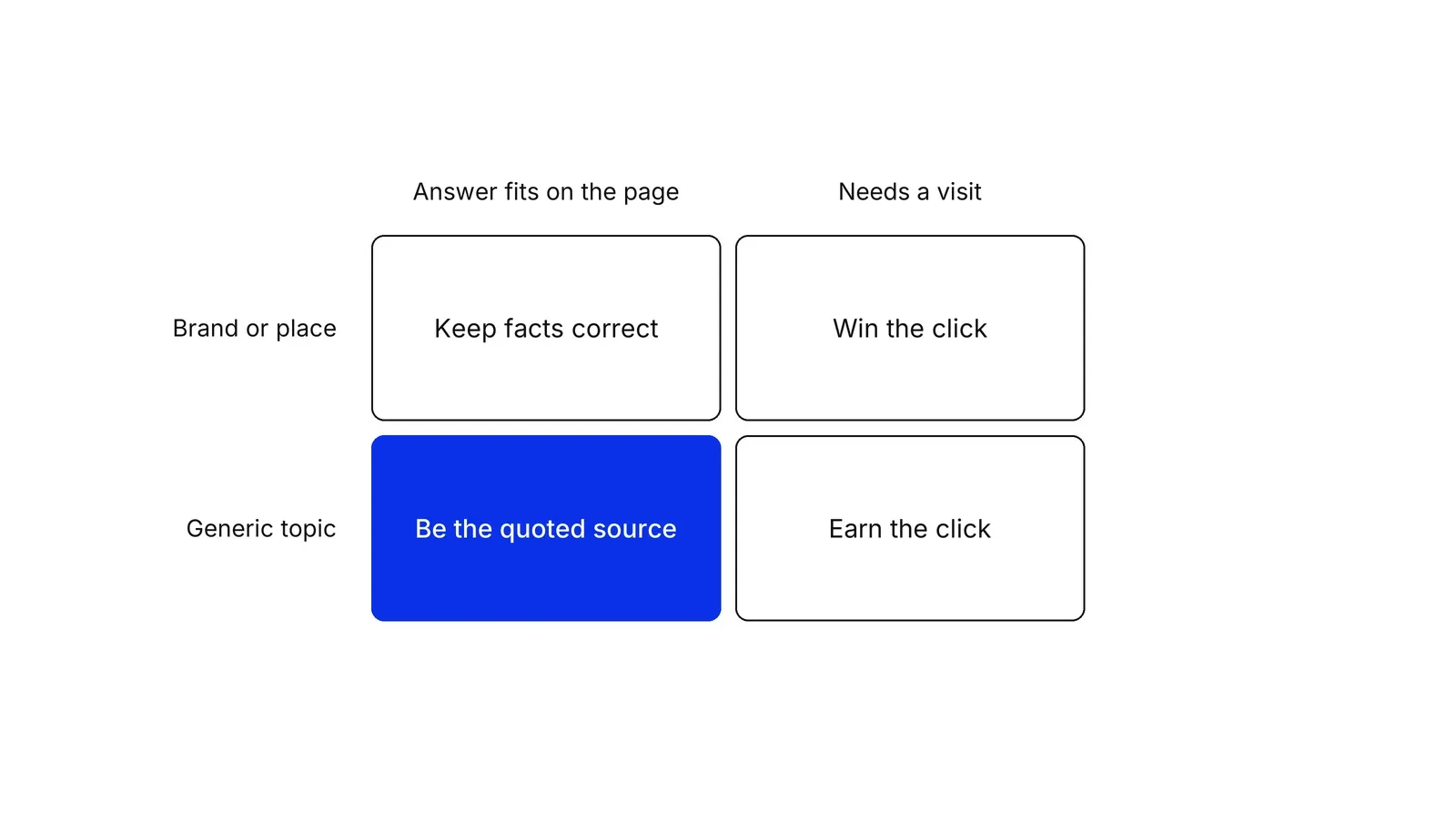
Branded, local and high-intent transactional searches keep sending clicks, according to Fishkin, while simple factual questions are the most exposed. Sorting your own queries along those lines is step one of the strategy.
A search that ends without a click is not always a lost one. Li, Huffman and Tokuda showed in 2009 that some abandoned queries are good abandonment, where the results page itself met the need, and that it was more common on mobile. A searcher who read your opening hours on the results page got what they came for.
What replaces traffic as the goal?
Exposure, recognition and actions that happen off your site replace traffic as the main goal. Fishkin has described the practice as creating content that gives value without requiring a click, and suggested measuring branded search growth, brand sentiment and conversion rates over click-level attribution. Three working pieces follow.
First, put your answer into a form that survives being cut out. Google’s snippet controls let you restrict what is shown, but each restriction trades visibility for protection. Featured snippets cannot be requested, only earned and then controlled.
Second, count actions on the surface. A Business Profile reports calls, messages, bookings, directions and website clicks, which is a conversion record for searchers who never reached your site.
Third, build recognition where search cannot reach. The Wikimedia Foundation attributes part of its decline to younger users turning to social video. Reusing a strong answer in several formats, as in content repurposing, reaches those people, and shares in private channels are measured the way dark social is: SparkToro’s 2023 test found WhatsApp, Slack and TikTok visits arrived as Direct. The link between mentions and being named by AI tools is covered in GEO. The reason recognition pays at all is the argument in How Brands Grow and the model of mental and physical availability. The IPA’s Binet and Field warn that teams relying on short-term online metrics risk long-term success.
A Growth Lab plan starts from a query audit like the one in step one: Growth Lab.
How to apply Zero-click search strategy, step by step
- Sort your queries by click risk. Export your Search Console queries and give each one a label: answerable on the results page (definitions, conversions, quick facts), branded or local, transactional, or needs a visit (tools, comparisons, long guides). Result: a spreadsheet that shows which part of your search traffic is exposed to zero-click behavior.
- Change what you report. Add four lines next to sessions: impressions for your answerable pages, clicks and impressions for your brand name, actions on your Business Profile, and the new-customer question 'how did you hear about us'. Result: a weekly view in which a falling click count no longer reads as a failure when the other lines hold.
- Write the answerable pages to be quoted. Open each page with a 40 to 60 word answer that makes sense when cut out, and put your name or product in the example, not in a slogan. Result: pages that can be lifted into a snippet or an AI answer and still carry your brand.
- Put the conversion on the surface. Fill every field of your Business Profile, keep hours, prices and services current, and turn on calls, messages and bookings. Result: the searcher can act without visiting your site, and you can count the action.
- Take the content to where your audience already is. Repurpose your best answers into the newsletters, communities, video and podcasts your buyers use, and find them with audience research. Result: a calendar of formats that reach people before they search.
- Review the trade each quarter. Compare branded search, profile actions and sales conversations against the quarter before. Keep what moved them and drop what only moved vanity numbers. Result: a one-page decision on where next quarter's content hours go.
Examples
Wikipedia, a documented case
The Wikimedia Foundation reported in October 2025 that human pageviews to Wikipedia were about 8% lower than in the same months of 2024, after it reclassified bot traffic. It said it believed the drop reflected generative AI and social media: search engines increasingly answer questions directly, often using Wikipedia content, and younger users look for information on social video platforms. The content kept being used; the visits did not follow.
A dental clinic
Illustrative, no real clinic implied. A clinic's page on how long a root canal takes shows up in 4000 searches a month and gets 120 clicks, 3%. The team rewrites the first lines into a two-sentence answer that names the clinic, and starts counting calls from its Business Profile. Calls rise from 40 to 55 a month while page clicks stay flat. The 15 extra calls are the result the page click count could not show.
A payments company's glossary
Illustrative, no real company implied. A payments company has 30 glossary pages that answer questions like what a chargeback is. Each page is rewritten to answer in the first 50 words, and the team tracks monthly impressions and clicks for the company name. If branded impressions go from 1000 to 1300 a month while glossary clicks fall, the glossary is doing the job of building recognition.
When to use it
Use it when a large share of your organic visits comes from informational queries, when impressions are rising and clicks are not, when your market buys on recommendation, or when leadership still reads sessions as the only measure of content. It also fits local businesses, where the profile on the results page is often the first and only touch.
When not to use it
Skip it as a main plan when most of your growth comes from branded, local or high-intent transactional searches, which still send clicks, or when your product is bought through paid channels with solid conversion tracking. Do not use it as a reason to stop investing in your own site, since the site's content shapes what Google and AI tools say about you.
Common mistakes
- Treating every falling click count as a zero-click problem, when rankings, seasonality or a broken page may be the cause. Check position and impressions first.
- Blocking snippets with nosnippet to protect traffic, which also removes the visibility the strategy depends on.
- Copying one study's percentage into a board slide. Panels, regions, devices and definitions differ between studies, so the numbers are not interchangeable.
- Giving the answer without the brand, so the searcher gets help and forgets who gave it.
- Replacing clicks with nothing. Without branded search, profile actions or a customer question, there is no way to see whether the strategy works.
FAQ
What is a zero-click search?
A zero-click search is one that ends on the results page without the person visiting another website. In SparkToro's 2026 study a click of any kind counts as a click, including one to a Google property such as Maps or YouTube, so zero-click means the search produced no click at all.
What percentage of Google searches are zero-click?
It depends on the study. According to SparkToro, a Datos panel gave 58.5% for the US and 59.7% for the EU in 2024. SparkToro's 2026 study, using Similarweb data for US searches from January to April 2026, reported 68.01%. The panels differ, so treat the gap as a direction, not an exact change.
Do AI Overviews reduce clicks?
Several studies say yes, and Google disputes the framing. According to Pew, a traditional result was clicked in 8% of visits with an AI summary against 15% without. Google says total click volume is relatively stable and quality has risen. Studies are correlational except for a 2026 field experiment on one group of volunteers.
Is zero-click search bad for SEO?
It changes what SEO is for. Pages that answer simple questions get fewer visits, while branded, local and transactional searches still send clicks, as Fishkin notes. SEO then supports being found, quoted and remembered, and traffic becomes one signal among several.
Is a zero-click attack the same thing?
No. A zero-click attack is a security exploit that compromises a device without the user opening or tapping anything. Zero-click search is a marketing term for searches that end without a visit to a website. The two share a name and nothing else.
Sources
- SparkToro (Rand Fishkin), 2024 Zero-Click Search Study, July 2024
- SparkToro (Rand Fishkin), In 2026, Less than One Third of Google Searches Still Send a Click, June 2026
- SparkToro, Less than Half of Google Searches Now Result in a Click, 2019
- SparkToro, In 2020, Two Thirds of Google Searches Ended Without a Click, 2021
- SparkToro, New Research: Dark Social Falsely Attributes Significant Percentages of Web Traffic as Direct, 2023
- Datos, State of Search Q4 2025
- Pew Research Center, Google users are less likely to click on links when an AI summary appears in the results, 22 July 2025
- Google Search Central, AI features and your website
- Liz Reid, Google, AI in Search is driving more queries and higher quality clicks, 6 August 2025
- Ahrefs, AI Overviews Reduce Clicks
- Search Engine Roundtable, Similarweb: No Clicks From Google Grew From 56% to 69% Since AI Overviews, 3 July 2025
- Similarweb, Generative AI and publishers report
- Stephanie T. Wang and others, AI in Search Reduces Publisher Referrals Without Improving User Experience: Experimental Evidence, arXiv, August 2026
- Wikimedia Foundation, New user trends on Wikipedia, 17 October 2025
- Jane Li, Scott Huffman, Akihito Tokuda, Good abandonment in mobile and PC internet search, SIGIR 2009
- Google Search Central, Featured snippets and your website
- Google Search Central, Control your snippets in search results
- Google Business Profile Help, Understand your Business Profile performance and insights
- NextNW, Zero-Click Marketing: An Exclusive Interview with Rand Fishkin of SparkToro, 6 February 2025
- IPA, Les Binet and Peter Field, The Long and the Short of It
Last updated Oct 9, 2026


Marketing agency or growth system: when a company outgrows its agency
An agency is the right call while the founder still runs most of the company. Once the business starts copying itself into new locations or markets, it needs a system that sets goals, tests hypotheses and owns the result.

Why healthcare marketing agencies stall: the short, mid and long wins model we use with clinics
Most agencies own the click and nobody owns the front desk. How we structure clinic work in three horizons, the research behind each one, and one year of results.

The compliance layer under fintech marketing operations
A fintech marketing agency can build campaigns. It cannot own the compliance review, the KYC drop-off or the multi-market licensing rules that decide whether a lead ever becomes a customer.