Psychological safety
Psychological safety is a team's shared belief that it is safe to take interpersonal risks such as admitting a mistake, asking for help or disagreeing, which Amy Edmondson linked to learning and performance.
Psychological safety is a team's shared belief that it is safe to take interpersonal risks, such as admitting a mistake, asking for help or disagreeing with the plan. Amy Edmondson introduced the construct in 1999 after finding that hospital units with better teamwork reported more errors. It does not mean comfort or low standards: teams learn best where high safety meets high standards.
- Origin
- Amy C. Edmondson (building on Edgar Schein and Warren Bennis, 1965, and William Kahn, 1990), 1999
- Level
- 401 · Expert
- Fits
- Small and mid-size, Scale-up, Enterprise
- Time to apply
- A week to survey the team and read the results; a quarter of changed leader behavior before the numbers move
- What you need
- a team of three or more people who work on the same task · an anonymous way to collect seven short survey answers · a leader willing to read the results and act on them in public
Psychological safety is a team’s shared belief that it is safe to take interpersonal risks. People can admit a mistake, ask for help or question the plan without expecting to be punished or rejected. Amy Edmondson of Harvard Business School defined the term for work teams in a 1999 paper in Administrative Science Quarterly. The idea is older: she credits Edgar Schein and Warren Bennis, who wrote about it in a 1965 book on organizational change, and William Kahn, who tied it to employee engagement in 1990. A review by Edmondson and Zhike Lei dates the first work to the 1960s and a revival to the 1990s.
How did a hospital study start the idea?
It began as an accident. In Edmondson’s own account in The Fearless Organization, she was a first-year doctoral student on a team studying medical error, and her job was to test whether better teamwork meant fewer errors. Nurse investigators collected error data in patient care units in two hospitals over six months. The rates differed 10-fold between the best and worst unit. The correlation ran the wrong way: units rated as better teams had more errors.
She suspected that good teams do not make more mistakes, they report more. A research assistant who knew neither her hypothesis nor the earlier data then observed the units and interviewed staff. He found that the units differed in whether people felt able to talk about mistakes, and those differences tracked the detected error rates almost perfectly. Her 1996 paper in the Journal of Applied Behavioral Science reports that patient care groups in two hospitals differed in how likely errors were to be detected and learned from. The name psychological safety came a couple of years later.
How is psychological safety measured?
The standard tool is the seven-item scale from Edmondson’s 1999 study. Members rate statements about their own team: whether a mistake is held against you, whether problems and tough issues can be raised, whether people are rejected for being different, whether it is safe to take a risk, whether it is difficult to ask others for help, whether anyone would deliberately undermine your efforts, and whether your skills are valued. Three of the seven are worded negatively and reverse scored.
The study surveyed 496 people in 53 teams at an office furniture manufacturer. Responses came from 427 members of 51 teams, an 86 percent response rate, and 135 of 150 managers outside the teams rated their learning and performance. Team psychological safety was associated with learning behavior, and learning behavior mediated the link between safety and team performance. Team efficacy, the belief that the team can succeed, was not associated with learning once safety was controlled for.
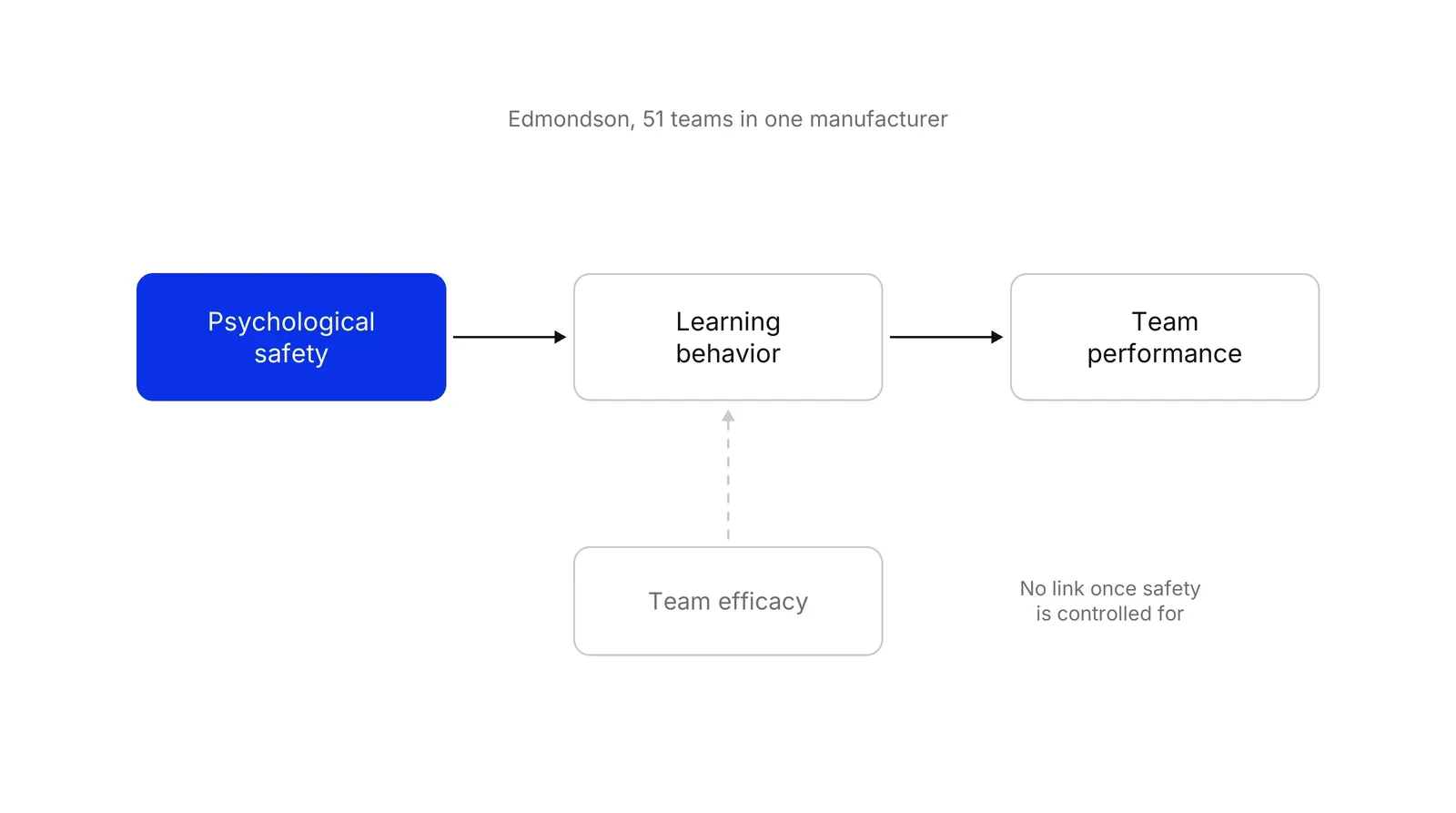
This was one company and 51 teams, so it shows an association in one setting. Later work has widened the base. Frazier and colleagues pooled 136 independent samples covering more than 22,000 individuals and nearly 5,000 groups in a 2017 meta-analysis in Personnel Psychology. They compared antecedents, tested whether safety predicts task performance and citizenship behavior beyond leader relations and work engagement, and checked the effects of research design and national culture. The abstract gives the scope but no coefficients, and the Science for Work summary describes many of the relationships as moderate. Newman, Donohue and Eva’s 2017 systematic review covers the antecedents, outcomes and moderators at several levels, and Edmondson and Bransby’s 2023 review groups recent work into four themes: getting things done, learning behaviors, improving the work experience and leadership.
Two other findings show how leaders shape it. Nembhard and Edmondson surveyed 23 neonatal intensive care units and tested leader inclusiveness, meaning words and deeds that invite and appreciate others’ contributions. In a study of 16 operating room teams, Edmondson found that the most effective leaders explained why change mattered and reduced concern about status differences.
What did Google’s Project Aristotle find?
Project Aristotle is Google’s internal study of team effectiveness, and it ranked psychological safety first of five dynamics. Google’s re:Work guide says it covered 180 teams, 115 engineering project teams and 65 sales pods. The five dynamics, in order of importance, were psychological safety, dependability, structure and clarity, meaning and impact. Colocation, consensus decision making, extroversion, individual performance, workload, seniority, team size and tenure were not significantly connected with effectiveness at Google.
Read it as company research. The findings sit on Google’s own site, not in a peer-reviewed journal, and the guide does not report the underlying statistics. Edmondson says her 1999 study influenced the project, so Aristotle is better seen as a large practitioner confirmation than as independent proof.
Is psychological safety the same as being comfortable?
No. Edmondson is explicit that it does not imply ease, comfort or lower performance standards. She writes that being nice is not the same as being psychologically safe, and cites workplaces where people are polite in meetings and disagree afterwards in the hallway. Her 2x2 treats safety and standards as two separate dimensions.
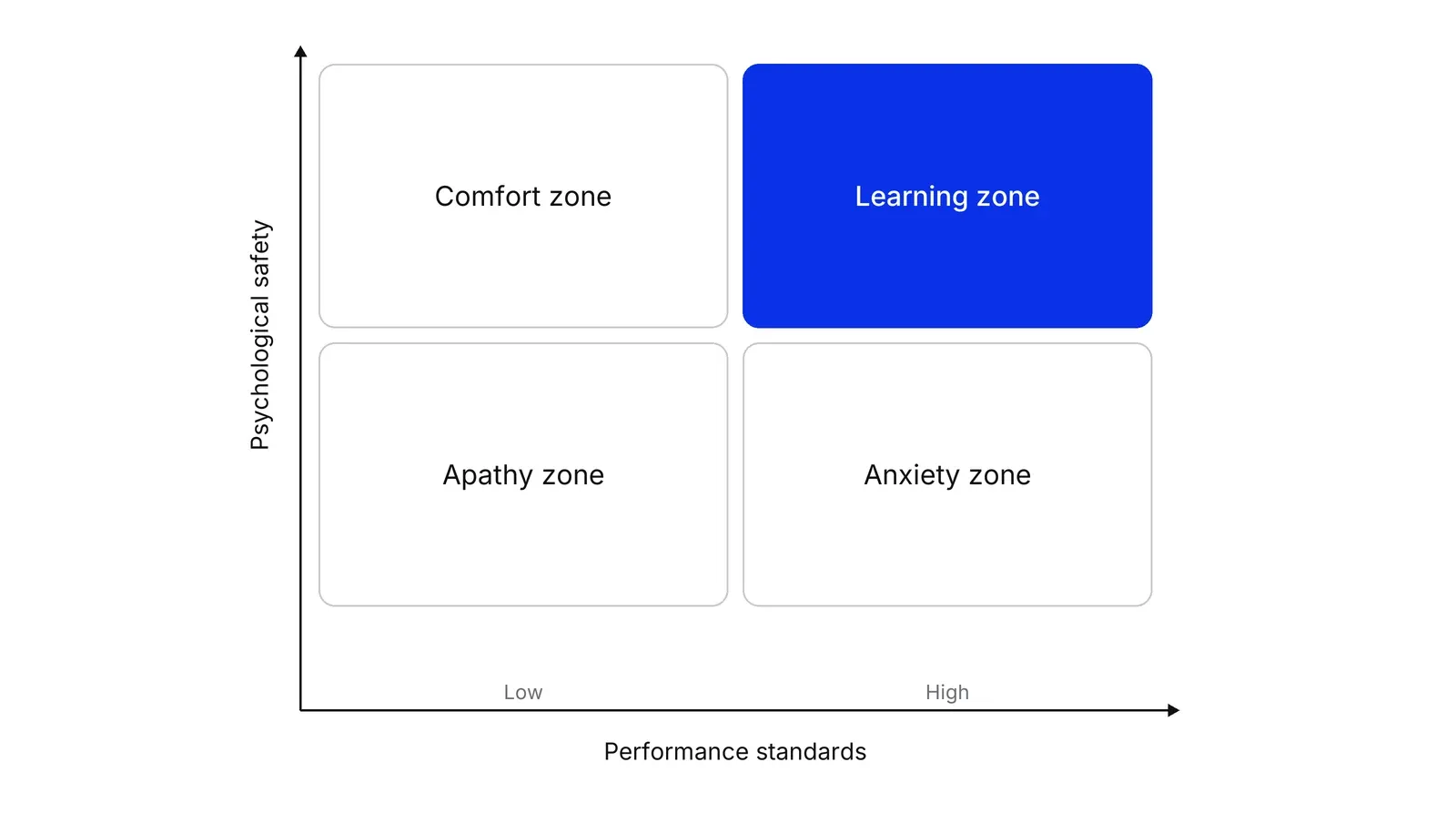
| Zone | Safety | Standards | What Edmondson says happens |
|---|---|---|---|
| Learning zone | High | High | People collaborate, learn from each other and do complex work |
| Comfort zone | High | Low | Open and collegial, but little challenge, learning or innovation |
| Anxiety zone | Low | High | People hold back questions and ideas, and quality and safety suffer |
| Apathy zone | Low | Low | People show up but disengage and protect themselves |
Her anxiety zone is interpersonal anxiety about speaking up, not worry about a demanding goal. Other studies support the link between safety and productive disagreement. Bradley and colleagues, studying 117 project teams in 2012, found that task conflict went with better performance only where psychological safety was high.
There is also a caution about the top end. Eldor, Hodor and Cappelli reported in 2023, across five studies, that moderate safety went with better in-role performance on routine tasks and very high safety with a decline, and that collective accountability buffered the decline. It is one paper, and its authors say the result does not excuse ridicule or abuse. It is a reason to keep standards and accountability in the room, which matches Edmondson’s second axis.
Where does it fit with other team frameworks?
Psychological safety is a condition that other tools depend on. The Five Dysfunctions of a Team puts trust at the base of its pyramid, and Edmondson’s work gives that level a measurable form. Radical candor describes how a manager gives direct feedback; it works only where people believe they can hear it. After action reviews and pre-mortems are the routines that turn a safe team into one that learns, and Tuckman’s stages help you judge when a newly formed team is ready to take those risks. A Growth Lab plan can start from a baseline survey of how safe each team feels.
How to apply Psychological safety, step by step
- Measure it before you fix it. Ask every team member to rate seven statements on a scale, such as whether a mistake is held against you, whether tough issues can be raised and whether it is difficult to ask others for help (Edmondson's 1999 items). Keep answers anonymous. Result: a score per team and a list of the weakest items.
- Read the result team by team. Edmondson reports that psychological safety varies between groups in the same hospital or company, so a company average hides the teams that need attention. Compare teams, not the whole firm. Result: one or two named teams where speaking up is hardest.
- Go first as the leader. Open the next meeting by naming one thing you got wrong and one thing you do not know. Research on cardiac surgery teams found that the most effective ones explained why change mattered and played down status differences. Result: the first visible example of a risk that was survived.
- Respond to bad news with a question. When someone reports a mistake or a doubt, ask what happened and what would help, before any judgment. Result: the next report arrives sooner, which is the behavior the scale measures.
- Review failures without blame. Run an after action review or a pre-mortem, so the team talks about causes and fixes while the facts are fresh. Result: a written list of changes with owners.
- Keep the standards visible. State the goals, the quality bar and the review dates in the same meetings. Safety without a standard drifts into the comfort zone. Result: a team that can say what good looks like and still say when it is falling short.
- Measure again after a quarter. Repeat the seven items with the same team and compare the weakest ones. Result: evidence of whether your behavior changed how safe people feel.
Examples
Edmondson's hospital units (documented)
In the study that started the idea, Edmondson expected the best-rated hospital teams to make the fewest medication errors. Independent nurse investigators, who collected error data in patient care units in two hospitals over six months, found a 10-fold gap between the best and worst unit, and the better-rated teams had the higher error rates. A researcher who knew neither the hypothesis nor the data then observed the units and found that the open units talked about mistakes, so more of them were detected. The better teams did not make more errors; they reported more.
A clinic front desk
Illustrative. A clinic's booking team of six sees the same double-booking problem every Monday, but nobody mentions it because the last person who did was told to be more careful. The manager runs the seven-item survey and finds the lowest scores on the items about mistakes being held against people. She starts the next huddle by describing her own scheduling error, asks the team what the booking tool makes easy to get wrong, and the double-booking fix comes from the receptionists within a month.
A fintech compliance team
Illustrative. A payments company's compliance analysts suspect a screening rule produces many false alerts, but the rule was designed by the head of the team and nobody wants to challenge it. The head holds a pre-mortem on the next rule change and asks each analyst to write how it could fail. The analysts' notes include the false-alert problem, and the rule is redesigned before launch, with the standard for alert quality unchanged.
When to use it
Use it when a team's work is uncertain or depends on people sharing information: product development, clinical teams, support, compliance, operations after a reorganization. It fits any case where problems are known to someone on the team but reach the leader late, or not at all.
When not to use it
Do not use it as a cure for unclear goals, wrong hiring or a weak strategy, because a safe team can still be aimless. Do not use it to make a team more comfortable at the cost of standards.
Common mistakes
- Treating psychological safety as niceness. Edmondson writes that being nice is not the same as being safe. Candor and productive disagreement are the goal.
- Lowering the bar to make people feel safe. Edmondson's own 2x2 puts that in the comfort zone, where there is little learning.
- Reading one company-wide score. Safety differs between teams under different leaders, so the average hides the problem.
- Announcing that everyone is safe to speak up. People judge the leader's reaction to the first mistake or disagreement, not the announcement.
- Treating Google's findings as a controlled experiment. Project Aristotle is company research, published on Google's own site and not in a journal.
FAQ
What is psychological safety in a team?
It is a shared belief among team members that the team is safe for interpersonal risk taking, in Amy Edmondson's 1999 definition. In practice it means people can admit a mistake, ask for help or challenge the plan without expecting to be punished, embarrassed or rejected. It is a property of a group, not of a single person's personality.
How do you measure psychological safety?
Use Edmondson's seven-item scale from her 1999 study. Members rate statements such as whether a mistake is held against you, whether it is safe to take a risk and whether it is difficult to ask others for help. Three items are reverse scored. Average the answers per team, keep responses anonymous and compare teams.
Did Google prove psychological safety drives team performance?
Google's Project Aristotle studied 180 teams, 115 engineering project teams and 65 sales pods, and ranked psychological safety first of five dynamics. It is company research on Google's re:Work site, not a peer-reviewed paper. The stronger evidence is academic: Edmondson's 1999 study and the 2017 meta-analysis of 136 samples.
Can a team have too much psychological safety?
Edmondson says safety without high standards produces a comfort zone with little learning. A 2023 paper by Eldor, Hodor and Cappelli found an inverted-U link with in-role performance on routine tasks across five studies, and collective accountability offset the decline. It is one paper, so treat it as a caution, not a rule.
Sources
- Amy C. Edmondson, Psychological Safety and Learning Behavior in Work Teams, Administrative Science Quarterly 44(2), 1999
- Amy C. Edmondson, Learning from Mistakes Is Easier Said Than Done: Group and Organizational Influences on the Detection and Correction of Human Error, Journal of Applied Behavioral Science 32(1), 1996
- Amy C. Edmondson, The Fearless Organization, Wiley, 2018 (publisher page and Chapter 1 excerpt)
- Amy C. Edmondson, Zhike Lei, Psychological Safety: The History, Renaissance, and Future of an Interpersonal Construct, Annual Review of Organizational Psychology and Organizational Behavior 1, 2014
- Amy C. Edmondson, Hannah Bransby, Psychological Safety Comes of Age: Observed Themes in an Established Literature, Annual Review of Organizational Psychology and Organizational Behavior 10, 2023
- M. Lance Frazier, Stav Fainshmidt, Ryan L. Klinger, Amir Pezeshkan, Veselina Vracheva, Psychological Safety: A Meta-Analytic Review and Extension, Personnel Psychology 70(1), 2017
- Alexander Newman, Ross Donohue, Nathan Eva, Psychological safety: A systematic review of the literature, Human Resource Management Review 27(3), 2017
- Science for Work (Center for Evidence-Based Management), Psychological safety
- Google re:Work, Guide: Understand team effectiveness (Project Aristotle)
- Edgar H. Schein, Warren G. Bennis, Personal and Organizational Change Through Group Methods: The Laboratory Approach, Wiley, 1965 (library catalog record)
- William A. Kahn, Psychological Conditions of Personal Engagement and Disengagement at Work, Academy of Management Journal 33(4), 1990
- Ingrid M. Nembhard, Amy C. Edmondson, Making it safe: the effects of leader inclusiveness and professional status on psychological safety and improvement efforts in health care teams, Journal of Organizational Behavior 27(7), 2006
- Amy C. Edmondson, Speaking Up in the Operating Room: How Team Leaders Promote Learning in Interdisciplinary Action Teams, Journal of Management Studies 40(6), 2003
- Anita L. Tucker, Amy C. Edmondson, Why Hospitals Don't Learn from Failures: Organizational and Psychological Dynamics That Inhibit System Change, California Management Review 45(2), 2003
- James R. Detert, Ethan R. Burris, Leadership Behavior and Employee Voice: Is the Door Really Open?, Academy of Management Journal 50(4), 2007
- Bret H. Bradley, Bennett E. Postlethwaite, Anthony C. Klotz, Maria R. Hamdani, Kenneth G. Brown, Reaping the benefits of task conflict in teams: The critical role of team psychological safety climate, Journal of Applied Psychology 97(1), 2012
- Liat Eldor, Michal Hodor, Peter Cappelli, The limits of psychological safety: Nonlinear relationships with performance, Organizational Behavior and Human Decision Processes 177, 2023 (Tel Aviv University record)
- Knowledge at Wharton, The Downside of Psychological Safety in the Workplace, November 2023
- Harvard Business School Working Knowledge, Are Great Teams Less Productive? (interview with Amy Edmondson), 2007
- HBS Online, Amy Edmondson on Building High-Performing Teams, The Parlor Room podcast, October 2024
- Amy Gallo, What Is Psychological Safety?, Harvard Business Review, February 2023
Last updated Oct 9, 2026


Fractional COO or embedded operations team? How to choose at Series A
The two models solve different problems: how to tell which one your company needs, and what each costs in time and control.

What operational systems successful fintech startups use: lessons from ten companies
Starling, Monzo, Qonto, bunq, Lunar, Pleo, Tide, Ramp, Mercury and Column scaled on four operating systems. Regulators' findings show what breaks when one of them lags behind growth.

What a revenue operations manager actually owns
Pipeline definitions, CRM hygiene, forecasting and the handoffs between marketing, sales and success. What the role covers, and how it differs from sales ops.