Holacracy and teal organizations
Holacracy is a written rulebook for running a company through roles and circles instead of managers, and a teal organization is Frederic Laloux's name for companies built on self-management, wholeness and evolutionary purpose.
A teal organization, in Frederic Laloux's 2014 book Reinventing Organizations, runs on self-management, wholeness and evolutionary purpose instead of a management hierarchy. Holacracy, created by Brian Robertson, is one rulebook for doing it, with roles, circles and fixed meetings. Evidence from Zappos, Medium and a field experiment suggests it works for some people and some kinds of work, not for everyone.
- Origin
- Brian Robertson (Holacracy); Frederic Laloux (teal organizations), 2007 (HolacracyOne); 2014 (Reinventing Organizations)
- Level
- 301 · Advanced
- Fits
- Small and mid-size, Scale-up
- Time to apply
- A 4-week pilot with one team, then a review
- What you need
- one team of 8 to 15 people with a stable purpose · a sponsor who gives up the right to overrule inside the pilot · someone who has read the Holacracy Constitution or a similar rule set
A teal organization is a company that replaces the management hierarchy with self-management, invites people to bring their whole selves to work and lets its strategy follow a sense of purpose. The term comes from Frederic Laloux’s 2014 book Reinventing Organizations. Holacracy is a separate thing: a written rulebook, created by Brian Robertson, that tells a company exactly how to run itself without managers. People often merge the two, but teal describes and Holacracy prescribes.
Where teal comes from
Laloux’s book was published by Nelson Parker in Brussels in 2014. In a strategy+business article adapted from it, he sorts organizations into stages named by colors borrowed from Ken Wilber: red, amber, orange, green and teal. Orange is the modern corporation run like a machine. Green adds empowerment and shared values. Teal is the next stage he describes.
He studied 12 organizations that each had at least 100 employees and five years of teal-style operation. Two of them, AES and BSO/Origin, later reverted to traditional management after a change of CEO or owner, a point worth remembering before assuming these models are stable. The rest include the Dutch home-care provider Buurtzorg, FAVI and Morning Star.
The three breakthroughs
Laloux names three. Self-management means people work through peer relationships, with high autonomy in their own domain and responsibility for coordinating with others. Wholeness means people are invited to “reclaim their inner wholeness” instead of showing a narrow professional self. Evolutionary purpose means strategy comes from what the organization senses the world is asking of it, in place of plans, budgets and targets.
Buurtzorg is his best-known case. Its own site describes teams of about 12 nurses who serve a neighborhood and decide how to organize their work and divide responsibilities, and quotes a KPMG case study from 2012 crediting it with a 50 percent reduction in hours of care. Both the quote and Laloux’s own figures are claims, not independent audits. Gary Hamel made a related argument in Harvard Business Review in 2011, writing that management is the least efficient activity in an organization.
What Holacracy adds: roles, circles and two meetings
Holacracy is a management system whose rules sit in a published constitution. HolacracyOne, which Robertson co-founded with Tom Thomison in 2007, describes itself as the original developer. Robertson’s book Holacracy was published by Henry Holt in 2015, and the Constitution has been revised since, with version 4.1 released in June 2015 and version 5.0 the current one. The constitution is free and open source under a Creative Commons licence.
Its building blocks are simple. A role has a name plus a purpose, domains it alone controls and accountabilities, which are ongoing activities it carries out for other roles. A circle is a container that organizes roles around a common purpose, and the anchor circle holds the purpose of the whole organization. One person can fill several roles, and a role can hold its own internal circle.
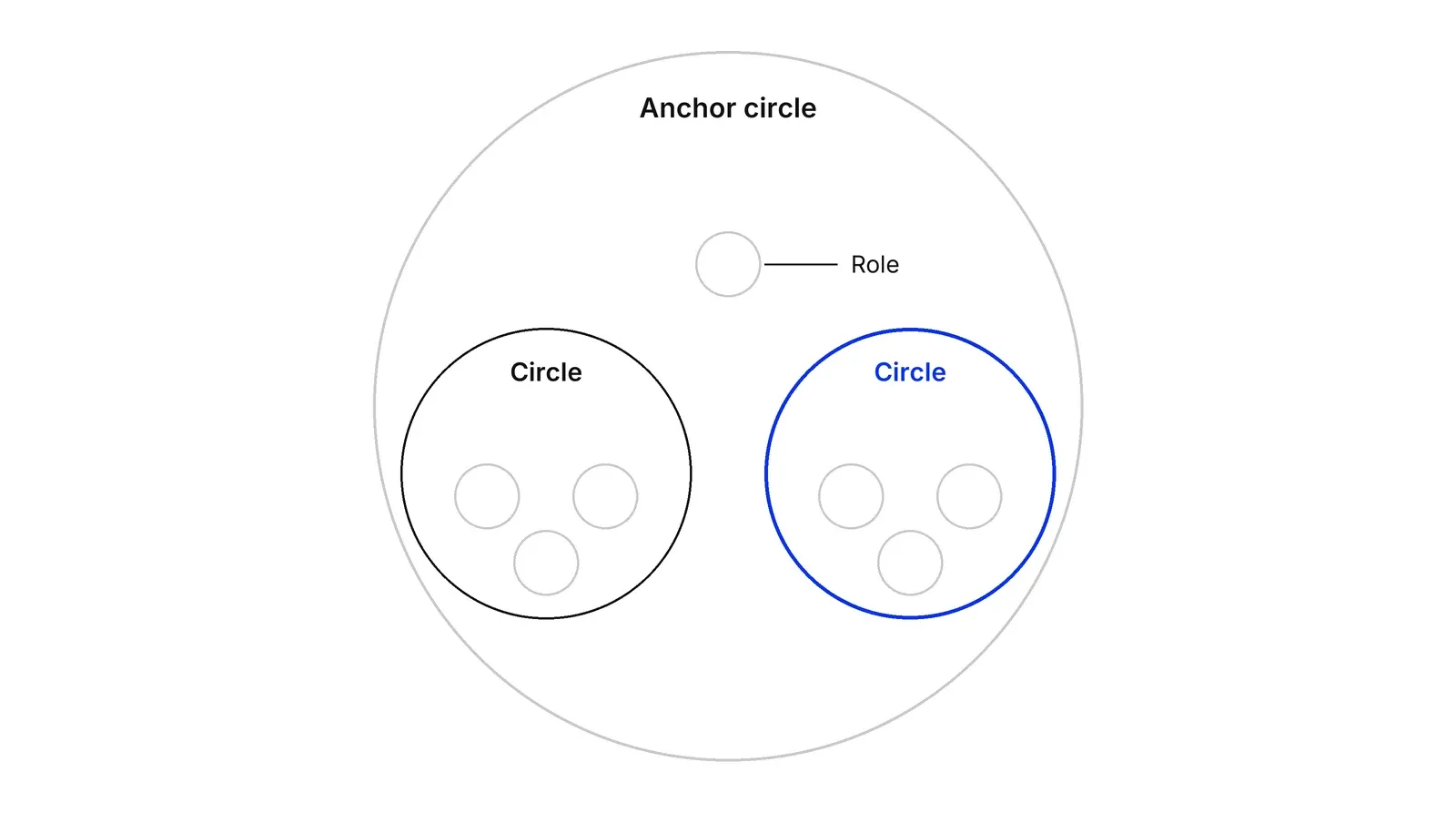
Two meeting types keep the structure alive. In a governance meeting, any member can propose a change to roles or rules, and the proposal is processed with an objection round: it stands unless someone shows it would cause harm. A tactical meeting follows seven default steps, from check-in and metrics review to agenda triage, and handles the work itself. Keeping the two apart is the system’s central design choice.
Version 5.0 of the Constitution speaks of a Circle Lead, the person who controls role assignments inside a circle. Earlier versions, such as the one Zappos used, called this a Lead Link, and Lee’s research notes that Lead Links could set priorities and allocate resources but could not intervene in the work of a role.
How it went at Zappos and Medium
Fortune reports that Medium began experimenting with Holacracy in 2012, and Zappos adopted it in 2013, according to Lee’s dissertation. Tony Hsieh wanted it because productivity per employee had fallen as the company grew, and he hoped self-organization would reverse that. Two years in, Bernstein and colleagues report, roles per employee at Zappos had grown from one to 7.4. Bernstein has noted that a system with more roles has more to manage. John Bunch said in a 2016 HBR podcast Zappos had about 150 managers before the change and over 350 Lead Links after it.
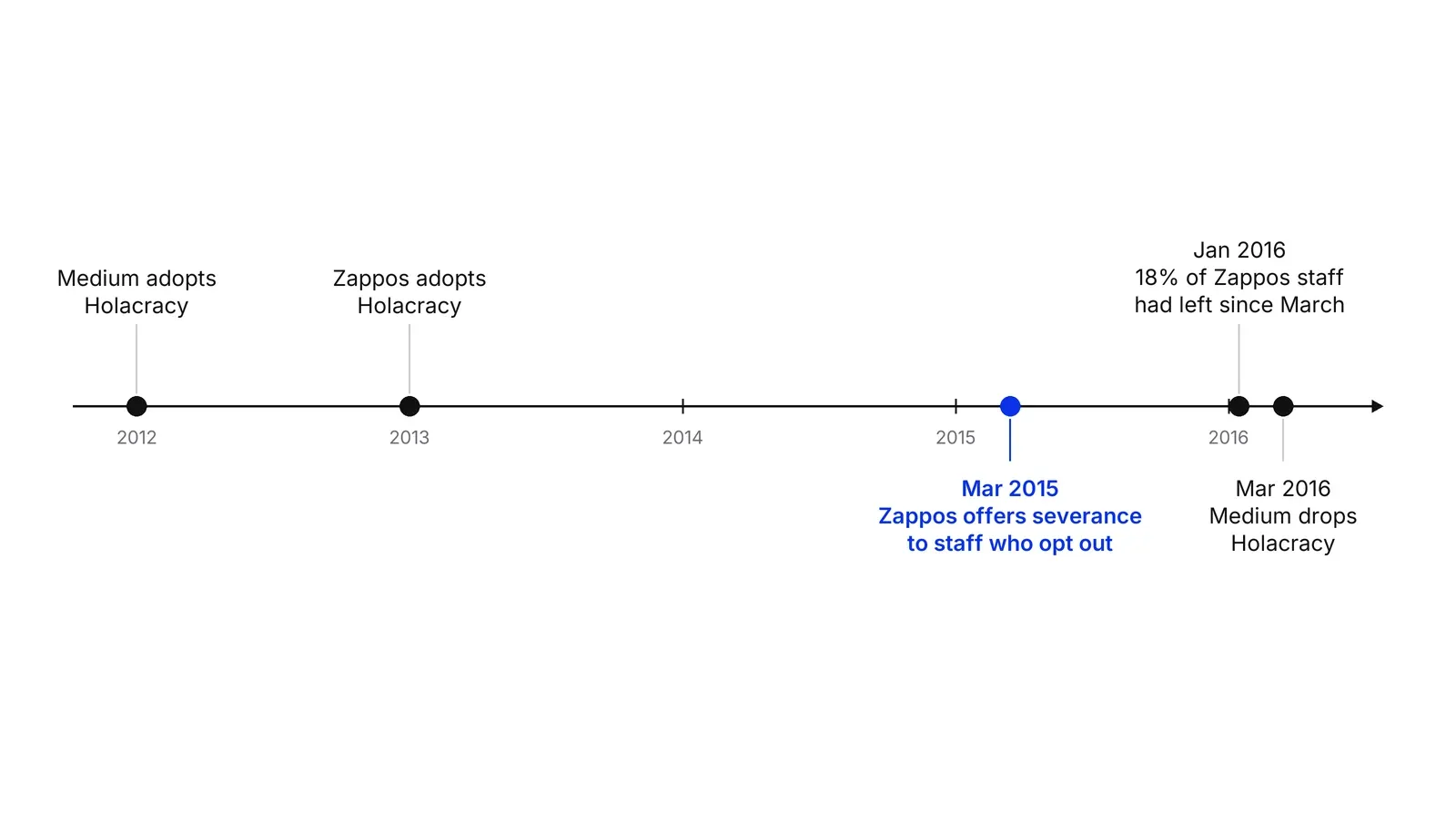
The March 2015 memo is the most cited moment. Staff who did not want the model were offered at least three months of severance if they left before 30 April. Retail Dive reported that about 14% of the workforce took it, and Fortune reported in January 2016, citing COO Arun Rajan’s post, that 18% of staff, about 260 people, had left since March. Sources disagree on how much of the exodus was about Holacracy itself.
Medium went the other way. Fortune reported on 4 March 2016 that it was dropping the model. Its head of operations Andy Doyle wrote that the system had become “a small but persistent tax” on effectiveness, that aligning across functions was slow, and that defining every role in detail hindered a proactive attitude.
What the research says
Bernstein, Bunch, Canner and Lee, in the HBR article from July-August 2016, find three shared traits in self-organizing models: teams are the basic structure, they govern themselves inside a larger framework, and leadership is spread across roles and shifts with the work. They conclude that replacing management wholesale is hard and often does not pay off, while single elements can help many companies.
Lee and Edmondson’s 2017 paper adds a definition. A self-managing organization decentralizes authority formally and systematically across the whole organization, which separates it from earlier work on post-bureaucratic firms, humanistic management and workplace democracy. Lee’s later doctoral dissertation reports a 12-month quasi-experiment in a Washington state technology agency: 39 groups and 265 people, about half the agency, opted in. Radical decentralization did not improve empowerment, engagement or job satisfaction for the average employee. It helped high performers, people who were interested in it and people in psychologically safe groups. These are the conditions that situational leadership would predict, since people who are able and willing need less direction.
Critics differ. Foss and Klein argue in 2014 that managerial authority still matters for setting the rules of the game. Jo Freeman’s 1972 essay warned that groups without formal structure develop informal power that nobody can hold to account, and Holacracy’s answer is to write everything down. Puranam, Alexy and Reitzig suggest that what is new in such forms is often the bundle of old solutions, not any single idea.
How it compares with ordinary structure
| Question | Hierarchy | Holacracy | Teal as Laloux describes it |
|---|---|---|---|
| Who decides? | The manager above | The person in the role, inside its domain | Peers, within their domain |
| What defines a person’s work? | A job title and a boss | Roles with written accountabilities | Peer relationships and shared purpose |
| How does structure change? | A reorganization from above | Governance meetings with a consent process | Varies by company |
A RACI matrix clarifies who does what inside any structure, and role definitions in Holacracy serve a similar purpose. The questions of span of control, operating model design and a competency model do not disappear when managers do. They move to the team. A Growth Lab plan starts from the decisions a team makes each week and only then decides how much structure to put around them: see our practice.
How to apply Holacracy and teal organizations, step by step
- Choose a team and a decision type. Pick one team whose work needs fast local decisions, such as support or a product squad, and list the decisions it makes each week. Teams whose work needs strict reliability, such as payment settlement, are a poor first choice. Result: a pilot scope and a list of decisions the team will own.
- Write roles with purpose and accountabilities. For each recurring piece of work, write a role with a purpose, the domains it controls and the ongoing activities it is accountable for. Let people hold several roles. Result: a role list that replaces job titles for the pilot.
- Agree how rules change. Decide who can propose a change to a role and how objections are handled. Holacracy uses a consent process in which a proposal passes unless someone shows it harms the team. Result: a written change process that every member has read.
- Run two meeting types. Hold a short tactical meeting each week for blockers and next actions, and a governance meeting every few weeks to change roles and rules. Keep the two apart. Result: a rhythm in which work and structure changes are never mixed.
- Set a pay and growth rule before you start. Decide how pay, promotion and performance feedback work when there are no managers. Zappos found compensation hard to set once people held varied roles. Result: a stated rule that the team can accept or reject up front.
- Review at four weeks with the people who stayed and who struggled. Ask what got faster, what got slower, and who found it hard. Lee's field experiment found effects differed sharply between people. Result: a decision to stop, keep the pilot, or adopt single elements such as role clarity.
Examples
Zappos, 2013 to 2016
Zappos adopted Holacracy in 2013, and by 2015 its CEO Tony Hsieh pushed everyone to commit fully. A March 2015 offer gave staff who did not want the new model at least three months of severance if they left by 30 April. About 14% took it, and by January 2016 the total was 18%, about 260 people, including 50 who took a second offer. The case shows the cost of an all-in switch, and does not by itself show that the model works or fails.
A payments support team
Illustrative. A fintech support team of 12 splits work into roles such as chargeback handler, onboarding reviewer and escalation owner, each with a written purpose and a short list of accountabilities. A weekly tactical meeting clears blockers. Regulatory reporting stays outside the pilot, because the cost of an error there is high and the work needs a named, accountable manager.
A clinic's patient-coordination team
Illustrative. A clinic group lets its coordinators own roles for scheduling, insurance paperwork and reminder calls, and change the role definitions in a monthly governance meeting. Clinical decisions stay under existing medical responsibility. Only the coordination work moves to the role model.
When to use it
Use it, in full or in parts, when the work changes faster than an org chart can be redrawn, when the people involved want more authority and have the skills for it, and when a sponsor will protect a pilot for months. Role clarity and a consent-based way to change rules are worth borrowing even if you never drop managers.
When not to use it
Skip a full switch when reliability matters more than adaptability, when most people prefer to be told what to do, or when leaders will not give up the right to overrule. Do not adopt it to hide a compensation or performance problem, and do not announce it by memo and offer exits to those who object.
Common mistakes
- Treating self-management as the absence of management. Bernstein's point is that management is shared, not gone, and a system with more roles has more to manage.
- Forcing the switch. Zappos told staff in March 2015 to commit or take severance, and 18% of the workforce had left within about ten months.
- Writing roles in so much detail that nobody owns the gaps. Medium's Andy Doyle said detailed role definitions got in the way of a proactive attitude.
- Skipping the pay and promotion rules. Without them, people lose the usual signals of progress.
- Assuming everyone benefits. In Lee's field experiment the average effect on empowerment, engagement and job satisfaction was zero.
FAQ
What is a teal organization?
A teal organization, a term from Frederic Laloux's 2014 book, is one built on three ideas: self-management through peer relationships instead of a hierarchy, wholeness so people can bring their whole selves to work, and evolutionary purpose, where strategy comes from sensing what the organization is called to do. Laloux drew on 12 organizations.
What is the difference between Holacracy and teal?
Teal is a description of how some organizations work, drawn from case studies. Holacracy is a specific, written rulebook with defined roles, circles, meetings and a constitution. Laloux lists Holacracy among teal practices, but a company can be self-managing without Holacracy, as Buurtzorg's neighborhood nursing teams are.
Does Holacracy work?
The evidence is mixed. A 12-month field experiment in a US state agency found no average improvement in empowerment, engagement or satisfaction, with gains for high performers, the interested and the psychologically safe. Zappos kept the model while many staff left, and Medium dropped it after about four years.
Why did Medium stop using Holacracy?
Andy Doyle, Medium's head of operations, wrote in March 2016 that the system was not wrong or fringe, but the company had changed and Holacracy imposed a small but persistent tax. He said cross-functional alignment was slow and detailed role definitions hindered a proactive attitude.
Can a company run without managers?
Some do, but research suggests they usually still manage work, only in a shared way. Bernstein and colleagues argue wholesale replacement is hard and often does not pay off, while single elements can help. Foss and Klein argue managerial authority still matters for setting the rules of the game.
Sources
- Ethan Bernstein, John Bunch, Niko Canner, Michael Y. Lee, Beyond the Holacracy Hype, Harvard Business Review, July-August 2016
- INSEAD faculty and research, Beyond the Holacracy Hype: the overwrought claims and actual promise of the next generation of self-managed teams, HBR 94(7-8), 38-49
- Michael Y. Lee, Amy C. Edmondson, Self-managing organizations: exploring the limits of less-hierarchical organizing, Research in Organizational Behavior 37, 2017
- INSEAD faculty and research, Self-managing organizations: exploring the limits of less-hierarchical organizing
- Michael Y. Lee, Self-managing organizations: exploring the dynamics and consequences of radically decentralizing authority, doctoral dissertation, Harvard Business School, 2019
- Holacracy Constitution, version 5.0, HolacracyOne
- HolacracyOne, The Holacracy Constitution v4.1 is out, June 2015
- HolacracyOne, Holacracy Constitution 4.0 released
- HolacracyOne, Explore Holacracy
- HolacracyOne, organization profile
- Publishers Weekly, review of Brian J. Robertson, Holacracy, Henry Holt, 2015
- Frederic Laloux, The future of management is teal, strategy+business, 2015
- Frederic Laloux, Reinventing Organizations, Nelson Parker, Brussels, 2014 (catalogue record)
- Buurtzorg, About us
- Fortune, Medium is dropping holacracy, March 4, 2016
- Fortune, Zappos is losing more employees over Holacracy, January 14, 2016
- Retail Dive, Zappos sees workforce exodus ahead of Holacracy transition, May 11, 2015
- HBR IdeaCast 535, The Zappos Holacracy experiment, July 2016
- Gary Hamel, First, let's fire all the managers, Harvard Business Review, December 2011
- Phanish Puranam, Oliver Alexy, Markus Reitzig, What's new about new forms of organizing?, Academy of Management Review 39(2), 2014
- Nicolai J. Foss, Peter G. Klein, Why managers still matter, MIT Sloan Management Review 56(1), 2014
- Jo Freeman, The tyranny of structurelessness, 1972
Last updated Oct 9, 2026


Fractional COO or embedded operations team? How to choose at Series A
The two models solve different problems: how to tell which one your company needs, and what each costs in time and control.

What operational systems successful fintech startups use: lessons from ten companies
Starling, Monzo, Qonto, bunq, Lunar, Pleo, Tide, Ramp, Mercury and Column scaled on four operating systems. Regulators' findings show what breaks when one of them lags behind growth.

What a revenue operations manager actually owns
Pipeline definitions, CRM hygiene, forecasting and the handoffs between marketing, sales and success. What the role covers, and how it differs from sales ops.