MQL and SQL
MQL and SQL are the two labels for a lead before and after sales takes it on: marketing qualifies the first, sales qualifies the second, and the written rules between them decide how much pipeline you get.
An MQL, or marketing qualified lead, is a lead that marketing has judged ready to be passed to sales. An SQL, or sales qualified lead, is a lead that sales has checked and decided is a likely customer worth working as a deal. The terms come from the SiriusDecisions Demand Waterfall, now owned by Forrester, and both need written criteria.
- Origin
- SiriusDecisions (Demand Waterfall); now part of Forrester, 2006 per Forrester; rearchitected 2012; Demand Unit Waterfall 2017; B2B Revenue Waterfall 2021
- Level
- 201 · Tool
- Fits
- Small and mid-size, Scale-up
- Time to apply
- one working session to agree definitions; a month of leads to see whether the handoff holds
- What you need
- one person from marketing and one from sales who can both change the rules · a CRM or marketing tool where lead stage and owner are recorded · a list of the last 50 to 100 leads and what happened to each
An MQL is a lead that the marketing team has qualified as ready for the sales team, and an SQL is a lead that the sales team has judged a likely customer (HubSpot’s default definitions). The two labels mark a handoff. Before the MQL, marketing owns a person who showed interest. After the SQL, a salesperson owns a possible deal. Teams use the pair to settle who works a lead, how fast, and what marketing is held responsible for.
Where the terms come from
MQL and SQL spread through the Demand Waterfall, a model published by SiriusDecisions, a B2B research firm that Forrester agreed to buy in November 2018 and completed buying on 3 January 2019 for $245 million in cash.
The launch year is disputed. Forrester’s own sales operations post says the Waterfall was first launched in 2006, with a rearchitected version in 2012 and the Demand Unit Waterfall in 2017. An agency write-up gives 2002 as the launch year. This page uses Forrester’s date and flags the conflict. Forrester renamed the 2017 model the B2B Revenue Waterfall in May 2021, adding renewal, cross-sell and upsell opportunities.
The stages in order
The original version has five core stages, as Forrester describes it: marketing generates inquiries, some become MQLs and go to sales, sales accepts them, qualifies them for buying readiness, and then wins the deal. The first stage is any person who responds to marketing. The second is the MQL. The third is the sales accepted lead, or SAL. The fourth is the SQL. The last is the closed deal.
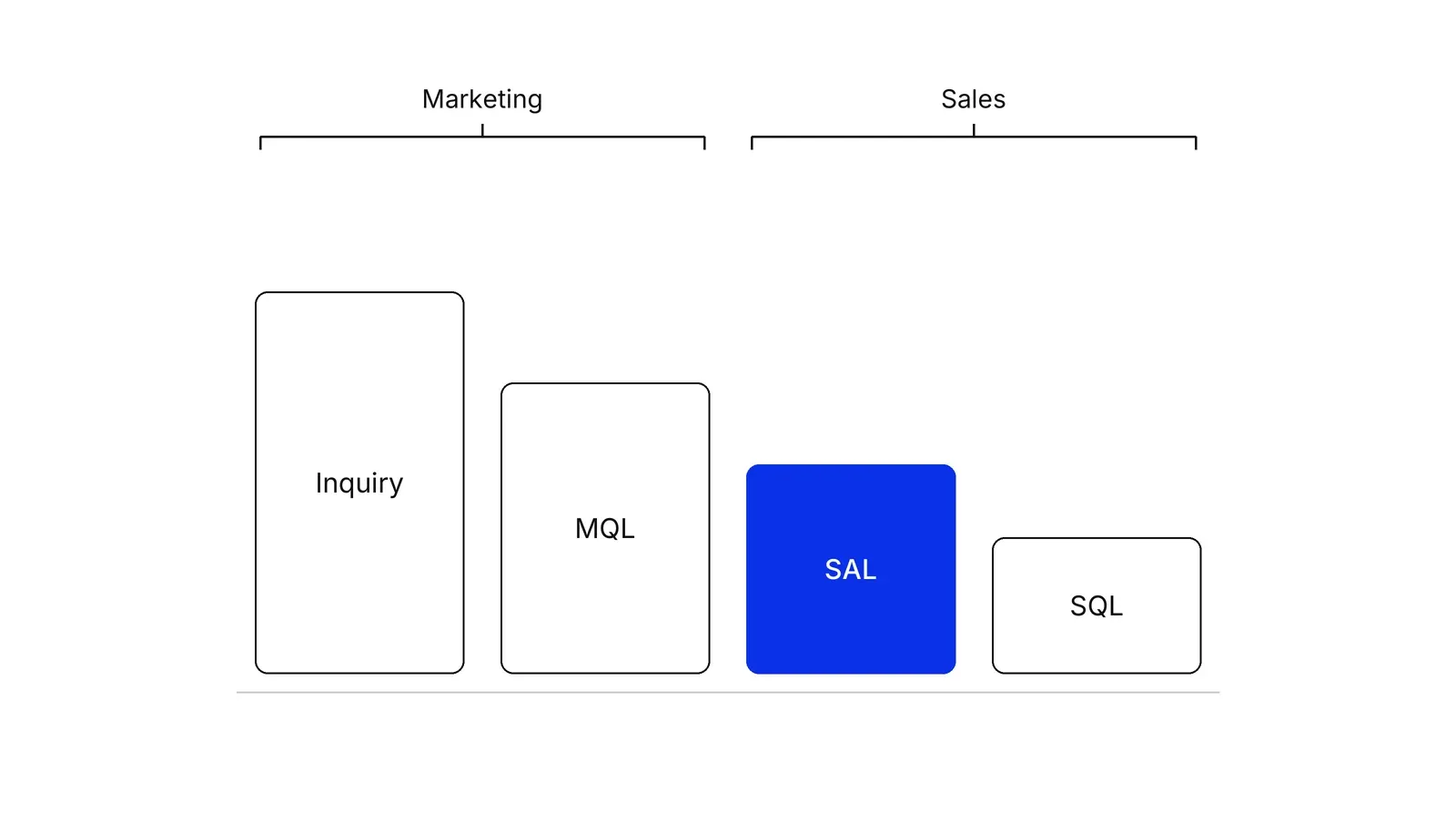
The 2012 version added stages for telesales, including an automation qualified lead, which meets lead scoring thresholds, and a teleprospecting qualified lead. That detail matters only if you run an outbound calling team.
MQL and SQL side by side
| MQL | SQL | |
|---|---|---|
| Who decides | Marketing | Sales |
| Based on | Engagement and fit, for example an ebook download or email list signup | A conversation: fit with past customers, a real problem, and BANT |
| Question it answers | Is this person worth a call? | Is this a deal worth forecasting? |
| Typical next step | Sales acceptance or rejection | Discovery meeting |
Salesforce describes an MQL as someone who has engaged with marketing and may not yet know whether the product fits, and an SQL as a lead that meets three checks: resembles past customers, has a problem you can solve, and clears the budget, authority, need and timeline questions of BANT. The fit check is easier when you have an ideal customer profile written down.
What goes into an MQL rule
Most MQL rules combine two things: who the person is and what they did. Salesforce’s guide describes assigning points to demographic traits such as geography, role, company size and industry, and to behaviour, with negative scores for signs like a missing budget. A fit rule without an action produces a list of the right companies that nobody has asked for anything. An action rule without fit produces a pile of students and competitors who downloaded the same guide. The rule earns its keep when a rep can read the reason a lead qualified and agree with it. The detailed mechanics of points and thresholds belong to lead scoring, a separate topic.
Why the SAL step matters
The SAL turns a push into an agreement. Forrester’s sales operations post lists what both teams should settle: common definitions, sales response times, and the criteria for accepting and rejecting a lead. Without an acceptance step, a lead can be routed to a rep and left alone, and marketing will report it as handed over.
The friction is old. Philip Kotler and co-authors wrote in 2006 that sales and marketing often undervalue each other’s contributions. Speed is part of it: a 2011 Harvard Business Review study of online inquiries concluded that most companies are not responding nearly fast enough. A written response time is the cheapest fix.
A worked example with simple numbers
Take a company whose marketing team passes 400 MQLs in a month. Sales accepts 240, rejects 160, and qualifies 60 of the accepted as SQLs. That is 60 percent acceptance and 25 percent of accepted leads becoming SQLs, or 15 percent of MQLs. The numbers are arithmetic, not a benchmark. Their value is the rejection list: if 100 of the 160 rejections say ‘wrong industry’, the fix sits in marketing’s targeting.
Why Forrester now argues against the MQL
Forrester’s analysts say a lead-centric process converts fewer than 1% of inquiries to closed-won, that MQL point values are typically set by guesswork, and that Forrester’s 2021 buying survey found over 80% of buying decisions involve a group of more than three people. A 2023 Forrester post reports 28% of buyers decided in groups of four to nine and 46% in groups of two to three. Its 2026 survey puts a typical purchase at 13 internal stakeholders and nine external influencers.
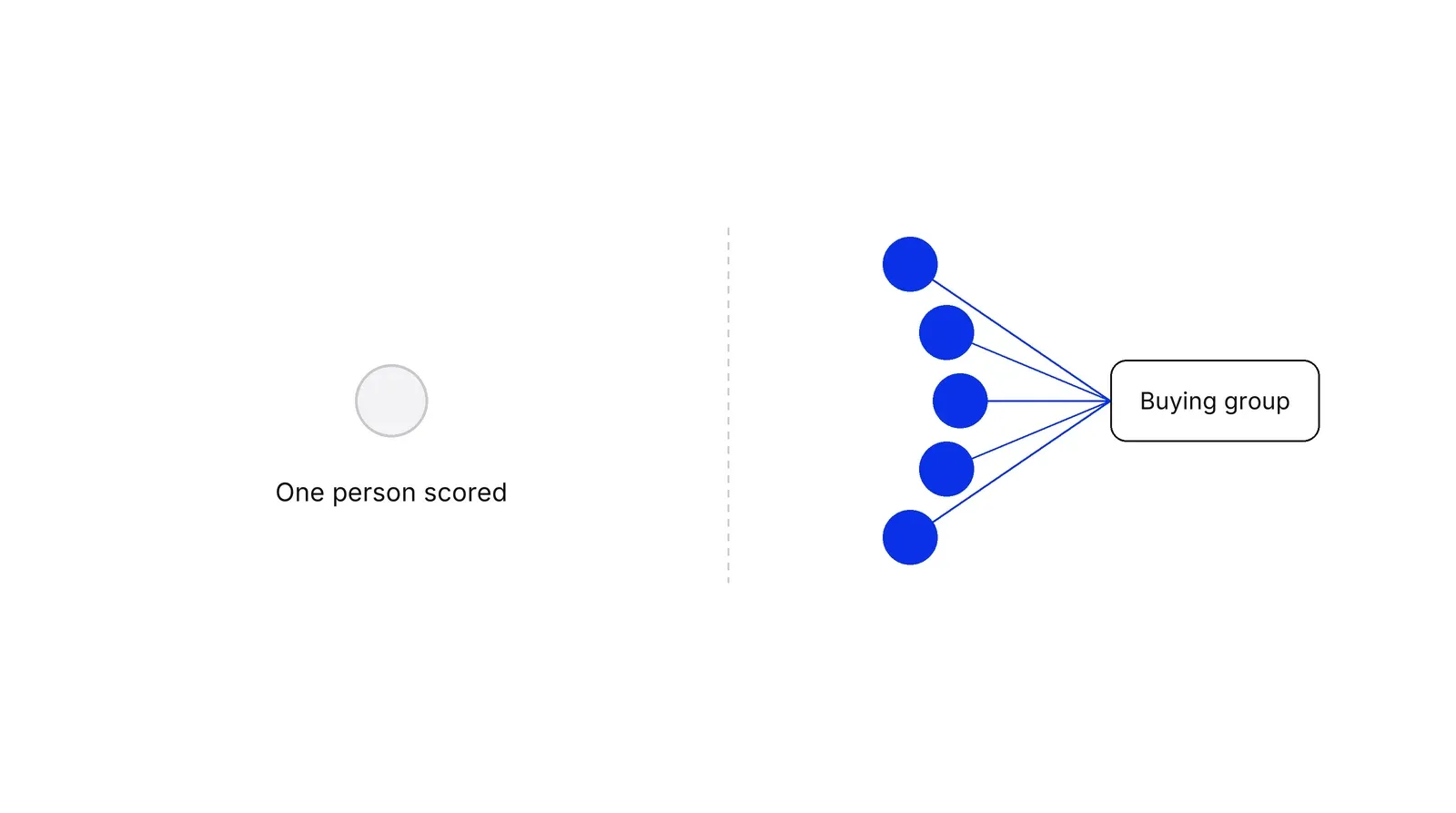
The replacement, the Demand Unit Waterfall, tracks buying groups rather than single leads. Forrester reports clients saw a 50% rise in meeting-to-closed-won conversion when marketing delivered three or more members of a buying group to sales, a figure Forrester collected from its own clients, not a controlled study.
The practical reading: if you sell to one decision-maker at small companies, MQL and SQL still work. If your deals involve committees, keep the labels for reporting and qualify at the group level. Marketing funnel logic still applies, and the question of whether a lead came from demand creation or demand capture changes how you read its MQL-to-SQL rate. A Growth Lab plan starts from agreeing these definitions across marketing and sales.
How to apply MQL and SQL, step by step
- Write one sentence per stage. Sit marketing and sales together and write what each stage means: inquiry, MQL, sales accepted, SQL, won. Each sentence names who decides and which fields in the CRM prove it. Result: a one-page glossary that both teams signed, so 'qualified' means the same thing in both reports.
- Set the MQL rule from past wins. Take the last 20 closed deals and look at what the buyer did and who they were before sales spoke to them. Turn the common pattern into a rule, such as a fit check plus a defined action. Result: an MQL rule built on evidence, with the fit part linked to your ideal customer profile.
- Add a sales acceptance step. Give sales a short window to accept or reject every MQL, and require a reason when they reject. Result: a visible SAL stage, and a list of rejection reasons that shows whether the problem is lead quality, routing or follow-up.
- Define the SQL check. Decide what a rep must confirm on the first conversation: a fit with past customers, a real problem the product solves, and the budget, authority, need and timeline questions from BANT. Result: a short checklist the rep fills in before a lead becomes an SQL.
- Write the handoff agreement. Record how fast sales responds, who owns a lead at each stage, what happens to a rejected lead and how often the two teams review the numbers. Result: a service-level agreement that names a response time and an owner for every stage.
- Measure each handoff on your own data. Count leads entering and leaving each stage for a month, and calculate the share that moves on. Result: your own MQL-to-SAL, SAL-to-SQL and SQL-to-won rates, which are the only benchmarks worth steering by.
Examples
A KYC software vendor selling to payment companies
Illustrative: a vendor of identity-check software counts a lead as an MQL when a compliance or operations manager at a payment company downloads a licensing guide and then opens two product emails. A sales rep accepts it within a day, calls, and finds the company already evaluates two other tools and has a regulator deadline in the quarter. That conversation, not the download, is what turns it into an SQL. Only the second event goes in the sales forecast.
A telehealth platform selling to employers
Illustrative: a platform that sells virtual care to employers gets 300 form fills in a month from a webinar. Marketing marks 90 as MQLs because the company has more than 200 employees and an HR title. Sales accepts 60, rejects 30 with the reason 'no benefits budget owner', and qualifies 12 as SQLs after a call. Those 30 rejections tell marketing which job titles to stop targeting.
When to use it
Use MQL and SQL when marketing and sales are separate teams, leads come in at volume through forms, events or campaigns, and nobody can say why good leads go cold between the two. They work best when one person usually decides and the sales cycle is short enough that individual lead behaviour matters.
When not to use it
Skip a person-by-person MQL model when you sell mainly to groups of buyers, run account-based selling with a short target list, or have so few leads that a founder reads every one. Forrester now recommends tracking buying groups and opportunities in those cases, and a spreadsheet of named accounts will do more than a scoring rule.
Common mistakes
- Letting marketing alone define the MQL and then judging sales for not working the leads it produces.
- Setting point values and thresholds by guesswork. Forrester's analysts say these thresholds are usually not based on analysis of what predicts a purchase.
- Skipping the sales acceptance step, so a lead can sit assigned but untouched with nobody accountable.
- Counting an MQL as pipeline. It is a lead, and only the SQL stage onward represents a conversation with a buyer.
- Copying another company's conversion rates as targets instead of measuring your own.
FAQ
What is the difference between an MQL and an SQL?
An MQL is judged ready for sales by marketing, usually from engagement and fit, such as downloading a guide. An SQL is judged a likely customer by sales after talking to the lead, using fit, a real problem and signals such as budget, authority, need and timeline.
What is a SAL and do I need one?
A SAL, or sales accepted lead, is an MQL that sales has formally agreed to work. It sits between MQL and SQL in the SiriusDecisions model. You need it when leads vanish between the teams, because it makes acceptance, or rejection with a reason, a recorded event.
What is a good conversion rate from MQL to SQL?
There is no universal rate. Forrester reports that a lead-centric process turns fewer than 1% of inquiries into won deals, and the figure moves with deal size and channel. Measure your own rate at each stage over a quarter and compare it with your own history.
Is the MQL dead?
Not everywhere, but Forrester analysts argue it should end. A 2023 Forrester post says most companies are now deciding when and how to leave MQLs, not whether, because buying decisions come from groups and a single scored contact misses the group's signals.
Who invented MQL and SQL?
The terms spread through the SiriusDecisions Demand Waterfall. Forrester's own posts date its launch to 2006, while another industry account says 2002, so the exact year is disputed. SiriusDecisions was bought by Forrester, announced in November 2018 and completed in January 2019.
Sources
- Forrester, Forrester Debuts Next-Generation B2B Revenue Waterfall To Help Firms Accelerate Revenue Growth, press release, 2021
- Forrester, Meet the Newest SiriusDecisions Demand Waterfall!, 2017
- Forrester, The Demand Waterfall: A Modular System to End Chaos, 2018
- Forrester, The Demand Waterfall: What Sales Operations Needs to Know
- Forrester, We Knew It Wasn't About Leads Anymore: The Inside Story of the New SiriusDecisions Demand Waterfall, 2017
- Forrester, Keys to Implementing the SiriusDecisions Demand Unit Waterfall, 2017
- Forrester, SiriusDecisions Summit APAC 2017: The Demand Unit Waterfall, Which Approach Is Right for You?
- Forrester, Surprise! You Can Set Up the Demand Unit Waterfall in Salesforce With Standard Functionality, 2020
- Forrester, The Revenue Process Alignment Series, Part 1: The End of MQLs, 2022
- Forrester, The Goodbye MQL Transformation Accelerates, 2023
- Forrester, Saying Goodbye To MQLs: A Parting That Is All Sweet And No Sorrow, 2023
- Forrester, Forrester's 2026 Buyer Insights: GenAI Is Upending B2B Buying, press release
- Forrester, Forrester To Acquire SiriusDecisions, press release, 2018
- Forrester, Forrester Completes Acquisition Of SiriusDecisions, press release, 2019
- Clever Touch, The Rise and Fall of the SiriusDecisions Waterfall
- MarketOne, SiriusDecisions Demand Waterfall in practice
- HubSpot Knowledge Base, Use lifecycle stages
- Salesforce, Sales Qualified Leads: What They Are and How to Qualify Them
- Salesforce, What Is BANT? The Way to Qualify Better Leads and Close More Deals
- Philip Kotler, Neil Rackham, Suj Krishnaswamy, Ending the War Between Sales and Marketing, Harvard Business Review, 2006
- Brent Adamson, Matthew Dixon, Nicholas Toman, The End of Solution Sales, Harvard Business Review, 2012
- James Oldroyd, Kristina McElheran, David Elkington, The Short Life of Online Sales Leads, Harvard Business Review, 2011
Last updated Oct 9, 2026


Marketing agency or growth system: when a company outgrows its agency
An agency is the right call while the founder still runs most of the company. Once the business starts copying itself into new locations or markets, it needs a system that sets goals, tests hypotheses and owns the result.

Why healthcare marketing agencies stall: the short, mid and long wins model we use with clinics
Most agencies own the click and nobody owns the front desk. How we structure clinic work in three horizons, the research behind each one, and one year of results.

Why channel tests stall after month three
Most paid channel tests do not end with a decision. They end when the budget runs out, the attribution model changes, or everyone quietly stops looking at the dashboard.