Sales process stages
Sales process stages are the ordered checkpoints a deal passes from first contact to a signed contract or a recorded loss, defined here by what the buyer has said or done at each one.
Sales process stages are the ordered checkpoints a deal passes between first contact and a signed contract or a recorded loss. The textbook model has seven steps, but a CRM pipeline works better when each stage has an exit criterion: something the buyer has said or done that anyone on the team can check, such as a named budget owner or a returned signed contract.
- Origin
- No single inventor; the seven-step model was studied by Dubinsky and by Moncrief and Marshall, 1981; 2005
- Level
- 201 · Tool
- Fits
- Startup, Small and mid-size, Scale-up
- Time to apply
- half a day to write the criteria, one quarter of closed deals to measure real stage win rates
- What you need
- admin access to your CRM and its current list of stages · the last 20 or so closed deals, won and lost, with their dates · one sales manager who can overrule a rep on where a deal sits
A sales process is the fixed sequence of stages a deal passes through, from first contact to a signed contract or a recorded loss. A stage is a checkpoint, and this guide defines each checkpoint by something the buyer has said or done. Two reps looking at the same deal should then put it in the same place.
Where the stages come from
The textbook sequence has seven steps: prospecting, preapproach, approach, presentation, overcoming objections, close and follow-up. Kadić-Maglajlić and colleagues list them as the process personal selling has long been organised around. An open sales textbook calls the model the accepted standard for almost a hundred years and cites William Moncrief and Greg Marshall’s 2005 paper The evolution of the seven steps of selling for the point.
Academic work on the selling process goes back further. A. J. Dubinsky’s 1981 study used factor analysis to find the underlying dimensions of the techniques salespeople use, at a time when, he wrote, no published empirical research had examined them. Later work asks whether the sequence still holds. Marshall, Moncrief, Rudd and Lee used focus groups in the United States and the United Kingdom and found evidence of a revolution in the buyer-seller relationship driven by social media and related technology. Both older papers sit behind publisher paywalls, so this page relies on their published abstracts and on later work that cites them.
Why seven steps do not make a pipeline
The seven steps describe what the seller does. Presentation is complete when the rep has presented, whatever the buyer made of it. A CRM needs the opposite: a state of the deal that a manager can check without trusting the rep.
That matters because stages drive numbers. In Salesforce, each stage maps to a probability and a forecast category, so a deal moved forward early inflates the forecast. Its documentation shows an example in which early stages map to 10 to 60% in the Pipeline category, and Negotiation/Review maps to 90% in Commit.
What is an exit criterion?
An exit criterion is a fact about the buyer that must be true before a deal moves to the next stage. The idea comes from product development, where Robert Cooper’s stage-gate systems put a gate between stages.
Three tests make a criterion usable. The buyer did or said it, not the rep. It leaves a trace in an email, a calendar entry, a file or a field the buyer filled in. And a second person can find that trace in under a minute.
A six-stage model with buyer-verifiable exits
This is a starting point for a sales-led B2B team, not a standard. Rename the stages for your market.
| Stage | Exit criterion (the buyer has…) | Where the evidence lives |
|---|---|---|
| 1. Lead | replied, booked a call or filled in a form that fits your ideal customer profile | Form record, reply, calendar |
| 2. Qualified | described the problem in their own words and named who owns the budget, the BANT checks | Call notes, email |
| 3. Evaluating | shared requirements, volumes or success criteria in writing | Email, shared document |
| 4. Proposal | received a written offer and confirmed it covers their criteria | Reply to the proposal |
| 5. Commitment | named the signer and started their legal, security or procurement review | Review request, contract draft |
| 6. Closed | signed (won) or gave a reason (lost) | Signed document, reason field |
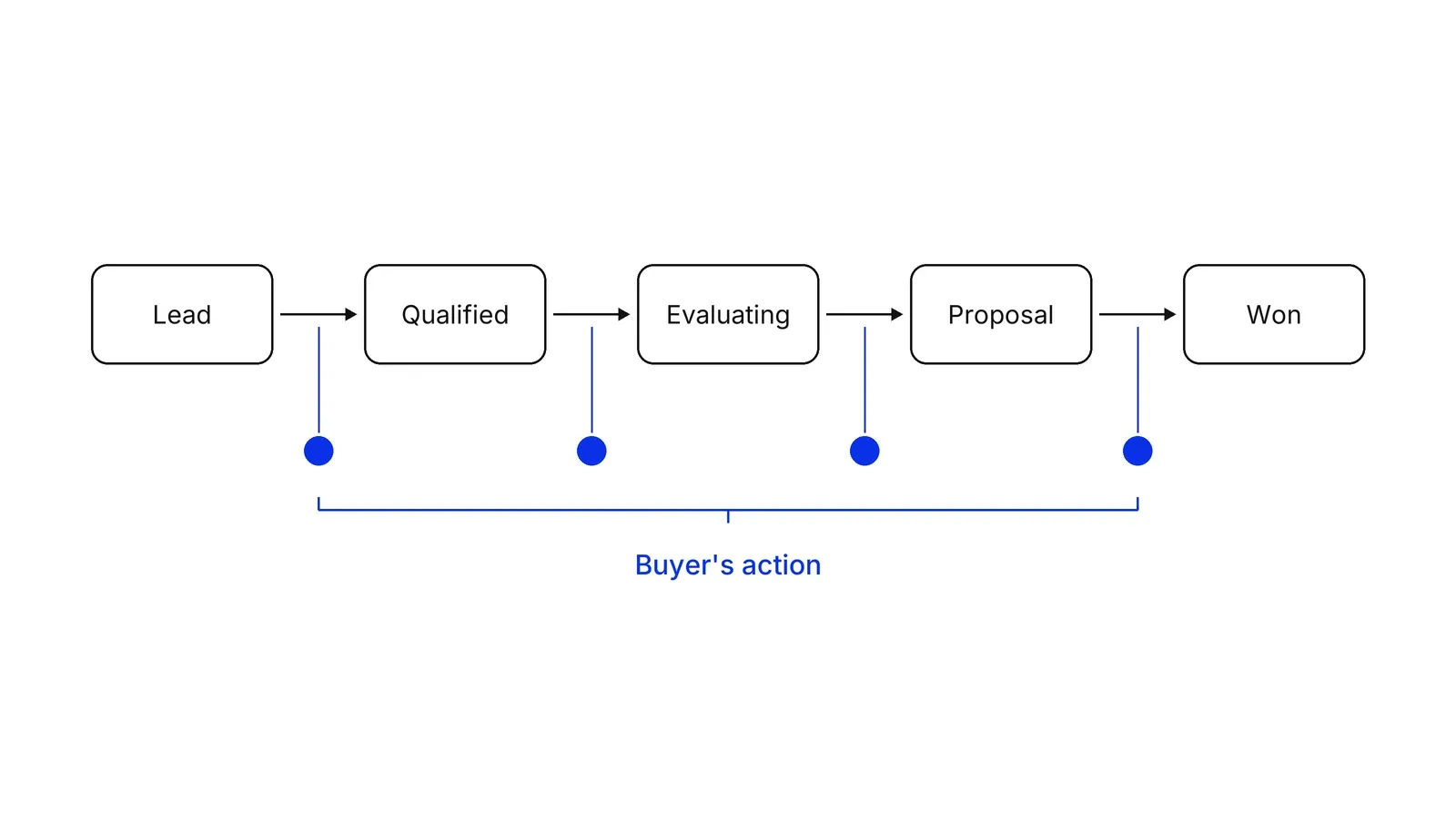
Even prospecting, the first step, lacks shared vocabulary: Jolson and Wotruba note substantial disagreement among sales organizations about the terms used for prospecting elements. Paschen, Wilson and Ferreira describe key sales tasks for each stage of the B2B funnel, a useful cross-check when you write criteria.
Stage 1 depends on who you chose to sell to. If the lead was never a fit, no later stage repairs it. Where a sales development team qualifies leads for account executives, Terho, Salonen and Yrjänen found that the handoff depends on clear end-qualification criteria, with joint rules on terminology, ownership and response times.
How CRMs encode stages
Vendor documentation shows what each tool fixes for you and what it leaves to you.
| Tool (vendor docs) | What is built in | What you still decide |
|---|---|---|
| Salesforce | Each stage carries a probability and a forecast category; Closed Won is 100%, Closed Lost 0% | Open stage names and percentages; key fields and guidance per stage |
| Kommo (formerly amoCRM) | Incoming leads, Closed-won and Closed-lost cannot be deleted; templates by business type | Every stage between them |
| Bitrix24 | Each pipeline has its own stages; a deal can be finished from any stage | Whether skipping a stage is allowed |
Bitrix24 shows a consequence of skipped stages. Its classic funnel report counts only stages a deal actually entered, while the conversion report fills in the stages a winning deal bypassed. The same deals give different conversion rates depending on how the tool counts skips, which is one more reason to write the criteria down.
Default probabilities are placeholders
Salesforce’s tutorial example gives Qualification a 10% chance and Proposal/Review 60%. Those are values for one sample team.
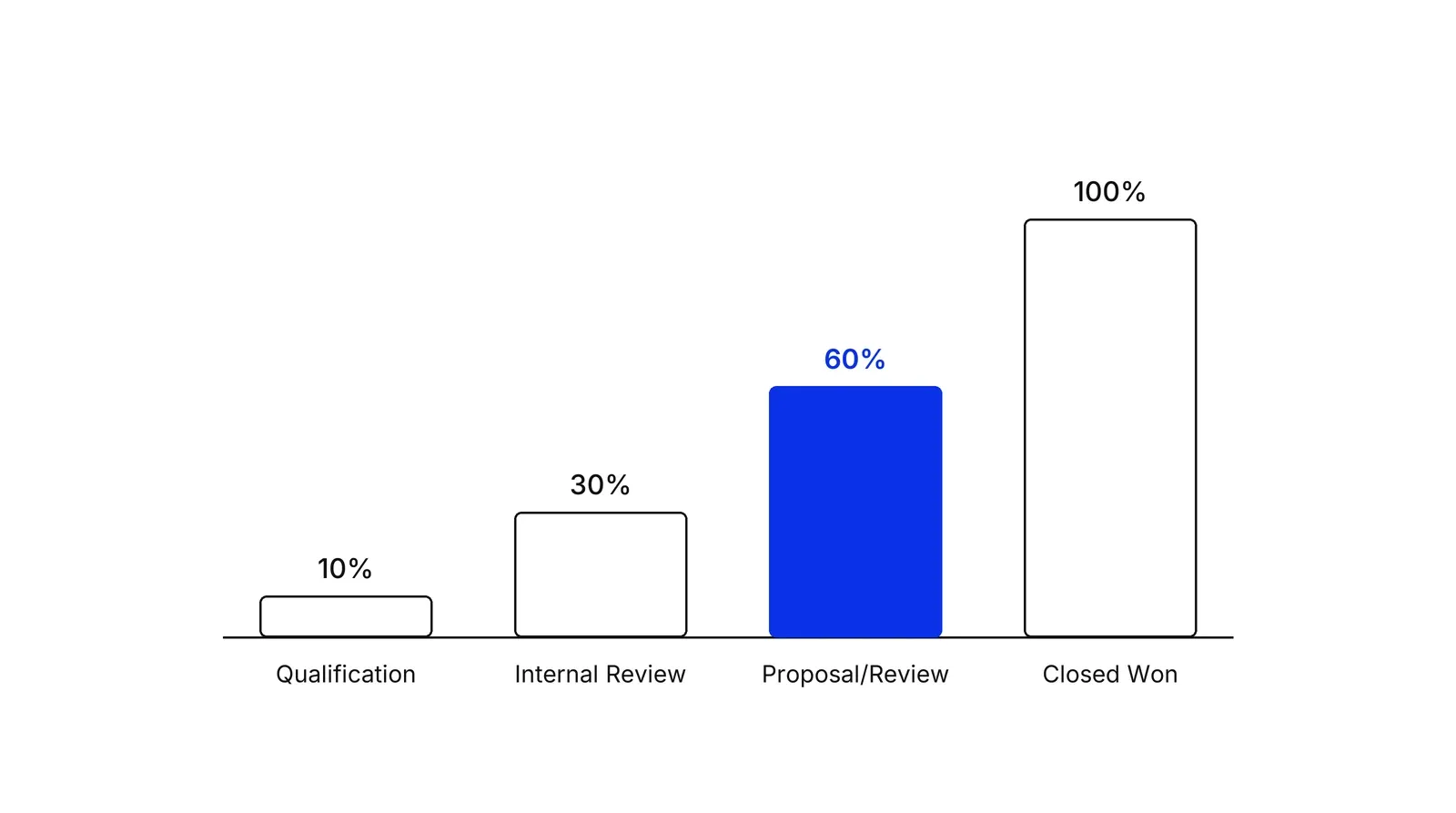
Take 40 deals at Qualification and 10 at Proposal/Review, each worth $20,000. At the sample rates the weighted pipeline is (40 x 0.10 + 10 x 0.60) x $20,000 = $200,000. Now suppose your own history shows Qualification deals closing at less than half the sample rate, so that stage contributes less than half of the $80,000 the sample rate gives. The forecast is then off by that shortfall before any rep has done anything wrong, because the error sits in a default value.
Yan and colleagues make the same argument with data: in place of subjective human ratings, they estimate the win-propensity of leads from logged activity, and report deploying the model at a large B2B technology company.
Stages follow the buyer
Viio and Grönroos argue that the sales process should be adapted to the customer’s level of buying readiness. Adamson, Dixon and Toman report that customers need sales reps less than they once did, because procurement teams armed with data can define solutions themselves. Weitz, Sujan and Sujan propose that adaptive selling rests on the salesperson’s knowledge of customer types and sales strategies. Together these push stage design in one direction: tie progress to what the buyer does on their own, such as sending requirements unprompted.
A Growth Lab plan starts from the stages and the numbers behind them, so the sales model is built on measured conversion before anyone sets a target.
How to apply Sales process stages, step by step
- List the stages you have. Copy the stage names exactly as they appear in the CRM, in order, with the probability attached to each. Most teams find stages nobody can define. Result: one list that shows which stages are vague.
- Rename each stage as a state of the buyer. Replace activity names such as Presentation with states such as Problem confirmed or Budget owner named. A stage name should finish the sentence 'The buyer has...'. Result: stage names that describe the customer, not the rep's calendar.
- Write one exit criterion per stage. For each stage write the single fact that must be true before a deal leaves it, and where that fact is stored: an email, a calendar event, an uploaded file or a CRM field. Result: a table of stages, criteria and evidence.
- Define the two endings. Closed won needs a document the buyer signed. Closed lost needs a reason chosen from a short fixed list. Result: endings that can be reported on without anyone's opinion.
- Audit open deals against the criteria. Take every open deal and check its evidence. Move deals that fail back to the stage they really reached. Result: a pipeline total before and after the audit, and a list of deals that were optimism.
- Replace default probabilities after a quarter. Count how many deals that entered each stage later closed won, and use those rates instead of the defaults the CRM shipped with. Result: stage probabilities based on your own history.
Examples
A cross-border payments provider
Illustrative, no real company implied. A payments provider selling payout accounts to marketplaces defines Stage 3, Requirements shared, as 'the prospect sent monthly payout volume and corridors in writing'. Stage 4, Compliance review started, means the buyer uploaded its business verification documents. A rep cannot reach Stage 4 by feeling good about a call, because the upload either exists or it does not. Deals that stall before the upload show up as a clear drop between Stage 3 and Stage 4.
A private clinic selling corporate health plans
Illustrative, no real clinic implied. A clinic sells annual check-up packages to employers with 50 to 300 staff. Qualified means the HR lead named who holds the benefits budget. Evaluating means the employer shared headcount and the age mix. Commitment means the employer's finance contact asked for the contract. Each of these is something the employer did, and each can be found in an email thread.
Salesforce's own sample stages
Salesforce's Trailhead tutorial on stages defines Closed Won as the customer returning a signed contract and Closed Lost as no deal. Its sample setup assigns Qualification a 10% chance of closing and Proposal/Review 60%. The tutorial presents these as example values for one fictional team, which is the point: the percentages are placeholders until a team replaces them with its own results.
When to use it
Use it when a pipeline report looks healthy but forecasts keep missing, when two reps would put the same deal in different stages, or when a team is adding a CRM, a sales development function or a new product line and needs one shared definition of progress.
When not to use it
Skip it for a one-call, low-value sale where a buyer decides in minutes and a deal never sits in a stage, and for a founder selling the first ten deals alone, where the learning is in the conversations and a formal pipeline adds paperwork without information.
Common mistakes
- Naming stages after what the rep does, such as Demo or Proposal sent, so a deal advances because the rep acted and not because the buyer responded.
- Using more stages than anyone can define in a sentence. If a stage has no exit criterion, delete it or merge it with a neighbour.
- Keeping the default stage probabilities the CRM came with and reporting a weighted forecast as if the numbers were measured.
- Letting deals jump forward without evidence, then wondering why stage-to-stage conversion looks too good at the top and too weak at the bottom.
- Closing lost deals with a blank reason, which removes the one field that tells you which stage fails most often.
FAQ
What are the stages of the sales process?
The classic textbook list has seven steps: prospecting, preapproach, approach, presentation, overcoming objections, close and follow-up. A CRM pipeline usually compresses these into five or six open stages plus Closed Won and Closed Lost. The right names depend on your buyers; the right test is whether each stage has a checkable exit criterion.
How many stages should a sales pipeline have?
Fewer than most teams think. Salesforce's Trailhead guidance advises keeping the number of stages small and the names consistent across revenue streams. Start with five or six open stages, and add one only when you can name a buyer action that separates it from its neighbour.
What is the difference between a sales process and a sales funnel?
The sales process is the sequence of stages and the rules for moving between them. The funnel is the picture of how many deals sit in or pass through each stage. Terho, Salonen and Yrjänen describe the funnel's shape as an indicator of pipeline health. A bad process produces a funnel you cannot trust.
What is an exit criterion in sales?
It is a fact about the buyer that must be true before a deal moves to the next stage, for example that a named person confirmed the budget in writing. It borrows the gate idea from stage-gate systems in product development. A good criterion can be checked by someone other than the rep.
How do you set probabilities for pipeline stages?
Start with the CRM defaults, then replace them with your own history: of the deals that entered a stage in the last year, what share closed won. Salesforce lets admins change the default percentages. Research on pipeline analytics argues for data-driven win estimates over subjective ratings by reps.
Sources
- A. J. Dubinsky, A Factor Analytic Study of the Personal Selling Process, Journal of Personal Selling & Sales Management 1(1), 1981
- William C. Moncrief, Greg W. Marshall, The evolution of the seven steps of selling, Industrial Marketing Management 34(1), 2005
- Selma Kadić-Maglajlić, Nawar N. Chaker, Maja Arslanagić-Kalajdzić, The same only different: seven steps of selling in emerging markets, in A Research Agenda for Sales, Edward Elgar, 2021
- University of Minnesota Libraries, The Power of Selling, section 7.1, It's a Process: Seven Steps to Successful Selling (open textbook)
- Greg W. Marshall, William C. Moncrief, John M. Rudd, Nick Lee, Revolution in Sales: The Impact of Social Media and Related Technology on the Selling Environment, Journal of Personal Selling & Sales Management 32(3), 2012
- Marvin A. Jolson, Thomas R. Wotruba, Prospecting: A New Look at this Old Challenge, Journal of Personal Selling & Sales Management 12(4), 1992
- Barton A. Weitz, Harish Sujan, Mita Sujan, Knowledge, Motivation, and Adaptive Behavior: A Framework for Improving Selling Effectiveness, Journal of Marketing 50(4), 1986
- Paul Viio, Christian Grönroos, How buyer-seller relationship orientation affects adaptation of sales processes to the buying process, Industrial Marketing Management 52, 2015, Hanken research portal record
- Arizona State University, Center for Services Leadership, Value-based sales process adaptation in business relationships (Viio and Grönroos, 2014)
- Brent Adamson, Matthew Dixon, Nicholas Toman, The End of Solution Sales, Harvard Business Review, July-August 2012
- Harri Terho, Anna Salonen, Meri Yrjänen, Toward a contextualized understanding of inside sales: the role of sales development in effective lead funnel management, Journal of Business & Industrial Marketing 38(2), 2022
- Junchi Yan and colleagues, On Machine Learning towards Predictive Sales Pipeline Analytics, Proceedings of the AAAI Conference on Artificial Intelligence 29(1), 2015
- Jeannette Paschen, Matthew Wilson, João J. Ferreira, Collaborative intelligence: How human and artificial intelligence create value along the B2B sales funnel, Business Horizons 63(3), 2020
- Robert G. Cooper, Stage-gate systems: A new tool for managing new products, Business Horizons 33(3), 1990
- Salesforce Trailhead (vendor documentation), Create and manage stages and sales processes
- Salesforce Help (vendor documentation), Manage opportunity stage to forecast category mappings for pipeline forecasts
- Salesforce Trailhead (vendor documentation), Customize opportunity stages in a sales path
- Kommo, formerly amoCRM (vendor documentation), Edit your pipeline
- Bitrix24 Helpdesk (vendor documentation), Deals overview
- Bitrix24 Helpdesk (vendor documentation), Sales tunnels in CRM
- Bitrix24 Helpdesk (vendor documentation), Difference between classic and conversion sales funnels
Last updated Oct 9, 2026


Marketing agency or growth system: when a company outgrows its agency
An agency is the right call while the founder still runs most of the company. Once the business starts copying itself into new locations or markets, it needs a system that sets goals, tests hypotheses and owns the result.

Why healthcare marketing agencies stall: the short, mid and long wins model we use with clinics
Most agencies own the click and nobody owns the front desk. How we structure clinic work in three horizons, the research behind each one, and one year of results.

Why channel tests stall after month three
Most paid channel tests do not end with a decision. They end when the budget runs out, the attribution model changes, or everyone quietly stops looking at the dashboard.