Audience temperature (cold, warm, hot)
A way to sort the people you advertise to by how much contact they have had with you, cold, warm or hot, so each group gets a message and an ask it is ready for.
Audience temperature is a way to group advertising audiences by their relationship with a business. Cold audiences have never interacted with it, warm audiences have engaged without buying, and hot audiences have shown intent to buy. Each group gets a different message: the problem for cold, proof for warm, the offer for hot. Its older root is Eugene Schwartz's five stages of awareness from 1966.
- Origin
- Practitioner shorthand with no documented author; rooted in Eugene Schwartz's stages of awareness, 1966 (Breakthrough Advertising); temperature labels undated practitioner use
- Level
- 201 · Tool
- Fits
- Startup, Small and mid-size
- Time to apply
- two hours to sort audiences and draft one message per temperature; four weeks to read results
- What you need
- access to your ad accounts and the audience lists already in them · a pixel or tag with events for key steps: product view, pricing view, cart or form start · a CRM or email export to build customer and lead lists · one offer for each temperature, from a free resource to a price or trial
Audience temperature is a way to sort the people you advertise to by their relationship with your business. A cold audience has never interacted with you. A warm audience has engaged, for example by watching a video, following a page or visiting the site, but has not moved toward buying. A hot audience has shown intent: they looked at prices, started a form, added to cart or searched your name. Each temperature gets its own message and its own ask.
The labels are practitioner shorthand with no documented author. The idea underneath is older. In 1966, the copywriter Eugene Schwartz published Breakthrough Advertising with Prentice-Hall and described five stages of prospect awareness. A few web summaries date the book to 1952; the catalogue records for the first edition, including Open Library, say 1966.
What makes an audience cold, warm or hot?
The temperature comes from the signals a person has left with you. Ad platforms already sort audiences this way, even if they use other names. Google lists affinity and in-market segments for people who have not met you, and “your data” segments for people who have: site and app visitors, YouTube viewers and contact lists uploaded through Customer Match. Meta builds Custom Audiences from the pixel, app events, offline activity and customer files. Yandex Audiences does the same with CRM uploads, a pixel and look-alike segments.
| Temperature | Typical signals | Where the audience comes from |
|---|---|---|
| Cold | No contact yet | Interests, demographics, in-market segments, lookalikes |
| Warm | Watched a video, followed, read a guide, visited, subscribed | Engagement lists, site visitors, email subscribers |
| Hot | Viewed pricing, started a form or checkout, searched your brand, booked a call | Event-based lists, recent leads, brand search |
Lookalikes are cold, even though they start from your data. Meta builds them from a seed of at least 100 people and lets you choose how close the match is: the top 1% of similar people for precision, or 5% for reach. None of them has met you.
Customers belong on their own list. They know you best, but the right message is a repeat purchase or an upgrade, not a first-order offer.
Schwartz’s five stages, the older root
Schwartz sorted prospects by what they know, not by what they have done with you. Copywriters now use five labels for his stages: completely unaware, problem aware, solution aware, product aware and most aware. A version quoted by Joanna Wiebe at Copyhackers describes the most aware prospect as one who only needs to know “the deal”, and the completely unaware one as knowing nothing beyond their own identity or opinion. Posts by different writers number the stages in opposite directions, so check which end is stage 1.
The lesson copywriters take from it is that the copy starts where the prospect’s knowledge starts. A most aware buyer needs the offer and the price. A problem-aware reader needs to feel understood first; Copyhackers’ guide to pages for problem-aware visitors tells writers to stay with the pain before showing the solution. The less the prospect knows, the more the ad and the page must explain.
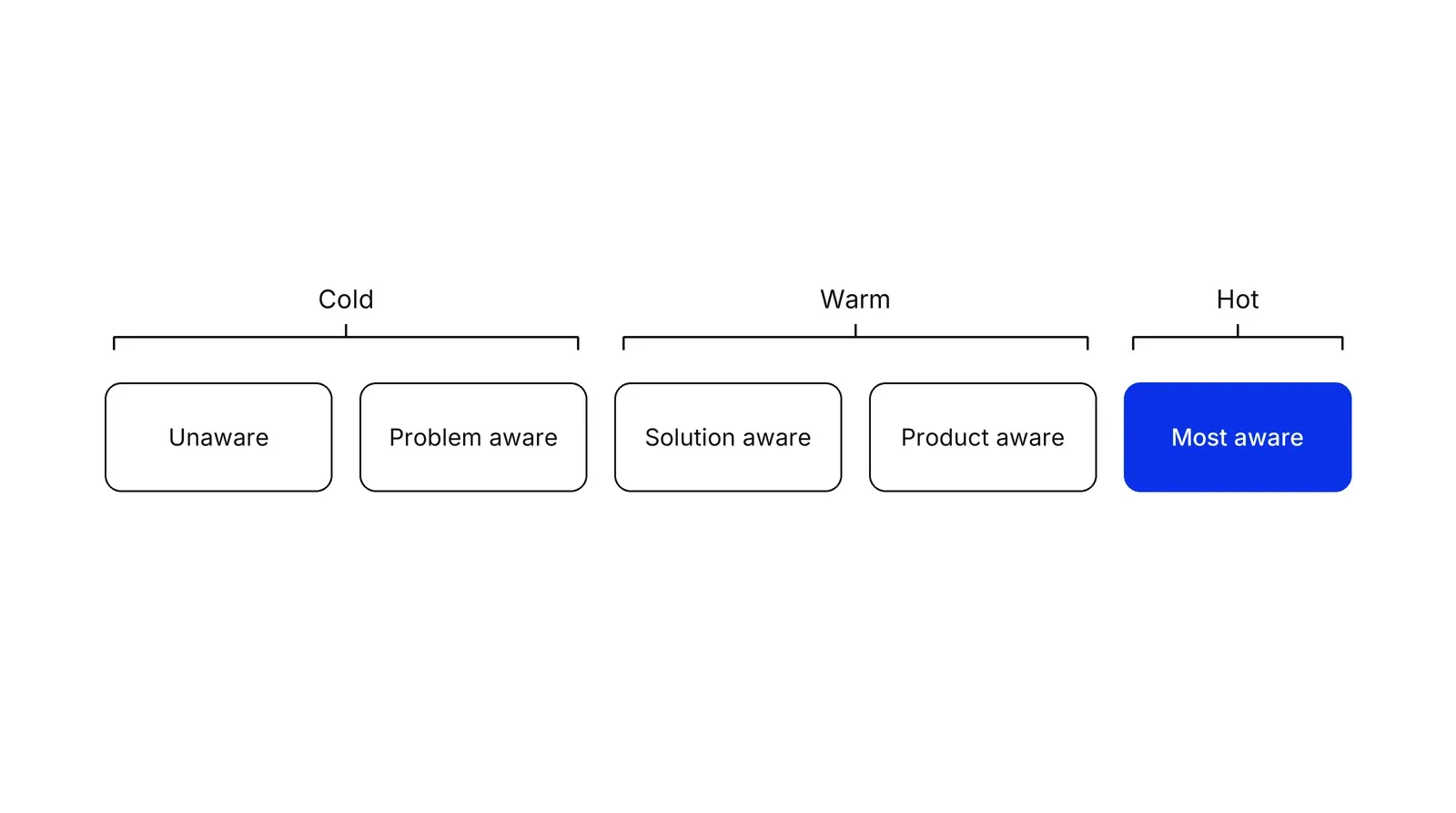
The mapping is approximate. Schwartz’s stages and the temperature labels both descend from step models of advertising, such as the hierarchy of effects Lavidge and Steiner proposed in 1961. Barry and Howard traced that family of models back to around 1900. The evidence for a fixed order is weak: after reviewing more than 250 studies, Vakratsas and Ambler found little support for any hierarchy in the sense of a time sequence. So treat temperature as a state a person is in today, not as a conveyor belt.
Contact and intent are two different things
Temperature by contact misses an important group: people who have never met you but are ready to buy from someone. A person searching “dentist near me” is cold to every clinic and most aware of the solution. A subscriber who has read your emails for two years is warm, yet may have no need this year.
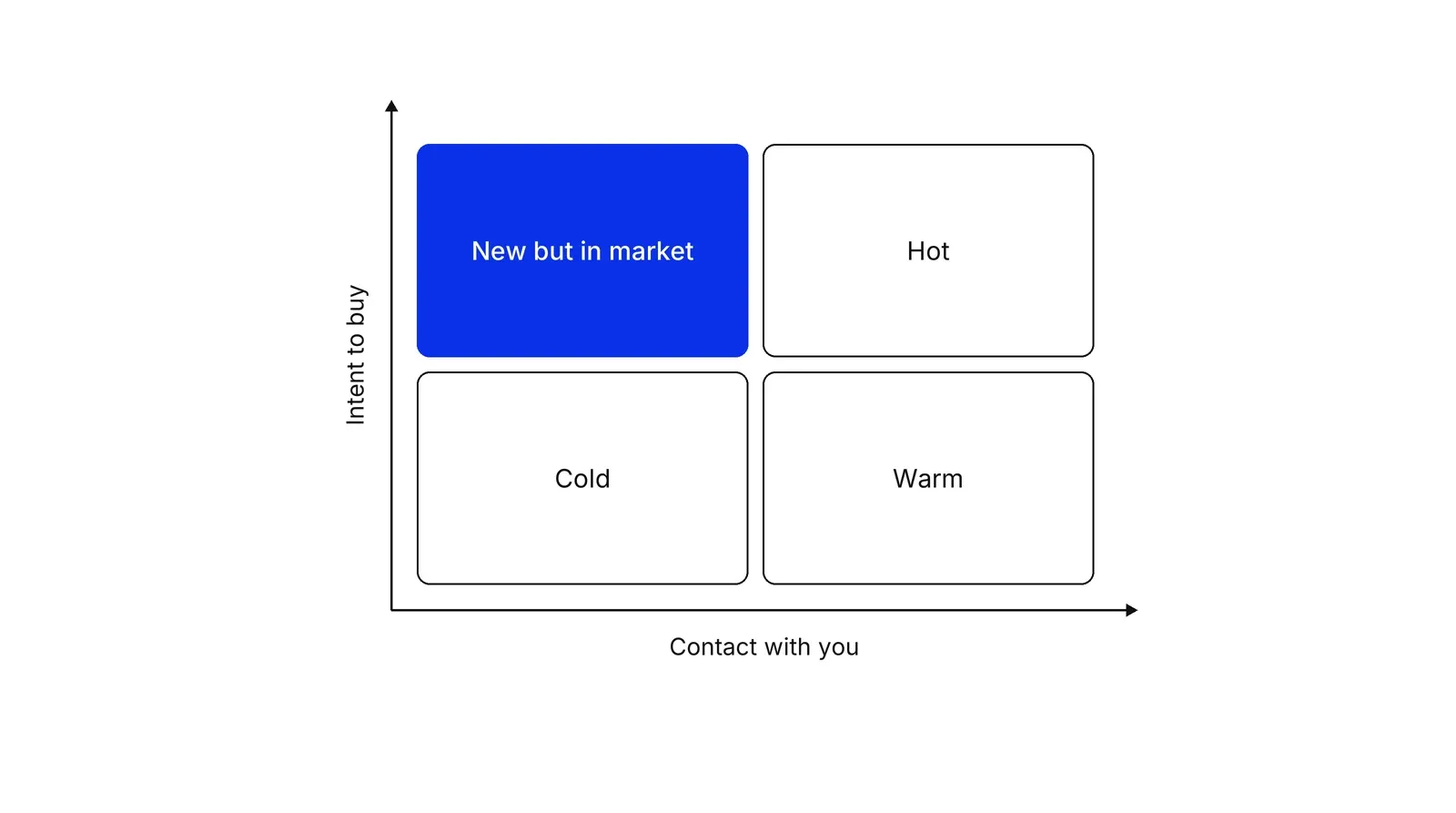
Search data shows both sides. In a study of a lodging chain’s paid search, Rutz and Bucklin found that generic searches, such as “hotels Los Angeles”, raised later searches for the brand name, while branded search did not feed generic search. Generic searchers start cold to the brand and turn hot. At the other end, the eBay experiments by Blake, Nosko and Tadelis found brand-keyword ads had no measurable short-term benefit, because people typing the brand arrived anyway. Hot audiences are the easiest to convert and the easiest to over-credit, so test them against a holdout, for example with the ghost ads method.
What to say at each temperature
The message should match what the person already knows. Research on display ads points the same way.
| Cold | Warm | Hot | |
|---|---|---|---|
| Lead with | The problem or the situation | Proof and how you differ | The offer and the next step |
| Ask for | Attention: a view, a read, a free tool | A small step: a signup, a demo, a quiz | The sale, the booking, the application |
| Detail level | Broad, category level | Specific to the product | Price, terms, availability |
Detailed ads only work once a person’s choice has narrowed. Lambrecht and Tucker found that retargeted ads showing the exact product a person viewed did worse than generic brand ads on average, and caught up only when browsing showed the person’s preferences had narrowed. In a study of a large US retailer’s display ads, Bruce, Murthi and Rao found retargeted ads were effective only when they offered a price incentive. Google’s work on the messy middle adds that buyers loop between exploring and evaluating, so a warm person can see proof several times before they turn hot.
How big each group is
The cold group is the largest by far, and most of it will not buy soon. John Dawes of the Ehrenberg-Bass Institute estimates that only about 5% of B2B buyers are in market at any time; the LinkedIn B2B Institute calls this the 95-5 rule. Hot lists are small, warm lists are bigger, and cold audiences hold the people who will buy next year.
That shapes the work. Cold campaigns fill warm lists, warm campaigns turn some of them hot, and hot campaigns close. How to set objectives, metrics and budget for each stage is covered in the paid media funnel page. List windows, frequency caps and lift tests for warm and hot audiences are covered under retargeting. Mapping audiences, messages and tests into one plan is part of Pushers’ Growth Lab work.
How to apply Audience temperature (cold, warm, hot), step by step
- List the signals you already collect. Write down every action you can see: video views, page engagement, site visits, email signups, pricing views, form starts, carts, brand searches, purchases. Note where each one lives (pixel, CRM, ad platform). Result: a signal inventory with the monthly count for each.
- Assign each signal a temperature. No contact is cold. Light engagement (watched, followed, read, subscribed) is warm. Actions that show a buying decision (priced, started a form, added to cart, searched your brand) are hot. Put customers in their own list. Result: three to four audience definitions with a recency window for each.
- Check awareness inside each temperature. Ask what each group knows about the problem and the solutions, using Schwartz's five stages. A cold searcher for 'dentist near me' is already solution aware; a warm subscriber may not have a problem today. Result: notes on which segments break the default message.
- Write one message per temperature. Cold: name the problem or the situation, with no hard ask. Warm: show proof and how you differ, with a comparison, case or demo. Hot: state the offer, the price and the next step, and remove friction. Result: three briefs that a designer and a copywriter can work from.
- Build exclusions and launch. Exclude warm and hot lists from cold campaigns, and hot lists from warm ones, so each person sees the message for their state. Customers are excluded from acquisition offers. Result: campaigns with non-overlapping audiences and a holdout group for the warm and hot ones.
- Read results by temperature. Judge cold campaigns by how many people move into warm lists, warm by how many become hot, and hot by cost per sale. Compare hot results with the holdout before crediting them. Result: a monthly table showing flow between temperatures, not only last-click sales.
Examples
A small business lending app
Illustrative. A lender to online sellers has 40,000 site visitors a month. Cold: video ads to sellers on marketplaces, about cash-flow gaps before peak season, with a free cash-flow calculator. Warm: people who used the calculator or watched half the video see a comparison of approval time and fees against a bank loan. Hot: people who started the application and stopped see an ad stating the approval time and a link back to their saved form. Each list excludes the hotter ones.
A dermatology clinic
Illustrative. Cold: local ads about one common concern, such as a mole that has changed, pointing to a short guide on when to get checked. Warm: guide readers and Instagram followers see the doctors, their qualifications and patient reviews. Hot: search ads on the clinic's name and on 'mole check near me', with prices and the booking link. Google's personalized advertising policy bars advertiser-built audiences for health ads, so on Google the warm step relies on search and email, and the message stays general about the clinic, not about the reader's condition.
When to use it
Use it when every campaign says the same thing to everyone, when cold audiences are being asked to buy on first contact, or when the team cannot say which audience a campaign is for. It is a quick way to give a small team a shared vocabulary for audiences and messages.
When not to use it
It adds little when nearly all demand comes from search, where intent is visible in the query and awareness matters more than prior contact. It is also too coarse for a buying committee in B2B, where five people at one account sit at different temperatures; account-based planning fits better.
Common mistakes
- Treating temperature as a fixed label when it decays: a cart from yesterday is hot, a cart from three months ago is closer to warm.
- Sending the hot offer, a discount or a demo request, to cold audiences who do not yet know they have the problem.
- Letting cold and warm campaigns overlap, so the same person sees a first-touch ad after they already asked for a price.
- Crediting hot campaigns with sales that would have happened anyway, such as brand-name search, without a holdout test.
- Defining temperature by contact alone and missing cold people who are already in market, like non-brand searchers.
FAQ
What is a cold audience in marketing?
A cold audience is people who have never interacted with your business: no visit, no follow, no email. You reach them through interests, demographics, in-market segments or lookalikes. They need a message about the problem or situation first, because they have no reason yet to care about your product or your offer.
What is the difference between a warm and a hot audience?
A warm audience has engaged with you, for example watched a video, followed the page, visited the site or subscribed, but has not shown a decision to buy. A hot audience has: they viewed pricing, started a form, added to cart or searched your brand name. Warm needs proof and comparison; hot needs the offer and an easy next step.
What are the five stages of awareness?
They come from Eugene Schwartz's 1966 book Breakthrough Advertising, and copywriters now label them unaware, problem aware, solution aware, product aware and most aware. They describe what a prospect knows about the problem and your product. The less aware the prospect, the more the copy has to explain before it can sell.
How do you warm up a cold audience?
Give it something useful that asks for little: a short video, a guide, a calculator, a clear explanation of a problem. People who watch, read or use it join your warm lists. Then show those lists proof and comparison. Measure cold campaigns by how many people they add to warm lists, not by sales.
Are existing customers a hot audience?
Treat them as a separate list. They know you better than any hot prospect, but they need a different message: a repeat purchase, an upgrade, a referral. Exclude them from acquisition campaigns so you do not pay to win people you already have, or show them a first-order discount.
Sources
- Eugene Schwartz, Breakthrough Advertising, Prentice-Hall, 1966 (Internet Archive catalogue record)
- Open Library, Breakthrough advertising, Eugene M. Schwartz, first published 1966
- Joanna Wiebe, Copyhackers, How long should your pages be? (five stages of awareness)
- Copyhackers, Conversion copy course takeaways, 2022 (stages numbered 1 to 5)
- Tyler J. Koenig, Copyhackers, How to write a landing page for problem-aware visitors, 2020
- Robert J. Lavidge, Gary A. Steiner, A Model for Predictive Measurements of Advertising Effectiveness, Journal of Marketing 25(6), 1961
- Thomas E. Barry, Daniel J. Howard, A review and critique of the hierarchy of effects in advertising, International Journal of Advertising, 1990 (WARC)
- Demetrios Vakratsas, Tim Ambler, How Advertising Works: What Do We Really Know?, Journal of Marketing 63(1), 1999
- Google Ads Help, About audience segments
- Google Ads Help, About your data segments
- Google Ads Help, About Customer Match
- Meta for Developers, Marketing API, Custom Audiences
- Meta for Developers, Marketing API, Lookalike Audiences
- Yandex, Yandex Audiences help (Аудитории)
- Oliver J. Rutz, Randolph E. Bucklin, From Generic to Branded: A Model of Spillover in Paid Search Advertising, Journal of Marketing Research 48(1), 2011 (author PDF)
- Thomas Blake, Chris Nosko, Steven Tadelis, Consumer Heterogeneity and Paid Search Effectiveness: A Large-Scale Field Experiment (NBER working paper 20171)
- Anja Lambrecht, Catherine Tucker, When Does Retargeting Work? Information Specificity in Online Advertising, Journal of Marketing Research 50(5), 2013 (MIT DSpace)
- Norris I. Bruce, B.P.S. Murthi, Ram C. Rao, A Dynamic Model for Digital Advertising: The Effects of Creative Format, Message Content, and Targeting on Engagement, Journal of Marketing Research 54(2), 2017
- NIM Marketing Intelligence Review, Norris I. Bruce, Effective display advertising: improving engagement with suitable creative formats
- Garrett A. Johnson, Randall A. Lewis, Elmar I. Nubbemeyer, Ghost Ads: Improving the Economics of Measuring Online Ad Effectiveness, Journal of Marketing Research 54(6), 2017
- Ehrenberg-Bass Institute, The 95:5 rule is the new 60:40 rule (research by John Dawes)
- Ty Heath, LinkedIn B2B Institute, The 95-5 rule
- Google Advertising Policies Help, Personalized advertising (health as a sensitive interest category)
- Alistair Rennie, Jonny Protheroe, Google, Decoding decisions: the messy middle of purchase behavior, 2020
Last updated Oct 9, 2026

Marketing agency or growth system: when a company outgrows its agency
An agency is the right call while the founder still runs most of the company. Once the business starts copying itself into new locations or markets, it needs a system that sets goals, tests hypotheses and owns the result.
Why healthcare marketing agencies stall: the short, mid and long wins model we use with clinics
Most agencies own the click and nobody owns the front desk. How we structure clinic work in three horizons, the research behind each one, and one year of results.

The compliance layer under fintech marketing operations
A fintech marketing agency can build campaigns. It cannot own the compliance review, the KYC drop-off or the multi-market licensing rules that decide whether a lead ever becomes a customer.