Thought leadership
Thought leadership is a way to position a company through the original ideas of its founders and experts, so that buyers trust it before they are ready to buy.
Thought leadership is free, expert-backed content that gives buyers a new way to think about a problem, without a product pitch. A company or a founder publishes it to earn trust before anyone is ready to buy, so that the brand is already on the shortlist when a need appears. It works only when the idea is new and the evidence is real.
- Origin
- Joel Kurtzman, strategy+business (term); practice from consulting and research firms, mid-1990s (term); sources differ on the exact date
- Level
- 301 · Advanced
- Fits
- Small and mid-size, Scale-up
- Time to apply
- two weeks to set the point of view and the first piece, then a monthly rhythm
- What you need
- one founder or senior expert who will put their name on the ideas · evidence nobody else has: your own data, cases, or years of observation · a list of the questions your buyers ask before they choose a supplier
Thought leadership is content that shares an original, expert view on a problem your buyers face, published for free and without a sales pitch. A company, a founder or a specialist uses it to build trust with people who are not buying yet. The test is simple: would a smart buyer learn something from the piece even if they never bought from you?
Where the term comes from
The phrase has a traceable origin, though not a settled date. The magazine strategy+business credits its founding editor, Joel Kurtzman, with coining “thought leader” in its first issue, and Kurtzman’s own 20-year retrospective calls an interview with Keshub Mahindra one of the magazine’s earliest “Thought Leader” interviews. The magazine was published by the consulting firm Booz Allen & Hamilton, which is why the term spread first through consulting.
Many sources say 1994. Kurtzman writes that the magazine was conceived that year, after a partner at Booz Allen approached him, but the same retrospective was written in 2015 to mark 20 years of publishing, so the first issue most likely came out in 1995. The credit rests on the magazine’s own account, and the first issue itself was not available to check.
The academic view is that the concept is still loosely defined. A 2021 paper in the Journal of Knowledge Management by Harvey and colleagues reviewed the research and 12 interviews with senior leaders of professional firms. They define it as knowledge from a trusted, eminent and authoritative source that is actionable and offers valuable solutions to stakeholders.
What buyers say they want from it
The best public data comes from the annual Edelman and LinkedIn study of B2B decision-makers. The 2020 edition surveyed 3,275 executives in September and October 2019. It defines the subject as free deliverables on a topic the producer knows well, excluding content mainly about its own products. Its findings are mixed, and every figure below comes from that report:
- 89% said it can be effective at improving their view of an organization, and 49% said it can influence a purchase.
- 59% agreed it is a more trustworthy basis for judging a company’s capabilities than its marketing materials and product sheets.
- Only 15% rated most of what they read as very good or excellent.
- Among producers, 74% had no way to link it to sales leads or wins.
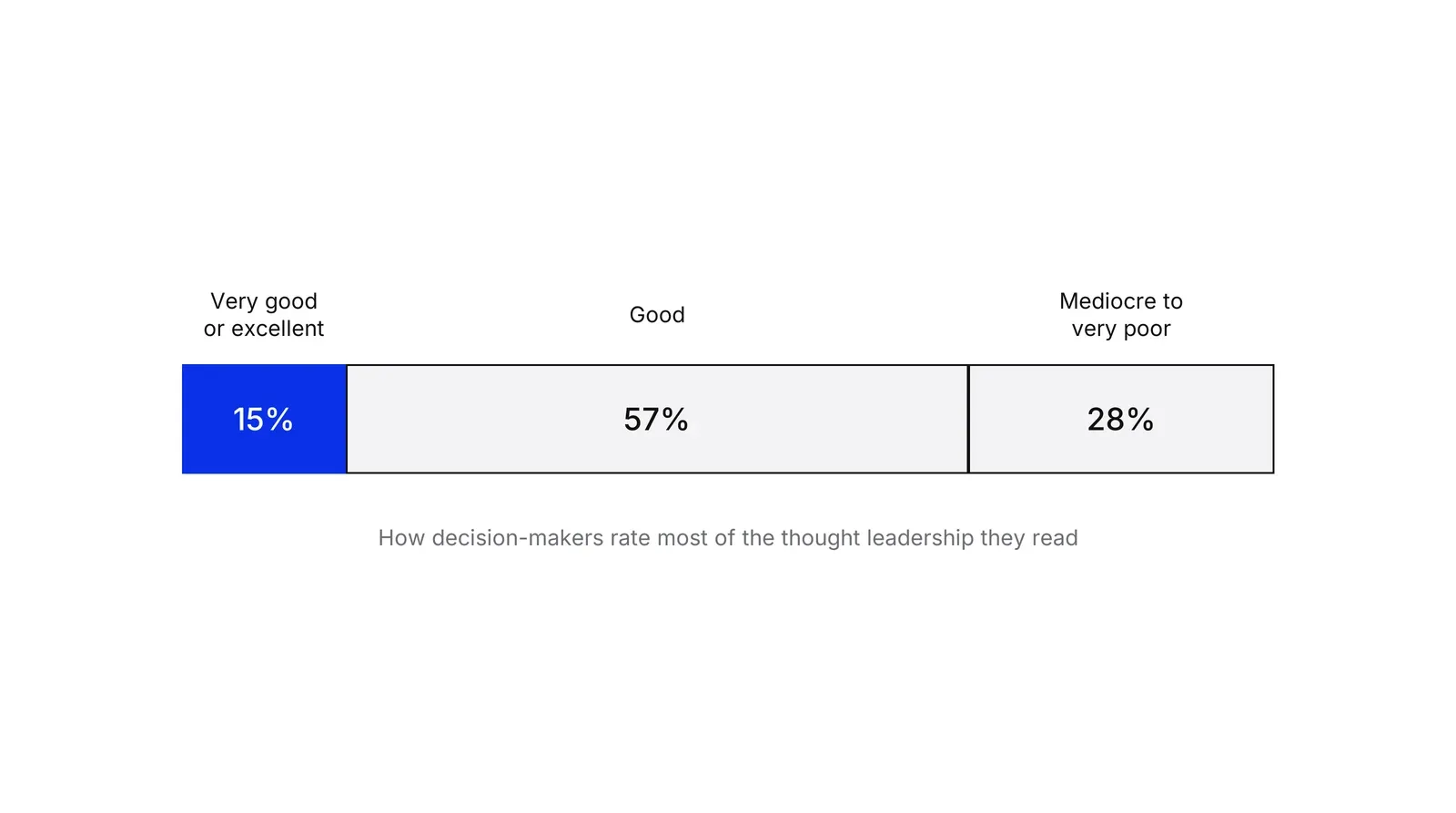
The same report lists what separates good from bad. Readers value content that explores challenges they had not considered or points out things they overlooked. They mark down content that repeats what everyone says, stays superficial or pushes a sale.
Later editions shifted the focus rather than repeating those numbers. The 2024 edition, its sixth, surveyed nearly 3,500 management-level professionals in seven countries and argues that the content can make buyers reexamine their assumptions and help protect existing customers from rivals. The 2025 edition surveyed nearly 2,000 professionals and looks at hidden buyers, the internal influencers whose involvement may not be visible to sellers. It says more than 40% of B2B deals stall because of misalignment inside the buying group, a figure it takes from Matt Dixon’s 2022 research.
Why it matters when most buyers are not buying
Professor John Dawes says up to 95% of business clients are not in the market for a given product at any one time. He calls the figure a heuristic, not a precise rule. His point for marketers is that most of your audience cannot act yet, so the job is to be remembered when they can. The 2024 Edelman page starts from the same point and notes that buyers now prefer a self-directed journey of digital discovery.
Expert content fits that job because it earns attention from people who have no reason to read a sales page. It also supplies the proof of expertise that search engines look for: Google’s guidance asks whether the content shows clear sourcing, evidence of expertise and background about the author. Our page on E-E-A-T covers that side in detail, and mental and physical availability explains why being remembered precedes being chosen. Jenni Romaniuk’s brand rejection study in two B2B service categories found rejection of each brand low, at around 10%, so lack of awareness is the likelier brake on growth. Weinberg and Lombardo of the LinkedIn B2B Institute draw the practical conclusion: invest in making every buyer remember the brand next time they need the product. The institute’s How B2B Brands Grow series gathers these papers.
How it differs from nearby practices
| Practice | Main aim | Typical content | Who speaks |
|---|---|---|---|
| Thought leadership | Trust and shortlist position | Original research, a stated point of view | A named expert or founder |
| General content marketing | Attract and keep an audience | Guides, comparisons, how-tos | A brand voice |
| PR and earned media | Third-party coverage | Announcements, expert comment | Spokesperson, press |
| Product marketing | Win the evaluation | Features, pricing, case studies | The company |
Content marketing as a whole has a patchy record. In a 2016 Harvard Business Review article, Adamson and Spenner report that CEB research with more than 5,000 B2B purchase participants found most content efforts fall short of expectations. The page on PR strategy and earned media shows how the two practices feed each other.
Who has to be the voice
Daniel Drezner’s book The Ideas Industry describes the thought leader as someone with one big idea who spreads it, in contrast to the public intellectual who comments on many subjects. Academic work points the same way. A 2019 study by Barry and Gironda found that recognition as a trusted authority links an expert’s competencies to content that resonates, and that practical helpfulness and generosity in sharing feed those competencies.
Companies can claim the role too. In an Orbit Media survey of 481 marketers, 70% said a company can be a thought leader. Judgement from the other side of the table matters more. An older Harvard Business Review analysis of the Thought Leadership Group’s index named five behaviors that influential brands share: a pioneering spirit, rigor, objectivity, authenticity and clarity. Our guide to the personal brand framework helps when the voice is one person.
How to run it as a loop
Practice is more repetitive than inspiring. The Content Marketing Institute’s 2026 B2B research, based on a survey fielded in mid-2025, found that 96% of B2B marketers say their organization creates it, yet only 10% report that more than half of the employees with relevant expertise take part. LinkedIn was named the most effective channel by 76%.
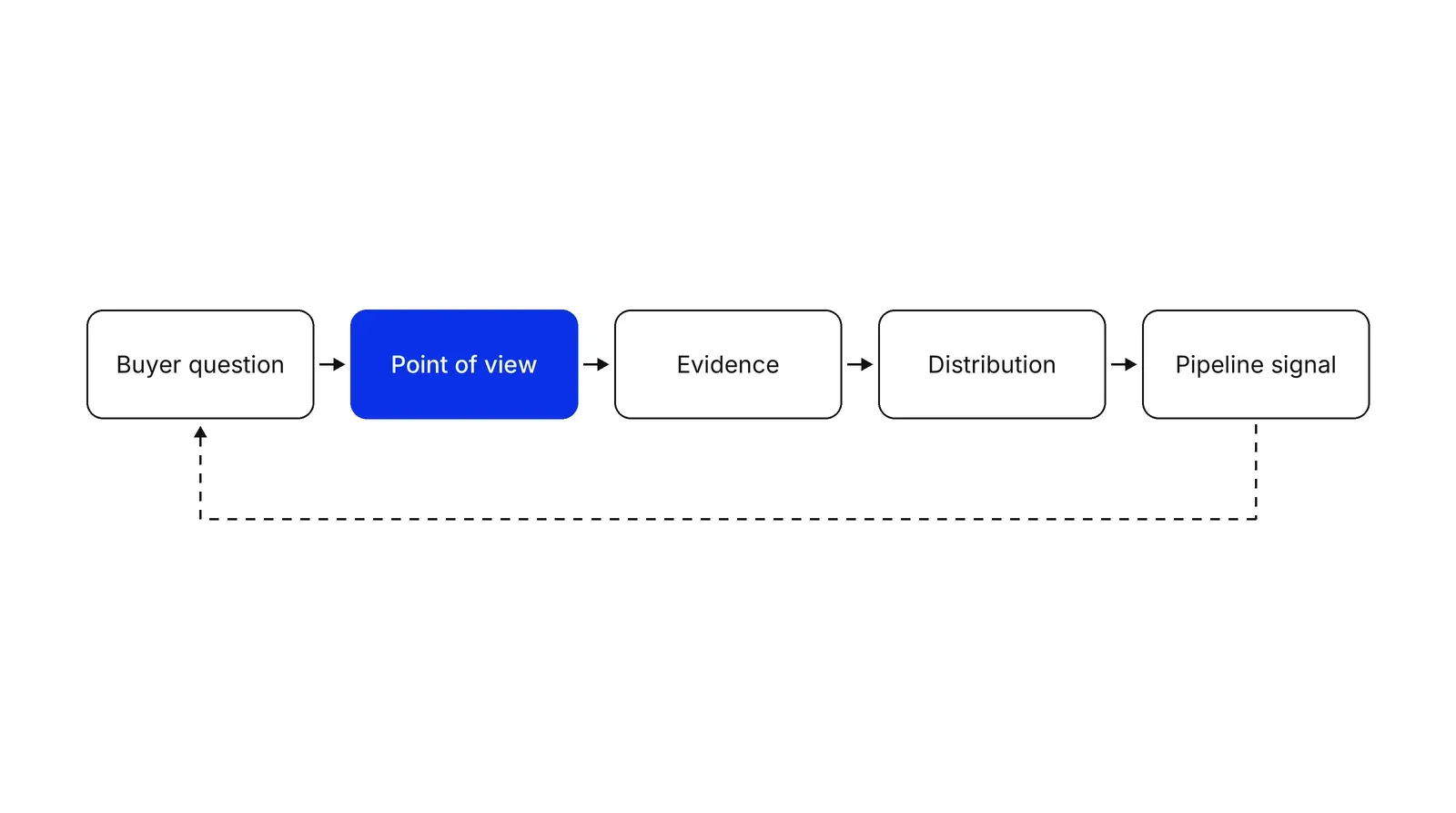
The point of view in the middle is the hard part, and a Growth Lab plan starts from the buyer questions and the evidence a company already holds.
How to apply Thought leadership, step by step
- Collect the questions buyers are stuck on. Read sales call notes, support tickets and the questions prospects ask before they sign. Pick the three that keep returning and that your competitors answer badly or not at all. Result: a ranked list of buyer questions, each with a real example attached.
- Write your point of view in one sentence. State a claim a smart person in your market could disagree with, for example 'most clinics measure ad spend per lead when they should measure it per patient who comes back'. Result: one sentence that a competitor would not sign.
- Back it with evidence only you hold. Use your own numbers, anonymised cases, a small survey or a method you have used for years. Merely repeating what everyone says is among the top traits decision-makers give for low-value content in the 2020 Edelman-LinkedIn study. Result: two or three pieces of proof you can show on the page.
- Put a named person behind it. Choose the founder or expert who will own the idea, and agree how much time they give each month, even if an editor drafts the text. Result: a named author for every piece, and a calendar slot for them.
- Send it where buyers already look. In the 2020 study, more than half of decision-makers found the last piece they read themselves on a feed or by search, so publish where your buyers read professionally and make it easy to forward. Result: each piece lives in two or three places, with one link to share.
- Watch for signals in the pipeline. Add a 'how did you first hear about us' field to forms, tag calls where prospects quote your ideas, and note which pieces sales reuse. Result: a monthly list of deals that mention your content, used to pick the next question.
Examples
McKinsey Global Institute: free research as a calling card
McKinsey set up its Global Institute in 1990. By its own description, no business or government commissions or funds the work, the results are shared publicly free of charge, and the McKinsey partners pay for it. The Institute's reports give buyers of consulting a view of how the firm thinks about big economic questions long before they hire anyone.
Stripe's annual letter in fintech
Stripe's cofounders John and Patrick Collison publish an annual letter that, in Stripe's words, takes stock of the business, reflects on the year and shares their views on trends in the online economy. The letter is about how the company sees the market, not about a product feature, and the founders put their names on it.
A payments company's founder (illustrative)
Illustrative, no real company implied. The founder of a cross-border payments firm sees in her own data that small exporters lose most of their money on delays, not on fees. She publishes a short paper with anonymised numbers, argues that fee tables hide the real cost, and presents it at two industry events. That is a claim buyers can test against their own invoices, which is what makes it more than a brochure.
When to use it
Use it when your buyers need weeks or months of trust before they choose, when the purchase is risky or technical, or when several people inside the buyer's company must agree. Founders in fintech, healthcare and professional services, where credibility decides who gets a call, get the most from it.
When not to use it
Skip it when you have no distinctive view or evidence yet, when the offer is a low-price, one-click purchase, or when nobody senior can spare time to stand behind the ideas. Without those, the result is generic content that adds to what readers already find mediocre.
Common mistakes
- Publishing product descriptions and calling them ideas. The Edelman-LinkedIn 2020 report itself leaves content that mainly describes products or services out of its definition.
- Repeating the consensus. 'Merely repeats what everyone else is saying' is among the top traits of low-value content in the same study.
- Making it anonymous. Content with no named expert gives the reader no one to trust, and Google's guidance asks for background about the author.
- Aiming only at the ready-to-buy few. The Dawes paper behind the 95:5 rule says most business buyers are not in the market at any given moment.
- Never connecting it to sales. In the 2020 study only 26% of producers could link their content to sales leads or wins.
FAQ
What is thought leadership?
It is expert content that offers a new perspective on a problem and is published free, without selling a product. Edelman and LinkedIn define it as free deliverables on a topic an organization knows well, excluding content mainly about its own products. The aim is trust and shortlist position before a buyer is in the market.
Who coined the term thought leader?
The magazine strategy+business credits its founding editor, Joel Kurtzman, with coining 'thought leader' in its first issue. The exact year is disputed: Kurtzman says the magazine was conceived in 1994, and it marked 20 years of publication in 2015, which points to 1995. The credit comes from the magazine itself.
Is thought leadership the same as content marketing?
No. Content marketing is the broad practice of publishing content to attract and keep an audience. Thought leadership is one kind of it, built on original ideas and expert evidence. A product comparison page is content marketing; a data-backed argument about how a market works is thought leadership.
Can a company be a thought leader, or only a person?
Both appear in the research. In a survey of 481 marketers run by Orbit Media, 70% said a company can be a thought leader. Drezner's work on the ideas market and the academic studies still point to named people as the face of the ideas, so most programs combine a person with a company channel.
How do you measure thought leadership?
Measure it by business signals, not only reach. The Content Marketing Institute's 2026 B2B research found 80% of marketers track engagement and 63% track business impact. Add a source field on forms, log deals where prospects cite your ideas, and review these monthly.
Sources
- Edelman and LinkedIn, 2020 Edelman-LinkedIn B2B Thought Leadership Impact Study (global report, fielded Sept-Oct 2019), archived PDF
- Edelman, 2024 Edelman-LinkedIn B2B Thought Leadership Impact Report, report page (archived)
- Edelman, 2025 Edelman-LinkedIn B2B Thought Leadership Impact Report, report page (archived)
- strategy+business, Remembering Joel Kurtzman
- Joel Kurtzman, Looking Back with Prescience, strategy+business, 2015
- The Boston Globe, Joel Kurtzman, 68, cynic turned optimist on the economy, 2016
- James Barry, John T. Gironda, Operationalizing Thought Leadership for Online B2B Marketing, Industrial Marketing Management, 2019
- William S. Harvey, Vince Wayne Mitchell, Alessandra Almeida Jones, Eric Knight, The tensions of defining and developing thought leadership within knowledge-intensive firms, Journal of Knowledge Management, 2021
- Daniel W. Drezner, Oxford University Press blog, Anti-authority and public distrust (on The Ideas Industry, 2017)
- Malcolm Gooderham, How Does a Brand Become a Thought Leader?, Harvard Business Review, November 2010
- Brent Adamson, Patrick Spenner, Avoid These Common B2B Content Marketing Mistakes, Harvard Business Review, February 2016
- John Dawes, Advertising effectiveness and the 95-5 rule: most B2B buyers are not in the market right now, Ehrenberg-Bass Institute and LinkedIn B2B Institute
- Peter Weinberg, Jon Lombardo, The 95:5 rule is the new 60:40 rule, Ehrenberg-Bass Institute for Marketing Science
- Jenni Romaniuk, Brand Rejection in B2B: Incidence, Reasons and Implications, Ehrenberg-Bass Institute and LinkedIn B2B Institute
- LinkedIn B2B Institute, How B2B Brands Grow
- Google Search Central, Creating helpful, reliable, people-first content
- Orbit Media, What is Thought Leadership Marketing? A new definition based on research
- Content Marketing Institute and MarketingProfs, B2B Content and Marketing Trends: Insights for 2026
- McKinsey Global Institute, About MGI
- Stripe, Stripe publishes 2022 annual letter
Last updated Oct 9, 2026


Marketing agency or growth system: when a company outgrows its agency
An agency is the right call while the founder still runs most of the company. Once the business starts copying itself into new locations or markets, it needs a system that sets goals, tests hypotheses and owns the result.

Why healthcare marketing agencies stall: the short, mid and long wins model we use with clinics
Most agencies own the click and nobody owns the front desk. How we structure clinic work in three horizons, the research behind each one, and one year of results.

Why channel tests stall after month three
Most paid channel tests do not end with a decision. They end when the budget runs out, the attribution model changes, or everyone quietly stops looking at the dashboard.