Win-back campaigns
A win-back campaign is a planned effort to bring lapsed customers back, built on a segment, a reason for leaving, an offer and a holdout group that shows how many came back because of it.
A win-back campaign is a targeted effort to get customers who stopped buying or cancelled to return. It starts by defining who counts as lapsed, groups them by value and by why they left, matches an offer to each group, and keeps a random holdout that gets nothing. The holdout shows how many customers returned because of the campaign and how many would have returned anyway.
- Origin
- Bernd Stauss and Christian Friege (regain management); Jacquelyn Thomas, Robert Blattberg and Edward Fox (reacquisition pricing), 1999; 2004
- Level
- 201 · Tool
- Fits
- Small and mid-size, Scale-up
- Time to apply
- two weeks to define and segment the list, then four to six weeks for a first test
- What you need
- a customer table with last purchase or last active date, value and, if you have it, the reason for leaving · an email or messaging tool that can split a list at random and suppress a group · a budget owner who accepts that part of the list gets no offer on purpose
A win-back campaign is a planned effort to bring back customers who stopped buying or cancelled. Academic work on it is fairly young. Stauss and Friege proposed “regain management” in the Journal of Service Research (1999), as a process of analysis, action and control aimed at customers who gave notice or whose relationship had already ended. Thomas, Blattberg and Fox followed in the Journal of Marketing Research (2004), arguing that win-back belongs next to retention in customer relationship management.
The idea is simple. A customer who once paid you has shown they value what you sell. The hard part is choosing which of them to contact, with what, and proving that the contact changed anything.
Who counts as a lapsed customer
A lapsed customer is one whose usual rhythm of buying or using your product has stopped for longer than their history predicts. Where there is no contract, you cannot see the moment a customer leaves. Schmittlein, Morrison and Colombo built a model (1987) that estimates the probability a customer is still active from the number and timing of past purchases, and Fader, Hardie and Lee published a simpler version (2005).
You can start without a model. Take the normal gap between purchases, pick a cutoff, and write it down. Duolingo’s public growth model, for instance, uses 30 days of inactivity for a dormant user.
Why lapsed customers differ from new ones
Lapsed customers are not a cold audience. Kumar, Bhagwat and Zhang studied a service firm (2015) and found that the stronger a customer’s first relationship with the firm, the more likely they were to accept a win-back offer. The same study links the reason for leaving and the nature of the offer to how long the second stretch lasts and how profitable it is.
That makes the reason for leaving the key input. Keaveney’s study (1995) of more than 500 service customers sorted reasons for switching into eight categories, which shows how varied they are. A customer who left over a billing error needs an apology and a fix. One who found a cheaper rival needs a different message. Support tickets, cancellation surveys and the notes your customer success team keeps are where these reasons sit.
Long life is not the same as high value either. Reinartz and Kumar found in a catalog retailer’s data that long-life customers were not necessarily the profitable ones, so rank the lapsed list by profit, not by tenure.
The campaign flow
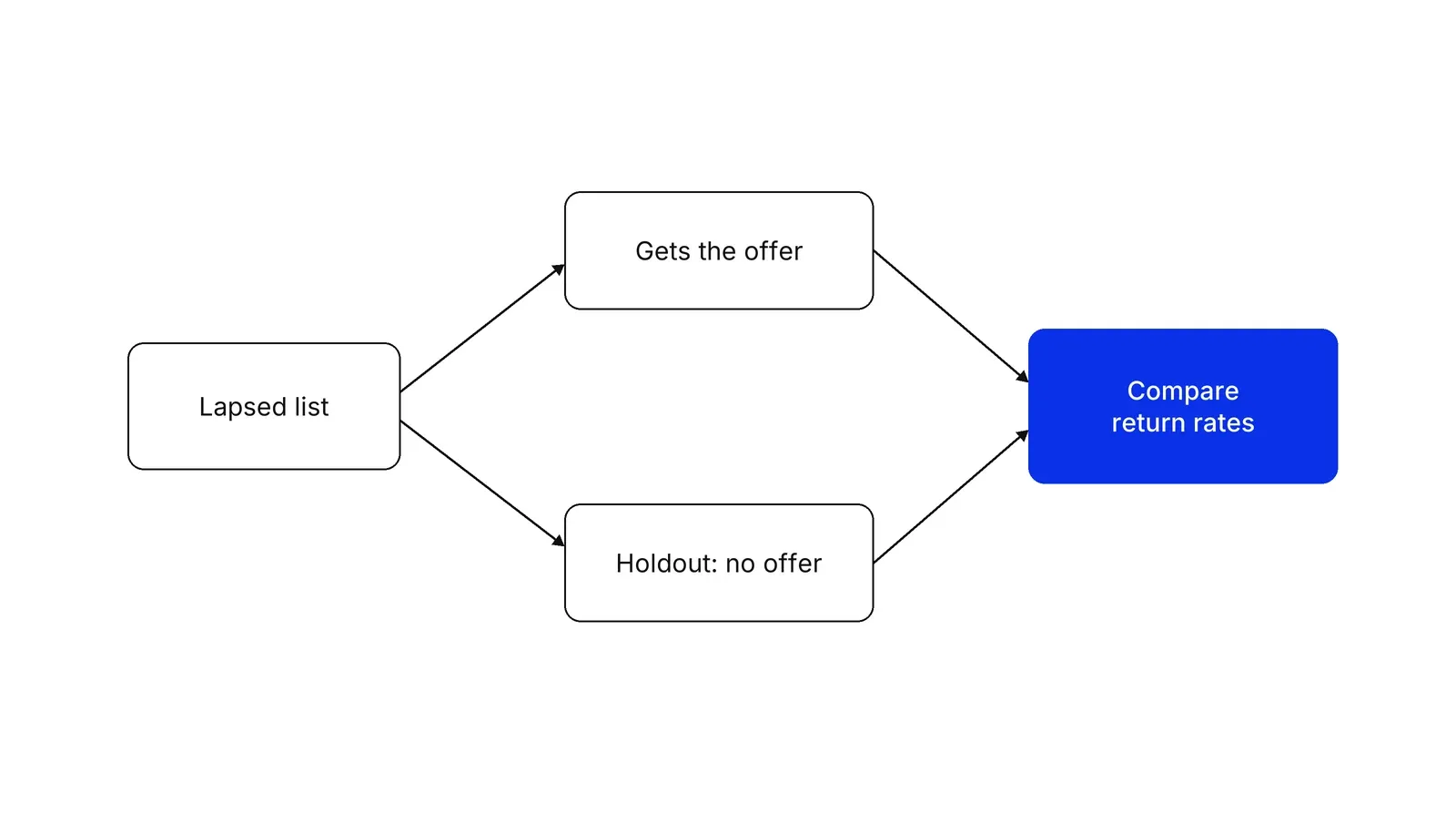
The flow has one unusual step. After segmenting, a random part of each segment is held back and receives nothing. Everything else is ordinary campaign work: a segment, a message, a send. The holdout is what turns the result from a count of returns into a measure of effect.
Choosing the offer
Thomas, Blattberg and Fox modeled both the return and the length of the second tenure for a service provider. Their result for that application was a low price to reacquire and higher prices after the customer is back. That is one dataset, so treat it as a hypothesis to test in your business, not a rule.
Fairness matters too. Homburg, Hoyer and Stock found that customers’ perception of fair treatment in the revival effort raised their satisfaction with it, and that satisfaction strongly affected revival performance. Tokman, Davis and Lemon, who studied win-back offers in the Journal of Retailing (2007), built a model of what makes such offers work. A discount that insults someone who left over service is an offer that feels unfair.
| Likely reason for leaving | First thing to try | What to avoid |
|---|---|---|
| Service failure | Fix the cause, then a personal note | A generic discount |
| Price | A time-limited lower price | Keeping the low price forever |
| Changed need | A plain update on what is new | Repeating the original pitch |
| Unknown | A short reminder, no incentive | An expensive offer to everyone |
Who to leave out
The obvious targets are not always the best. Ascarza’s study (2018), built on two field experiments, found that customers at the highest risk of churning are not necessarily the best targets for retention programs. Her advice is to target by responsiveness to the intervention. An earlier field experiment by Ascarza, Iyengar and Schleicher found that a proactive campaign raised churn from 6% in the control group to 10% in the treated group. Contact can remind people that they could leave.
Leave out anyone you offboarded for risk or compliance reasons. A fintech that closed an account after a review should not send it a coupon.
Proving it worked
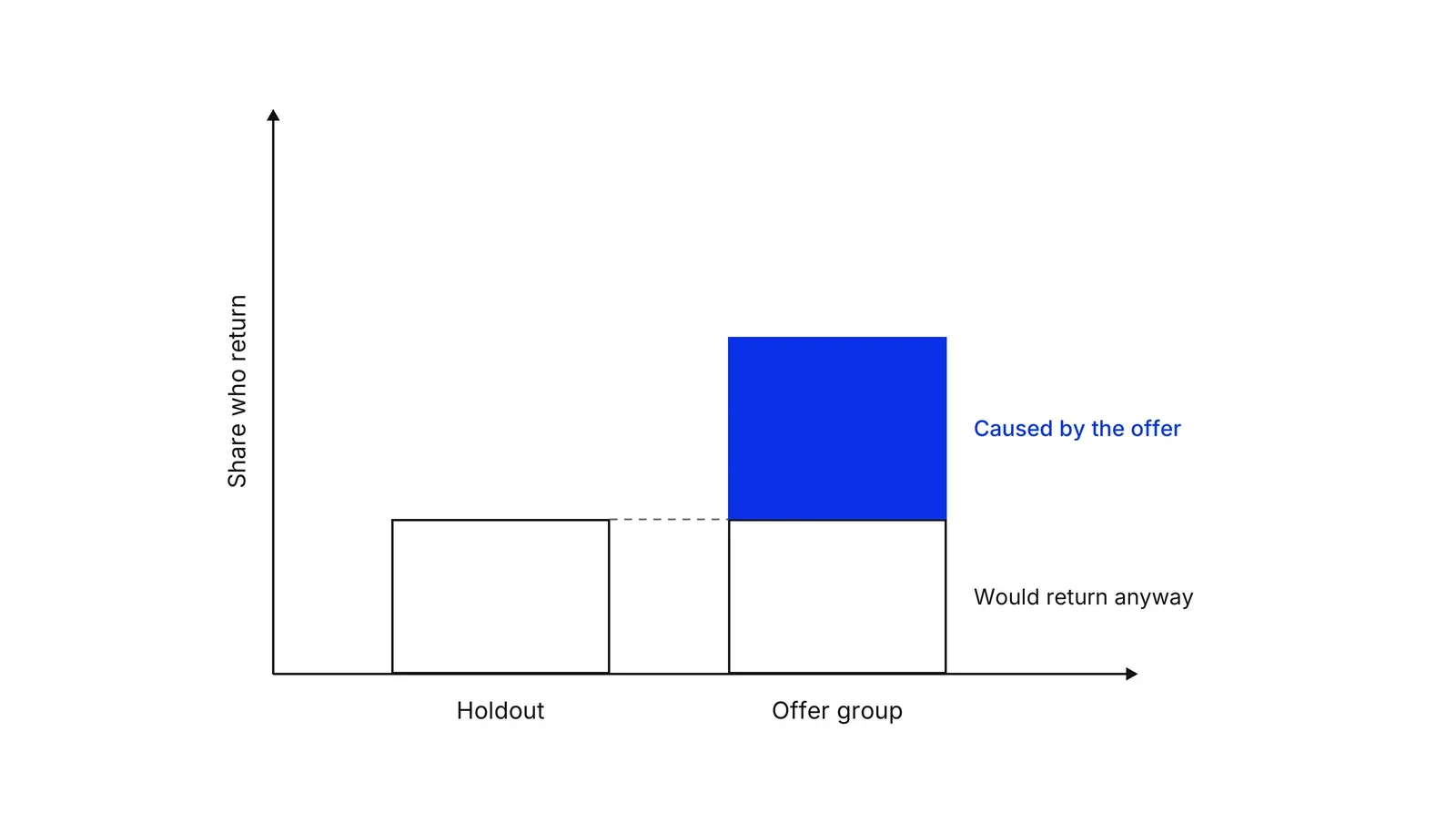
Some lapsed customers return on their own. Without a holdout, the campaign takes credit for them. The incrementality testing page covers the design and the group sizes. Lewis and Rao studied 25 field experiments (2015) and found individual sales so volatile that informative tests can need very large samples, so a small list may only support a rough read.
Paid channels need the same discipline. Johnson, Lewis and Nubbemeyer measured a retailer’s display retargeting with ghost ads and found it lifted purchases by 10.5%. Blake, Nosko and Tadelis found at eBay that new and infrequent users were positively influenced by search ads while frequent users, who accounted for most of the spend, were not. Gordon and colleagues found that observational methods often failed to match randomized results on Facebook. Lapsed audiences are a case where the people who return on their own are easy to mistake for success.
Report results in growth accounting terms: resurrected users, or reactivated revenue, as their own line next to new and churned.
Rules for contacting lapsed customers
Mailing a long-dormant list in one send is risky. Google’s sender guidelines apply extra requirements to senders of more than 5,000 messages a day to Gmail accounts, including one-click unsubscribe, and say to keep the spam rate below 0.10% and never reach 0.30%. Warm up a list in batches and drop non-openers.
Law differs by region. The FTC’s CAN-SPAM guide requires that an opt-out be honored within 10 business days. The UK’s ICO describes a soft opt-in for a business’s own recent customers and requires specific consent otherwise. A healthcare provider also has to check the HIPAA definition of marketing at 45 CFR 164.501, which excludes certain treatment messages unless a third party pays for them.
A Growth Lab plan starts from the lapsed list and the reasons behind it, because that is what a first test needs.
How to apply Win-back campaigns, step by step
- Define lapsed in your own numbers. Take the typical gap between purchases or logins in your data and pick the point after which a return is unlikely without a nudge. A subscription app may use 30 days, a clinic 12 months. Result: one written rule that sorts every customer into active, at risk or lapsed.
- Split the lapsed list by value and by reason. Sort lapsed customers by what they were worth in their first stretch with you, then by why they left: price, a service failure, a competitor, a changed need, or unknown. Exit surveys and support tickets hold most of this. Result: a table of segments with a size and a likely reason each.
- Match one offer to each segment. Fix the problem first for service failures, offer a lower reacquisition price for price leavers, and send a plain reminder where the reason is unknown or the need changed. Result: a one-line offer per segment and the cost of the offer per returning customer.
- Randomise before you send. Assign a random 10 to 25 percent of each segment to a holdout that receives nothing from this campaign, and freeze the assignment. Result: a list with two labelled groups and a send file that excludes the holdout.
- Send, then watch for a fixed window. Run the sequence for a fixed period and count returns in both groups over the same dates, with the same definition of a return. Result: a return rate for the offer group and for the holdout.
- Read the gap, then the second tenure. Subtract the holdout rate from the offer-group rate to get incremental returns, divide cost by that number, and follow the returned customers for several months to see whether they stay. Result: a cost per incremental customer and a retention figure for the second tenure.
Examples
A payments app and a fee waiver
Illustrative, no real company implied. A payments app has 2,000 merchants with no transaction in 90 days. It sends a month of waived fees to 1,500 and holds out 500. In the offer group 180 merchants transact again (12%); in the holdout 35 do (7%). At the holdout rate, 105 of the 180 would have come back anyway, so 75 are incremental. The waiver cost $20 for each of the 180, or $3,600, which is $48 per incremental merchant, not $20.
A clinic recalling patients
Illustrative, no real clinic implied. A clinic lists patients not seen in 12 months who were due for a check-up. Reminders and recall have a strong record in public health: the [US Community Preventive Services Task Force](https://www.thecommunityguide.org/findings/vaccination-programs-client-reminder-and-recall-systems) reports a median rise of 11 percentage points in vaccination rates across 29 studies. The clinic sends a plain recall message, no discount, and keeps a holdout to see how many book because of it.
Duolingo and the resurrected user
Duolingo's public growth model separates users who are active again after at least 30 days away, which it calls resurrected, from those who return after a shorter gap. Counting them as their own line, as growth accounting does, shows whether a win-back effort adds users or only recycles the ones who would have returned.
When to use it
Use it when growth accounting shows a large pool of churned or dormant customers, when new-customer costs keep rising, or when customers who left had a strong first stretch with you. It fits businesses where customers can return without a contract, such as retail, marketplaces, apps and clinics.
When not to use it
Skip it when customers left because of a risk or compliance decision you made, when you cannot fix the reason they left, or when consent to contact them has lapsed. It also adds little if most lapsed customers never had a real first relationship with you.
Common mistakes
- Sending one discount to the whole lapsed list, which pays full price to the customers who would have returned anyway.
- Judging the campaign by reactivations in the offer group alone, without a holdout to show what would have happened anyway.
- Targeting the customers most likely to churn or stay away, when the research says to target those most responsive to the offer.
- Emailing a years-old list in one blast and damaging the sender reputation of the whole domain.
- Counting a returned customer as a success without checking whether they stayed for more than one purchase.
FAQ
What is a win-back campaign?
It is a planned effort to bring back customers who stopped buying or cancelled. It differs from retention, which acts before a customer leaves, and from acquisition, which targets strangers. Researchers Stauss and Friege (1999) called the discipline regain management and described it as analysis, actions and controlling.
How long before a customer counts as lapsed?
There is no universal number. In businesses where customers can return without a contract, the right cutoff depends on the normal gap between purchases. Statistical models such as the Pareto/NBD, by Schmittlein, Morrison and Colombo (1987), estimate the probability that a customer is still active from the timing of past purchases.
Should a win-back offer be a discount?
Not by default. Thomas, Blattberg and Fox found that in their application a low reacquisition price followed by higher prices after return was best. Homburg, Hoyer and Stock [found](https://madoc.bib.uni-mannheim.de/24856) that fairness of the revival effort drives success. Test a discount against a plain reminder, with a holdout, before making it standard.
Is winning back a customer cheaper than acquiring a new one?
Sometimes, but there is no universal multiplier. Often-quoted ratios, such as five times cheaper, were not traced to a primary study here. Kumar, Bhagwat and Zhang show that profit depends on the first relationship, the reason for leaving and the offer. Measure your own cost per incremental customer.
How do I know a win-back campaign worked?
Compare the return rate of a randomly selected group that got the campaign with a holdout that did not. The difference is the incremental effect. Without the holdout, a campaign that merely contacts people who were about to return will look successful. See the incrementality testing framework for sizing the groups.
Sources
- Jacquelyn S. Thomas, Robert C. Blattberg, Edward J. Fox, Recapturing Lost Customers, Journal of Marketing Research 41(1), 2004
- Kellogg School of Management, Recapturing Lost Customers (research summary)
- Mehmet Tokman, Lenita M. Davis, Katherine N. Lemon, The WOW Factor: Creating Value Through Win-Back Offers to Reacquire Lost Customers, Journal of Retailing 83(1), 2007
- V. Kumar, Yashoda Bhagwat, Xi Zhang, Regaining Lost Customers: The Predictive Power of First-Lifetime Behavior, the Reason for Defection, and the Nature of the Win-Back Offer, Journal of Marketing 79(4), 2015
- Bernd Stauss, Christian Friege, Regaining Service Customers, Journal of Service Research 1(4), 1999
- Christian Homburg, Wayne D. Hoyer, Ruth M. Stock, How to Get Lost Customers Back? A Study of Antecedents of Relationship Revival, Journal of the Academy of Marketing Science 35(4), 2007
- University of Mannheim repository, Homburg, Hoyer and Stock, How to get lost customers back (abstract)
- Susan M. Keaveney, Customer Switching Behavior in Service Industries: An Exploratory Study, Journal of Marketing 59(2), 1995
- Eva Ascarza, Retention Futility: Targeting High-Risk Customers Might Be Ineffective, Journal of Marketing Research 55(1), 2018
- Eva Ascarza, Raghuram Iyengar, Martin Schleicher, The Perils of Proactive Churn Prevention Using Plan Recommendations, Journal of Marketing Research 53(1), 2016
- Werner J. Reinartz, V. Kumar, On the Profitability of Long-Life Customers in a Noncontractual Setting, Journal of Marketing 64(4), 2000
- David C. Schmittlein, Donald G. Morrison, Richard Colombo, Counting Your Customers: Who Are They and What Will They Do Next?, Management Science 33(1), 1987
- Peter S. Fader, Bruce G. S. Hardie, Ka Lok Lee, Counting Your Customers the Easy Way: An Alternative to the Pareto/NBD Model, Marketing Science 24(2), 2005
- Randall A. Lewis, Justin M. Rao, The Unfavorable Economics of Measuring the Returns to Advertising, Quarterly Journal of Economics 130(4), 2015
- Thomas Blake, Chris Nosko, Steven Tadelis, Consumer Heterogeneity and Paid Search Effectiveness: A Large-Scale Field Experiment, Econometrica 83(1), 2015
- Garrett A. Johnson, Randall A. Lewis, Elmar I. Nubbemeyer, Ghost Ads: Improving the Economics of Measuring Online Ad Effectiveness, Journal of Marketing Research 54(6), 2017
- Brett R. Gordon, Florian Zettelmeyer, Neha Bhargava, Dan Chapsky, A Comparison of Approaches to Advertising Measurement: Evidence from Big Field Experiments at Facebook, Marketing Science 38(2), 2019
- Google, Email sender guidelines (Google Workspace Admin Help)
- US Federal Trade Commission, CAN-SPAM Act: A Compliance Guide for Business
- UK Information Commissioner's Office, Electronic mail marketing
- Cornell Legal Information Institute, 45 CFR 164.501, definitions including marketing (HIPAA Privacy Rule)
- The Community Guide, Vaccination Programs: Client Reminder and Recall Systems
- Duolingo, How Duolingo's growth model works
Last updated Oct 9, 2026


Marketing agency or growth system: when a company outgrows its agency
An agency is the right call while the founder still runs most of the company. Once the business starts copying itself into new locations or markets, it needs a system that sets goals, tests hypotheses and owns the result.

Why healthcare marketing agencies stall: the short, mid and long wins model we use with clinics
Most agencies own the click and nobody owns the front desk. How we structure clinic work in three horizons, the research behind each one, and one year of results.

Why channel tests stall after month three
Most paid channel tests do not end with a decision. They end when the budget runs out, the attribution model changes, or everyone quietly stops looking at the dashboard.